

The average cost of business mediation in Australia depends on the dispute, the number of parties and the time needed to reach a workable outcome. There isn’t one fee that applies to every matter: complexity, location and how costs are shared all shape the total.
It’s understandable to want a clear figure before committing. The mediator’s fee is only one part of the financial picture, and the structure of the dispute can affect both the session required and the costs around it. A mediation fee is case-dependent and is set after a quote request.
This guide explains how complexity, location and multiple parties can influence costs, how parties may share them, and how mediation expenses compare with the potential financial consequences of a dispute continuing. The aim is to help you assess the cost in context, with a clearer view of the factors that matter before mediation begins.
Key Takeaways
- Identify how dispute complexity, location and the number of parties can shape the overall mediation cost.
- Include pre-mediation intake and practical session requirements when considering the full cost, not just the mediator’s fee.
- Understand how parties may share expenses and weigh mediation costs against the potential financial impact of a dispute continuing.
- Compare court, tribunal and industry-scheme pathways to see how the process and cost structure may differ.
How Much Does Mediation Cost in Australia?
Fees can vary with the format, number of participants and nature of the dispute. Intake, mediator time and session length may all affect the total.
Low-cost or subsidised options in the facts available apply to family mediation, not general business disputes. Eligible people may access free joint family mediation hours through Family Relationship Centres, while commercial mediation has separate fee structures.
Pre-mediation intake fees
Pre-mediation intake is an initial session to understand the issues and prepare participants. Include this step when estimating each party’s total. A clear intake can identify the matters that need discussion, including business assets or unresolved agreements.
Private hourly and full-day fees
The charging basis matters: hourly fees can accumulate if a dispute takes longer, while a day rate sets a fee for the session.
Commercial and business mediation fees
The number of participants and the dispute’s complexity are important factors when assessing the total.
Half-day and full-day mediation fees
Session length is another factor to consider when comparing fees. Family mediation arrangements don’t set prices for commercial disputes.
Cost-sharing and financial consequences
Agreeing how to divide mediation fees affects each party’s financial exposure. Parties can decide whether to share the mediator’s fee equally, split it differently or pay separate expenses themselves. A written arrangement can distinguish the mediator’s charge from each party’s legal costs. This helps prevent payment disagreements from becoming another issue in the dispute.
Legal representation adds a separate cost. If each side brings a lawyer, both parties need to account for attendance costs alongside mediation fees. The total depends on the time involved and the arrangements between participants. For example, a business with several parties may need to clarify each participant’s contribution before the session.
The financial comparison extends beyond the mediation itself. Legal expenditure is not a guaranteed cost for every case. Mediation is one form of dispute resolution, and its value to a business should be considered against the time and expense of continuing the disagreement through court processes.
Cost-sharing arrangements should reflect the dispute’s structure. Involving several businesses, owners or decision-makers can make an equal split impractical, particularly when parties have different roles or interests. Clarify who pays for the mediator, legal attendance and any other agreed expenses, then record the arrangement before the session. This gives each party a clearer basis for budgeting and keeps payment expectations separate from settlement discussions.
Family matters offer a useful contrast, but their fees shouldn’t be treated as business benchmarks. Business disputes involve commercial issues and the parties’ particular circumstances. Assess the likely financial consequences of an unresolved contract dispute alongside each party’s proposed share of mediation costs. This comparison can help decision-makers judge whether a negotiated agreement is financially proportionate.
Location and case complexity
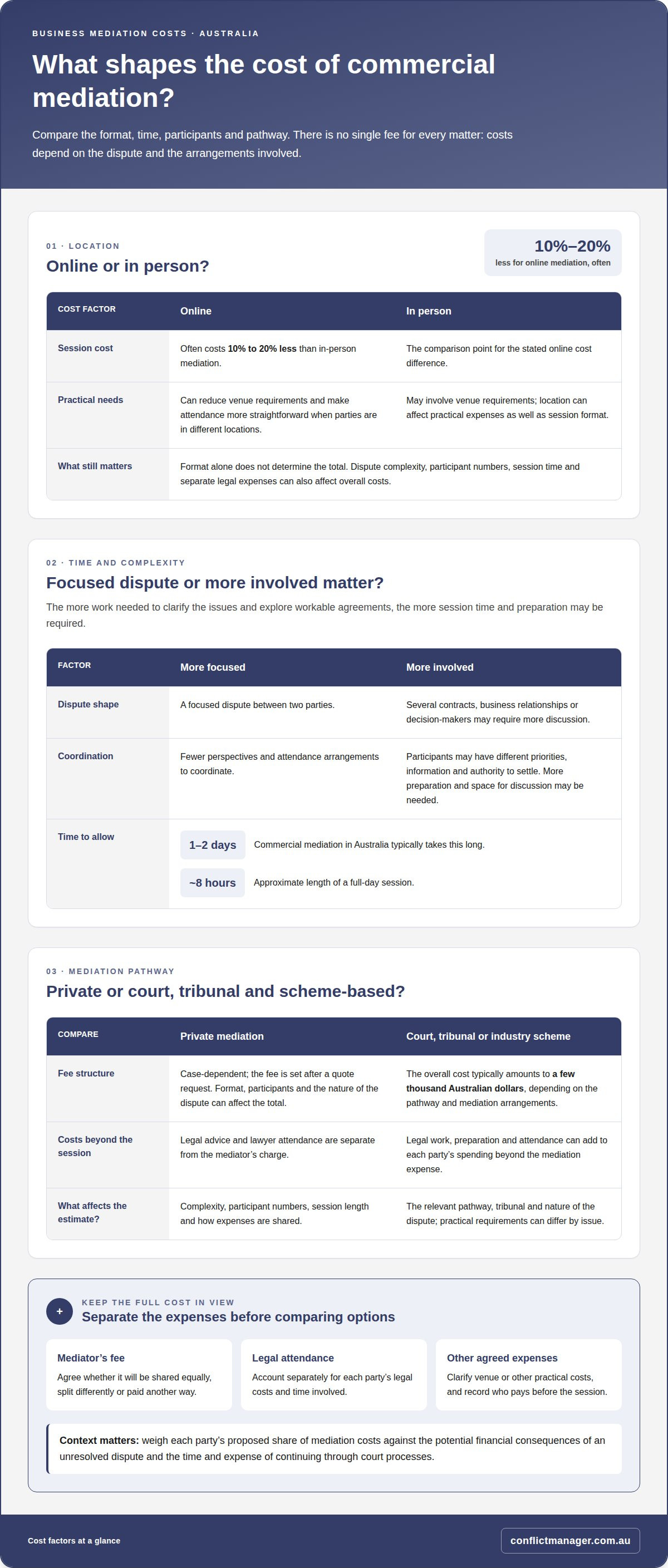
Location affects practical expenses as well as the session format. Online mediation often costs 10% to 20% less than in-person mediation. For parties based in different locations, an online format can reduce venue requirements and make attendance more straightforward.
Complexity shapes how much time a dispute needs. Commercial mediation in Australia typically takes 1-2 days, while a full-day session is approximately 8 hours. A disagreement involving several contracts, business relationships or decision-makers may need more discussion than a focused dispute between two parties. The central issue is how much work is needed to clarify the situation and explore workable agreements.
More participants can increase coordination demands. Each party may have different priorities, information and authority to settle, so the mediator needs to make space for those perspectives. Multi-party matters may also require more preparation and complex discussions. These factors can affect the time needed, rather than location alone determining the overall cost.
Legal fees are separate from the mediator’s charge. Legal advice may help a party understand its position and prepare for discussions, but it is not part of the mediation fee. Keep any consultation costs separate when comparing the total expense of resolving a commercial dispute.
Consent orders belong to a different context and are not a business mediation fee. They illustrate why the situation and any follow-on legal work matter when calculating total costs. For a business dispute, identify the mediation format, venue needs, likely duration and any separate legal consultation before comparing options.
What are the costs of mediation through Australian courts, tribunals and industry schemes?
Mediation arranged through an Australian court, tribunal or industry scheme can have a different cost structure from private mediation. The overall cost typically amounts to a few thousand Australian dollars. The amount depends on the pathway and the mediation arrangements involved, so the total may include more than the mediator’s fee.
For a court-connected matter, distinguish the mediation expense from the wider cost of the dispute. Legal work, preparation and attendance can add to each party’s spending. A business comparing court-linked mediation with private mediation should separate those costs, then consider who pays each component. This gives decision-makers a clearer comparison than looking at one session fee alone.
Tribunal mediation is another pathway to consider. The relevant tribunal and nature of the dispute shape the process and its costs. Before estimating expenses, identify whether the matter concerns a contract, commercial tenancy or another issue. Different categories can involve different practical requirements and affect the overall cost.
Industry schemes may also offer a route to mediation for disputes within their remit. Their cost structure depends on the scheme and the matter being handled. Before comparing pathways, identify the scheme’s role, the parties involved and the expenses each participant must meet. Keep mediator charges distinct from legal fees and other preparation costs.
These pathways don’t make cost comparison automatic. A useful assessment considers the dispute’s subject, the process available and the parties’ expected expenses together. It also weighs the cost of mediation against the consequences of continuing the dispute, rather than treating the lowest immediate fee as the only measure. For organisational conflict that needs structured discussion, explore organisational conflict management as a way to support clearer engagement between parties.
Conflict Manager: Family Conflict Resolution
Conflict Manager supports families and organisations facing disputes that strain relationships, decisions or day-to-day work. For a business conflict, Organizational Conflict Management can help structure difficult internal dynamics, while Stakeholder Facilitation supports constructive engagement between people with different interests.
Consider this support when direct discussions have stalled, a change is creating friction or several stakeholders need a clearer way to work through competing perspectives. Conflict Manager helps people understand the conflict and make space for considered discussion, rather than providing legal representation.
If family relationships and shared assets are central to the dispute, Family Conflict Resolution may be the more relevant pathway. To discuss your situation, contact Conflict Manager.
Choose a constructive next step
Understanding the average cost of business mediation in Australia is a starting point, not the decision itself. Before choosing a path, clarify what needs to change, who can make decisions and what a workable outcome would preserve. That preparation can keep discussions centred on the underlying business issue rather than the history of the disagreement.
Consider the relationship that needs to continue after the dispute, too. A resolution that addresses immediate concerns and supports future collaboration may serve the organisation better than a narrow focus on short-term concessions. When internal conversations become difficult to manage, an impartial process can bring structure and perspective.
For support with conflict involving an organisation or its stakeholders, contact Conflict Manager. A considered next step can create room for clearer discussion and a more stable way forward.
Frequently Asked Questions
Is Mediation Cheaper Than Going to Court?
Mediation can involve lower direct costs than taking a commercial dispute through litigation. Compare the mediation expense with likely legal work and the time involved in court proceedings. The financial difference depends on the dispute and how long it continues.
What other costs should you budget for on top of mediator fees?
Budget for expenses beyond the mediator’s charge, including legal attendance, venue hire and preparation. Private intake, interpreters and other agreed requirements may also affect each party’s total.
What is the average cost of business mediation in Australia?
The average cost of business mediation in Australia depends on the dispute and fee structure. Treat different fee arrangements as distinct pricing contexts, not as a single national average. Confirm whether quoted costs are per person or shared between parties.
What are typical hourly rates for commercial mediators in Australia?
Compare the billing basis as well as the rate: an hourly quote and a day rate cover different amounts of mediator time.
How much does a full day of business mediation cost in Australia?
Check whether a figure is per person or session-wide.
What factors affect the cost of business mediation in Australia?
Cost is shaped by case complexity, the number of parties, session length and location. A multi-party dispute may require more coordination, while venue hire adds an expense for in-person sessions away from the mediator’s office. Online mediation often costs 10% to 20% less than in-person mediation. The fee structure also matters: hourly charging, a day rate and per-person pricing produce different totals.


