

Whether a mediated agreement is legally binding in Australia depends on the parties’ intention and how they record it. Mediation discussions and proposals alone do not create a binding settlement. The agreement should clearly state that the parties intend to be bound, and they should sign a statement confirming that intention.
A written record matters, but writing alone does not make an agreement enforceable. The wording, the terms settled and the way the document is executed all help determine whether it creates obligations the parties can enforce.
This article explains when a mediated settlement may become binding, how it can be enforced through a court or contract, and why the choice between a private deed and consent orders matters. It also outlines settlement terms that clarify payment, performance and what happens if an obligation is not met.
Key Takeaways
- Distinguish a preliminary understanding from a final settlement by looking closely at the agreement’s wording and the parties’ intended obligations.
- Where court proceedings are already underway, consent orders can turn agreed terms into enforceable court orders, with less privacy than a private deed.
- Clear payment dates, performance duties and default consequences help reduce uncertainty if a party does not meet the settlement terms.
- When family or organisational conflict makes resolution difficult, structured facilitation can help parties clarify issues and work towards agreement.
When does a mediation agreement become legally enforceable, and can it be used in court?
A mediated settlement may become enforceable when the parties clearly agree to legal obligations and execute suitable documents. Its form affects confidentiality, court enforcement and the options available if a party breaches it.
Comparing Settlement Instruments
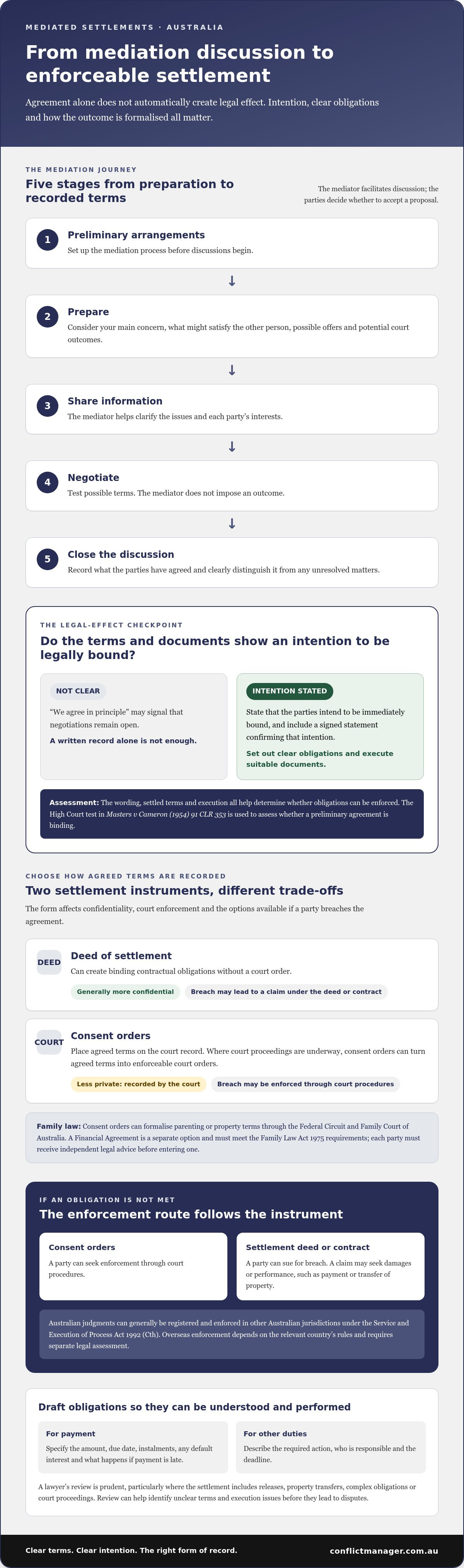
A settlement instrument records the parties’ agreement and shapes how they can enforce it. A deed of settlement can create binding contractual obligations without a court order, while consent orders place agreed terms on the court record.
A private deed generally offers greater confidentiality, while consent orders are less private because they are recorded by the court. Drafting a deed or seeking court orders can involve different legal and administrative costs, so the appropriate form depends on the dispute and the enforcement sought.
When Settlements Become Enforceable
A settlement becomes enforceable when its terms and documents show that the parties intended to be legally bound. Putting the agreement in writing alone does not make it binding, and a signed document still needs to set out clear obligations.
For example, a document saying “we agree in principle” may signal that negotiations remain open. Wording that the parties intend to be immediately bound points the other way. In Masters v Cameron (1954) 91 CLR 353, the High Court’s test is used to assess whether a preliminary agreement is binding.
Enforcing Settlements After Breach
After a breach, a party can seek to enforce consent orders through court procedures, or sue for breach of a settlement deed or contract. A claim under a deed may seek damages or performance, such as payment or transfer of property.
Australian judgments can generally be registered and enforced in other Australian jurisdictions under the Service and Execution of Process Act 1992 (Cth). Overseas enforcement depends on the relevant country’s rules and requires separate legal assessment. A signed agreement may also be changed by mutual agreement or set aside in appropriate circumstances.
Reviewing an Agreement Before Signing
Should a lawyer review a mediated agreement before signing in Australia? A lawyer’s review is prudent, particularly when a settlement includes releases, property transfers, complex obligations or court proceedings. It can identify unclear terms and execution issues before they lead to disputes.
Section 18 of the Australian Consumer Law may apply to misleading or deceptive conduct during negotiations for a Heads of Agreement, according to the Australian Competition and Consumer Commission. Review can help clarify whether the document records a final settlement or leaves terms open, and what each party must do if a deadline is missed.
Is Mediation Legally Binding in Australia?
Mediation is an alternative to legal proceedings in which a neutral third party helps people discuss a dispute and seek resolution. The mediator facilitates discussion and helps identify each party’s interests; the parties decide whether to accept a proposal. Unlike a court, the mediator does not impose an outcome. Mediation can give parties more control over the result, but reaching an agreement does not automatically give it legal effect.
Are family law mediation agreements legally binding in Australia? A mediated outcome isn’t automatically binding just because the parties agree. Family law consent orders can formalise parenting or property terms through the Federal Circuit and Family Court of Australia, using its forms and procedures. A Financial Agreement is a separate option, but it must meet the Family Law Act 1975 requirements. Each party must receive independent legal advice before entering one.
The process commonly moves through preliminary arrangements, preparation, information-sharing and negotiation, then closing. During preparation, each party can consider their main concern, what might satisfy the other person, possible offers and potential court outcomes. In information-sharing, the mediator helps clarify the issues and interests. Negotiation then tests possible terms. At closing, the parties record what they have agreed and distinguish it from unresolved matters. This sequence clarifies the outcome, whether discussions settle all or only part of the dispute.
Some procedures require genuine dispute-resolution steps before proceedings. Under the Civil Dispute Resolution Act 2011, genuine steps are required before actions in the Federal Court of Australia or Federal Circuit Court, subject to exclusions. In family custody and parenting matters, mediation is compulsory. These requirements encourage resolution efforts; they don’t mean the parties must accept a settlement.
Where family discussions remain difficult, Family Conflict Resolution can help parties work through concerns and explore possible agreement. Mediation supports negotiation, while the legal effect of any outcome depends on how the parties formalise it.
Practical settlement drafting and default provisions
Clear drafting turns negotiated terms into obligations the parties can understand and perform. The right documents also address payment defaults, execution and any property transfer.
Drafting Settlement Terms and Defaults
A settlement should state each obligation in practical, measurable terms. For payment, specify the amount, due date, instalments, any default interest and what happens if payment is late. For non-monetary duties, describe the required action, the responsible party and the deadline. These details help distinguish a completed settlement from terms that remain under discussion.
Where payment depends on security, identify the asset and the steps needed to support that security. Applicable interests may need registration or perfection under the Personal Property Securities Act 2009 (Cth). A missed instalment clause can also explain whether the unpaid balance becomes due, rather than leaving the consequences uncertain.
Written and Signed Agreements
Does a mediated agreement need to be in writing and signed in Australia? For a binding mediated settlement, the parties should record the agreed terms and sign a statement confirming that they intend to be legally bound. Writing alone does not automatically make an agreement enforceable; the wording and the parties’ intention matter.
Before signing, the parties can check that the document identifies them, records the final terms and separates settled issues from unresolved ones. Electronic signatures can be used in many cases. For a company document, section 127 of the Corporations Act 2001 (Cth) provides an execution method, including signature by two directors or a sole director who is also company secretary.
A deed of settlement can formalise a commercial compromise without requiring consideration, which can matter when each party exchanges releases or gives up claims. A simple contract may suit a straightforward settlement, but the document should match the obligations agreed and the parties’ intended legal relationship.
For a family property settlement, parties may formalise terms through consent orders or a Financial Agreement under the Family Law Act 1975. Financial Agreements have technical requirements, including independent legal advice for each party. Pressure, misleading conduct or unclear wording may also undermine a settlement; section 18 of the Australian Consumer Law may apply to misleading or deceptive conduct during Heads of Agreement negotiations.
Whether mediated agreements are legally binding
Whether a mediated agreement is legally binding in Australia turns on the parties’ intention, the wording and the surrounding circumstances. A signature is relevant, but it does not settle the question by itself. Courts may consider whether the parties meant to be bound immediately or intended to negotiate further before committing.
The Masters v Cameron test helps courts assess preliminary agreements. A document may show a concluded bargain that binds the parties straight away, or an agreement whose performance depends on a later formal contract. Alternatively, it may show that no legal commitment exists until that contract is signed. The distinction matters if one party withdraws after negotiation but before the formal documents are completed.
Heads of Agreement should therefore identify which terms bind now and which remain subject to further agreement. For example, parties might intend confidentiality and exclusivity clauses to take effect immediately, while leaving the final transaction subject to signed documents. A New South Wales Supreme Court judge restated principles for assessing Heads of Agreement on 9 May 2013. The document’s exact language and context remain central.
Before signing, compare the written terms with what the parties actually settled. Check that names, obligations, dates and any conditions match the negotiated outcome. If a term says “subject to contract”, clarify whether it postpones the whole settlement or only a particular obligation. A lawyer can assess whether the wording creates immediate commitments or leaves further negotiation open.
In a dispute involving several parties, separate signatures or documents may affect when each party becomes bound. A court may also consider whether the parties prepared documents for execution as an enforceable settlement. These details can matter if someone later denies that a final agreement was reached.
Where conflict is obstructing clear negotiation, work through the dispute with facilitated discussion before final terms are recorded.
Conflict Manager: Family Conflict Resolution
Conflict Manager helps families address conflict through Family Conflict Resolution, creating space to clarify concerns and explore possible ways forward. When family dynamics make constructive discussion difficult, a neutral facilitated process can help participants focus on the issues and their interests instead of getting stuck in repeated disagreement.
This support can be useful when relatives need to discuss shared decisions, responsibilities or a way forward after a dispute. It can help parties work towards clearer communication and an outcome they understand. The role is to support conflict resolution, not determine whether a settlement is legally enforceable. For advice about legal rights or formal documents, consult a lawyer.
To discuss Family Conflict Resolution, contact Conflict Manager.
Choose a clear path forward
The next step is to decide what needs attention before discussions continue: the terms, the relationships involved or the process for reaching agreement. Whether a mediated agreement is legally binding in Australia depends on the parties’ intention and the document they sign, so legal advice can clarify the effect of proposed terms before they commit.
When the difficulty lies in the conversation itself, structured conflict support can help participants return to the issues with greater focus. Conflict Manager offers Family Conflict Resolution, Organizational Conflict Management and Stakeholder Facilitation, supporting families, organisations and stakeholders as they work through conflict and consider a way forward.
If you’re ready to explore support for a difficult discussion, contact Conflict Manager for guidance. Taking a considered next step can help create room for a more constructive conversation.
Frequently Asked Questions
How do you make a parenting agreement legally binding?
Parents can apply for consent orders through the Federal Circuit and Family Court of Australia to formalise parenting arrangements as court orders. Proposed terms should set out workable arrangements, such as how changeovers and school holidays will be handled. A private parenting agreement reached in mediation is not itself a court order. The court’s family law forms and procedures apply when seeking consent orders.
What does signing a mediation agreement actually mean?
Signing records that a party has agreed to the document’s terms, but the legal effect depends on what those terms say and the document’s purpose. For example, signing minutes that record proposals for later negotiation may not have the same effect as executing final settlement documents. Read the whole document before signing, including clauses on confidentiality, outstanding conditions and when obligations begin.
Can I include a “subject to contract” clause to protect myself?
Yes, parties can use “subject to contract” wording to show that a proposed settlement remains conditional on a later formal contract. The effect depends on the clause’s scope. If the parties intend some provisions, such as confidentiality, to apply immediately, the document should say so expressly. Otherwise, uncertainty may arise about whether any commitment took effect before the final contract.
Can you change, cancel or enforce an agreement reached at mediation?
Parties can record a change they both accept, but one party should not assume they can cancel a concluded agreement unilaterally. A signed agreement may be set aside in appropriate circumstances. If another party breaches an enforceable settlement, the affected party can seek legal advice about contractual remedies or court enforcement. The available route depends on whether the settlement is a deed, contract or court order.
Does mediation decide what I am entitled to?
No. A mediator helps parties discuss their interests and possible outcomes; the mediator does not decide what either person is entitled to receive. For example, separating parents may negotiate a schedule suited to their circumstances, rather than have a mediator impose one. Each party can assess proposals against their priorities and potential court outcomes before deciding whether to settle.
Is a mediated agreement legally binding in Australia?
Whether a mediated agreement is legally binding in Australia depends on the parties’ intention, the agreed terms and how they document and execute them. A signed paper is not automatically enforceable simply because it came out of mediation. For example, wording that leaves key matters for later negotiation may indicate there is no final commitment. Clear obligations and an express intention to be bound help establish the agreement’s effect.


