

Confidentiality is central to business mediation: discussions are generally private, and the mediator helps the parties explore a voluntary resolution rather than deciding who is right. What to expect from business mediation sessions also depends on location: in Western Australia, a session usually takes at least four to six hours, while a Queensland Small Business Commissioner mediation can take up to four hours.
It’s reasonable to want clarity about what can be shared, whether to try an informal conversation first and what happens if no agreement is reached. Mediation provides a structured setting for difficult discussions, but it doesn’t require you to settle.
This article explains how confidentiality works, when direct negotiation may help, how long a session can take and what options may follow if the dispute remains unresolved. Understanding the process can help you approach your next decision with greater composure.
Key Takeaways
- Understand what confidentiality can cover, including private discussions with the mediator, and why the terms of the process matter.
- Consider whether direct negotiation is constructive, and take care to document any agreement reached.
- Plan for a substantial session, as complexity and the issues in dispute can shape how long discussions take.
- If mediation doesn’t settle the matter, you can consider continued negotiation or a formal determination through an appropriate legal avenue.
Is information disclosed during mediation confidential?
Business mediation discussions are generally confidential, but the protections depend on the process and its terms. Before sharing sensitive information, clarify what the mediator can keep private and what may be recorded in an agreement.
Without-prejudice discussions
Without-prejudice discussions are settlement negotiations intended to remain separate from later court evidence if mediation doesn’t resolve the dispute. This can give parties room to make proposals without treating each offer as an admission. Mediation differs from arbitration and litigation: the mediator guides negotiation, while an arbitrator or court makes a determination. The mediator does not decide who is right.
Confidentiality in face-to-face meetings
In a joint face-to-face meeting, confidentiality applies to the mediation discussion, not automatically to information shared outside it. Before the session, discuss expectations with the mediator, including who may attend and how information will be handled. In the Small Business Development Corporation process, parties sign an agreement to mediate at the start. Prepare by identifying the key issues and the outcome you hope to achieve.
Confidentiality in caucus discussions
A caucus is a private conversation between the mediator and one party, held separately from the joint discussion. Information shared in a caucus remains confidential, and the mediator can help test options without passing private details to the other party. If you want a point conveyed, tell the mediator what they may share. This distinction can support candid negotiation while leaving you in control of sensitive details.
Privacy, consent and communication
Confidentiality can also cover communication between a mediator and participant, including a private conversation before the joint session. If you ask the mediator to keep information private, they must maintain its privacy while you’re safe. The mediator remains impartial, helps parties consider options and cannot give legal advice or decide the outcome. Before discussions begin, raise your expectations and communication boundaries with the mediator.
Should I try to resolve the dispute myself before seeking mediation?
A direct conversation can be a sensible first step when both parties can discuss the business dispute constructively and understand the issues. Set out the specific points in disagreement, the practical outcome you want and any commitments you can make. If discussions become circular, trust has weakened or an informal offer could affect your legal position, mediation can provide a more structured negotiation.
Take care with unassisted settlement discussions. A party may unknowingly compromise its legal position while trying to resolve matters directly. If the dispute involves significant obligations, threatened proceedings or uncertainty about what a proposed concession means, seek legal advice before agreeing to terms. Mediation is voluntary in the Small Business Development Corporation’s process, so attending does not oblige either party to settle.
If the parties reach a solution, put the terms in writing rather than relying on a shared recollection. A clear record can state what each party will do, when they’ll do it, and how the agreement addresses the issues raised. In Western Australia, a signed mediation outcomes agreement through the Small Business Development Corporation is legally binding and can be enforced in court. The legal effect depends on the process and document, so don’t assume every informal note has the same status.
Before signing, check that the written terms match what was actually agreed. For example, if the resolution covers an outstanding delivery and future communication, specify each party’s responsibility for both. Settlement terms or a deed of release may be drafted to make an agreement final and legally enforceable. Where a family business dispute affects both commercial arrangements and an ongoing relationship, Family Conflict Resolution can help parties work through the underlying conflict.
If direct negotiation has stalled, the NSW Small Business Commissioner may help resolve a dispute before formal mediation is required. Choose an approach based on the dispute’s complexity, the parties’ ability to communicate and the consequences of getting the agreement wrong.
Arrival time and session duration
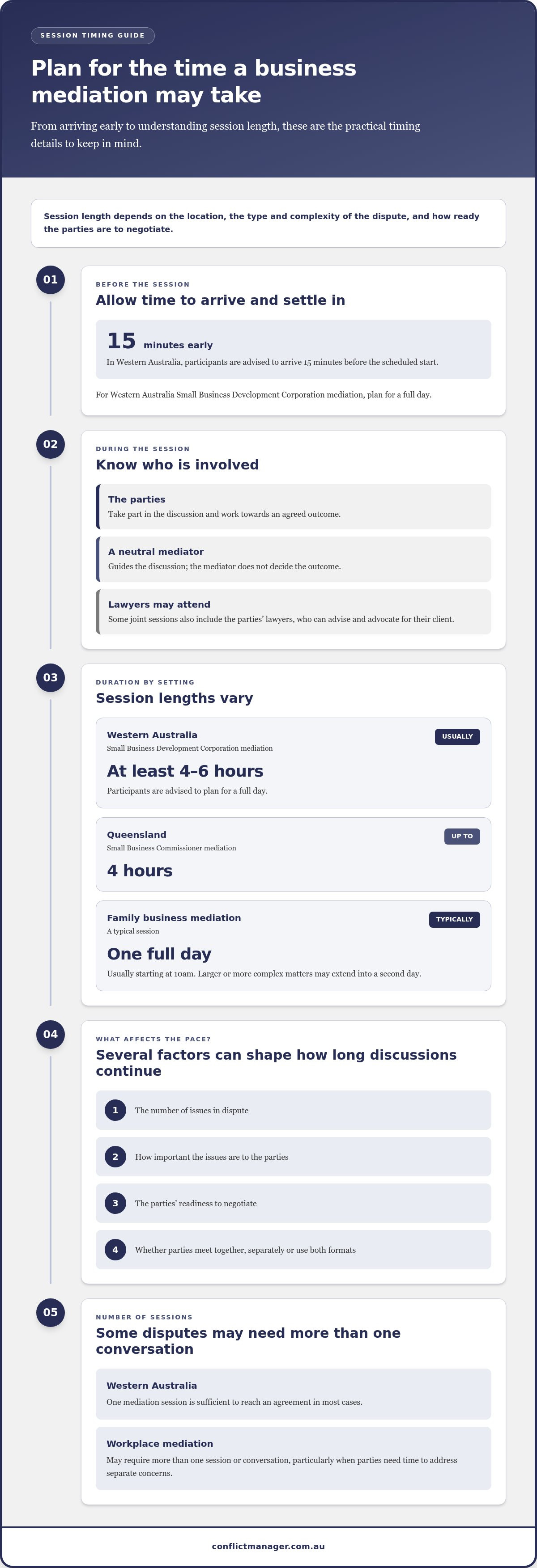
In Western Australia, business mediation through the Small Business Development Corporation usually takes at least four to six hours. Participants are advised to plan for a full day and arrive 15 minutes before the scheduled start. These details help you understand what to expect from business mediation sessions and make practical arrangements for the day.
Queensland Small Business Commissioner mediation can take up to four hours. A family business mediation typically lasts one full day, usually starting at 10am, and larger or more complex matters may extend into a second day. The number of issues, their importance and the parties’ readiness to negotiate all affect how long discussion continues.
Who attends? The parties take part, and a neutral mediator guides the discussion. Some joint sessions also include the parties’ attorneys. A lawyer can advise and advocate for their client, while the mediator does not decide the outcome.
In Western Australia, one mediation session is sufficient to reach an agreement in most cases. Workplace mediation may require more than one session or conversation, particularly when parties need time to address separate concerns. The pace also depends on whether parties meet together, separately or use both formats. Knowing what to expect from business mediation sessions can help you plan who needs to be available to make decisions.
Prepare for a working discussion, not a hearing. The session is generally focused on helping the parties discuss their positions and work towards an agreed outcome. Parties use the time to explain their positions, identify areas of agreement and explore proposals. For example, a discussion about a delayed supply arrangement may need to address both the outstanding delivery and the terms for continuing the relationship. Bring relevant records and decision-making authority so you can consider an offer during the session. If the parties need a break or more discussion, the mediator can manage the process accordingly. A longer session is not in itself a sign of failure; the focus is on whether the parties can reach a workable outcome.
Options if mediation does not resolve the dispute
An unresolved mediation is not the end of dispute resolution. In Western Australia, parties may continue negotiating or pursue another legal avenue, such as applying to an appropriate court or tribunal for a formal determination. The next step depends on the dispute, the outcome sought and whether both parties remain willing to negotiate.
For a retail shop lease dispute in Western Australia, either party may refer the matter to the State Administrative Tribunal after obtaining a certificate from the Small Business Commissioner for the application. This route applies specifically to that type of dispute. Consider whether the disagreement concerns the lease itself and whether a formal determination could resolve the issue more clearly than further negotiation.
Before moving towards litigation, a lawyer can advise on prospects of success and the risks of proceeding. That advice can help parties weigh the likely consequences of continuing, including the time and disruption involved. If they can still resolve individual issues themselves, further negotiation may narrow the conflict, even without settling every point. Record any new agreement clearly.
For complex technical or contractual matters, arbitration and expert determination are private, binding dispute-resolution processes. They differ from mediation: an independent decision-maker determines the matter rather than helping the parties negotiate their own outcome. The nature of the disagreement matters. A technical question about contract performance may suit expert determination, while a broader dispute may require another route.
Organisational conflict can also continue after a formal dispute reaches its next stage. If communication between stakeholders remains strained, explore Organizational Conflict Management to help address the working dynamics involved. The practical takeaway is to match the next process to the unresolved issue, then consider whether continued negotiation, a formal determination or support for ongoing conflict offers the clearest path forward.
Conflict Manager: Family Conflict Resolution
Conflict Manager provides Family Conflict Resolution when a business dispute is entangled with family relationships, shared responsibilities or decisions about the future. An impartial process can help participants clarify what is at stake, hear differing perspectives and work towards a more workable way forward.
If conflict extends beyond family members into organisational roles or stakeholder relationships, Organizational Conflict Management or Stakeholder Facilitation may better fit the situation. The focus is on addressing the conflict and improving the conversation, rather than providing legal representation or deciding the dispute.
If family dynamics are making a business disagreement difficult to address, you’re invited to contact Conflict Manager to discuss Family Conflict Resolution.
Choose a constructive next step
A dispute can become a turning point in how people work together. Decide what needs to change, who needs to be involved and whether a facilitated conversation could help restore a workable path forward. Understanding what to expect from business mediation sessions gives you a clearer basis for that decision, while progress depends on addressing the dynamics beneath the disagreement.
Conflict Manager offers Family Conflict Resolution, Organizational Conflict Management and Stakeholder Facilitation. These services support families, organisations and stakeholders working through conflict and seeking greater clarity in their relationships. If you’re ready to consider a facilitated way forward, discuss mediation with Conflict Manager.
A considered next step can make difficult conversations more purposeful and the way forward more manageable.
Frequently Asked Questions
Do the parties have to meet face to face?
No, business mediation doesn’t always require everyone to meet in person. Queensland Small Business Commissioner mediations are held virtually by phone or video, and mediation can also include separate conversations with the mediator. For example, parties who find a joint discussion difficult may speak privately before or during the process. The format shapes how people communicate, but not whether they can explore resolution.
How expensive is mediation compared to going to court?
Mediation and court proceedings have different cost components, so their total costs aren’t directly comparable. Mediation costs can include the mediator’s fee and any legal representation for the day; litigation can involve legal work and court processes over a longer period. Consider the dispute’s complexity, the preparation required and whether the matter resolves early. There’s no single cost comparison that applies to every Australian business.
What happens during a business mediation session in Australia?
A mediator helps the parties identify the issues and explore possible outcomes, rather than deciding the dispute. The mediator may first speak with participants separately, then bring them together to discuss priorities and proposals. For example, parties disputing a supply arrangement might explore revised delivery terms alongside payment concerns. The mediator structures the conversation so the parties can assess options themselves.
What are the stages of a commercial mediation process in Australia?
A commercial mediation generally moves from assessing suitability to preparing participants, holding discussions and recording any agreed outcome. In the Small Business Development Corporation process, the mediator speaks with potential participants before assessing whether mediation is suitable, and parties sign an agreement to mediate at the start. The session may include joint and private conversations. If terms are reached, they can be put in writing.
How long does business mediation usually take in Australia?
The overall process can take several days or months, depending on the dispute’s complexity and importance. That timeframe is different from the length of an individual session: a meeting may end without resolving every issue, or parties may need further conversations. A contractual disagreement involving several unresolved obligations, for instance, may require more work than a dispute with one clearly defined point.
Is business mediation confidential and legally binding in Australia?
Mediation discussions are generally confidential, but mediation itself doesn’t automatically make a proposed resolution binding. The written outcome and the process used matter. In Western Australia, a signed mediation outcomes agreement through the Small Business Development Corporation is legally binding and can be enforced in court. Before signing a settlement document, understand exactly which obligations it records and what each party has agreed to do.


