

Trust is rebuilt through consistent actions, not words alone. Rebuilding team morale after a major conflict depends on timely, honest communication, sincere appreciation, clear shared goals and purposeful collaboration across departments. Leaders also need to acknowledge unresolved harm and follow through on agreed changes.
It is understandable to want the team to move forward quickly, but a show of unity alone is unlikely to restore morale. People need room to raise concerns, evidence that commitments are being kept and respectful treatment in day-to-day work.
This article explains how to create those conditions without forcing reconciliation or glossing over what happened. You’ll learn how regular updates can curb rumours, how specific recognition can reinforce constructive behaviour, and how clear goals and cross-department projects can help colleagues rebuild working relationships. The focus is on practical steps that restore clarity and shared purpose, while allowing trust to grow through consistent action.
Key Takeaways
- Address rumours promptly with consistent updates, and create clear ways for staff to raise concerns and hear how they are being acted on.
- Recognise specific repair behaviours, such as listening respectfully and following through, without using praise to sidestep accountability.
- Connect individual responsibilities to organisational priorities, then set achievable goals that give people room to contribute and rebuild confidence.
- Use shared projects across departments to renew working relationships, strengthen cooperation and create opportunities to acknowledge progress.
1. Timely communication and addressing workplace rumours
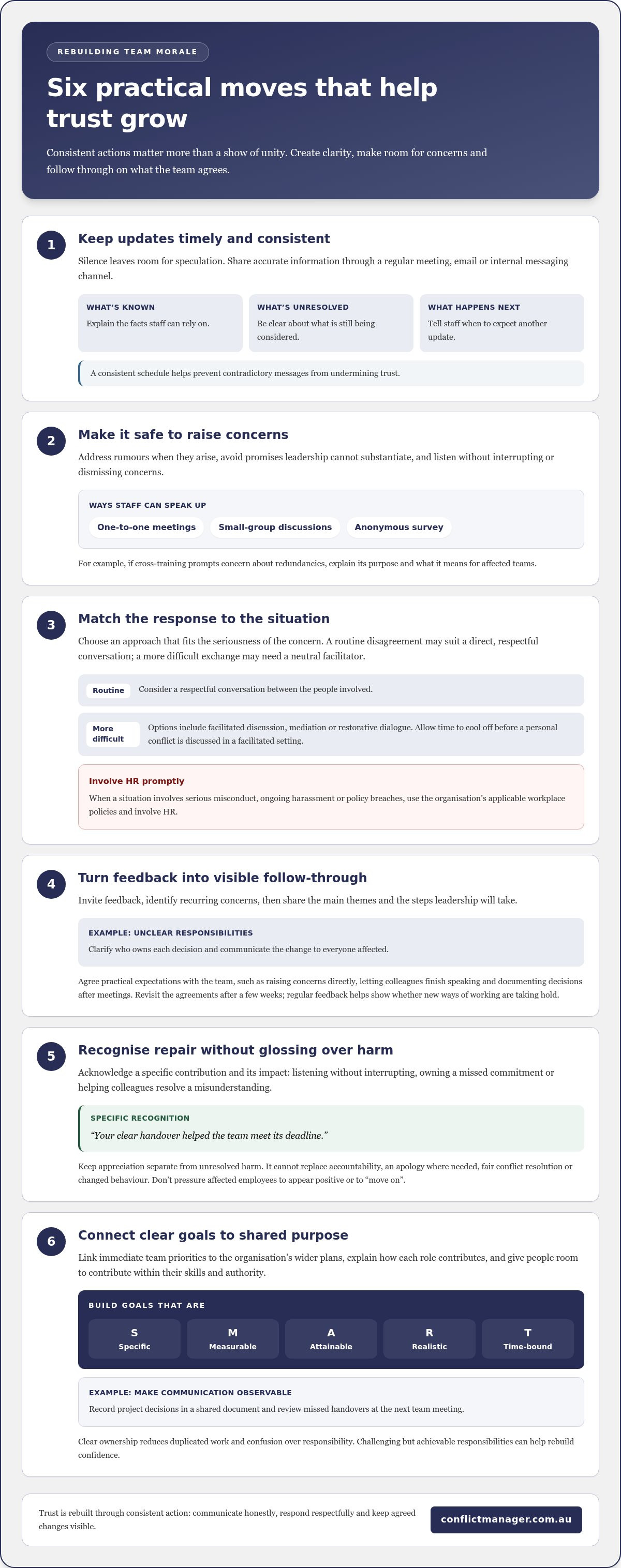
Silence creates room for speculation. After a serious disagreement or organisational change, leaders should share accurate updates through a regular meeting, email or internal messaging channel. If decisions are still being considered, explain what is known, what remains unresolved and when staff can expect another update. A consistent schedule helps prevent contradictory messages from undermining trust.
Address rumours when they arise. For example, if cross-training prompts concern about redundancies, explain its purpose and what it means for affected teams. Avoid promising outcomes that leadership cannot substantiate. Offer several ways to raise questions, such as one-to-one meetings, small-group discussions or an anonymous survey. Then listen actively, without interrupting or dismissing concerns.
In Australia, use the organisation’s applicable workplace policies to guide responses to bullying, conflict and mediation. Involve HR promptly when a situation involves serious misconduct, ongoing harassment or policy breaches. A routine disagreement may be addressed through a direct, respectful conversation, but serious conduct requires a response beyond informal discussion.
Options include a respectful conversation between the people involved, a facilitated discussion, mediation or restorative dialogue. Match the approach to the situation: direct discussion may help resolve a misunderstanding, while a neutral facilitator can support a more difficult exchange. Give employees time to cool off before a personal conflict is discussed in a facilitated setting.
Communication must lead to action. Invite feedback, identify recurring concerns, then share the main themes and the steps leadership will take. If staff report unclear responsibilities, for instance, clarify who owns each decision and communicate the change to everyone affected. Visible follow-through helps the workplace move forward.
Agree on future behaviours with the team. Record practical expectations, such as raising concerns directly, letting colleagues finish speaking and documenting decisions after meetings. Revisit these agreements after a few weeks. Regular feedback, rather than relying on an annual conversation, reinforces respectful conduct and shows whether new ways of working are taking hold.
2. Using appreciation sincerely rather than to control employees
Recognition after conflict should acknowledge a specific contribution, not demand loyalty. A manager might thank an employee for listening without interrupting, owning a missed commitment or helping colleagues resolve a misunderstanding. Name the behaviour and its impact: “Your clear handover helped the team meet its deadline.” Specific praise feels credible and highlights the actions that support a respectful workplace.
Keep appreciation separate from unresolved harm. It cannot replace accountability, an apology where needed, fair conflict resolution or changed behaviour. Managers should not celebrate “moving on” while affected employees still have concerns. Invite people to describe the impact in a private meeting, acknowledge their response and agree on what repair would look like. Do not pressure anyone to appear positive for leadership.
Psychological safety depends on employees being able to speak without fear of retaliation. Managers can welcome concerns, provide a private way to raise them and respond consistently without penalising the person who speaks up. For example, thank an employee for flagging a recurring handover problem, then examine the process before assigning blame. If serious distress emerges, offer access to workplace mental health resources.
Wellbeing support should reflect the pressure people are facing. During a difficult change, discuss practical flexibility, workload priorities and professional development in individual check-ins. These conversations help managers notice when strain affects concentration or collaboration, without treating every disagreement as a mental health issue. Support might include making existing mental health resources visible and giving staff time to develop relevant skills.
Retention also depends on a credible future. Make career progression and leadership opportunities visible, then invite employee input on process or culture improvements. In a team meeting, ask what should change in project handovers and report back on decisions. Where recurring conflict stalls this work, facilitated workplace conversations can help employees address concerns constructively.
3. Clear organisational and individual goals
After conflict, shared goals give colleagues a practical reason to work together. Leaders should connect immediate team priorities to the organisation’s wider plans, then explain how each role contributes. For example, a service team might make accurate handovers a shared priority, with each person responsible for recording decisions clearly. A common purpose can encourage engagement without asking staff to ignore unresolved concerns.
Make goals specific, measurable, attainable, realistic and time-bound. Replace “improve communication” with an observable action, such as recording project decisions in a shared document and reviewing missed handovers at the next team meeting. Clear measures show employees what progress looks like and make it easier to discuss performance using evidence rather than assumptions about intent.
Individual goals should contribute to the shared outcome while respecting each employee’s skills and authority. A manager might ask the person closest to a task to update a workflow, then agree which decisions they can make independently. Challenging but achievable responsibilities can rebuild confidence. Clear ownership also reduces duplicated work and confusion over who is responsible for gaps.
How long does it usually take to rebuild trust and team morale after conflict? Trust can take weeks or even months of consistent behaviour and accountability to restore. The pace depends on the depth of the conflict, whether commitments are kept and whether agreed goals feel fair. Treat progress as a pattern to observe, not a deadline that requires people to appear reconciled.
Review goals during regular check-ins. Ask employees what is helping, what is obstructing progress and where managers should listen more closely. If a shared target keeps slipping because responsibilities overlap, clarify decision rights and adjust the work plan. Recognise completed milestones as evidence of cooperation, not proof that every concern has disappeared. This keeps progress visible while giving the team room to address problems honestly.
4. Cross-department collaboration and team building
Cross-department projects give colleagues a shared task beyond the conflict itself. Pair people from different functions to solve a defined problem, such as improving a client handover or simplifying an approval process. Set roles, decision boundaries and expectations before work begins. A clear structure helps people build respect and working relationships through useful contributions.
Choose collaboration activities for their practical outcome, not just their social value. A short workshop could map where a process breaks down between departments, then assign owners to test improvements. A team-building exercise is more purposeful when it involves cooperation, such as designing a service workflow together. Shared experiences can renew camaraderie, but they do not replace accountability for earlier harm.
Learning and development can provide another route to cooperation. A training needs assessment can identify skills that would help individuals or teams work together more effectively. Cross-training can clarify how another department handles its responsibilities, too. Explain its purpose in advance, because employees may interpret it as a sign of coming layoffs. Give a specific example of which tasks participants will learn and how that knowledge supports continuity.
What are the risks of forcing reconciliation or team-building too soon? Employees may feel pressured to conceal concerns, perform closeness or accept unresolved harm. That can deepen resentment instead of restoring respect. Give people time to cool off, address the conflict directly and make group activities purposeful before arranging them.
Set simple conditions for a constructive joint project: agree on its purpose, invite concerns about participation and explain how decisions will be made. Afterward, ask team members what helped cooperation and what created friction. Use their feedback to improve the next collaboration rather than assuming one successful activity has repaired every relationship.
If unresolved workplace conflict is preventing departments from working together, arrange a facilitated workplace conversation to support a constructive way forward.
Conflict Manager: Family Conflict Resolution
Conflict Manager provides Organizational Conflict Management for workplaces where unresolved disputes are disrupting collaboration, morale or decision-making. When internal conversations stall, positions harden or several teams are involved, structured support can help clarify the issues and establish a constructive path forward.
For disputes involving multiple departments or stakeholders, Stakeholder Facilitation can support a focused conversation about concerns, responsibilities and workable next steps. It helps participants engage with the conflict directly and establish clearer ways of working together. This is a practical option when managers need a neutral process to move beyond repeated disagreements and consider what repair requires.
Conflict Manager also provides Family Conflict Resolution for family disputes. To discuss support for a workplace conflict, contact Conflict Manager.
Make the next step deliberate
Repair is more durable when the next step is specific, shared and observable. Before another difficult conversation or joint project, identify what needs to change, who will take responsibility and how the team will recognise progress. This keeps rebuilding team morale after a major conflict grounded in everyday behaviour, not a single statement of intent.
When internal efforts have stalled, an impartial process can help participants address entrenched disagreements and establish a workable way forward. Conflict Manager provides Organizational Conflict Management and Stakeholder Facilitation for workplace disputes, as well as Family Conflict Resolution for family matters. The right support depends on the conflict and the people involved.
If your organisation needs structured support to move forward, contact Conflict Manager for support. A considered next step can help create the conditions for steadier, more constructive working relationships.
Frequently Asked Questions
What are the first steps to rebuild team morale after a major workplace conflict?
To begin rebuilding team morale after a major conflict, stabilise day-to-day work before launching a team event. Identify decisions or handovers still affected, clarify temporary responsibilities and check privately with the people most involved. Then map the main causes and agree on a priority for repair. If concerns involve serious misconduct or ongoing harassment, involve HR rather than treating the situation as a morale issue alone.
How can managers acknowledge harm and rebuild trust after team conflict?
Managers rebuild trust by acknowledging the impact, taking responsibility for their part and describing a specific corrective action. If a colleague was publicly dismissed, for example, the manager can acknowledge the harm privately, correct the record with the same audience where appropriate and change how disagreement is handled in meetings. Follow up to ask whether the repair addressed the issue. Do not require forgiveness or a quick return to normal.
How should leaders communicate with employees after a serious team conflict?
Leaders should use an agreed source of updates and a consistent schedule so employees are not left reconciling conflicting accounts. Separate confirmed decisions from matters still under review, explain what staff can expect next and protect personal information. If a question concerns an individual case, acknowledge it and direct it through the appropriate confidential process rather than sharing personal details in a team-wide update.
What team activities help rebuild collaboration and morale after a dispute?
Choose activities that involve cooperation around a neutral task, not personal disclosure. A cross-functional scenario exercise could ask team members to trace a fictional service failure from request to resolution, then discuss where information was lost. A structured debrief can surface practical lessons without requiring anyone to revisit personal grievances. Offer an alternative for employees who are not ready for group participation, and explain the activity’s purpose beforehand.
How can you measure team morale and progress after a major conflict?
Use confidential pulse questions, themes from individual check-ins and operational indicators such as absenteeism, turnover, missed handovers and completed work. Establish a baseline, then compare patterns over time rather than reacting to short-term fluctuations. Ask whether employees feel able to raise concerns and whether coordination is improving. Interpret results alongside workload or organisational changes, which can affect the same indicators.


