

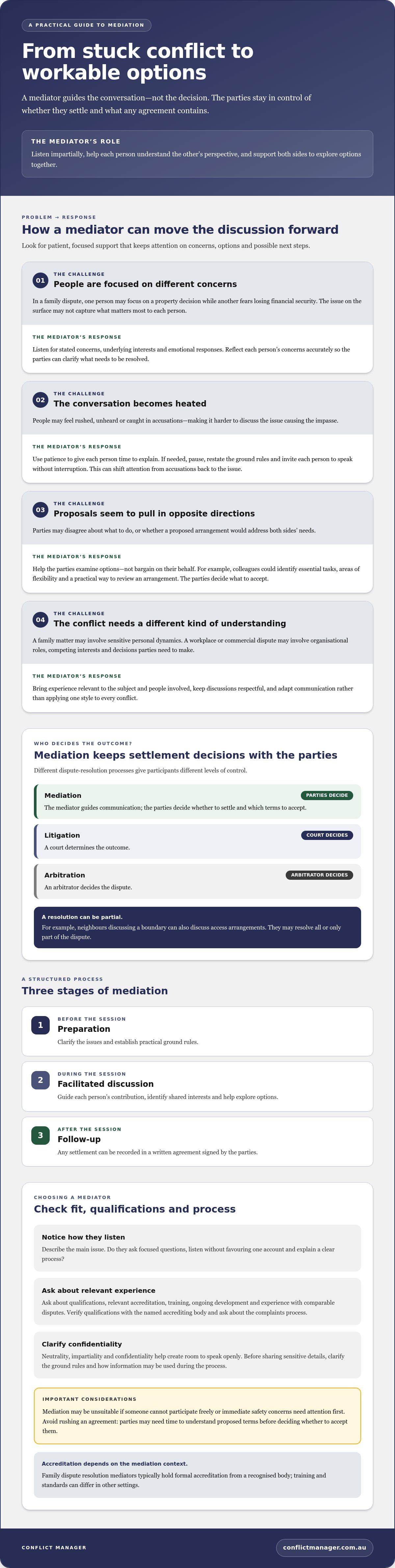
A mediator’s role is to guide the conversation, not decide who is right. What makes a good mediator is the ability to listen impartially, help each person understand the other’s perspective and support them to explore workable options together. The parties retain control over whether they settle and what any agreement contains.
It’s understandable to look for someone who can bring calm and direction when a dispute feels stuck. Patience, clear communication and negotiation skills can make space for a more constructive discussion. Relevant legal knowledge may also help keep proposals grounded in the issues at hand.
This article explains how these qualities work in practice, why collaboration is central to mediation and what to consider when assessing a mediator’s training and experience in Australia.
Key Takeaways
- Look for a mediator who keeps the parties in control of any agreement while helping discussions stay focused and constructive.
- Notice whether they listen for underlying needs and adapt their approach as the conversation shifts.
- Legal knowledge can help a mediator understand relevant rights and constraints without taking over the parties’ decisions.
- Consider relevant mediation training and experience, and seek structured support when family or organisational conflict becomes difficult to manage internally.
Mediation as a collaborative approach to dispute resolution
Mediation gives disputing parties a structured way to discuss issues and negotiate possible solutions. The mediator guides communication but doesn’t make a ruling. Unlike litigation, where a court determines the outcome, mediation leaves settlement decisions with the parties. In arbitration, an arbitrator decides the dispute. Each process gives participants a different level of control.
That control has practical value. For example, neighbours disputing a boundary can discuss access arrangements as well as the boundary itself. A mediator can help identify underlying concerns and options, but the parties decide whether to settle and which terms to accept. A resolution may address all or only part of the dispute.
Are mediators in Australia required to be accredited or meet professional standards? Requirements depend on the mediation context. Family dispute resolution mediators typically hold formal accreditation from a recognised body, while training and standards can differ in other settings. Ask about relevant qualifications, ongoing development and experience with disputes like yours.
Neutrality, impartiality and confidentiality matter because parties need room to speak openly. A mediator should avoid taking sides, treat each participant with respect and maintain confidentiality. Before sharing sensitive details, clarify the ground rules for confidentiality and how information may be used during the process.
Mediation may be unsuitable if a participant can’t take part freely or if immediate safety concerns need attention first. A rushed agreement can also leave important issues unresolved. For example, parties discussing property arrangements may need time to understand proposed terms before deciding whether to accept them.
A mediator’s process typically has three stages: preparation, facilitated discussion and follow-up. Before the session, they clarify the issues and establish practical ground rules. During the session, they guide each person’s contribution, identify shared interests and help explore options. Afterwards, any settlement can be recorded in a written agreement signed by the parties.
To assess credentials and complaints history, ask about the mediator’s relevant accreditation, training and experience with comparable disputes. Verify qualifications with the named accrediting body and ask about the complaints process. This gives you concrete information to weigh rather than relying on a title alone.
Patience, listening, negotiation and connecting with people
Active listening means more than waiting for a turn to speak. A mediator listens for each person’s stated concern, underlying interest and emotional response. In a family dispute, one person may focus on a property decision while another fears losing financial security. Reflecting both concerns accurately can help clarify what needs to be resolved.
Patience gives people time to explain themselves without being rushed into an agreement. If a conversation becomes heated, the mediator can pause, restate the ground rules and invite each person to speak without interruption. That reset can shift attention from accusations to the issue causing the impasse.
Negotiation means helping parties examine options, not bargaining on their behalf. For example, colleagues who disagree about responsibilities could identify essential tasks, areas of flexibility and a practical way to review the arrangement. A mediator can test whether a proposal addresses both sides’ needs and clarify what each person would be accepting.
How can you assess whether a mediator is a good fit for your dispute? Describe the main issue and notice whether they ask focused questions, listen without favouring one account and explain a clear process. Their approach should suit the subject of the conflict and the people involved.
For a family matter, look for experience with sensitive personal dynamics and the ability to keep discussions respectful. In a workplace or commercial dispute, assess whether the mediator can understand organisational roles, competing interests and the decisions parties need to make. In any setting, check that they adapt their communication rather than apply one style to every conflict.
When family tensions make constructive discussion difficult, Family Conflict Resolution can provide a structured setting to work through the issues. The mediator’s patience and listening help keep the conversation centred on concerns, options and possible next steps.
Experience can offer a useful perspective, especially when paired with patient listening to each side. A mediator’s self-reflection and ability to connect authentically with clients can also support trust. Treating all parties with dignity and respect means helping each person feel heard and valued.
Active listening means understanding each party’s needs, interests and perspectives while attending to the emotions and intentions beneath their words. Patience gives parties time to calm down, understand one another and work towards compromise.
Benefits of a mediator's legal background
Legal knowledge can help a mediator recognise which issues need careful examination. In a family property dispute, the parties may have different views about an agreement’s meaning or possible outcomes. A mediator with relevant legal experience can help clarify the questions and keep proposed options realistic, without deciding the dispute.
Family law knowledge may also help identify rights, obligations and potential court outcomes relevant to a discussion. For example, parents working through a parenting plan may need to consider whether proposed arrangements are workable and consistent with legal requirements. Understanding these considerations can keep negotiation focused on practical terms.
Complex documents can create another source of friction. A mediator familiar with legal agreements may help parties identify unclear wording, missing issues or points that need further consideration. In a property settlement, for instance, the parties might need to clarify which assets an agreement covers before discussing its terms.
That expertise has limits. A mediator’s role is to facilitate discussion, not represent either party or impose a legal outcome. Their legal background should inform the process without turning mediation into a courtroom argument or letting one person’s position dominate.
For participants, the distinction matters. A mediator can help explain how legal considerations affect the options under discussion, while each party remains responsible for deciding whether to accept an agreement. If a proposal has significant legal consequences, independent legal advice can help a person understand their position before committing.
When considering a mediator’s legal experience, focus on how relevant it is to the dispute. Ask whether they understand the legal issues involved, how they maintain impartiality and how they handle questions outside their role. For example, a mediator assisting with parenting arrangements needs insight into family law considerations, while an organisational dispute may involve different agreements and responsibilities.
Legal knowledge is most useful when paired with sound mediation practice. It helps keep discussions informed and grounded, while patience, neutrality and clear communication leave decisions in the parties’ hands.
What training and qualifications should a mediator have in Australia?
Training should match the type of dispute. In Australia, family dispute resolution mediators typically hold formal accreditation from a recognised body. Mediators in other settings may have different specialist preparation, so assess their training against the conflict you need to address.
A course certificate alone offers limited evidence of capability. Completing 40 hours of mediation training does not necessarily make someone competent. Practical skill also develops through supervised work, reflection and continued learning. Ask how a mediator maintains their practice and applies training to real discussions.
Relevant professional development can include ongoing training, supervision and peer discussions. These activities help mediators reflect on difficult sessions, improve their judgement and adapt their approach. For example, a mediator handling a workplace dispute may need different techniques from one facilitating a family disagreement.
Assess the mediator’s preparation across several areas:
- Specialist knowledge: Look for training in conflict resolution, negotiation and mediation techniques relevant to your dispute.
- Practical experience: Ask about comparable matters and the mediator’s role in guiding those discussions.
- Continued learning: Find out how supervision, peer exchange and further training inform their practice.
For family disputes, formal family dispute resolution accreditation can be a useful indicator. For organisational or commercial conflicts, relevant experience and focused mediation training help show whether the person understands the setting and its dynamics. A legal qualification may add subject knowledge, but it doesn’t replace mediation skills or impartiality.
Before engaging a mediator, ask them to explain their training, accreditation and experience in plain terms. Then consider whether their approach suits the people involved and the issues at hand. A clear explanation should help you understand how they’ll structure the discussion, manage competing perspectives and support negotiation without deciding the outcome.
If your dispute needs a structured conversation, explore support for resolving conflict and consider the skills and process that would best serve the people involved.
A commenter urges ongoing training, supervision and peer discussions throughout careers. The Mediator and Mediation Skills Training course is four weeks long. A commenter reports 20 years’ practice after an LLM in alternative dispute resolution.
Conflict Manager: Family Conflict Resolution
Conflict Manager provides Family Conflict Resolution for families facing disputes that are difficult to manage through informal conversations alone. A facilitated process can help family members clarify concerns, hear different perspectives and work towards practical next steps, particularly when sizable assets or ongoing relationships add complexity.
For conflict within a business, Organizational Conflict Management can support clearer discussions during structural change or emotionally charged situations. Stakeholder Facilitation can help bring relevant parties into a focused conversation when competing priorities make progress difficult.
These services suit situations where people need an impartial process to discuss issues and explore options together. Start by identifying the central conflict, who needs to be involved and what a constructive outcome might look like. Contact Conflict Manager to discuss the right form of support for your situation.
Choose a constructive next step
A useful next step is to define what progress would look like for the people involved. It might mean opening a difficult conversation, clarifying responsibilities or discussing family decisions with less friction. That focus can help you judge whether mediation suits the situation and what kind of support would be valuable.
Understanding what makes a good mediator is a starting point; the process also needs to fit the dispute. Conflict Manager offers Family Conflict Resolution, Organizational Conflict Management and Stakeholder Facilitation to support different settings and relationships.
If a structured, impartial conversation could help move matters forward, contact Conflict Manager to discuss mediation. A considered first step can make room for clearer decisions and more constructive dialogue.
Frequently Asked Questions
What qualities and skills make a mediator effective?
What makes a good mediator effective is sound judgement and the ability to notice how a conversation is unfolding, not just what people say. They can recognise when one person is dominating, invite quieter participants to contribute and keep their own reactions from shaping the discussion. In a family succession meeting, for example, they can help each affected person explain their concerns.
What communication and conflict-resolution techniques do good mediators use?
Good mediators use agendas, open questions and checks that proposed solutions address the real problem. A practical test of what makes a good mediator is how they respond to a broad accusation, such as “The team is careless”. They can ask which decision or behaviour caused concern, help turn criticism into a clear request, then clarify agreed next steps in each person’s own words.


