

Resistance in a meeting is not always a direct refusal. It may show up as silence, repeated objections, side conversations or reluctance to take part. Overcoming resistance to professional facilitation starts with treating these signals as information about trust, risk or what people feel they may lose, not as disruption to shut down.
It’s understandable to want a tense discussion back on track quickly. But pushing past resistance can leave the underlying concern untouched. A calm response creates room to understand what’s driving it and what the group needs to move forward.
This article sets out four ways to respond: use reflection and dialogue to lower pressure, establish and reinforce shared norms, communicate the purpose and process clearly, and explore the risks and safety concerns beneath objections. You’ll learn how to recognise different forms of resistance and choose a response that respects participants while keeping the conversation purposeful.
Key Takeaways
- Read silence, objections and reduced participation as possible signals of concern, then make space for reflection before asking for group discussion.
- Agree on respectful participation norms and use structured turn-taking to help people feel heard when views differ.
- Set out a meeting’s purpose, intended outcome and process clearly, and explain how participants’ input will be used.
- Explore what resistance may reveal about trust, change fatigue, practical risks or perceived loss before choosing how to respond.
- When internal discussions remain difficult to manage, professional facilitation can help create a more structured setting for dialogue.
1. A process from projection to reflection, dialogue, and action
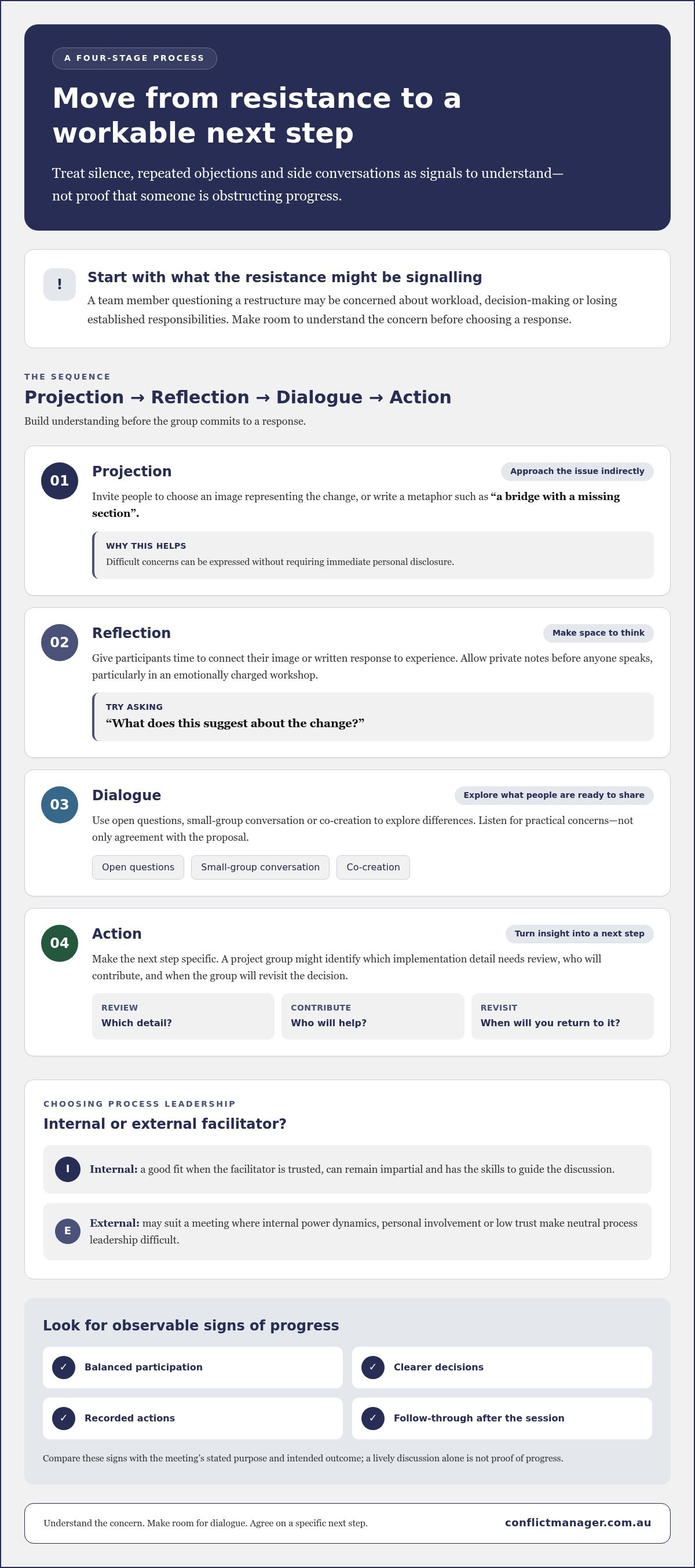
Resistance may appear as silence, repeated objections or side conversations. Treat these behaviours as signals to investigate, not proof that someone is obstructing progress. For example, a team member questioning a restructure may be worried about workload, decision-making or losing established responsibilities.
A structured process moves the discussion through four stages: projection, reflection, dialogue and action. Each stage changes the distance between participants and the issue, helping the group build understanding before committing to a response.
- Projection: Invite people to approach the issue indirectly. Ask them to choose an image representing the change, or write a metaphor such as “a bridge with a missing section”. This can make difficult concerns easier to express without requiring immediate personal disclosure.
- Reflection: Give participants time to connect their image or written response to experience. Ask, “What does this suggest about the change?” or allow private notes before anyone speaks. In an emotionally charged workshop, individual reflection can reduce pressure to respond in front of the full group.
- Dialogue: Invite participants to share what they’re ready to discuss. Use open questions, small-group conversation or co-creation to explore differences. Leadership should listen for practical concerns, not only agreement with the proposal.
- Action: Turn the insights into a specific next step. For example, a project group might identify which implementation detail needs review, who will contribute, and when the group will revisit the decision.
How do you choose between an external facilitator and an internal facilitator? Choose an internal facilitator when they’re trusted, can remain impartial and have the skills to guide the discussion. An external facilitator may suit a meeting where internal power dynamics, personal involvement or low trust make neutral process leadership difficult.
What evidence shows professional facilitation improves meeting or workshop outcomes? Look for observable signs: balanced participation, clearer decisions, recorded actions and follow-through after the session. Compare these with the meeting’s stated purpose and intended outcome, rather than treating a lively discussion as proof of progress.
How can you respond when senior leaders or employees oppose using a facilitator? Ask what concerns them, then explain the facilitator’s role, process and intended outcome. If a senior leader fears losing control, clarify that they retain their decision-making responsibilities while the facilitator supports participation and dialogue.
What should Australian organisations look for when hiring a professional facilitator? Look for relevant experience with the group’s conflict or change context, a clear process and the ability to manage power differences. Ask how they’ll support participation, handle sensitive discussion and turn meeting insights into practical next steps.
2. Establishing and reinforcing group norms
Shared norms make participation more predictable, particularly when a group includes different levels of status or strong disagreement. Before discussing a restructure, for example, a facilitator can ask participants what respectful challenge looks like: questioning a proposal without attacking the person who raised it. The group’s own language gives the norm practical meaning.
Agree on how people will contribute, how disagreement will be handled and what happens when discussion becomes personal. Keep expectations visible, whether on a meeting slide or in a shared document. A clear prompt such as “describe the impact, not the person’s motive” gives participants a practical way to raise concerns without escalating blame.
Norms need to shape the meeting, not sit unused in its opening minutes. If one voice dominates, the facilitator can refer to the group’s agreement on balanced participation and invite others in. If someone interrupts, the facilitator can pause, restate the relevant norm and return the floor to the speaker. This consistent response shows that the rules apply across roles and levels of seniority.
- Make contribution accessible: Offer spoken and written ways to participate. A person uncertain about speaking in front of senior colleagues might first submit a concern in writing.
- Share airtime: Use structured turn-taking when views are polarised. Each participant can respond to the same question before anyone takes a second turn.
- Separate challenge from disrespect: Invite participants to test an idea while avoiding personal judgement. “What could make this plan fail?” is more useful than “Who came up with this?”
- Address drift promptly: Name the behaviour and reconnect it to the agreed norm. For example, “We agreed to let each person finish. Let’s hear the rest of that point.”
These practices can also reveal where uncertainty or unequal status is shaping the conversation. If junior employees stay silent after a manager speaks, the facilitator might gather written views before inviting open discussion. The aim isn’t to force agreement, but to make it possible for differing views to be heard.
What steps help build trust and gain buy-in before a facilitated session? Explain the session’s purpose, who will take part, how input will be used and which decisions remain with leadership. Invite participants to raise concerns beforehand, then reflect their priorities in the session plan so they can see their perspectives have shaped the process.
For a group that struggles to maintain fair participation, structured stakeholder discussions can help establish and reinforce shared expectations.
3. Open and transparent communication
Uncertainty grows when staff hear about a decision without understanding its purpose. In a workplace restructure, a team might learn that reporting lines will change but not know which responsibilities are affected. Name what’s decided, what remains open and who will make the final decision. This gives participants a clearer basis for taking part.
At the meeting’s outset, use the POP model: Purpose, Outcome, Process. Explain why the discussion is happening, what it should produce and how it will run. For example: “We’re here to identify handover risks, clarify which need further review, and record who will follow up.” Participants can then assess whether the discussion is meeting its stated aim.
Overcoming resistance to professional facilitation depends in part on making the process visible. Explain how comments will be recorded, who will receive the notes and how feedback may influence the decision. If a suggestion can’t be adopted, explain why. A clear response helps people see that their contribution was considered, even when it doesn’t determine the outcome.
- Clarify the request: State what participants are being asked to do, such as test a proposed workflow or identify implementation risks.
- Explain decision boundaries: Separate settled decisions from questions still open to discussion, so consultation isn’t mistaken for a promise to accept every proposal.
- Invite private input: Offer a channel for people who aren’t ready to raise a concern in front of colleagues.
- Close the loop: Confirm what the group heard, who will consider it and when participants will receive an update.
Public agreement can sometimes conceal private reservations. A facilitator might ask, “What might make this plan difficult to support in practice?” Participants can share anonymous written comments before the group discusses common themes. This can surface concerns about workload or unclear accountability without requiring anyone to challenge a colleague publicly.
For organisational change, involve affected stakeholders while plans can still be shaped. If staff say a new process creates an unnecessary approval step, decision-makers can consider that feedback before implementation. Regular updates matter too: explain what has changed, what remains under review and why.
These practices make overcoming resistance to professional facilitation more about clarity than persuasion. The aim isn’t to manufacture consensus. It’s to give participants an accurate account of the process, a meaningful way to contribute and a clear understanding of how decisions will be made.
That clarity also depends on how people are welcomed into the conversation. One facilitator says they open workshops by encouraging discussion, mutual respect and questions, while recognising that participants are at different stages in their DEI journeys. Managers should communicate the change vision while addressing employees’ concerns and anxieties. Clear communication about the reasons for organisational change, expectations and available support can help reduce anxiety among affected people.
Facilitators can build trust by helping participants feel safe to express concerns, free from retaliation and taken seriously. Organisations should communicate the reasons for change, its objectives and its impacts clearly and consistently.
4. Resistance as information about risk, stakes, and safety
An objection can point to a practical flaw, a strained relationship or fear of consequences. In a change meeting, “This won’t work” might mean the proposed roster leaves a shift uncovered. It could also signal fatigue after previous initiatives were abandoned. Treat the statement as a clue, then explore the reasons before choosing a response.
Start with a neutral follow-up: “What would make this difficult to put into practice?” The answer may reveal missing skills, unclear responsibilities or a power dynamic participants don’t feel safe naming. If people expect judgement or retaliation, asking them to speak candidly in front of senior leaders may deepen silence instead of building trust.
In a change workshop, ask what participants are being asked to let go of. A team may be losing familiar routines, influence over decisions or confidence in how work will be assessed. Naming the specific loss helps separate practical concerns from assumptions and gives the group something concrete to examine.
- Operational risk: Ask which task, handover or customer commitment could be affected. Record the example and identify what information would test the concern.
- Change fatigue: Ask what happened with earlier initiatives. Find out whether participants saw abandoned plans, shifting priorities or extra work without support.
- Fear of judgement: Offer private reflection or written input before group discussion. Let people choose what they’re ready to share.
- Power concerns: Notice who speaks freely and who holds back. Consider whether the meeting format gives people with less authority a meaningful way to contribute.
These distinctions matter because a single technique won’t address every situation. A process concern may need operational review; low trust may call for clearer boundaries and careful participation. Don’t invite more vulnerability than the session can support. If a participant raises a sensitive issue, acknowledge it, clarify what the meeting can address and avoid pressing for personal detail.
How should you explain the role and value of a professional facilitator to stakeholders? Explain that a facilitator structures the discussion, supports balanced participation and helps the group clarify concerns and next steps. They guide the process; the organisation remains responsible for its decisions.
What are the risks of proceeding without professional facilitation? In a high-conflict meeting, dominant voices may shape the record while quieter participants withhold relevant concerns. The group may leave with unresolved issues, unclear actions or apparent agreement that doesn’t reflect what people actually think.
Use resistance to refine the process, not to force disclosure or acceptance. When stakeholders face competing risks, structured stakeholder facilitation can give the discussion a clear purpose while leaving decision-making with the organisation.
5. How can facilitators address concerns about cost, neutrality, and loss of control?
Concerns about engaging a facilitator often reflect practical stakes. A manager may question the cost when a project has a tight budget, while a participant may worry that an outsider will favour senior leaders. Address each concern directly: acknowledge it, ask what sits behind it, then explain how the process will handle the issue.
For cost, define the work before discussing the investment. Clarify the meeting’s purpose, who needs to participate, the preparation required and the outcome the organisation needs. A short discussion to clarify a decision differs from a series of sessions addressing entrenched conflict. Defining the scope helps decision-makers judge whether facilitation fits the problem and available resources.
Then consider the cost of leaving the issue unresolved without claiming that facilitation will guarantee savings. For example, a team can examine whether repeated meetings are delaying a decision, creating duplicated work or leaving responsibilities unclear. Compare those effects with the proposed scope, and define what a useful outcome would look like. This makes the decision more grounded than comparing facilitation with no cost at all.
- Neutrality: Explain how the facilitator will invite differing views, manage airtime and record areas of agreement and disagreement. For example, a project sponsor can state their position, but shouldn’t control which participants get heard.
- Decision authority: Set out who retains the decision. A facilitator can guide discussion and help clarify options, while the executive team or designated group remains accountable for its choice.
- Confidentiality and notes: Agree what will be recorded, who will see it and how sensitive information will be handled. Participants need to understand these boundaries before sharing concerns.
- Process control: Identify the meeting’s purpose, topics and decision points in advance. If the discussion moves beyond scope, the facilitator can name the shift and ask whether the group wants to address it.
Neutrality doesn’t mean ignoring power differences. If a senior leader is present, the facilitator can clarify that everyone will have a way to contribute, including through written input or structured turns. If someone questions the facilitator’s impartiality, explain the process rather than dismissing the concern. A clear method gives stakeholders something specific to assess.
To address concerns about losing control, distinguish control over the process from control over the decision. A chief executive may set the decision boundaries and retain final authority, while the facilitator supports a fair examination of operational risks and stakeholder perspectives. This division can make participation meaningful without suggesting every proposal will be adopted.
Discussing cost, neutrality and control openly can help stakeholders decide whether facilitation suits the situation. Discuss a facilitated process when your group needs a defined structure for a difficult conversation.
Conflict Manager: Family Conflict Resolution
Conflict Manager provides Family Conflict Resolution for families working through disputes involving relationships, responsibilities or shared assets. When conversations repeatedly stall or family members struggle to raise concerns constructively, a facilitated process can create space for clearer discussion.
For workplace tensions or difficult organisational change, Organizational Conflict Management can help address conflict within an organisation. When a decision affects several parties, Stakeholder Facilitation supports structured discussion of different interests and concerns. The right approach depends on who is involved and what the group needs to resolve.
Consider involving Conflict Manager when internal discussions remain stuck, trust is strained or competing perspectives make progress difficult. Contact Conflict Manager to discuss the situation and the support that may fit.
Make the next conversation more workable
A difficult meeting doesn’t have to define what happens next. Treat resistance as a reason to examine whether the process gives people enough clarity, influence and confidence to participate. The aim isn’t to secure agreement at any cost; it’s to help the right people address the issue with care and make considered decisions.
Overcoming resistance to professional facilitation can begin with a practical choice: identify whether the challenge involves a family, an organisation or a group of stakeholders. Conflict Manager offers Family Conflict Resolution, Organizational Conflict Management and Stakeholder Facilitation to support these different contexts.
If the discussion needs a steadier structure, contact Conflict Manager to explore a suitable next step. A more considered conversation can create room for progress.
Frequently Asked Questions
What does resistance look like in meetings?
Resistance can show in how participants engage with a meeting, not just in what they say. People may repeatedly reopen a settled agenda item, agree conditionally without taking action, or share key information only in private conversations afterwards. For example, a project team might approve a decision in the room, then fail to assign owners or complete related tasks. These patterns warrant attention, but need context before they can be interpreted.
What is change resistance?
Change resistance is behaviour or concern that slows, challenges or limits a proposed change. It can be a deliberate objection, but may also reflect uncertainty about new responsibilities or doubts about how a decision will work in practice. For example, a team might question a new approval process because it appears to duplicate existing work. Understanding the specific concern helps distinguish a practical issue from opposition to change itself.
Why do participants resist facilitation?
Participants may resist facilitation if they expect the session to expose them to judgement, take time without resolving anything or repeat an unhelpful past experience. Someone who has attended meetings where feedback disappeared may reasonably question whether contributing will make a difference. Explain how their input will be handled and what the session can address. This gives participants a clearer basis for deciding how to take part.
Why do teams resist professional facilitation?
Teams may see an external facilitator as a sign that leaders can’t manage disagreement, or worry that involving someone new will unsettle working relationships. A team with established routines may also view a facilitated process as an interruption to delivery. Leaders can address these concerns by explaining the practical purpose, recognising the team’s existing knowledge and showing how the discussion connects to its work.


