

A family charter earns support through the conversations that shape it, not by presenting relatives with a finished document. To understand how to get buy-in for a family charter, clarify its purpose, invite family members to discuss shared principles and concerns, and give everyone a meaningful voice. A charter isn’t legally binding; its authority comes from the family’s commitment to its contents.
That distinction matters. Relatives may agree that clearer expectations would help while holding different views about ownership, succession, family roles or decision-making. If those differences remain unspoken, the charter can feel like someone else’s agenda rather than a shared reference point.
This guide explains what a family charter covers and why it works best as a governance document, not a family manifesto. You’ll learn how open discussion, broad involvement and neutral facilitation can help relatives find common ground, and why the process takes time. The goal isn’t to eliminate every disagreement. It’s to build enough shared understanding for the charter to guide decisions when difficult questions arise.
Key Takeaways
- Begin with conversations about purpose and shared aspirations before drafting provisions, so the charter reflects family agreement rather than a small group’s decisions.
- Consider how ownership, succession, employment and family governance affect different relatives, including younger generations.
- Use confidential input, clear ground rules and neutral facilitation to help surface concerns and identify common ground.
- Frame the charter around guiding principles that can inform decisions as family circumstances change, rather than rigid rules for every situation.
- Keep the charter active by revisiting it in family discussions and using it as a shared reference when difficult decisions arise.
First things first - what exactly are family charters?
A family charter, also called a family constitution or protocol, sets out principles and expectations for relatives connected to shared assets or a family business. In Australia, a family charter for a family business isn’t legally binding; its authority comes from family members’ commitment to its contents. It guides how relatives work together, rather than acting as a legal document or a manifesto for every aspect of family life.
A charter’s contents reflect the family’s circumstances. It may record shared values, business policies, expectations for family employment, succession principles, meeting arrangements and ways to address conflict. It can also clarify how members expect to make important decisions together. Start by discussing the business’s purpose, ownership and mutual expectations, rather than drafting rules before those questions have been explored.
That order matters. A charter records agreements already reached; it can’t create agreement where none exists. Begin by discussing why the family wants a charter and what it should help them decide. For example, relatives might explore how leadership could change over time, then identify the principles that should guide that transition. Starting with purpose gives each proposed policy context and brings differences to light before drafting.
Participation shapes whether the final document feels genuinely shared. Include family members affected by its principles, and consider the voices of younger generations. One described charter process involved 16 family members, from a grandmother to a 15-year-old grandson. Where full attendance is difficult, partners or spouses can provide feedback on drafts or join selected parts of a meeting. Members should also consider how decisions could affect their children.
Family meetings provide a forum to test shared goals and clarify differing views. A confidential questionnaire can gather individual perspectives, followed by group discussions to explore common themes and priorities. Set ground rules so members can raise concerns without turning the meeting into a contest over leadership or influence. The conversation should shape the charter, not simply endorse provisions written by a small group.
Draft only after the family has discussed its principles and reached sufficient agreement. Share each draft with participants, invite specific comments, and explain how feedback will be considered. Several revisions may be needed as relatives clarify wording or test whether a principle works in practice. Stress-test language against a real decision, such as a succession discussion, before approving it. Keep the final text clear enough for members to remember and use.
Common mistakes include drafting too early, excluding affected relatives, rushing discussion and treating a signature as proof of lasting agreement. A signed charter that isn’t used can become a historical record rather than a governance tool. Family members can formalise their commitment with a signing ceremony, but should keep referring to the charter in meetings and important decisions.
Reviewing family structure, assets and governance
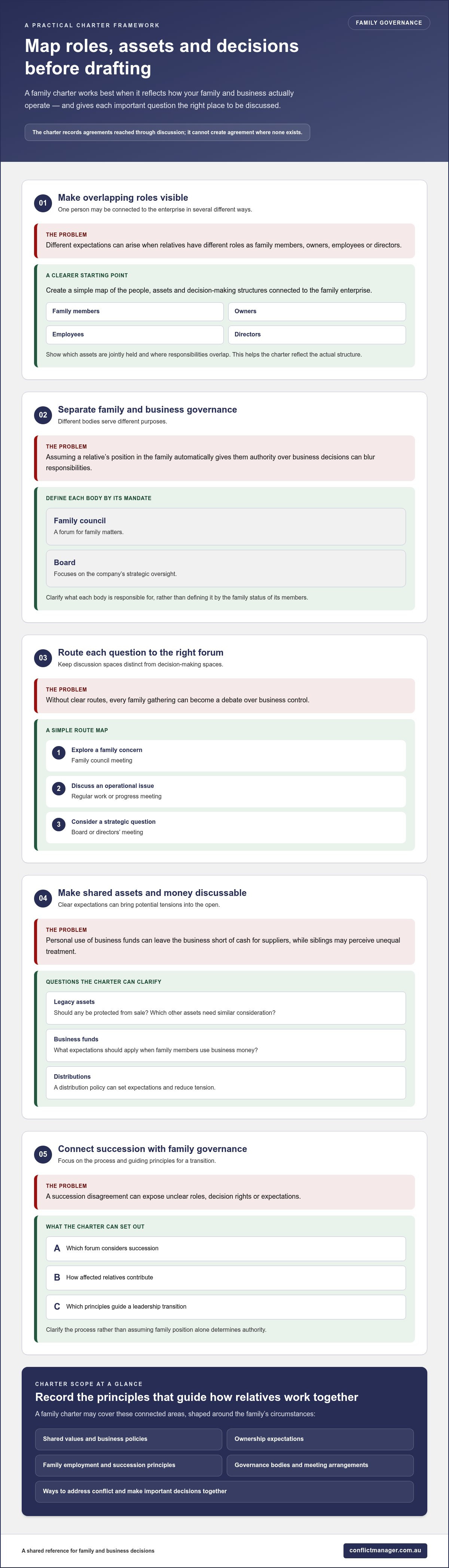
Map who belongs to the family, how ownership is held and how the family business makes decisions. Charter questions should cover shared values, ownership expectations, succession, family employment, governance bodies and conflict resolution.
Mapping family, ownership and business
Mapping family, ownership and business means identifying the people, assets and decision-making structures connected to the family enterprise. This matters because relatives may have different roles as family members, owners, employees or directors. A simple map can show who participates in each role, which assets are jointly held and where responsibilities overlap. It makes expectations easier to discuss and helps the charter reflect the actual structure.
Next, distinguish family governance from business governance. A family council can provide a forum for family matters, while a board focuses on the company’s strategic oversight. Define each body by its mandate, not by the family status of its members. This helps avoid assuming that a relative’s position in the family automatically gives them authority over business decisions.
Keep discussion forums separate from decision-making forums. Relatives might explore a concern at a family council meeting, then take an operational issue to a regular work or progress meeting. Strategic questions belong in board or directors’ meetings. Clear routes help members raise concerns in the right setting, rather than turning every family gathering into a debate over business control.
A charter can also clarify how shared assets and money are managed. For example, a family may discuss whether to protect legacy assets from sale and which other assets need similar consideration. If family members use business funds for personal expenses, the business may lack cash for suppliers, while siblings may perceive unequal treatment. A distribution policy can set expectations and reduce that tension.
Linking succession and family questions
Connecting succession and family questions means linking future leadership decisions with the family’s governance arrangements. This matters because a succession disagreement can expose unclear roles, decision rights or expectations. The charter can identify which forum considers succession, how affected relatives contribute and which principles guide a transition. It should clarify the process, rather than assume family position alone determines leadership.
Use meetings to separate questions about business capability from questions about family relationships. For instance, discuss what the business needs from its next leader, who assesses those needs and how the board contributes. Then consider how ownership may continue across generations and what information family members need before decisions are made. Recording these principles gives future discussions a shared reference point.
Review the charter as family structure, ownership and business responsibilities change. A new generation joining the business may prompt discussion about employment policies, while a change in ownership may affect meeting participation. The document can guide those conversations without trying to predict every circumstance. Its value is in clarifying who decides, where discussion belongs and which principles should shape decisions.
Neutral facilitation and conflict resolution
Different views can make family charter discussions difficult, especially when business decisions also affect relationships. A neutral facilitator gives members a structured way to raise concerns, clarify what’s at stake and work towards shared priorities. The facilitator guides the process, not the family’s values or outcomes. A practical answer to how to get buy-in for a family charter starts with making room for every perspective.
Preparation makes meetings more useful. Each family member can complete a confidential questionnaire to identify priorities or concerns before group discussion. The facilitator can then present themes without attributing comments to individuals. For example, several relatives may value continuity but differ over who should lead the family business. The group can explore the issue without turning the discussion into a personal contest.
During meetings, ground rules help keep difficult conversations focused. Members might agree to let each person finish, ask clarifying questions before responding and distinguish facts from assumptions. The facilitator can invite quieter relatives to contribute and pause discussion when it strays from the question. For families considering how to get buy-in for a family charter, balanced participation helps ensure the process doesn’t belong to the most vocal relatives alone.
An impartial facilitator can help when no relative can guide the conversation without appearing aligned with one side. An external perspective may help the family identify the issue, choose an appropriate forum and consider possible options. For instance, a concern about daily operations may belong in a work meeting, while disagreement about shared ownership calls for a family governance discussion.
Facilitated charter development should connect each discussion to a clear outcome. The facilitator can help members identify common ground, record unresolved questions and distinguish agreement on principles from decisions needing further work. If relatives differ about succession, the group might first agree on the qualities expected of future leadership. The family can then consider specific arrangements through its chosen governance process.
Keep the document faithful to what participants have discussed. After a meeting, circulate a summary of agreed themes and open questions, then invite corrections before drafting. At the next meeting, test each proposed statement against the original discussion. If a clause creates new conflict or misrepresents a member’s view, return it to the group rather than treating the draft as settled.
Facilitation is especially relevant when family members avoid a subject, repeat the same dispute or struggle to separate personal concerns from business decisions. A structured process can make tensions discussable without promising that everyone will agree. The charter should reflect genuine understanding, and unresolved differences should remain visible until the family is ready to address them.
Using principles instead of strict rules
A family charter is more adaptable when it sets out principles to guide decisions, rather than rules trying to predict every circumstance. For example, a commitment to stewardship can help relatives consider a proposed asset sale, even if the charter doesn’t prescribe the outcome. Clear principles provide a shared reference point while leaving room to respond to changes in the family business.
Begin each discussion by defining the purpose behind a proposed statement. If the concern is fair access to employment, the underlying value might be equal opportunity. The principle could then guide how relatives apply for roles, while the family business sets practical recruitment policies through the appropriate governance process. This separates shared family expectations from operational detail.
It helps to distinguish three elements during drafting:
- Values describe what the family wants to preserve, such as trust, contribution or responsible ownership.
- Roles clarify who participates in a decision, such as owners, directors or family members.
- Rules or policies set out specific procedures, such as how a family meeting records decisions.
Keeping these elements distinct prevents a value from becoming an inflexible instruction. A principle of inclusion, for instance, doesn’t automatically mean every relative decides every business matter. The charter can explain how the family will hear different perspectives while defining which governance body is responsible for a particular decision.
Use discussion to test whether proposed principles are meaningful and workable. Ask members what a value would look like during a difficult decision, then compare their answers. If “fairness” means equal distributions to one person and recognition of contribution to another, the family has uncovered a genuine difference. Clarify what the principle means before turning it into charter language.
Examples make abstract values easier to assess. A family that values long-term stewardship might discuss whether to retain a legacy asset, how to weigh future investment and who should contribute to the decision. The charter needn’t dictate the result. Instead, it can set out the considerations and process members expect to use, leaving the eventual choice to the circumstances.
Involve family members in reviewing each principle, including relatives who may experience its effects differently. A statement about family employment should make sense to current employees and younger relatives considering future roles. Invite them to flag wording that feels unclear, overly broad or impractical. Revising a principle through discussion builds shared understanding and makes the final document more useful.
Finally, check that each principle serves the charter’s purpose. Remove language that repeats another statement or adds detail better handled by a policy. Test the remaining principles against decisions the family may face, such as succession, ownership changes or conflict. The goal is a concise framework members can remember and apply, not a rulebook for every possible event.
Why a family charter can help
A family charter gives relatives a shared reference when ownership, business priorities and personal relationships intersect. Its value isn’t that it removes disagreement. Instead, it helps family members recognise the purpose behind a decision and consider how their choices affect the family’s legacy, wealth and business over time.
Without an agreed framework, a difficult question can quickly become personal. For example, if one sibling seeks a role in the family business and another questions their suitability, the discussion may shift from capability to perceived favouritism. A family constitution can set principles for employment decisions, giving relatives a shared basis for considering the issue.
A charter can also reduce uncertainty before conflict takes hold. Family members can agree where different concerns belong, who should contribute and how decisions will be discussed. A concern about day-to-day work might go through business management, while questions about family ownership can be addressed in an appropriate family forum. Clear routes help keep issues separate.
Succession is another area where a shared reference can help. A family may discuss what it expects from future leadership, how owners will contribute to the process and which values should guide a transition. These conversations can bring hidden assumptions to light before a leadership change makes them harder to resolve. The charter won’t choose a successor, but it can clarify how the family intends to approach the decision.
For relatives with different views about wealth, a charter can provide a place to examine what the family wants its assets to achieve. Some may prioritise preserving a legacy asset; others may favour using or selling it to meet current needs. Recording the family’s objectives and decision principles gives future discussions context without dictating the outcome in advance.
A useful charter also connects stated values with conduct. If the family names respect as a value, members can discuss what respectful participation means during meetings, disagreements and major decisions. This makes the principle practical and gives relatives a way to recognise when conversations have moved away from the standards they agreed to uphold.
The document only helps when family members use it. Revisit its principles during family meetings, introduce them to younger relatives and refer to them when decisions test the family’s shared commitments. A signed charter left unread can’t guide succession or strengthen relationships. Regular use keeps its purpose visible as family roles and business circumstances change.
If unresolved family conflict is obstructing these discussions, seek support for family conflict resolution to help create a clearer path towards shared decisions.
Conflict Manager: Family Conflict Resolution
Conflict Manager supports families when unresolved differences make charter discussions difficult or prevent relatives from reaching shared decisions. Through Family Conflict Resolution and Stakeholder Facilitation, the focus is on clarifying concerns, structuring conversations and helping participants work through competing perspectives.
This support may be relevant when the same disagreement repeatedly stalls drafting, family members feel unheard, or ownership and succession questions have become personal. A neutral process can help relatives identify what needs discussion and consider how to move forward, while leaving the family responsible for its decisions and charter.
If family conflict is affecting your charter discussions, contact Conflict Manager to discuss the situation.
Make the next conversation count
The practical answer to how to get buy-in for a family charter is to make participation meaningful before decisions are settled. Choose one unresolved question the family needs to address, then invite the people affected to explain what matters to them. That first conversation can show whether the next step is clearer information, a better forum or support to work through an entrenched disagreement.
There’s no need to force progress by polishing the wording while the underlying issue remains unsettled. A useful next move is to agree on what the family will discuss, who needs a voice and how differing views will be handled. If relatives can’t hold that conversation constructively, Conflict Manager offers Family Conflict Resolution, Organizational Conflict Management and Stakeholder Facilitation.
Contact Conflict Manager to discuss support for your family’s next step. A considered conversation can create room for a more workable path forward.
Frequently Asked Questions
How do you define decision rights before succession rights?
Agree who has authority to make each decision before discussing who might eventually lead. For example, distinguish the board’s responsibility for business strategy from owners’ decisions about shared assets and the family forum’s role in discussing family expectations. This clarifies the process without favouring a potential successor. Once decision rights are clear, relatives can discuss leadership criteria and how to reach a succession decision.
If the family changes every decade, why would the governance document stay frozen?
A family charter shouldn’t remain frozen. It stays useful when it reflects changes in ownership, relationships and business circumstances. A new generation joining the business, a change in family employment or a shift in shared assets can make earlier wording less relevant. Set a review point after a substantial change and ask whether the charter still reflects how the family wants to make decisions.
Where should you start?
Start by naming the concern the family wants the charter to address. For example, if relatives disagree about family members entering the business, clarify whether the issue is eligibility, assessment or decision-making authority. That distinction helps focus the discussion. A clear purpose also gives participants a way to judge whether proposed charter wording addresses the real concern.
Which governance bodies should the charter actually define?
Define only the bodies the family uses or intends to establish, and state each one’s mandate. A family council might discuss family expectations, while a company board addresses business strategy. If a family office or owners’ meeting has a role, clarify what it considers and how its discussions connect with other forums. This helps members distinguish a place to raise concerns from a body with decision-making authority.
What is a family charter and what is it used for?
A family charter, also called a family constitution or protocol, records principles and expectations for relatives connected to collectively owned assets or a family business. A family charter can guide family discussions and provide a shared reference when difficult questions arise. Relatives use it as a shared reference for matters such as ownership, family employment, succession and resolving disagreements. It guides family discussion rather than replacing legal documents or deciding every future issue.
How can you explain the benefits of a family charter to relatives?
Explain the benefit through a decision relatives recognise, rather than presenting the charter as paperwork. For example, it can help clarify how family members will discuss a proposed sale of a shared asset or a change in business leadership. Ask relatives what uncertainty they want to reduce. Connecting the charter to their concerns makes its purpose concrete and gives them a reason to participate.
Who should be involved in creating a family charter?
Include relatives whose ownership, work or family responsibilities may be affected by the charter’s principles. That may mean owners, family-business employees, relatives outside the business and younger family members whose future may be shaped by decisions. Partners or spouses can also provide feedback on draft wording if they can’t attend discussions. Consider whose perspective is missing before treating a draft as representative of the family.
How do you start a family charter discussion with family members?
Invite relatives to discuss one shared concern, without asking them to approve a finished document. You might say, “We have different expectations about family employment. What would a fair process look like?” Then give each person space to explain what matters to them. Keep the first conversation focused on understanding the issue, and record questions that need a separate discussion or more information.


