

Silence can put a family business at greater risk than an honest disagreement. Relationship conflicts cause 60% of family business failures. The fear that a family business will fail due to conflict is understandable, but avoiding difficult conversations can let problems deepen; clear decision-making, governance, mediation and boundaries give families practical ways to address tensions before they disrupt the business.
Raising a difficult issue can feel like a risk to family relationships, especially when family history and business responsibilities overlap. But leaving disagreements unspoken can blur authority and delay decisions.
This article explains how clear decision-making, family governance and structured meetings can support better business choices, when mediation can help, and how boundaries between family and work can contain tension. The goal isn’t to eliminate disagreement, but to give it a deliberate process that helps protect working relationships and the business’s ability to move forward.
Key Takeaways
- Clarify who has authority to decide, how succession will work and how family members can raise concerns before tensions stall business decisions.
- Use regular, structured meetings to separate family concerns from business decisions and build shared understanding of the business’s direction.
- Bring in a neutral mediator when discussions become entrenched, so each person can be heard and the underlying issues can be addressed.
- Set clear expectations for behaviour and keep personal disagreements out of work discussions where possible.
- Address disagreements early; practical governance, mediation and boundaries can help protect both family relationships and business continuity.
Authority and strategic decision-making
Unclear authority can turn routine business choices into tests of loyalty. A sibling may expect an equal say because of ownership, while another assumes operational responsibility gives them the final decision. Without an agreed decision-maker, even a staffing change or investment can revive old grievances. Define roles, decision rights and escalation steps before the next high-stakes choice.
Common sources of conflict in family-owned businesses include unclear roles, succession disagreements, sibling rivalry, perceived unfairness and different views of the business’s future. Generations may also disagree about risk and change. Tensions intensify when relatives don’t know who has authority or how to challenge a decision.
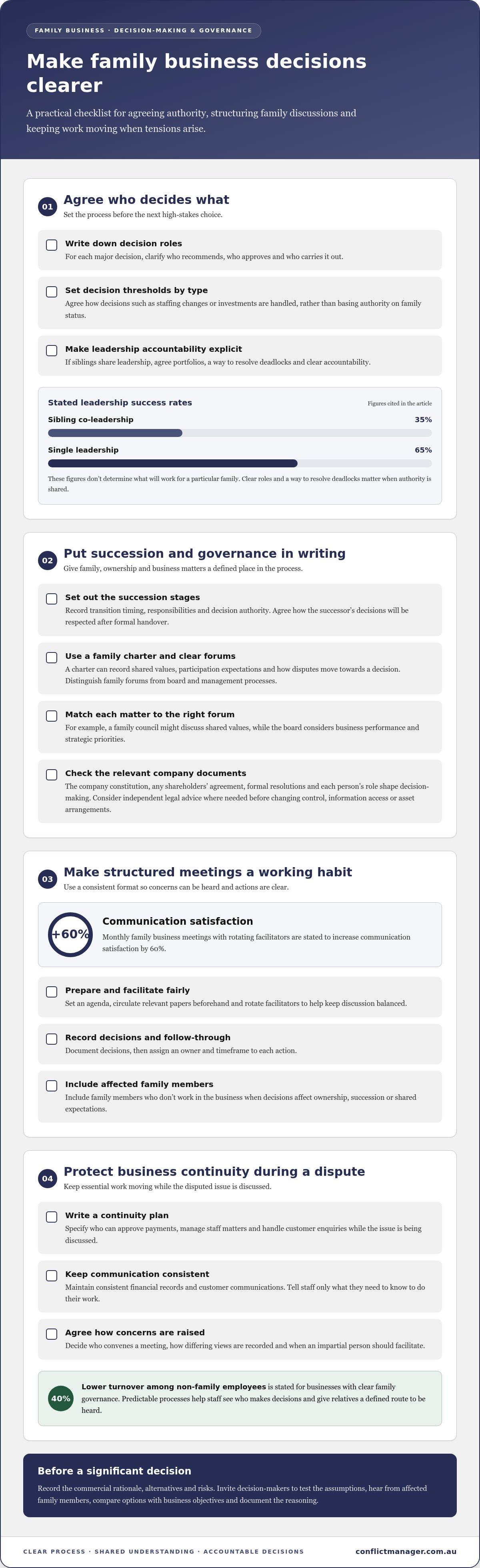
Write down who recommends, approves and carries out each major decision. For example, an operations lead might recommend new equipment, while an agreed governance group approves the investment. Set decision thresholds by type, not family status. A clear process lets relatives raise concerns without turning every disagreement into a contest for control.
Emotion also affects business judgement. Loyalty may make a relative reluctant to question a weak proposal; sentiment can keep an outdated role in place. Before approving a significant decision, record its commercial rationale, alternatives and risks, then invite each decision-maker to test the assumptions.
Leadership structure deserves particular care. Sibling co-leadership has a stated 35% success rate, compared with 65% for single leadership. These figures don’t settle what will work for a particular family. They do underline why co-leaders need explicit portfolios, a method for resolving deadlocks and clear accountability. Without those agreements, overlapping authority can turn differences into recurring disputes.
Succession needs the same precision. Clear role definitions and agreed timing can help make family business transitions more manageable. Put the transition stages, responsibilities and decision authority in writing. A founder may retain informal influence after handing over formal authority, so agree how the successor’s decisions will be respected in practice.
When fear of a family business failing due to conflict starts shaping decisions, separate evidence from obligation. If relatives can’t assess options impartially, ask a facilitator to guide the discussion. Define the decision, identify who has authority, hear from affected family members, compare options with business objectives, then record the rationale. This structure makes disagreement visible and gives the family a consistent path to action.
2. Family governance and structured meetings
Governance gives family members agreed structures for discussing business, family and ownership matters. Without them, the same disagreement can surface in board decisions, informal conversations and family gatherings, with no shared process for resolving it. A family charter can set out shared values, expectations for participation and how disputes move from discussion to a decision. Pair it with clear board and management processes so business decisions don’t depend on who has the strongest voice at home.
In Australia, a family dispute alone doesn’t determine a company director’s or shareholder’s authority. The company constitution, any shareholders’ agreement, formal resolutions and each person’s role shape how decisions are made; directors’ and shareholders’ responsibilities also differ. Before changing control, access to information or asset arrangements, identify the relevant documents and assess the proposed action against them, with independent legal advice where needed.
Good governance also creates checks on decisions. A family business can include impartial third-party board members, bringing an external perspective when relatives disagree. Written rules should distinguish family forums from board and management structures, and specify which matters each forum addresses. For example, a family council might discuss shared values, while the board considers business performance and strategic priorities. Clear boundaries help prevent personal concerns from displacing business oversight.
Regular meetings turn those rules into a working practice. Monthly family business meetings with rotating facilitators are stated to increase communication satisfaction by 60%. Set an agenda, circulate relevant papers beforehand, record decisions and assign an owner and timeframe to each action. Include family members who don’t work in the business when decisions affect ownership, succession or shared expectations. A rotating facilitator can keep discussion balanced and stop one relative from controlling every conversation.
During a dispute, protect day-to-day operations with a written continuity plan. Specify who can approve payments, manage staff matters and handle customer enquiries while a disputed issue is being discussed. Keep financial records and customer communications consistent, and tell staff only what they need to know to do their work. This reduces uncertainty without making employees messengers between relatives.
Conflict-resolution structures work best before positions harden. Agree how family members raise concerns, who convenes a meeting, how differing views are recorded and when an impartial person should facilitate. Businesses with clear family governance have 40% lower turnover among non-family employees. The practical value lies in predictable processes: staff can see who makes decisions, while relatives have a defined route to be heard.
When family members struggle to hold a constructive discussion, facilitated family discussions can help create a more neutral process for addressing the dispute.
3. Internal peacemakers and external mediators
An internal peacemaker may help relatives restart a stalled conversation. Choose someone trusted by all parties, rather than a family member with a strong stake in the outcome. Their role is to help each person speak, clarify the issue and agree on a next step. A respected aunt, for example, might help siblings prepare for a discussion, but shouldn’t be expected to decide who leads the business.
When family relationships or business authority make neutrality difficult, an external mediator can provide an impartial process. A mediator helps participants slow down, hear different perspectives and examine the interests behind their stated positions. A dispute about the founder’s legacy, for instance, may also involve concerns about capability, recognition or future direction. Mediation can bring those concerns into the conversation without taking sides.
Before mediation, identify the specific decision or relationship issue the family wants to address. Each participant can write down what happened, what matters to them and what outcome they could accept. The mediator can then agree on an agenda, set expectations for respectful discussion and clarify who needs to attend. This preparation keeps the meeting focused, especially when ownership, management and family roles overlap.
During the meeting, distinguish positions from underlying needs. If a sibling insists on retaining control, ask what that control protects: continuity, status, financial security or concern for the founder’s work. Then explore options against shared business needs. Hear each person without interruption, summarise points of agreement, identify unresolved issues and develop possible actions.
Record any agreement in clear, specific language. Include the decision, each person’s responsibilities, timing, how progress will be reviewed and what happens if circumstances change. For example, relatives might agree to trial a revised reporting arrangement, followed by a scheduled review meeting. A written record reduces later disputes about what was said. If the family wants formal or legally binding terms, get legal advice on the document before signing.
Effective mediation addresses causes as well as immediate symptoms. A disagreement about a promotion might reflect perceived favouritism, unclear criteria or an older grievance. Naming the underlying issue can help relatives resolve more than the immediate argument. It also gives them a chance to respect the family’s legacy while considering what the business needs next.
Use external support when repeated discussions reach the same deadlock, a key decision remains delayed, or family members can’t speak openly together. Mediation doesn’t replace business analysis or legal advice; it provides a structured setting for discussion and agreement. The family remains responsible for its decisions, but a neutral process can help turn entrenched positions into workable next steps.
Personal and professional boundaries
Family ties don’t disappear when relatives enter the workplace. A disagreement at Sunday lunch can carry into Monday’s staff meeting, affecting colleagues who aren’t part of the family. Set expectations for workplace behaviour, such as discussing performance in scheduled one-to-ones rather than at family gatherings. Address personal disputes promptly, before they shape decisions about rosters, promotions or customer service.
Keep family conversations separate from business discussions. Use a family setting to discuss relationships and a formal business meeting to review performance, staffing or investment. If a discussion becomes heated, pause and agree when and where to resume. This gives everyone time to consider the issue without allowing an argument to become an informal business decision.
Boundaries also protect staff from being drawn into family disagreements. Don’t ask employees to pass messages, take sides or resolve disputes between relatives. If siblings disagree about a supplier, for example, assign one authorised contact to manage the account and give staff consistent instructions. Clear reporting lines help employees understand their responsibilities and keep customer commitments steady.
Succession can test these boundaries. A founder may continue directing staff after a successor takes formal responsibility, leaving employees unsure whose instructions to follow. Agree how authority will work during the transition, which decisions the successor owns and how the founder can offer input. A written transition plan can help preserve relationships while giving the new leader room to succeed.
Seek professional advice when family conflict affects a significant business decision, stalls succession or disrupts working relationships. A lawyer can advise on legal rights and documents; a business succession professional can help plan transition options. A facilitator can support difficult conversations by giving relatives a structured way to hear each other. These roles address different needs, so define the question before choosing the support.
If conflict cannot be resolved and the business may need to split or close, avoid making that decision during an argument. Map the available options, identify the effects on staff, customers, assets and family relationships, and obtain independent legal and financial advice before acting. A facilitated discussion can help relatives explore whether separation, a sale or closure offers the clearest path forward.
Create a practical boundary plan: name who can speak for the business, decide where family matters will be discussed and set a process for pausing heated conversations. Review the plan during succession discussions or after a dispute changes working arrangements. These steps help prevent personal disagreements from quietly becoming operational decisions.
Fear of conflict in family businesses
In a family business, avoiding disagreement can seem like a way to protect relationships. A founder may postpone a conversation about succession because raising it feels disloyal; siblings may stay silent about an uneven workload to preserve family harmony. But silence leaves the underlying issue untouched. Fear that a family business will fail because of conflict can itself encourage delay, giving unresolved concerns more influence over decisions.
Relationship conflicts are stated to cause 60% of family business failures. That figure points to the stakes of unresolved tension, not a prediction for any individual business. Consider how a dispute over a new strategy can also carry concerns about respect, authority or whose contribution matters. If the family treats it only as a commercial disagreement, those reasons may remain unspoken and continue shaping later decisions.
Generational change can make this pattern especially difficult. A successor proposing new systems may intend to strengthen the business, while the founder hears criticism of a legacy built over many years. The successor, in turn, may interpret resistance as doubt about their capability. Both may end up defending their positions instead of explaining what they fear losing.
The appearance of harmony also has practical costs. If a family avoids discussing a declining product line, a small concern can lead to a delayed investment decision, confused staff direction or growing resentment. State the issue in specific, business-focused terms: “We need to decide whether to keep or replace this product line.” Then separate the decision from personal judgements about who raised it.
A useful first step is to raise the disagreement early, while the family can still discuss options. Ask each person to describe the business concern, the relationship concern and the outcome they hope to protect. For example, siblings debating a promotion can consider the role’s requirements separately from assumptions about family loyalty. Record points of agreement, unresolved questions and who will take the next action.
If discussion stalls, don’t treat silence as agreement. Set a time to return to the issue, invite affected family members and use a neutral facilitator if direct conversations keep becoming personal. This makes disagreement discussable without requiring relatives to settle every emotional difference before acting. It also helps the family address a business decision before avoidance narrows its options.
Early support is particularly useful during succession, after a death or when conflict starts affecting staff and customers. If your family is caught in repeated avoidance, seek help addressing family business conflict through a structured conversation.
Conflict Manager: Family Conflict Resolution
Conflict Manager helps families and organisations address disputes through Family Conflict Resolution, Organizational Conflict Management and Stakeholder Facilitation. Turn to this support when family discussions repeatedly stall, succession tensions affect business decisions, or stakeholders need a structured way to work through competing concerns.
In a family business, conflict often carries both operational and personal weight. A facilitated process can help participants clarify the issues, hear different perspectives and identify practical next steps. It complements governance and professional advice by focusing on the conversations and working relationships involved.
If your family is ready to address a business dispute constructively, visit conflictmanager.com.au.
Choose a constructive next step
Fear of a family business failing due to conflict can make every conversation feel consequential. Choose one unresolved issue and agree how to discuss it, who needs to be involved and what progress would look like. That shared intention can shift attention from blame towards the future the family wants to shape.
When an impartial conversation would help, Conflict Manager offers Family Conflict Resolution, Organizational Conflict Management and Stakeholder Facilitation. These services support families and stakeholders as they work through difficult dynamics and identify a way forward.
Contact Conflict Manager to discuss options for your situation. A considered conversation can help your family move forward with greater clarity and purpose.
Frequently Asked Questions
How common is conflict in Australian family businesses, and how often does it contribute to business failure?
Conflict’s frequency depends on factors such as succession, ownership arrangements and changing business priorities. Relationship conflicts are stated to cause 60% of family business failures. That figure describes their reported contribution to failure, not the likelihood of any particular business failing. Families can assess their own exposure by noticing whether disagreements recur around authority, workload or investment, and whether those issues delay decisions or affect day-to-day work.
What warning signs show family conflict is putting an Australian business at risk?
Watch for repeated delays in decisions, contradictory instructions to staff or key family members withdrawing from discussions. Other warning signs include employees carrying messages between relatives or customers receiving inconsistent answers. If two owners give different directions about a supplier, for example, clarify who is responsible and how the disagreement will be resolved. A pattern of unresolved issues affecting operations calls for timely attention.
How can family businesses separate family relationships from business decisions?
Make the distinction visible: label meetings as family or business discussions, and state their purpose when inviting attendees. Discuss a relative’s performance against the role’s agreed requirements, for example, not their place in the family. Keep sensitive family matters out of staff meetings, and don’t use business decisions to settle personal grievances. If the topics overlap, record each separately and assign an appropriate next step.
What steps can owners take to resolve conflict in a family business?
Start by defining the specific issue, rather than debating anyone’s character or intentions. Invite those directly affected to explain their concerns, then identify what information or decision is still needed. A dispute about a planned expansion, for example, may require updated forecasts and clear criteria for assessing risk. Agree who will gather the information, when the group will reconvene and how the decision will be documented.
How can a family business create a family constitution, governance structure, or succession plan?
Begin with a working session on the family’s shared principles, business priorities and expectations for family involvement. Turn the discussion into practical sections covering participation, communication, dispute processes and document review. For succession, describe possible stages, responsibilities and handover conditions rather than relying on informal promises. Ask relevant legal and business advisers to review documents affecting ownership, control or formal company decisions.
When should a family business use mediation, and how does mediation work in Australia?
Consider mediation when direct discussions repeatedly stall, a major decision is blocked or relationships make open conversation difficult. Participants identify the issue and meet with a neutral mediator, who guides the discussion and helps clarify concerns and possible options. The mediator doesn’t choose the outcome for the family. Participants can record agreed actions, then seek legal advice if they want formal documents prepared or reviewed.


