

Trust is rebuilt through clear accountability, not goodwill alone. To understand how to restore trust in a family business, separate family relationships, trust ownership and company operations. Address the dispute directly and agree how decisions will be made. A trustee manages trust assets under the trust deed, while a company’s directors run its operations and its shareholders own it.
When conflict enters a family business, its effects can reach beyond the original disagreement, clouding authority, succession and confidence in everyday decisions. It’s understandable to want a quick return to normal, but trust is harder to repair when personal grievances and business responsibilities remain tangled. This article explains how separating ownership from operations can clarify roles, how family disputes can affect a trust, and what governance arrangements can help reduce future friction. It also explains when structured conflict resolution can help family members and stakeholders work towards clearer, more practical decisions.
Key Takeaways
- Distinguish trust ownership from company operations so family members can see who holds authority and who makes day-to-day decisions.
- Rebuild confidence through direct acknowledgement, clear commitments and consistent follow-through rather than relying on goodwill alone.
- Consider governance arrangements such as a shareholders’ agreement or buy-sell agreement to clarify expectations when circumstances change.
- Set out each family member’s role, decision-making authority and boundaries to reduce overlap and prevent disagreements from becoming operational disputes.
- When internal discussions stall, structured facilitation can help family members and stakeholders work towards clearer, workable decisions.
Separating trust ownership from company operations
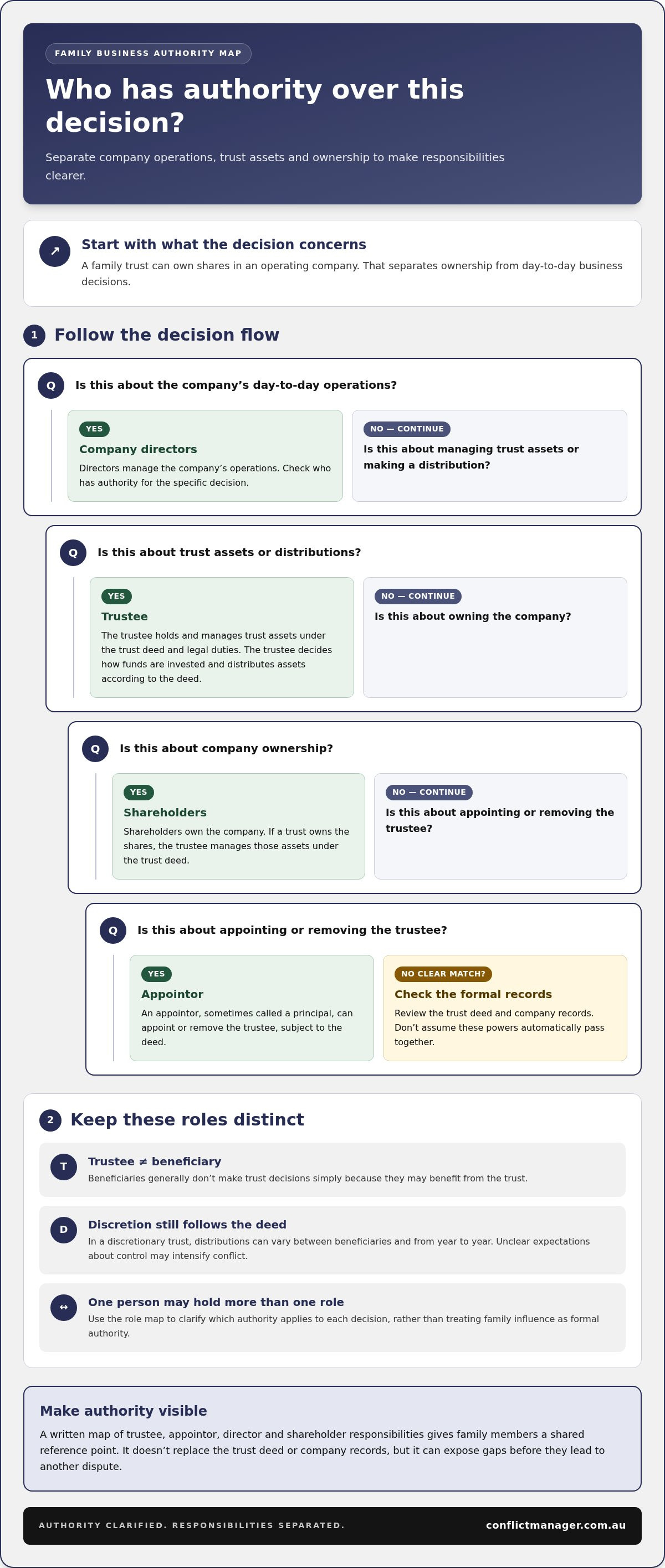
A family trust can own shares in an operating company, separating ownership from day-to-day business decisions. The company’s directors manage operations, while shareholders own the company. If the trust owns the shares, its trustee manages those assets under the trust deed. This distinction can clarify who makes business decisions and who controls the ownership structure.
The Australian Taxation Office describes a trust as an obligation to hold property for beneficiaries. Although a trust is a legal relationship rather than an entity, it is treated as a taxpayer entity for tax administration. A trustee, whether an individual or a corporate trustee, holds and manages trust assets according to the deed and legal duties. Beneficiaries generally don’t make trust decisions simply because they may benefit from the trust.
Control also depends on the roles established by the deed. An appointor, sometimes called a principal, can appoint or remove the trustee, subject to the deed. The trustee decides how trust funds are invested and distributes assets to beneficiaries according to the deed. In a discretionary trust, distributions can vary between beneficiaries and from year to year. This discretion can help families allocate income, but unclear expectations about control may intensify conflict.
A company beneficiary, often called a bucket company, may receive trust income. Retained profits need careful attention because trust income may need to be distributed in accordance with the trust deed. Undistributed income is taxed to the trustee at a top marginal tax rate of 47%. Company tax treatment also depends on classification. According to the Australian Taxation Office, base rate entity companies are taxed at 25% on profits, while other companies are taxed at 30%.
Tax and ownership arrangements don’t resolve family disagreements by themselves. A trust-owned company can separate asset ownership from operations and support succession, because the trust may continue holding company shares as trustees change. However, trust assets aren’t governed by a controller’s Will. Families need to understand who can appoint trustees and who can direct company decisions, rather than assuming those powers automatically pass together.
Establishing or changing this business structure involves more than signing a trust deed. Setting up a trust involves considering how its assets will be held, rather than relying on the deed alone. A company may need to be registered with ASIC, and transferring its shares to the trust may form part of a restructure. Each structure has distinct obligations, including annual trust tax returns, trust resolutions and ASIC requirements. Accountants, legal advisers and financial planners can assess proposed changes and their effects.
How long does it take to restore trust in a family business, and how can progress be measured? There’s no single timeframe. Measure progress through agreed responsibilities, decisions made within those boundaries and commitments completed consistently. Without professional help, relatives may confuse personal influence with formal authority, overlook deed or company obligations, or repeat disputed decisions without addressing their underlying cause.
Understanding how to restore trust in a family business means clarifying both the human agreement and the formal structure. A written map of trustee, appointor, director and shareholder responsibilities gives family members a shared reference point. It doesn’t replace the trust deed or company records, but it can make authority visible and expose gaps before they lead to another dispute.
What are practical steps to rebuild trust in a family business?
Start with the specific rupture, not a general demand to “move on”. If a sibling approved spending without consultation, identify the decision, who was affected and which authority was unclear. Separate observable actions from interpretations. “The supplier contract was signed before the board meeting” is more useful than “You never respect me”.
Then create a shared account of what happened. Each person should describe the event, its business impact and what they need addressed. A family member who felt excluded may need earlier access to financial information; the person who made the decision may need a clear delegation limit. Record disputed details separately rather than forcing immediate agreement.
- Acknowledge the impact. Name the action and its consequences without shifting blame. For example, a manager who shared confidential business information can acknowledge that colleagues lost confidence and explain what will change.
- Agree immediate boundaries. Identify decisions that need approval, information that must remain confidential and who can speak for the business. If relatives disagree over a major purchase, pause that decision until the authorised decision-makers review it.
- Set specific commitments. Replace “I’ll communicate better” with a defined action, such as circulating a written agenda before each scheduled family-business meeting. Clear commitments make follow-through visible.
- Review progress consistently. At each agreed review, record completed commitments, missed actions and unresolved issues. If a commitment wasn’t met, discuss the reason and agree a practical correction, rather than treating silence as resolution.
Trust returns through repeated evidence. A relative who agrees to provide regular management reports should deliver them on the agreed date, explain any delay and avoid selective disclosure. A family member returning to a business role might first receive defined responsibilities, with performance discussed against those duties rather than family history.
Keep relationship repair distinct from operational accountability. A sincere apology doesn’t automatically settle who can approve payments, hire relatives or access company records. Conversely, a new approval process won’t address the hurt caused by exclusion or broken confidence. Address both: what needs to change between people, and what needs to change in business practice.
Choose a setting that supports focused discussion. A meeting with a written agenda, a neutral chair and agreed speaking turns can prevent the most senior relative from dominating decisions. If a conversation becomes personal, return to the specific event and its effect on work. Record decisions and circulate them to those responsible for carrying them out.
Assess progress through practical signs: agreed decisions are followed, people raise concerns before they become operational surprises, and responsibilities are respected. These signs don’t require instant agreement or restored closeness. They show whether relatives can work predictably while trust is being rebuilt.
When conversations repeatedly stall, or family members can’t discuss the conflict without reviving it, structured family conflict resolution can provide a facilitated setting to clarify concerns and develop workable agreements. It’s particularly relevant when unresolved personal disputes are affecting business decisions or working relationships.
What governance structures help prevent conflict in Australian family businesses?
Good governance makes authority visible before disagreement tests it. In an Australian family business, separate the family’s conversations from the company’s formal decisions. A family forum can discuss shared values, succession expectations and employment principles. A company board can focus on performance, risk and strategy. Recording which forum decides each matter reduces confusion when relatives hold several roles.
A family constitution or written family-business protocol can set out shared expectations. It might explain how relatives enter the business, how performance is assessed and how family concerns reach decision-makers. For example, it can distinguish a family member’s employment discussion from a shareholder decision. Treat the document as a practical reference, then align formal company records and agreements with the structure.
For business partners, a shareholders’ agreement or buy-sell agreement can help address changes in ownership. The agreement can cover how shares may be transferred, how a departing owner’s interest is valued and how a deadlock is handled. Key person insurance may also be considered when planning for the loss of an essential owner or operator. These arrangements work best when owners discuss difficult scenarios before a crisis.
Directors need a dependable decision-making process. Set out which matters require board consideration, who prepares the papers and how decisions are recorded. A proposed expansion, major borrowing or appointment of a relative might need a clear approval pathway. Meeting agendas and minutes record the reasoning, assigned actions and any declared conflicts of interest. That record can help prevent later disputes about what was agreed.
- Clarify decision rights: distinguish decisions reserved for directors, shareholders, managers and family discussions.
- Set reporting routines: agree what operational and financial information owners receive, and when.
- Define escalation: specify how an unresolved disagreement moves from a direct discussion to a formal meeting or facilitated conversation.
- Review succession arrangements: identify who could take responsibility for key roles and how the transition would be discussed.
Each structure should fit the business, not simply reflect family history. A founder may remain a shareholder but no longer manage daily operations. A capable adult child may lead a team without automatically receiving authority over ownership decisions. Writing these distinctions into role descriptions, delegations and meeting procedures helps relatives challenge decisions through the right channel.
Governance also needs maintenance. Review the family protocol when ownership, leadership or family circumstances change, and review company decision procedures when responsibilities shift. Proposed changes to a business structure can affect tax and compliance obligations, so professional advisers should assess them. A clear process isn’t a substitute for specialist advice; it helps the family identify the questions that advice must address.
When established processes exist but relatives can’t use them constructively, Organizational Conflict Management can help address working relationships and friction around decisions. Governance gives a family business structure; careful facilitation can help people apply it without turning each disagreement into a contest for control.
How can family members set clear roles and decision-making boundaries in a family business?
Start by listing each person’s roles, not just their family relationships. One person may be a shareholder, director and employee, while another may be a beneficiary who works in the business. Those positions carry different responsibilities. A role map makes overlaps visible, so relatives can distinguish ownership discussions from management instructions and family conversations.
For each role, record its purpose, authority and limits. A sales manager might approve routine customer discounts but refer an unusual contract to a director. A director might oversee strategy but leave staff rosters to the operations manager. Clear examples prevent authority from depending on seniority, family status or who speaks most firmly in a meeting.
Use a decision-rights schedule to show who recommends, decides, carries out and receives updates on key matters. Include hiring, spending, customer commitments, borrowing, performance reviews and changes to family members’ duties. Keep the schedule consistent with company records and applicable agreements. If a proposed boundary affects a director’s formal responsibilities, distinguish internal delegation from duties that remain with that director.
- Define the decision. Describe it in practical terms, such as hiring a relative, approving a supplier or changing a manager’s duties.
- Name the decision-maker. Specify the role with authority, rather than relying on a person’s name alone. This keeps the process workable when responsibilities change.
- Set the consultation boundary. Identify who must be heard before a decision, and who needs the outcome communicated afterwards.
- Record exceptions. State how urgent matters are handled and when a decision must be reviewed by the usual authority.
Separate family employment from family entitlement. A relative applying for a role can be assessed against the position’s requirements, reporting line and performance expectations. A family member already employed should receive feedback through the same defined management process used for comparable responsibilities. This helps prevent a performance discussion from becoming a dispute about inheritance, loyalty or past family grievances.
Boundaries also need a route for challenge. If a sibling believes a manager exceeded their authority, they should raise the specific decision through an agreed process rather than countermanding instructions in front of staff. A written escalation path can identify who reviews the concern, what information is relevant and how the outcome is recorded. That protects employees from conflicting directions.
Review the role map whenever leadership, ownership or family circumstances change. A founder stepping back may need to transfer operational decisions gradually, while retaining a clearly defined ownership role. Discuss the change with affected relatives, document revised responsibilities and tell employees which instructions now apply. If family members cannot agree on boundaries, Family Conflict Resolution can help them work through the disagreement and establish clearer arrangements. Discuss family conflict resolution when unresolved role disputes are disrupting business decisions.
If a challenge is needed, identify who reviews it and how the outcome is recorded. Keep the process focused on the decision and the relevant role, so a challenge doesn’t become an informal contest of family authority. Where ownership or a trust is involved, identify those roles separately from day-to-day management. Make clear which decisions belong to the company’s governance process and which relate to trust assets or distributions. Written boundaries should not suggest that beneficiaries make decisions reserved for a trustee.
A company’s shares can be gifted to beneficiaries under a Will, and those beneficiaries may exercise the deceased member’s voting rights depending on the company constitution. In a family trust, the trustee controls the trust’s assets and makes decisions without input from beneficiaries. Australian trust distributions should benefit the intended beneficiary, not other beneficiaries or family members. In Australia, a family discretionary trust can allocate income among family members at the trustee’s discretion, and the amounts may vary between beneficiaries and from year to year. Recording these distinctions alongside role boundaries can help relatives understand where they may participate, where they receive information and where authority rests.
Conflict Manager: Family Conflict Resolution
Conflict Manager provides Family Conflict Resolution for family members whose disputes affect business relationships or decisions. When conversations repeatedly stall, roles remain contested or old grievances disrupt current work, a structured process can help participants clarify concerns and identify practical agreements. The focus is on conflict between people and its effect on the business, rather than replacing formal legal or financial advice.
When tension also involves employees, business partners or other stakeholders, Organizational Conflict Management or Stakeholder Facilitation can help bring relevant perspectives into a clearer discussion. The right approach depends on who is involved and what needs to be resolved. To discuss a family business conflict, contact Conflict Manager.
Make the next conversation more constructive
Restoring confidence isn’t about returning the family to an earlier version of the business. It’s about creating conditions where people can raise concerns, make decisions and meet responsibilities without reopening the same dispute. The question of how to restore trust in a family business becomes more manageable when the next step is specific: identify the conversation that can’t be avoided, who needs to take part and what a workable outcome would look like.
When family members are caught between personal history and business responsibilities, an impartial process can help keep discussion focused. Conflict Manager provides Family Conflict Resolution, Organizational Conflict Management and Stakeholder Facilitation to support conversations involving relatives, colleagues and other stakeholders. The right offering depends on who is involved and where the conflict affects the business.
If you’re ready to discuss a difficult family-business situation, contact Conflict Manager to discuss your situation. A clear next conversation can create room for a more stable way forward.
Frequently Asked Questions
How can family business owners communicate openly after a breach of trust?
Use a predictable communication channel and make difficult information discussable. For example, if a relative discovers a supplier problem, they should share verified facts, explain what remains uncertain and invite relevant questions before rumours spread. Agree which information is confidential and who needs access. Acknowledging what went wrong without minimising its effect helps others assess the response instead of having to infer intentions from silence.
How should a family business resolve conflict between relatives?
Address the business impact first, then work through the disagreement without involving employees as messengers. If two relatives give staff opposing instructions, a manager can confirm which direction applies while the relatives arrange a focused discussion. Keep the dispute with those directly involved, clarify which decision or relationship needs attention, and document any agreed outcome. If the conflict concerns a formal company or trust decision, keep that process distinct from the personal discussion.
When should a family business use an independent mediator or facilitator in Australia?
Consider facilitation when relatives repeatedly reach an impasse, avoid necessary conversations or can’t discuss succession without the dispute affecting staff or stakeholders. A neutral process can help participants hear different perspectives and focus on practical next steps. Conflict Manager provides Family Conflict Resolution, Organizational Conflict Management and Stakeholder Facilitation. These services can suit conflicts involving family members, business relationships or wider stakeholder groups, depending on who needs to participate.
How can family businesses create a succession plan that rebuilds confidence?
Identify who will carry on the business and document each person’s role, decision-making authority and boundaries. Clarify who can appoint or remove the trustee and who makes company decisions, and consider a shareholders’ or buy-sell agreement. Review commitments regularly so family members can see that agreed responsibilities are being followed.


