

What if the hardest part of an estate dispute isn’t deciding what’s fair, but agreeing on what fairness means? In blended families, relationships formed at different times can shape expectations, loyalties and memories of promises. That can make resolving blended family estate disputes feel personal as well as practical, particularly when conversations become charged and family ties are at stake.
It’s understandable to want clarity without allowing disagreement to deepen. A structured, impartial process can help family members organise the issues, explain their priorities and focus on workable next steps, without asking one relative to act as the family’s advocate.
This article explores why estate conflict can arise in blended families and how a clearer process can support constructive conversations. It also explains how professional conflict management differs from legal representation: the focus is on communication, priorities and practical direction, not legal advice. Conflict Manager’s collaborative approach, including Roadmap Creation and Implementation Support, can help families establish a path forward while keeping relationships in view.
Key Takeaways
- Blended families can hold different expectations about fairness, belonging and inheritance, so estate disagreements may involve more than practical decisions.
- Resolving blended family estate disputes can begin with separating relationship concerns, practical estate questions and legal questions.
- A tailored process can clarify who needs to be involved, organise the issues and turn discussion into recorded next steps.
- Conflict management can support constructive conversations and planning, but it doesn’t determine legal entitlements or provide legal representation.
- An impartial change agent can help a family work towards its optimal outcome, rather than assuming a simple compromise is the answer.
Why resolving blended family estate disputes can be so complex
An estate disagreement can carry several kinds of weight at once: grief, loyalty, questions of fairness and practical concerns about what happens next. A family may be making decisions while adjusting to a loss, revisiting old tensions or interpreting past conversations differently. These strands can be difficult to separate, especially when each person believes they’re protecting someone or something important.
A blended family is formed when partners bring children or other family relationships from previous partnerships into a new family structure. Some families also have children together. There’s no single pattern: Understanding Blended Families can help frame the term, but every family has its own relationships and history.
A blended-family estate dispute is a disagreement about an estate in which family members’ different expectations or concerns make it difficult to agree on practical next steps. That’s different from routine planning. People can have different preferences and still make progress; conflict becomes more apparent when those differences obstruct decisions, communication or action.
What makes estate disagreements in blended families distinct?
Relationships across current and previous partnerships can shape what people expect, remember and feel responsible for. A surviving partner may be concerned about security and continuity, while children from an earlier relationship may focus on a parent’s intentions, family history or their own sense of connection. Shared children and step-relationships can bring other perspectives.
These differences don’t automatically create opposing sides. One person may see a proposal as a way to provide stability; another may experience it as a sign that their place in the family is being overlooked. Even relatives who want a fair outcome may define fairness differently, based on their relationships and experiences. Recognising that distinction makes discussion more precise than assuming everyone is arguing about the same thing.
Which concerns can sit beneath an inheritance disagreement?
For some family members, a dispute involves more than the value or distribution of assets. It can touch on recognition, security, trust, past promises or a sense of belonging. An item with modest financial value, for example, may matter because of who owned it, what it represents or what someone understood had been promised.
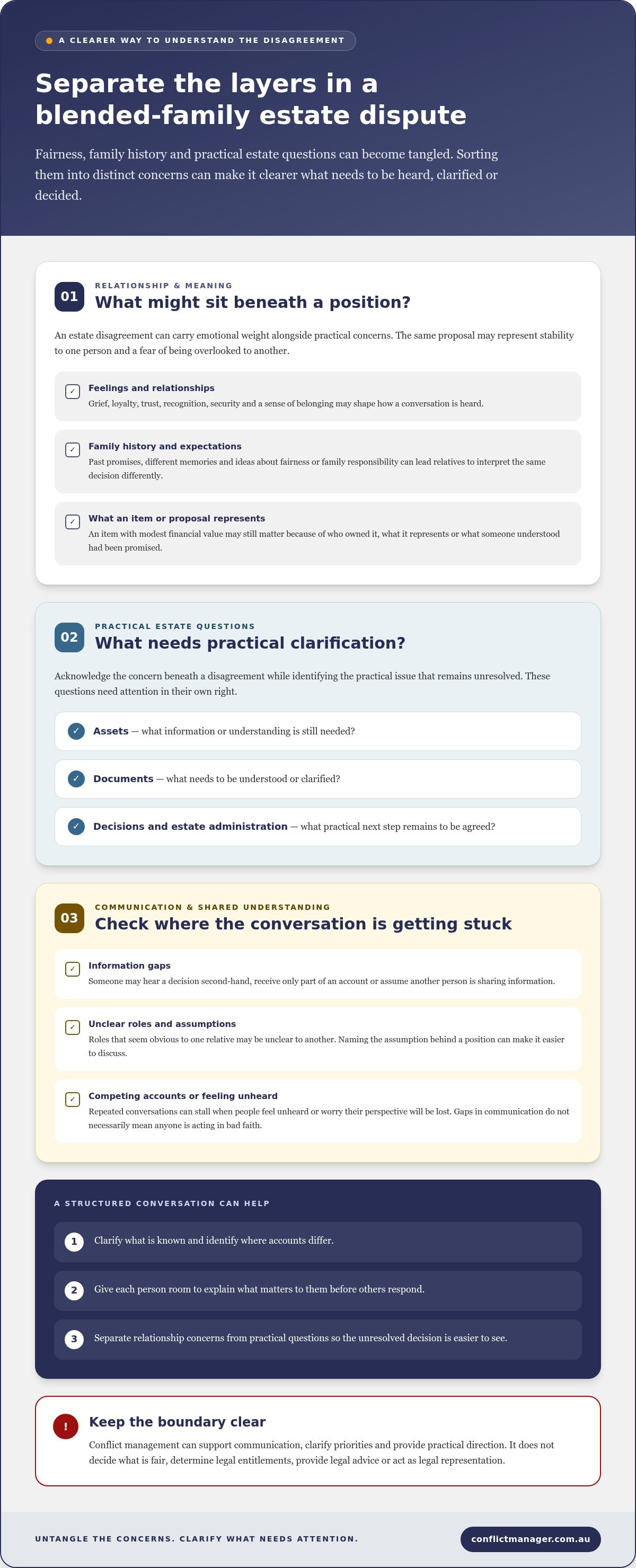
Separate that emotional meaning from practical questions about assets, documents, decisions and estate administration. Neither should be dismissed, but they need different kinds of attention. A family can acknowledge the concern beneath a disagreement while identifying what information or practical decision remains unresolved. This doesn’t decide what is fair or settle a legal question. It helps show where the conversation is stuck and what needs to be understood next.
How family relationships and communication can intensify estate disputes
Once disagreement surfaces, practical questions rarely stay separate from family history. Grief can make conversations harder to absorb, and an old grievance may shape how a new suggestion is heard. A discussion about who will handle a task, for example, may also carry an unspoken concern about trust, recognition or influence. The practical issue is real, but it may not be the only issue in the room.
Communication can add another layer. A family member might hear a decision second-hand, receive only part of an account or assume someone else is responsible for sharing information. Roles that seem obvious to one person may be unclear to another. These gaps can fuel suspicion without anyone deliberately withholding information or acting in bad faith.
How do different expectations become entrenched?
Expectations about fairness and family responsibility are often formed over time rather than agreed aloud. One person may believe that support should reflect current need; another may place more importance on consistency with what they understood a parent had said. Neither view necessarily captures the whole picture.
Past experiences can give the same estate decision different meanings. A proposal to delay a practical step might feel prudent to one relative and excluding to another who worries their perspective will be lost. Naming the assumption behind each position makes it easier to discuss, rather than treating disagreement as proof that someone is unreasonable.
Why can family-led conversations reach an impasse?
Repeated conversations may stall when participants feel unheard or fear that speaking less confidently will leave them with less influence. Defensiveness can follow, and competing accounts of what was said can make it harder to find shared ground. People may repeat their positions more firmly while the concerns beneath them remain unexplored.
Pressure can narrow attention further. If the family feels a decision must be made quickly, members may focus on securing a preferred outcome rather than understanding others’ concerns. A calmer, structured discussion can create room to clarify what’s known, identify differing accounts and let each person explain what matters to them before others respond.
Separating relationship concerns from practical questions helps families see what needs to be heard, what needs clarification and what decision remains to be made. This doesn’t require everyone to agree about the past. It can help prevent unresolved hurt from being mistaken for a practical objection, or a practical question from being taken as a personal slight.
When family members are going in circles, an impartial facilitator can help organise discussion without becoming another family advocate. Impartial family conflict resolution can provide a structured setting to clarify concerns and identify practical next steps, while keeping the relationships involved in view.
Compare the issues, options and limits before choosing a way forward
Estate disagreements often combine questions that need different kinds of attention. A family may discuss communication, personal priorities, practical administration and the meaning of legal documents in the same conversation. Treating them as one issue can make progress harder: people might debate a practical step while the underlying concern remains unspoken, or expect a facilitated discussion to answer a legal question it cannot determine.
A useful starting point is to sort the concerns without deciding who is right. The categories below can overlap, and one disagreement may involve more than one.
How family members communicate, what feels unresolved, and whether people feel heard or included.
What individuals value or hope to protect, such as security, recognition, continuity or a sense of fairness.
What information, decisions or administrative tasks are outstanding, and who is involved in addressing them.
How relevant documents or legal concepts apply to the circumstances. The answer may depend on jurisdiction and specific facts, so it shouldn’t be assumed in a family discussion.
Which parts of the dispute need different kinds of attention?
Consider a disagreement about what to do with an estate asset. The practical question might be what information is available and what action is being proposed. A relationship concern could be that a family member feels excluded from the conversation. A legal question may involve how a document is interpreted. These issues are connected, but they aren’t interchangeable. Separating them helps identify which points can be discussed together and which need a different form of guidance.
Conflict management supports discussion and planning. It can help participants clarify concerns, organise options and identify questions for further consideration, but it doesn’t determine legal entitlements or decide what an estate outcome should be.
What can mediation and conflict management contribute?
Mediation is one possible structured process for addressing disagreement. An impartial facilitator can guide communication when family members are struggling to make progress alone, helping them set out issues, hear different perspectives and consider possible next steps. Conflict management can also help clarify priorities and keep practical planning distinct from legal interpretation.
Neither process guarantees agreement or relationship repair. What’s possible depends on the circumstances and participants’ willingness and capacity to engage. Mediation is not a substitute for legal representation, and a facilitated conversation can’t establish which legal position is correct. Legal interpretation and entitlements need to be considered separately with appropriate legal guidance.
For resolving blended family estate disputes, this distinction gives the family a clearer basis for choosing what to address first. A structured process can focus on matters participants can work through together, while leaving legal conclusions outside its scope.
A practical process for moving a blended family estate dispute forward
Once a disagreement is affecting communication or decisions, a clear process can restore some order. It shouldn’t force every family into the same sequence or require agreement about the past. The aim is to understand what’s preventing progress, identify who needs to be involved and create practical next steps that fit the family’s circumstances.
A structured process turns a complex dispute into manageable issues, clear questions and agreed actions. A family might work through steps like these, adapting them as needed:
- Clarify the dispute. Describe the current disagreement in plain language. Distinguish the immediate decision from wider concerns that may be affecting it.
- Identify participants. Consider whose perspective is relevant and who needs to be involved in particular decisions. Make roles clear rather than relying on assumptions or messages passed between relatives.
- Organise the issues. Separate relationship concerns, family priorities, practical questions and matters that need legal consideration. Note what’s known, what’s disputed and what remains unanswered.
- Facilitate discussion. Set a respectful structure for people to explain their concerns, listen to different perspectives and consider options. An impartial facilitator may help when family members find it difficult to make progress together.
- Record next steps. Capture agreed actions, open questions, responsibilities and decision points in clear language, so participants have a shared reference after the conversation.
How can family members prepare for a constructive discussion?
Before meeting, each participant can write down their concerns, what they hope might happen in practical terms and what they still need to understand. Keeping those points distinct can make it easier to explain a priority without presenting it as a demand. Participants don’t need to agree on past events to discuss what would help address the current issue.
It can also help to identify which details are known, disputed or need further consideration. This reduces the chance that an assumption or second-hand account is treated as settled fact. Preparation is for clarity, not for building a case against another family member.
How should families turn discussion into next steps?
After a conversation, record actions and responsibilities in neutral, specific language. Include unresolved questions and note which decisions are still pending, rather than implying that everyone has agreed when they haven’t. Confidential documentation can support follow-through where appropriate, giving participants a consistent account of what was discussed and what remains open.
Reviewing progress can help the family assess whether actions are being completed and whether the approach remains workable. Evaluation provides an opportunity to adjust the process if it isn’t helping discussion move forward; it doesn’t guarantee agreement or repair relationships.
For impartial support to organise discussion and practical direction, explore family conflict resolution with Conflict Manager. The process is tailored to the family’s circumstances and focused on a workable path towards its optimal outcome, rather than assuming compromise is the only measure of progress.
How Conflict Manager can guide blended family estate dispute resolution
When family members are caught in a difficult estate discussion, an impartial change agent can create structure without becoming another family advocate. Conflict Manager works alongside families to clarify what is happening, understand the priorities involved and support practical progress. The process is tailored to the circumstances, with the aim of pursuing the client’s optimal outcome, not simply finding a middle-ground settlement.
A workable outcome may involve more than splitting the difference. It could mean clarifying responsibilities, identifying questions that still need attention or agreeing on a practical way to communicate. Conflict management supports discussion and planning. It doesn’t determine legal entitlements or provide legal representation, so legal questions remain distinct from the facilitated family process.
What does a tailored conflict-management roadmap address?
Roadmap Creation can give the family a considered structure for moving forward. Recommendation & Planning involves designing strategic intervention around the situation, while Mediation Services can support structured discussion where appropriate. Conflict Project Management can organise the people and resources involved in a conflict around the client’s goals, rather than letting activity become fragmented or driven only by immediate pressure.
Implementation Support helps carry agreed actions into practice. Evaluation can then assess whether the approach is meeting its intended aims and appears sustainable, or whether adjustments are needed. These stages offer direction, not a promise of settlement; the process and its outcomes depend on the family’s circumstances and participation.
How can impartial support help preserve family relationships?
Emotions can make it difficult to keep discussion focused, particularly when participants have different accounts or feel their influence is at risk. An impartial change agent can bring a clear process to those conversations, helping participants express concerns and consider next steps without taking sides. Where relevant, Leadership Alignment can help clarify shared priorities, and communication planning can support more consistent discussion among those involved.
This work doesn’t require relatives to agree on the past or guarantee that relationships will be repaired. It creates conditions for clearer communication and practical choices, while keeping the human relationships in view. Confidential documentation and measurable outcomes can also support a deliberate process, giving the family a basis to review what has moved forward and what remains unresolved.
For support with resolving blended family estate disputes, explore a clearer path through family conflict with an impartial, collaborative process shaped around your circumstances.
Clarity. Stability. Resolution.
Take the next step towards a workable way forward
Progress doesn’t require every family member to see the past in the same way. A useful next step can be smaller: identify the question holding things up, what each person needs clarified and whether a structured conversation could help. That gives the family a point of focus without demanding an immediate resolution.
For families considering support with resolving blended family estate disputes, Conflict Manager brings an impartial perspective to complex family dynamics. Founder & Principal Conflict Manager Dennis Benjamin has 35+ years experience, and the team includes strategic partners in family estrangement, succession planning, legal matters and financial analysis. This perspective can help shape a process around the family’s circumstances and its optimal outcome, rather than assuming compromise is the only measure of success.
If a clearer process could help your family move forward, explore a clearer path through family conflict with Conflict Manager.
Frequently Asked Questions
Is mediation suitable for a blended family estate dispute?
Mediation may help family members discuss concerns with professional guidance when a facilitated conversation is appropriate. For example, relatives who disagree about the future of a family home may benefit from space to explain their priorities and consider options. Suitability depends on the situation and participants. Mediation doesn’t determine legal entitlements, guarantee agreement or replace legal representation; its purpose is to support discussion, not decide legal questions.
Can a blended family resolve an estate dispute without making matters worse?
No process can promise a particular outcome, but a clear structure and respectful communication can help participants examine the dispute without escalating it. Conversation guidelines, such as taking turns and pausing if discussion becomes unproductive, may help. Separate practical questions from relationship concerns, avoid assigning blame and document actions everyone has agreed to. These steps can support considered progress, but can’t ensure agreement or preserve family relationships.
What causes estate disputes in blended families?
Possible sources include different expectations, family history, concerns about recognition and competing views about fairness or responsibility. Relatives may interpret the same past conversation differently or place different weight on a promise they remember. These dynamics aren’t present in every family. Practical estate questions can overlap with emotional meanings, so resolving blended family estate disputes often starts with identifying each concern rather than treating the disagreement as one simple issue.
How can family members discuss inheritance concerns constructively?
Start by identifying the concern each person wants understood, then distinguish confirmed information from assumptions or differing recollections. Keep the discussion focused on one issue at a time, such as what information is missing or what decision remains open. Use neutral language and check that others have understood before responding. A written record of open questions and agreed actions can help, though conversation alone may not resolve complex estate or legal matters.
Does mediation replace legal advice in an estate dispute?
No. Mediation supports communication and conflict resolution, while legal advice addresses legal rights and obligations. A facilitated discussion may help relatives clarify concerns or consider practical options, but it doesn’t determine whether a will or estate arrangement is legally valid. Conflict Manager provides conflict-management support, not legal representation. Keeping these roles distinct helps families address communication issues without treating discussion as a legal decision.
What happens if family members cannot agree during mediation?
A lack of agreement doesn’t mean the discussion was without value. Participants may still clarify which issues remain contested, identify areas of agreement and record questions that need further attention. For example, a family might agree on how to share information while remaining divided on a separate decision. Next steps depend on the circumstances and unresolved matters. Mediation doesn’t guarantee a settlement or predetermine what happens next.
How does a conflict manager help with a family estate dispute?
A conflict manager can provide impartial guidance, give discussions a clear structure and help develop a roadmap for practical next steps. Depending on the family’s needs, Conflict Manager may use Mediation Services to support discussion, Conflict Project Management to organise resources around client goals, or Implementation Support to help progress agreed actions. The work is collaborative and tailored; it doesn’t promise settlement, legal advice or a particular effect on family relationships.


