

What if the safest way to talk about inheritance is to begin with something other than money? If you're wondering how to discuss inheritance with aging parents, it’s understandable to worry that asking could sound self-interested or put pressure on them. A calmer starting point is to centre their wishes: what matters to them, what they want their family to understand and how they’d like difficult decisions approached.
The conversation doesn’t need to happen all at once. A gentle opening, careful listening and room for your parents to set the pace can help keep it respectful. If they’re hesitant or upset, that response doesn’t have to end the discussion. It may mean the timing or approach needs to change.
This guide offers practical ways to raise the subject, respond to defensiveness and keep your parents’ choices at the centre. It also explains when impartial support, such as family conflict resolution, may help if conversations repeatedly become strained. The aim isn’t to secure an outcome for yourself. It’s to build understanding and reduce the scope for confusion or conflict later.
Key Takeaways
- Inheritance conversations can include family expectations and future planning, not just who receives assets.
- Before raising the subject, clarify what you hope to understand and avoid assuming your parents are ready to share private details.
- To explore how to discuss inheritance with aging parents, ask permission, explain your concern and invite them to share their perspective.
- If emotions rise or siblings disagree, acknowledge the response and consider pausing rather than pushing for an immediate resolution.
- When conversations keep circling the same disagreement, impartial facilitation can help the family communicate more constructively without promising consensus.
Why discussing inheritance with ageing parents can feel so difficult
Inheritance can sound like a conversation about assets, but families may also need to talk about personal wishes, expectations and future planning. The subject has legal and social dimensions, as the general overview of Inheritance illustrates. A family discussion doesn’t have to begin with documents or figures, though. It can start with what your parents want their family to understand and how they’d like these matters approached.
That breadth can make the topic harder to raise. An adult child may be thinking about clarity or avoiding misunderstandings, while a parent hears a request for private details or a decision. Silence can leave assumptions untested: family members may have different ideas about what has been discussed or what matters most. It doesn’t predict a particular legal or financial outcome, but it can make it harder to understand one another’s expectations.
Why adult children hesitate to raise inheritance
You may worry your parents will feel upset, differences between siblings will surface, or your question will sound financially motivated. Those concerns deserve attention, but they don’t prove your intention is selfish. Future planning can be emotionally charged for everyone, particularly when it brings change, vulnerability or family roles into focus. Even a caring question can land poorly if the timing feels rushed or the wording sounds like a demand.
Keep the focus on parents’ wishes and autonomy
Your parents decide what they’re comfortable discussing and when. You can be curious about their plans without assuming you’re entitled to know the details or receive an inheritance. A respectful enquiry invites them to share what they choose; pressure seeks information or an outcome they haven’t agreed to provide. That distinction can guide your tone when the subject feels loaded.
It also helps to separate the purpose of the conversation from the answers you might receive. You may want to understand what your parents value, whether they’ve considered how they want family members to communicate, or what they’d like remembered about their decisions. None of those questions requires them to disclose amounts, show private documents or settle every detail in one sitting.
Before raising the subject, consider what you’re hoping for and whether that expectation could shape your words. If you find yourself preparing to ask who gets what, pause and consider whether a broader question about their wishes would be more appropriate. Learning how to discuss inheritance with aging parents begins with making room for their perspective, including the possibility that they’re not ready to talk. A conversation can still be worthwhile even if it ends with no decision, provided it leaves your parents’ choice and dignity intact.
Prepare for an inheritance conversation without making assumptions
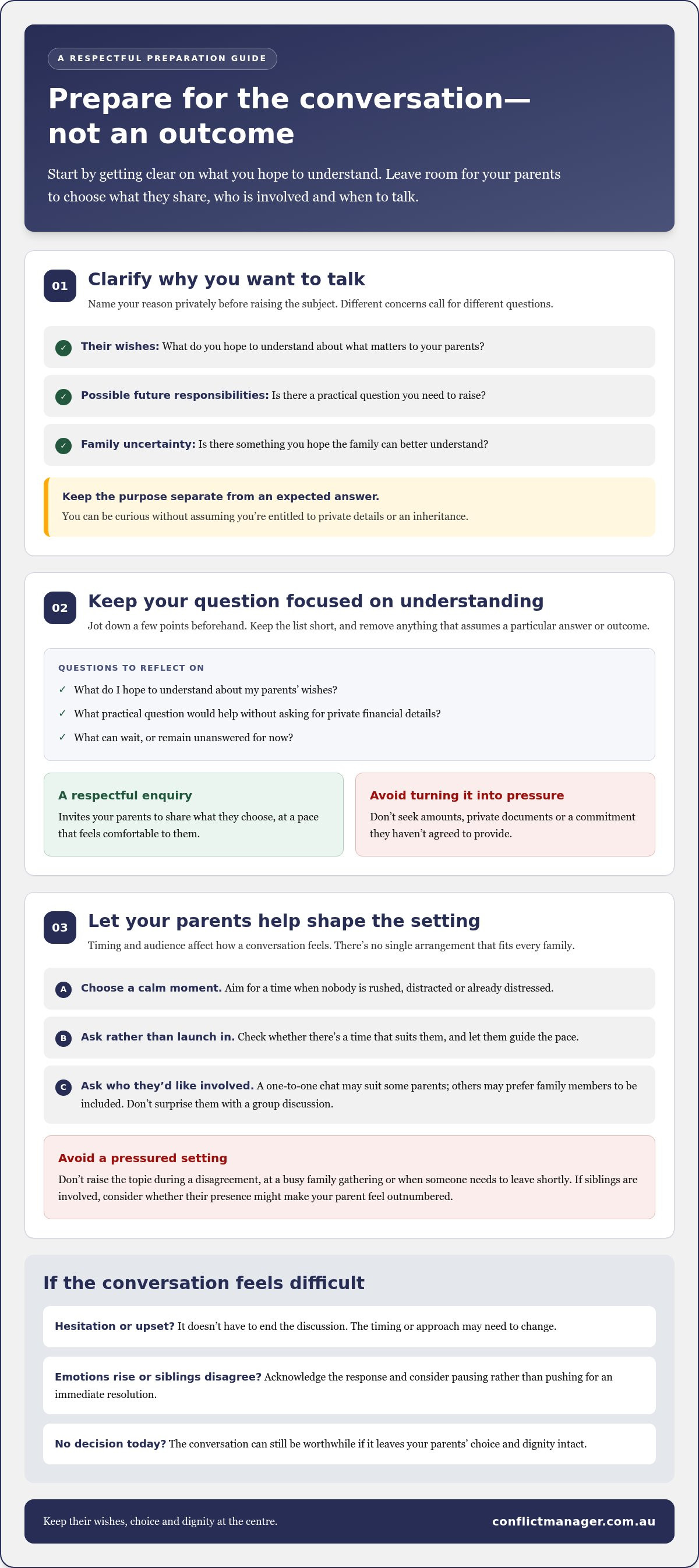
Preparation isn’t about rehearsing arguments or building a case for a particular outcome. It’s about understanding why you want to talk, what you genuinely need to know and how to make room for your parents’ perspective. A little reflection can keep practical concerns from becoming demands, especially if family members have different expectations or levels of involvement.
Before approaching them, write down the question you hope the conversation can help answer. Keep it focused on understanding, not obtaining amounts, documents or a commitment. Guidance such as Fidelity's Guide to Estate Planning Conversations can also offer a useful framework for thinking through your approach.
Clarify your reason for raising the subject
Ask yourself whether you’re concerned about your parents’ wishes, possible future responsibilities or uncertainty within the family. These are different starting points. Naming yours privately can help you avoid blending a practical question with an expectation about receiving assets. Consider, too, what you can leave undecided. Your parents may choose not to share certain details, and preparation means being ready to respect that boundary.
You might find it useful to jot down a few points before the conversation:
- What do I hope to understand about my parents’ wishes?
- What practical question would help, without asking for private financial details?
- What can wait, or remain unanswered for now?
Keep the list short. If it grows into a set of demands, return to the purpose of the discussion and remove anything that assumes an answer or outcome.
Choose the right setting and participants
Timing and audience shape how a conversation feels. Choose a calm, private moment when nobody is rushed, distracted or already distressed. A one-to-one chat may feel more comfortable for some parents; others may prefer family members to be included. Don’t surprise them with a group discussion. Ask who they’d like involved, and let them guide the setting and pace.
Consider practical conditions as well as who will be there. Avoid raising the topic in the middle of a disagreement, during a busy family gathering or when someone needs to leave shortly. You could ask whether there’s a time that suits them rather than launching into the subject without warning. If siblings are involved, consider whether their presence would support an open exchange or make your parent feel outnumbered. There’s no single arrangement that fits every family.
When considering how to discuss inheritance with aging parents, measure preparation by your readiness to listen, not by how thoroughly you can argue your position. If family tensions make it difficult to approach the subject calmly, family conflict resolution support can help create a more constructive setting for discussion.
How to start discussing inheritance with ageing parents
A considered opening can lower the pressure without making the subject less important. The aim isn’t to secure answers on the spot. It’s to invite a conversation your parents can shape, then respond to what they actually say rather than what you fear they might mean.
A simple sequence can help you stay grounded:
- Ask permission. Check whether they’re comfortable talking about future wishes, and accept it if they’d rather choose another time.
- Explain your concern. Use first-person language to say why understanding their perspective matters to you.
- Invite their view. Ask what they’d like the family to understand or keep in mind.
- Listen before following up. Give them time to answer, and check that you’ve understood before introducing another question.
Use an opening that invites rather than demands
A permission-based opening gives your parents room to choose whether to engage. Keep it calm and clear about your intention, without raising asset values or assuming they need to make a decision. For example: “Would you feel comfortable talking about your wishes for the future? I’d like to understand what matters to you, so I can be more considerate of your choices.”
That wording explains your reason while leaving the subject in their hands. Avoid phrases that imply an answer is overdue or that you expect to inherit. If they agree to talk, begin with an open question, such as, “What would you most like us to understand about your wishes?”
Listen for values before asking practical questions
Your parents may first talk about what they want protected, remembered or handled in their own way. Let them finish. Then reflect back what you heard: “It sounds as though keeping things fair between us matters to you.” Give them the chance to correct or add context before asking what they’d like to discuss next.
Open questions keep the conversation from becoming an interview. Try asking what feels important to them, what concerns they have about family communication, or how they’d prefer the topic to be approached in future. Avoid stacking questions together. One thoughtful question, followed by a pause, is often easier to respond to.
A pause or change of subject tells you something about the moment, but it doesn’t automatically mean refusal. Your parent might need time to think, may be unsure what you’re asking, or simply may not want to continue then. Acknowledge the shift and offer to leave it there. The conversation may take more than one sitting, and that’s fine. For anyone considering how to discuss inheritance with aging parents, patience is part of the method: understanding can develop gradually, without pressing for a resolution before your parents are ready.
Respond to hesitation, strong emotions or sibling disagreement
There isn’t one predictable response to an inheritance conversation. Your parents may be ready to talk, uncertain about what to share, or unwilling to discuss it. A strong reaction can feel unsettling, but it doesn’t automatically tell you what they think about the topic or what they’ll be willing to discuss later. Focus first on responding calmly, rather than trying to secure an answer.
If parents become defensive or do not want to talk
Acknowledge what you’ve heard without arguing with their response. You could say, “I can see this feels uncomfortable. Would you prefer we leave it here, or talk another time?” If they say no, respect that. Repeated questions, a surprise confrontation or treating silence as consent can make the exchange feel like pressure. A pause is a reason to stop for now, not to intensify your approach.
If emotions rise, lower the temperature before deciding what comes next. You might say, “I don’t want this to become upsetting. We can stop here.” Then allow the conversation to end. Don’t follow them from room to room or continue the discussion through messages to get a response. If they later choose to revisit it, let them help set the timing and boundaries. If they don’t, respect their choice without treating it as agreement.
If siblings disagree about what should happen
Sibling disagreement can quickly shift attention from a parent’s wishes to competing interpretations of what is fair. Bring the discussion back to what your parent has actually said, rather than treating assumptions as established facts. Name differences without assigning motives: “We seem to have heard that differently. Can we check what Mum meant?” This keeps the focus on clarification, not accusation.
A family conversation isn’t a vote on a parent’s choices. Each person can be heard, but agreement among siblings shouldn’t replace asking the parent what they want. If tempers rise, pause and separate the immediate communication issue from questions that require legal or financial advice. A family discussion can help people understand one another; it shouldn’t be treated as a substitute for advice about documents, rights or financial arrangements.
Try these responses to keep the exchange constructive:
- “I hear that we have different views. Can we stay with what Dad has told us?”
- “I don’t want to assume what you meant. Could you explain that again?”
- “We may need to pause and return to this when we’re all calmer.”
Learning how to discuss inheritance with aging parents includes recognising when a conversation needs space, or when family members can’t communicate productively without support. If the same disagreement keeps repeating, explore a composed approach to family conflict through impartial facilitation focused on clearer discussion, not a forced agreement.
When impartial support can help a family move forward
Some family conversations reach a point where good intentions aren’t enough to keep them constructive. The same argument may return without anyone feeling heard, assumptions may be treated as facts, or discussion may shift from your parents’ wishes to blame between relatives. These patterns can make it difficult to move forward, even when family members want greater clarity.
Recognise when a conversation needs structure
Consider whether people can stay focused on the issue, listen without interruption and distinguish what your parents have said from what others believe they meant. If every attempt ends in the same disagreement, or a parent’s perspective is repeatedly sidelined, an impartial facilitator can help organise the discussion and clarify what needs attention. This support can help with communication, but it doesn’t replace legal or financial advice about documents, rights or decisions.
Structure can also give a family a way to proceed without trying to resolve every question at once. Conflict Manager’s Roadmap Creation provides a customized conflict resolution plan with clear milestones, helping participants identify the issues to address and the steps for progressing them. The plan supports a process; it doesn’t dictate what family members must decide.
How Conflict Manager can support family resolution
Conflict Manager acts as an impartial change agent when strong emotions or entrenched differences make progress difficult. Its Mediation Services provide direct conflict resolution with professional guidance, when appropriate. The aim is to support practical, sustainable outcomes and preserve relationships wherever possible, rather than impose a compromise or promise that everyone will agree.
Impartial facilitation can create room for each person to explain their concerns while keeping the conversation grounded in what is known, what remains unclear and what the family needs to discuss next. It can be useful when relatives interpret the same conversation differently or direct communication has become tense. A facilitator doesn’t decide what a parent should want. The focus is on helping the family communicate more clearly and consider a constructive way forward.
Before seeking support, write down the recurring point of disagreement, what each person understands differently and what you hope a structured conversation might clarify. Keep the purpose modest: a first step might be to hear one another more accurately, not reach a final agreement. That gives the process a practical starting point while respecting that some matters may need separate professional advice.
If you’re considering how to discuss inheritance with aging parents and family conversations keep circling back to conflict, explore whether impartial family conflict resolution could help. Consider what you’d want a guided discussion to clarify, then review Conflict Manager’s approach and decide whether it fits your family’s needs. The aim is steadier communication and a more considered process, not a guaranteed result.
Take the next step at your own pace
A first conversation doesn’t need to settle every question. It can simply create a more respectful starting point, with your parents’ choices and comfort guiding what happens next. If discussions feel stuck, an impartial perspective can help the family find a clearer way to communicate without forcing agreement.
Conflict Manager’s approach is that of an impartial change agent, focused on practical long-term resolution and progress. Dennis Benjamin, Founder & Principal Conflict Manager, brings 35+ years of experience, alongside strategic partners with expertise in family estrangement, succession planning, legal matters and financial analysis. This broader perspective can help families consider their communication needs while keeping legal and financial advice distinct.
If you’re still considering how to discuss inheritance with aging parents, you don’t have to work out every step alone. Explore how Conflict Manager can support a clearer family conversation and consider what kind of discussion would feel constructive for your family. With care, patience and impartial support, a difficult subject can become an opportunity to build greater understanding.
Frequently Asked Questions
How do I bring up inheritance with my ageing parents?
Begin by asking whether they’re comfortable talking about future plans, then explain what you hope to understand. For example, you might want to know how they’d like the family to handle questions or communicate if circumstances change. Keep the first discussion focused on one concern rather than presenting a long list. If they agree to talk, follow their lead and leave room for another conversation later.
Is it wrong to ask my parents about their inheritance plans?
No, asking respectfully isn’t automatically wrong. Your intention and approach matter: seeking to understand your parents’ preferences is different from assuming you’re entitled to information or assets. Before raising the subject, consider whether you’re asking about a practical family matter or hoping to confirm what you may receive. If your parents don’t want to share details, respect that boundary and avoid treating their answer as a negotiation.
What should I do if my parents refuse to discuss inheritance?
Accept their answer and don’t keep pressing for an explanation. You could say, “I understand. I won’t push this now.” If appropriate, ask whether they’d prefer to raise the subject themselves in future, then let them decide. A refusal doesn’t authorise you to seek private information elsewhere or infer what their plans are. If you have an immediate practical concern, keep it separate and explain that concern without demanding inheritance details.
Should I discuss inheritance with my parents alone or with my siblings?
Let your parents’ preference guide who joins the conversation. A private discussion may give them more room to speak freely, while a family meeting can help if they want everyone to hear the same message. Ask before inviting siblings. If you first speak one-to-one, avoid presenting your interpretation to the rest of the family as your parent’s settled position. Check what they’re comfortable sharing with others.
How can I discuss inheritance without sounding greedy?
Be clear about your reason for asking and keep the focus on your parents’ wishes, not what you expect to receive. For instance, explain that you want to understand how they’d like family members to communicate about future arrangements. Avoid leading with questions about asset values, shares or who will receive particular items. You can’t control how your words are received, but a measured, open question helps make your intention clearer.
Can a neutral person help with a family inheritance conversation?
Yes. An impartial facilitator can help family members take turns, clarify what they mean and keep the discussion focused when direct conversations have become strained. Conflict Manager’s Mediation Services provide direct conflict resolution with professional guidance, when appropriate. A facilitator supports communication, but doesn’t decide what your parents should want or guarantee agreement. Questions about legal documents or financial consequences should be kept distinct from the family discussion.
What if my siblings and I disagree about our parents’ wishes?
Don’t settle the disagreement by majority vote or assume that one sibling’s account is definitive. Separate what your parent said from each person’s interpretation, then identify what needs clarification. If your parent is willing, ask them directly in a way that doesn’t position siblings against one another. If that conversation feels difficult or the disagreement keeps recurring, impartial family conflict resolution can help create a more constructive discussion.


