

A disagreement about strategy or authority may be only part of the problem. In a family business, a current decision can bring old grievances, perceived favouritism and years of sibling history into the room. Resolving sibling conflict in family business settings means addressing the business issue without pretending the relationship history doesn’t matter.
If raising the conflict feels likely to make things worse, that hesitation is understandable. Yet leaving roles, expectations or decision-making unresolved can allow tension to shape the business in quieter ways. A constructive process separates the immediate issue from the wider family dynamic, while giving both the business and the relationship appropriate attention.
This guide explains what may be driving sibling conflict, how to open more productive conversations and how to establish a workable basis for decisions. It also covers when impartial support, such as mediation or conflict project management, can help align the people and practical steps involved. The aim isn’t simply to find a middle ground, but to support an outcome that can be implemented and sustained.
Key Takeaways
- Clarify the business decision at stake, then distinguish it from assumptions or unresolved concerns about fairness, authority and recognition.
- Prepare for a constructive conversation by identifying what needs to be decided and what each sibling needs to understand.
- In resolving sibling conflict in family business, focus on clear responsibilities and follow-through, not just a quick compromise.
- Agree on specific actions and a time to review progress so decisions translate into practical change.
- Consider impartial support when discussions repeatedly stall or the same communication patterns keep resurfacing.
Resolving sibling conflict in a family business starts with understanding the issue
Sibling conflict in a family business is a work-related disagreement shaped by the siblings’ business roles and their family relationship. The disagreement may concern a decision that needs to be made, but its meaning can be influenced by expectations about authority, fairness or recognition. That complexity deserves attention, but it doesn’t mean the business or the relationship is beyond repair.
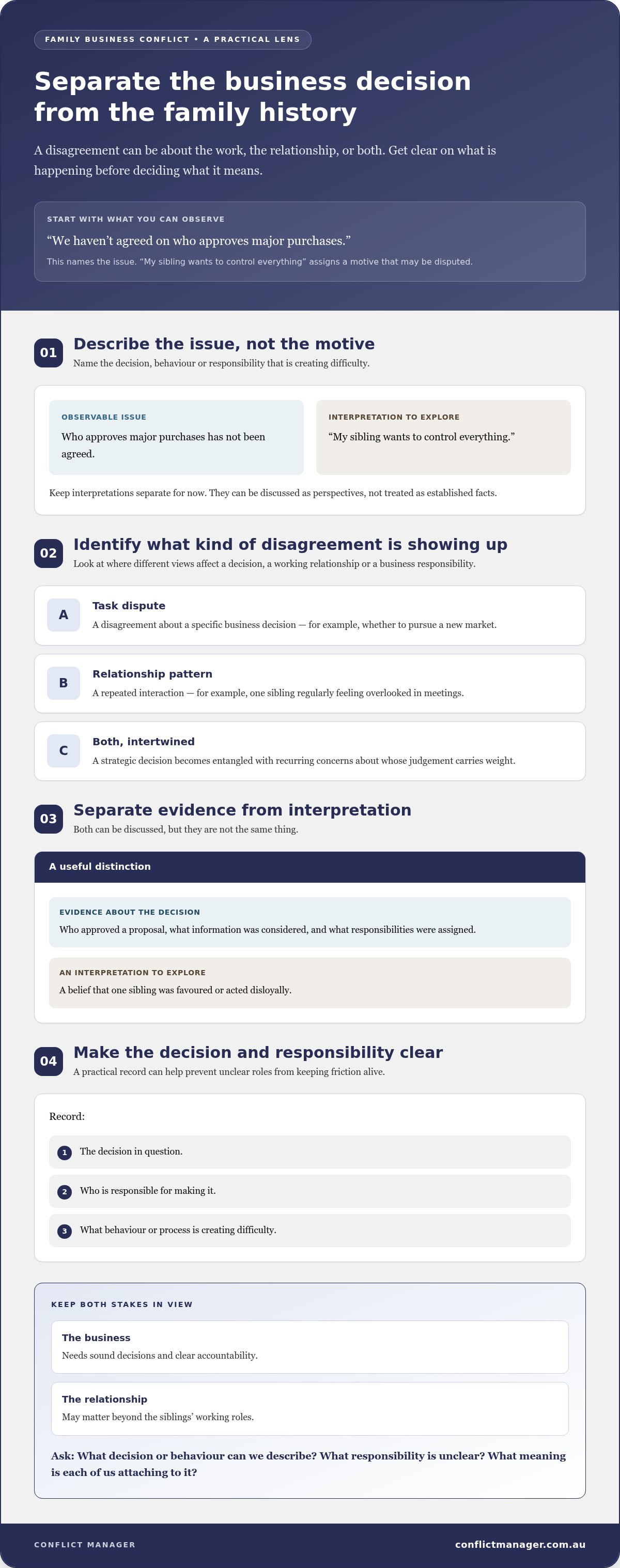
Start by describing what is happening rather than deciding what it means. “We haven’t agreed on who approves major purchases” identifies an observable issue. “My sibling wants to control everything” assigns a motive that may be disputed. Separating the two gives both siblings something specific to examine.
Which sibling disagreements are affecting the business?
Look for where different views begin to affect a decision, working relationship or business responsibility. Siblings may favour different strategies, take different views of risk, disagree about who has leadership authority or question whether each person’s contribution is recognised. A clear description makes it easier to discuss the issue without reducing it to a judgement about character.
- Task dispute: A disagreement about a specific business decision, such as whether to pursue a new market.
- Relationship pattern: A repeated interaction, such as one sibling regularly feeling overlooked in meetings.
- Both: A strategic decision becomes entangled with recurring concerns about whose judgement carries weight.
Unclear responsibilities can keep friction alive. If both siblings believe they have final say, even routine decisions may become contested. Record the decision in question, who is responsible for making it and what behaviour or process is creating difficulty. Keep interpretations separate for now. They can be discussed as perspectives, not treated as established facts.
Why can a business disagreement feel personal?
Family history may shape how a workplace conversation is heard. A request for evidence might feel like distrust, or a challenge to a proposal might be interpreted as another instance of being dismissed. Those reactions can be connected to earlier experiences, but they aren’t universal explanations or proof of anyone’s motive. Understanding sibling rivalry can offer general context for how sibling dynamics may develop; the particular meaning of a business exchange still needs to be understood in its own setting.
There are two stakes to keep in view: the business needs sound decisions and clear accountability, while the siblings may also want to preserve a relationship beyond their working roles. Neither concern should be used to silence the other. The aim of resolving sibling conflict in family business is to identify the practical issue and make room for each person’s account of how the conversation or decision affected them.
That distinction creates a grounded starting point. Before debating solutions, ask: what decision or behaviour can we describe, what responsibility is unclear, and what meaning is each of us attaching to it? The answers may not match. Naming that difference can help siblings discuss the source of friction without assuming the worst about one another.
How sibling roles and business decisions reinforce family business conflict
A business disagreement can have more than one layer. Two siblings may differ on whether to expand, for example, while also questioning who has authority to decide and whose contribution is recognised. If responsibilities aren’t clear, each new decision can revive concerns about fairness or trust, even when the immediate issue is practical.
Strategic and relational issues may need attention together because the same decision can affect both the business’s direction and each sibling’s sense of authority, fairness and recognition.
Keep evidence and interpretation distinct. A record of who approved a proposal, what information was considered and what responsibilities were assigned is evidence about the decision. A belief that one sibling was favoured or acted disloyally is an interpretation to explore, not a fact to assume. This distinction supports resolving sibling conflict in family business without dismissing either the operational concern or its personal impact.
When the disagreement is mainly strategic
Differences in risk tolerance, priorities or leadership approach can be legitimate. One sibling may support investing in growth, while another prefers to protect existing operations. Bring the discussion back to the decision required, the information available and the business objectives both siblings recognise. Existing plans and governance arrangements can guide the conversation, but they may not answer a new question or resolve unclear authority by themselves.
Make the choice explicit: what options are under consideration, what assumptions support each one, and who is responsible for deciding? This keeps debate focused on the proposal rather than turning a difference in judgement into a verdict on either sibling’s commitment.
When the disagreement carries a relationship history
Notice repeated interactions without assigning fixed roles or blame. Does one sibling often feel interrupted, or does another experience questions as a lack of trust? Recognition and perceived unequal treatment may influence how a present exchange lands, but each person’s interpretation should remain open to discussion. Invite both siblings to explain what they observed and how it affected their view of the decision.
Patterns matter, but they don’t tell the whole story. A sibling who takes the lead in meetings may be following an established responsibility, or the arrangement may leave the other feeling excluded. Clarifying the role and hearing each perspective can reveal what needs to change without assuming intent.
A useful way to examine a difficult decision is to separate three questions:
- What happened? Describe the proposal, decision or interaction in observable terms.
- What did it mean to each sibling? Hear how authority, contribution or fairness was experienced.
- What needs clarification? Identify the objective, decision-maker or responsibility that would help prevent the same tension from recurring.
This approach makes room for both business evidence and individual perspective. Where the overlap keeps conversations stuck, impartial family conflict resolution support can help structure discussion around the decision and relationship dynamics, without assuming either sibling is at fault.
Why sibling conflict is not solved by compromise alone
Compromise can help siblings move past a stand-off, but agreeing on an outcome doesn’t always settle who decides, who carries out the work or how progress will be reviewed. If those details remain unclear, the same disagreement may return in a different form. A business plan can help assess priorities and strategic options, but it can’t settle every concern about trust, recognition or perceived fairness.
Harmony isn’t the same as silence. Avoiding a difficult conversation may ease tension in the moment, yet leave an important decision unresolved. A more durable approach keeps the business question in view while making room to discuss how the conflict is affecting the relationship. The goal isn’t to force consensus; it’s to reach a clear, workable arrangement and understand what remains unsettled.
What a middle-ground agreement can leave unresolved
A middle ground can be useful when both siblings genuinely accept the trade-off. For instance, they might agree to trial a proposed change before deciding whether to proceed further. But even a sensible outcome needs clear ownership: who will manage the trial, what information will be reviewed and who makes the next decision? Without those terms, agreement may mask uncertainty rather than resolve it.
| Approach | What it can achieve | What may remain unresolved |
|---|---|---|
| Immediate settlement | Reduces the immediate stand-off; may identify a temporary way forward. | Decision authority, responsibilities or the concern beneath the disagreement may remain unclear. |
| Structured resolution | Clarifies the decision, agreed actions, responsibilities and how follow-through will be reviewed. | It still depends on the siblings being willing to discuss concerns and put agreed actions into practice. |
| Business plan alone | Provides context for objectives, priorities and strategic choices. | It may not address how each sibling experiences fairness, trust or communication. |
How to keep the business issue and family relationship in view
Separate the matter into two connected questions: what business decision needs to be made, and what relationship concern is affecting the discussion? Each sibling can describe the impact in their own words. Treat those accounts as perspectives to understand, not as proof of another person’s intent.
Then distinguish what requires a business decision from what needs careful discussion. The siblings may need to confirm who has authority to approve a change, while also addressing one person’s concern that their input is routinely overlooked. One question calls for clarity about the decision process; the other calls for listening and acknowledgement. Neither should be used to dismiss the other.
For resolving sibling conflict in family business, a useful agreement records the decision, each person’s responsibilities and the next review point. If the siblings can’t reach clarity themselves, structured, impartial facilitation can help them examine both the practical issue and its impact without treating compromise as the only acceptable outcome.
A practical process for addressing sibling conflict in a family business
Good intentions aren’t enough if a difficult discussion has no clear purpose or endpoint. A proportionate process helps siblings focus on what needs to change, hear different perspectives and turn discussion into action. A straightforward disagreement may be handled directly; repeated deadlock or entrenched communication patterns may call for impartial support.
Resolving sibling conflict in family business settings means defining the issue, preparing for discussion, hearing each perspective, agreeing actions and reviewing progress. The sequence provides structure without assuming every disagreement requires formal mediation.
Prepare a constructive conversation
Before meeting, identify the specific business decision and any behaviour or recurring pattern affecting the discussion. Invite each sibling to separate what they observed from what they infer, then consider what they need from the conversation. Agree on a focused agenda and a setting where both can speak without being rushed or interrupted.
A short preparation checklist can help keep the discussion grounded:
- Decision: What needs to be decided, and by whom?
- Information: What facts, plans or existing arrangements are relevant?
- Impact: How is the disagreement affecting the work and each sibling’s ability to contribute?
- Next step: What would make this conversation useful, even if everything isn’t resolved at once?
Keep the agenda narrow. If the immediate issue is who leads a project, avoid trying to resolve every past disagreement in the same meeting. Acknowledge wider concerns, then agree whether they need a separate conversation.
Turn discussion into clear next steps
After each sibling has had space to speak, summarise the points of agreement and difference in neutral language. Check that both recognise their perspective in the summary. Then identify what can be decided now, what needs further information and who will take responsibility for each action.
Record decisions and unresolved questions plainly. For example, note who will prepare options for a business decision, what information is needed and who will make the decision once that information is available. Avoid vague entries such as “work together better”. Specific actions make progress easier to see and reduce the chance of different expectations taking hold.
- Define the issue: State the decision or behaviour that needs attention.
- Prepare: Gather relevant information and consider the impact and desired next step.
- Hear perspectives: Give each sibling time to describe their observations, concerns and needs.
- Agree actions: Clarify decisions, responsibilities and any questions still to be resolved.
- Review progress: Set a review point that fits the decision and check whether the agreed actions have helped.
Decide in advance how to handle disagreement if it resurfaces. Siblings might pause a discussion, return to the agreed objective or seek an impartial facilitator if they cannot move forward. The review point should suit the issue, not an arbitrary timeframe. A decision with immediate operational consequences may need a different check-in from a longer-term change.
When repeated conversations aren’t producing clear actions, structured family conflict resolution can help organise the discussion and support practical follow-through.
When structured conflict support can help siblings move forward
Some disagreements can be resolved through a direct conversation and a clear decision process. Structured support becomes more useful when the same decisions remain unresolved, discussions repeatedly break down or siblings can no longer raise concerns without returning to entrenched communication patterns. These are signs that the way the conflict is being handled may need attention, not proof that either sibling is at fault.
An impartial guide can give the discussion structure, help distinguish business questions from relationship concerns and keep attention on a practical outcome. This support can work alongside the family’s existing people and business arrangements, rather than replacing them. The focus is on understanding what is blocking progress and identifying a way forward that fits the situation.
What Conflict Manager can bring to a sibling dispute
For direct conflict resolution, Mediation Services provides professional guidance when appropriate. The process is not simply about splitting the difference. It can help siblings clarify the issues, consider their respective perspectives and work towards an outcome aligned with the client’s goals.
Conflict Project Management manages the resources involved in a conflict and helps ensure that advice and activity remain directed towards the client’s goals. This can be useful where a dispute touches several responsibilities or requires input from existing business structures. Roadmap Creation turns the discussion into a customised plan with clear milestones and practical next steps, making the path forward easier to understand and act on.
From resolution planning to sustainable follow-through
A sound plan needs attention after the conversation ends. Implementation Support can help translate agreed actions into measurable outcomes, while Evaluation provides an opportunity to consider whether the approach is working and what may need adjustment. This follow-through matters when siblings need to change how a decision is made, clarify responsibilities or rebuild a workable rhythm of communication.
Depending on the circumstances, Leadership Alignment can help bring leadership perspectives into clearer focus, while Recommendation & Planning supports considered next steps. These services can be brought together in a tailored process, rather than assuming every sibling dispute needs the same intervention. The aim is to support a sustainable outcome, not impose a standard solution.
Structured support may be especially relevant if previous discussions have produced temporary agreement but little change in practice, or if the siblings’ working relationship is affecting important business decisions. Resolving sibling conflict in family business requires both a clear route through the current issue and attention to what will help the agreed approach hold over time.
If internal conversations have stalled, Conflict Manager’s family conflict resolution support can help bring structure to the process. Clarity. Stability. Resolution.
Choose a constructive next step
The next step doesn’t need to resolve every part of the sibling relationship. It can begin with a shared decision to address the business issue clearly, while allowing each person’s concerns to be heard. That commitment can create room for change without requiring either sibling to set aside what matters to them.
For resolving sibling conflict in family business, impartial guidance can help keep the process focused on practical outcomes while preserving relationships wherever possible. Dennis Benjamin, Founder & Principal Conflict Manager, brings 35+ years experience to this work, guiding families through complex conflict with care and objectivity.
If you’re ready to move from repeated tension towards a considered way forward, explore how Conflict Manager can support a constructive path forward. A clearer conversation can be the beginning of stronger decisions and a more workable future together.
Frequently Asked Questions
Can siblings work together in a family business after a serious conflict?
Yes, siblings may be able to work together again, but it depends on whether they can establish workable expectations and boundaries after the conflict. For example, they might agree to route project decisions through a defined process rather than relying on informal conversations that have become contentious. A renewed working arrangement doesn’t require immediate personal closeness. It does require enough shared commitment to communicate respectfully and carry out agreed responsibilities.
Is sibling rivalry always harmful to a family business?
No. A difference in ambition or approach isn’t automatically damaging; constructive challenge can prompt siblings to test assumptions and consider alternatives. The distinction lies in how the disagreement is handled. If debate stays focused on proposals and evidence, it may inform decisions. If it becomes personal, involves withholding information or repeatedly undermines someone’s authority, the business may need to address the pattern before it affects collaboration.
What should I do if my sibling refuses to discuss the conflict?
If your sibling won’t talk, avoid escalating with repeated demands or a surprise confrontation. Send a concise, calm invitation that identifies one business matter, explains why a conversation would help and offers a practical format, such as a written exchange or a meeting with an impartial facilitator. If they still decline, keep necessary business communication clear and documented, and consider what decisions can be managed through existing responsibilities.
How can siblings separate business disagreements from family grievances?
Give each concern a clear place in the conversation. For instance, label an agenda item “approval process for new spending” and note separately that one sibling feels their input has been overlooked. Discuss the business process using relevant records and responsibilities, then allow space to hear the relationship concern without treating a perception as established fact. If the topics keep merging, consider separate conversations with an agreed link between them.
Should a family business use its business plan to resolve sibling conflict?
Yes, a business plan can help test whether a proposal aligns with the agreed direction, priorities and assumptions. It shouldn’t be treated as the final word if the plan doesn’t address the decision at hand or if siblings disagree about how it applies. Use it as a reference, then identify what new information or decision criteria are needed. A plan can inform a strategic choice, but it can’t decide what feels fair between siblings.
Can a neutral facilitator help when one sibling believes the other is favoured?
Yes. A neutral facilitator can help both siblings examine the concern without assuming that favouritism occurred or that the concern is unfounded. They can invite specific examples, clarify how decisions and recognition are handled, and help the siblings identify what would make the process feel more transparent. This can shift the conversation from defending motives to examining actions and expectations, while keeping the business decision in view.


