

What if setting boundaries in a family business could protect family relationships rather than weaken them? When work discussions follow you home, routine decisions feel personal and raising a concern risks being read as disloyalty, it can be hard to separate the roles. The answer isn’t to care less about the business or one another. It’s to make expectations and authority clearer.
Family relationships, business responsibilities and personal time can overlap, but they don’t have to remain tangled. Boundaries give family members a shared way to decide when work is discussed, who has authority over particular decisions and how concerns can be raised respectfully.
This guide explains how to distinguish family and workplace roles, agree on practical expectations and respond constructively when boundaries are tested. You’ll also learn how impartial guidance, including Mediation Services when appropriate, can help family members navigate difficult conversations when they’re too involved to reset the terms together. The aim is to create clarity that supports the business while preserving connection wherever possible.
Key Takeaways
- Identify recurring moments when family responsibilities and business expectations collide, then focus on the situation you can address.
- Setting boundaries in a family business works best when agreements clarify roles, decision-making, communication and personal time.
- A clear limit doesn’t have to mean withdrawing care or respect; how it’s discussed can help protect trust.
- Use a collaborative process to raise the issue, agree on a workable boundary and decide when to review it.
- When conversations keep stalling or tension rises, impartial facilitation can help family members work towards practical next steps.
Why boundaries matter in a family business
Family loyalty can be a source of commitment and continuity. It can also make business responsibilities difficult to separate from personal relationships. A disagreement about a work decision may feel like a judgement on someone’s character, while a request for more time at home can be mistaken for a lack of commitment. The overlap is part of what makes a family business distinctive, but it can leave expectations unclear if no one names them.
That ambiguity affects how people work together. Employees spend over 2.8 hours weekly managing conflict, costing billions in lost output annually (source: CPP Inc 2008). Replacing employees due to conflict costs 30‑150 % of their annual salary (source: Society for Human Resource Management). These figures describe the wider impact of workplace conflict; they don’t show that boundaries alone can prevent it. Clearer expectations are one practical way to address recurring friction before it becomes harder to discuss.
A boundary is a clear agreement about roles, decisions, communication or availability. It makes expectations and responsibilities visible, rather than leaving people to infer them from family history or habit. It isn’t a punishment, a withdrawal of care or an attempt to control another person. It provides a shared reference point for handling work and family interactions.
When family and work roles become blurred
Consider a relative who questions a purchasing decision during the workday. If their authority in that area hasn’t been discussed, the person responsible may hear the challenge as a lack of trust. Later, the disagreement may resurface over dinner, where neither person is sure whether they’re speaking as colleagues or family members. The operational issue then takes on a personal meaning that makes it harder to resolve on its merits.
Family connection and workplace authority are related, but they aren’t interchangeable. A parent may hold a senior business role, while an adult child manages a particular function. Naming who has input, who makes the decision and where the discussion belongs can help keep disagreement focused on the work. It doesn’t remove emotion; it gives people a clearer structure for addressing it.
What a healthy boundary can clarify
Useful boundaries address situations that recur. They might clarify who can approve a purchase, which matters belong in a work meeting, what channel to use for business messages, or when colleagues are unavailable outside work hours. The point is not to prescribe every interaction. It is to make the next step clearer when familiar friction arises.
A family-business boundary is an agreed limit that clarifies how people will handle a recurring work or family situation. With that clarity, relatives can disagree respectfully without assuming that agreement is required or that a different view signals disloyalty. A boundary can support a more constructive conversation, though it can’t guarantee consensus or resolve every underlying conflict.
Which boundaries matter most in a family business?
Useful boundaries begin with recurring points of friction, not a wish to manage someone else’s behaviour. A family business may need clarity about who leads a team; another may need a shared approach to work messages after hours. The right agreements depend on the business’s size and structure, but roles, decisions, communication and personal time commonly deserve attention.
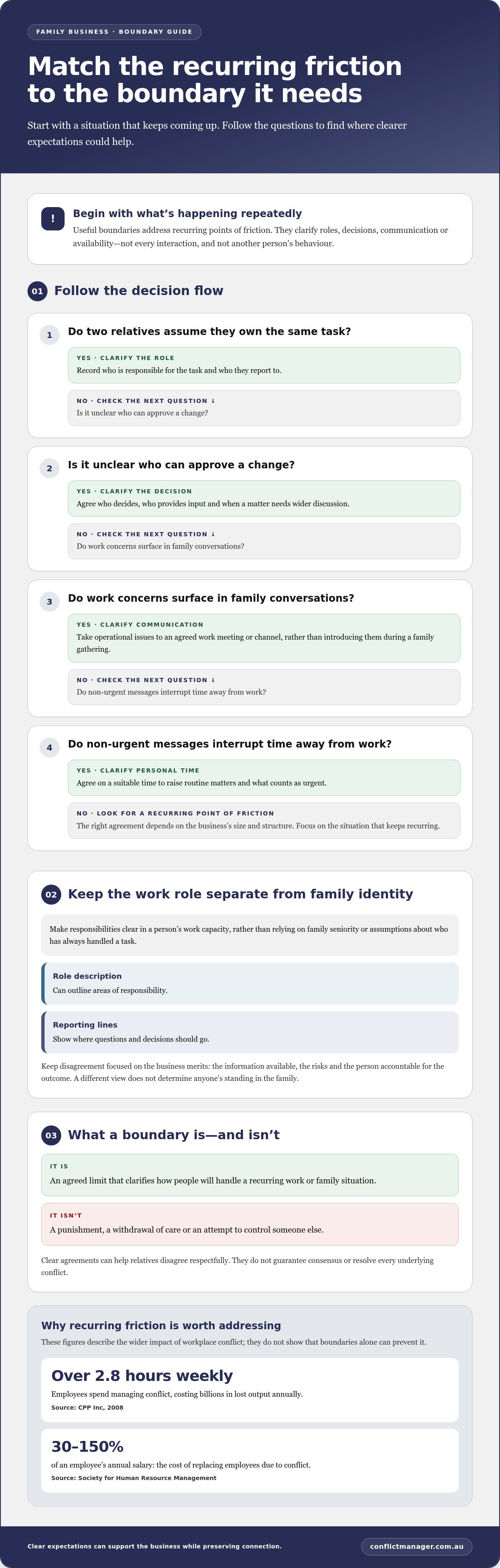
| Boundary | Common need | Workable example |
|---|---|---|
| Role | Two relatives assume they own the same task. | Record who is responsible for the task and who they report to. |
| Decision | It’s unclear who can approve a change. | Agree who decides, who provides input and when a matter needs wider discussion. |
| Communication | Work concerns surface in family conversations. | Take operational issues to an agreed work meeting or channel. |
| Personal time | Non-urgent messages interrupt time away from work. | Agree on a suitable time to raise routine matters and what counts as urgent. |
Separate family identity from workplace responsibility
Clarify responsibilities in a person’s work capacity, rather than relying on family seniority or assumptions about who has always handled a task. A brief role description can outline areas of responsibility, while reporting lines show where questions and decisions should go. These tools can be simple enough for a small family enterprise or more formal as the organisation grows. The aim is to make accountability visible, not to rank family members.
If a colleague questions a proposal, keep the discussion focused on its business merits: the information available, the risks and the person accountable for the outcome. That disagreement doesn’t determine anyone’s standing in the family. Separating the two contexts gives people room to challenge a work decision without treating it as a personal rejection.
Agree on communication and time outside work
Choose where work matters belong. A team issue might be raised in a scheduled meeting or a designated work channel, rather than introduced during a family gathering. For non-urgent messages, agree on a reasonable time to send them and when a response is expected. The details can vary; consistency matters more than imposing a single arrangement on every family or role.
Personal-time limits can be framed as a shared way to protect rest and attention, not as a refusal to support the business. For example, relatives might agree to park routine operational questions until the next workday, while deciding separately how genuinely time-sensitive matters are handled. The boundary addresses the situation, rather than asking someone to care less.
When setting boundaries in a family business, start with the agreement that would reduce the most repeated confusion. If family members find it difficult to discuss that limit impartially, impartial family conflict resolution can help create space for a constructive conversation.
Do boundaries damage trust or weaken family authority?
It can feel that way at first. In a family business, a practical request may carry more meaning than intended: “Let’s keep work messages to the agreed channel” might be heard as “I don’t want to talk to you”. When family and business identities overlap, people can interpret a limit as a judgement about their loyalty, importance or place in the family.
That reaction deserves attention, but it doesn’t mean the boundary is wrong. A limit concerns how a particular situation will be handled; it doesn’t have to diminish care, respect or connection. Trust is not the absence of boundaries. It can also grow through clear, consistent expectations that reduce the need to guess what a request means.
Why a clear limit is not the same as rejection
Start with the practical issue, not an accusation about someone’s character. Instead of “You always bring work into family time”, try: “We’ve been discussing operational issues during family dinners, and it’s leaving little room for time together. Could we take routine work matters to our business meeting?” The second version identifies a pattern and proposes a change without labelling a person as the problem.
Listen to how the request lands. A relative might explain that they raise issues at home because the business meeting feels rushed, or because they’re unsure where else to take a concern. That information may point to an adjustment in the process without removing the purpose of the boundary. The aim is to understand the concern and agree on a workable way forward, not to abandon the limit at the first sign of discomfort.
Consistency matters. If an agreed boundary is applied selectively, people may see it as a personal rule rather than a shared expectation. If circumstances change, discuss a revision openly rather than letting the agreement quietly erode. Calm follow-through, paired with respectful language, helps make the distinction between “this behaviour needs a limit” and “you matter less to me” easier to recognise.
When authority and family status pull in different directions
Family seniority and workplace responsibility don’t always sit with the same person. A parent may be the older relative, while an adult child holds the role accountable for a particular area. If decisions default to family rank rather than agreed business responsibilities, authority can become unclear and routine disagreement may feel like disrespect.
When setting boundaries in a family business, return the discussion to the role, the decision at hand and the agreed process. If someone outside the decision-maker’s area has a concern, the family can agree how that input is heard without silently transferring authority. The arrangement should be discussed and reviewed if responsibilities change; a boundary is useful when people understand both what it covers and why.
Family status describes a relationship; workplace authority comes from an agreed business role. Keeping those ideas distinct doesn’t require relatives to care less about one another. It allows them to question a business decision, uphold a responsibility or ask for a change without making that disagreement a verdict on the family bond.
How to set and maintain boundaries in a family business
A boundary is more likely to hold when it responds to a real, recurring difficulty and the people affected understand its purpose. A practical process keeps the conversation focused: identify the pattern, define the limit, discuss it together and agree when to review it. The aim isn’t to produce a perfect rule for every situation. It’s to create an arrangement people can use and adjust as responsibilities change.
- Identify the recurring issue. Describe what happens and its practical effect. For instance, decisions may be delayed because relatives both expect to approve the same type of purchase.
- Define the boundary. State what needs to change in terms of a role, decision or situation. Be specific about the action or process, rather than trying to dictate how someone should feel or behave generally.
- Discuss it collaboratively. Explain why the limit matters, then invite the other person’s perspective. Their concerns may reveal a useful adjustment, but keep the boundary’s central purpose in view.
- Agree how to revisit it. Decide how you’ll recognise whether the arrangement is working and when you’ll review it, particularly if duties or business needs change.
Prepare for a boundary conversation
Before raising the issue, separate observable events from assumptions about motives. “The last purchasing decisions were held up because approval wasn’t clear” is more constructive than “You don’t trust me to do my job”. Then make a direct request tied to the relevant responsibility, such as agreeing who has final approval. Choose a suitable business setting for work matters, so the conversation can focus on responsibilities rather than being folded into family time.
Make room for the other person to describe what they see. They may have information about the current process that you’ve missed, or a concern about being excluded from decisions. Acknowledging that perspective doesn’t require you to withdraw the request. It helps both parties refine the agreement so it is clear, workable and connected to the issue they’re trying to resolve.
Some agreements are best kept simple and verbal; others benefit from being written down. Record responsibilities, decision-making steps or communication practices when people might reasonably remember them differently. A short note of what was agreed, who is responsible and when the arrangement will be reviewed can prevent ambiguity from returning. Keep it practical, and update it if roles or circumstances change.
Respond when an agreed boundary is tested
If the boundary is crossed, begin with a calm reminder rather than an immediate accusation: “We agreed to bring routine work questions to our meeting. Can we put this on the agenda?” A single lapse may call for clarification; a repeated pattern may suggest the agreement isn’t workable or the underlying issue remains unresolved. Discuss what’s happening before deciding on next steps, and revisit the arrangement if responsibilities or circumstances have shifted.
Repeated conflict doesn’t automatically call for a harsher ultimatum. If family members can’t reset the discussion together, impartial facilitation can help clarify the concerns and support direct conversation. Explore family conflict resolution support when an impartial structure would help you work through contested expectations.
When family-business boundaries need impartial support
Some boundary discussions become difficult to move forward internally. The same issue keeps resurfacing, emotions rise before anyone can clarify the practical concern, or a conversation stalls because each person is too close to the history behind it. These patterns may signal a need for impartial facilitation, not a reason to impose a harsher ultimatum. A neutral process can help family members hear one another and focus on the decisions and expectations that need attention.
Conflict Manager works as an impartial change agent alongside the people in the business and its existing structures. The aim is not to take authority away from family members or prescribe a standard arrangement. It is to help clarify competing concerns, support direct discussion and establish practical steps towards progress, while preserving relationships wherever possible.
What impartial guidance can contribute
An impartial perspective can help stakeholders distinguish stated positions from the concerns beneath them. For example, a disagreement about who approves a decision may also involve concerns about accountability, trust or being heard. Mediation Services provide professional guidance for direct conflict resolution when appropriate. Leadership Alignment uses workshops and communication planning to help key stakeholders clarify expectations and work towards a shared direction.
That structure doesn’t guarantee agreement. It can, however, create a more considered space to examine the issues, recognise different responsibilities and identify where expectations need to be clearer. The focus remains on practical, longer-term progress rather than treating each disagreement as a separate incident.
Turning agreed boundaries into sustained practice
A constructive conversation is a beginning, not the whole process. Once people agree on a boundary, they may need a way to translate the intention into responsibilities, actions and follow-through. Roadmap Creation provides a customised conflict-resolution plan with clear milestones, helping participants define what needs to happen next and how progress will be considered.
Implementation Support can support measurable outcomes through confidential documentation. This helps keep agreed actions visible and provides a reference point as people put new expectations into practice. The process can be tailored to the situation and existing structures, rather than adding formality for its own sake.
For families setting boundaries in a family business, sustained progress often depends on clarity and a willingness to revisit an agreement when circumstances change. An impartial guide can help keep that review focused on what is working, what remains unresolved and what practical adjustment may be needed. The guiding principle is simple: Clarity. Stability. Resolution.
If repeated tension is making internal conversations difficult, explore impartial family conflict resolution as a way to support a more structured discussion.
Take the next step towards a clearer way forward
Setting boundaries in a family business is an ongoing practice, not a single conversation. As responsibilities and circumstances shift, family members can return to their agreements, notice what is working and address what needs adjustment. A willingness to review arrangements can help keep them relevant without turning every change into a judgement about trust or commitment.
If shared history makes it difficult to find neutral ground, impartial support can provide space to clarify concerns and consider a practical path forward. Dennis Benjamin, Founder & Principal Conflict Manager, has 35+ years experience. Conflict Manager offers Mediation Services for direct conflict resolution when appropriate, alongside Roadmap Creation and Implementation Support to help turn agreed intentions into practical actions.
Explore how Conflict Manager can support a clearer path forward. A thoughtful next conversation can begin with a manageable agreement and build from there.
Frequently Asked Questions
How do you set boundaries with a family member who is also your boss?
Start by identifying whether the issue concerns your family relationship or your boss’s authority at work. In a private business conversation, describe a concrete example, such as receiving conflicting instructions about a task, and explain its effect on delivery. Ask which instruction takes priority and how future direction will be confirmed. This keeps setting boundaries in a family business grounded in responsibilities. If attempts to resolve the issue stall, impartial facilitation may help clarify expectations.
How can family members keep work disagreements out of family gatherings?
Agree in advance how to defer business topics raised during family time. You might use a neutral phrase such as, “Let’s make sure we give this proper attention at work,” then note the issue for the next suitable discussion. If the matter is genuinely urgent, agree how to identify that and who should be involved. Deferring a debate isn’t dismissing it; it creates a deliberate place to address it properly.
Should family members who work in the business have written role descriptions?
Written role descriptions can be useful when colleagues have different understandings of who owns a task or answers to whom. For instance, a description can outline who prepares a proposal and who gives final approval, reducing uncertainty before a disagreement arises. Develop the wording with the people affected and revisit it as duties evolve. Treat it as a shared reference, not a scorecard for measuring someone’s value to the family.
What should I do if a family member ignores a boundary repeatedly?
Address the pattern directly, using specific instances and their effect on the work rather than guessing at intent. Check whether everyone understood the agreement and whether the process is realistic in current circumstances. If it is clear and still being disregarded, consider who else needs to participate in resolving the issue and what discussion would help. Where conversations repeatedly become stuck or highly charged, impartial support can help stakeholders work towards a constructive next step.
Can a family business set boundaries without formal policies?
Yes. A conversation can establish a workable expectation without creating a formal policy, particularly where the arrangement affects a small group or a specific recurring situation. Make sure the people involved share the same understanding of what was agreed and how they’ll handle exceptions. If confusion returns, a short written note can help preserve consistency. Documentation is most useful when it records a genuine agreement, rather than standing in for a conversation that hasn’t happened.
How do you set boundaries when a family member owns the business?
Clarify how ownership decisions differ from day-to-day decisions assigned to particular roles. For example, agree which matters a manager can handle within their responsibilities and which should be brought to the owner for input. Then establish how and when those discussions will happen. Frame the boundary as a way to make decision pathways workable, not as an attempt to diminish the owner’s standing or exclude them from matters that concern them.


