

The fairest way to fire a family member is to treat the employment decision and the family relationship as connected, but not interchangeable. If performance concerns have continued despite clear feedback, working out how to fire a family member fairly means focusing on the role, the evidence and a consistent process, rather than loyalty or frustration. That can be difficult when the person is also a relative, business partner or family stakeholder.
It’s reasonable to want a decision that protects the business without causing avoidable harm across the family. A measured process helps you assess what’s happening, give the employee a clear opportunity to respond and consider whether dismissal is justified, while keeping Australian workplace obligations in view.
This article sets out a practical framework for assessing performance, making and communicating a fair decision, and planning the transition. When family and business conversations become difficult to manage internally, neutral facilitation can give them structure and help clarify workable next steps. It doesn’t guarantee agreement or replace legal advice.
Key Takeaways
- Assess the decision against the role, business needs and reliable performance evidence, not family tensions or assumptions.
- Learn how to fire a family member fairly by setting out concerns clearly, hearing their response and weighing next steps through a consistent process.
- Keep procedural fairness distinct from legal compliance, and consider the Australian workplace obligations relevant to the employee and business.
- Communicate the decision privately and with dignity. Ending the employment relationship doesn’t end the person’s place in the family.
- Use neutral facilitation to structure difficult conversations, clarify boundaries and explore workable next steps without asking a facilitator to make the employment decision.
When is firing a family member the fairest decision for the business?
Three responsibilities can pull in different directions: maintaining role performance, protecting business stability and respecting a personal relationship. A fair decision doesn’t promise a painless outcome. It means reaching a reasoned conclusion based on clear expectations, reliable evidence and genuine consideration of the employee’s response, rather than loyalty, frustration or pressure from other relatives.
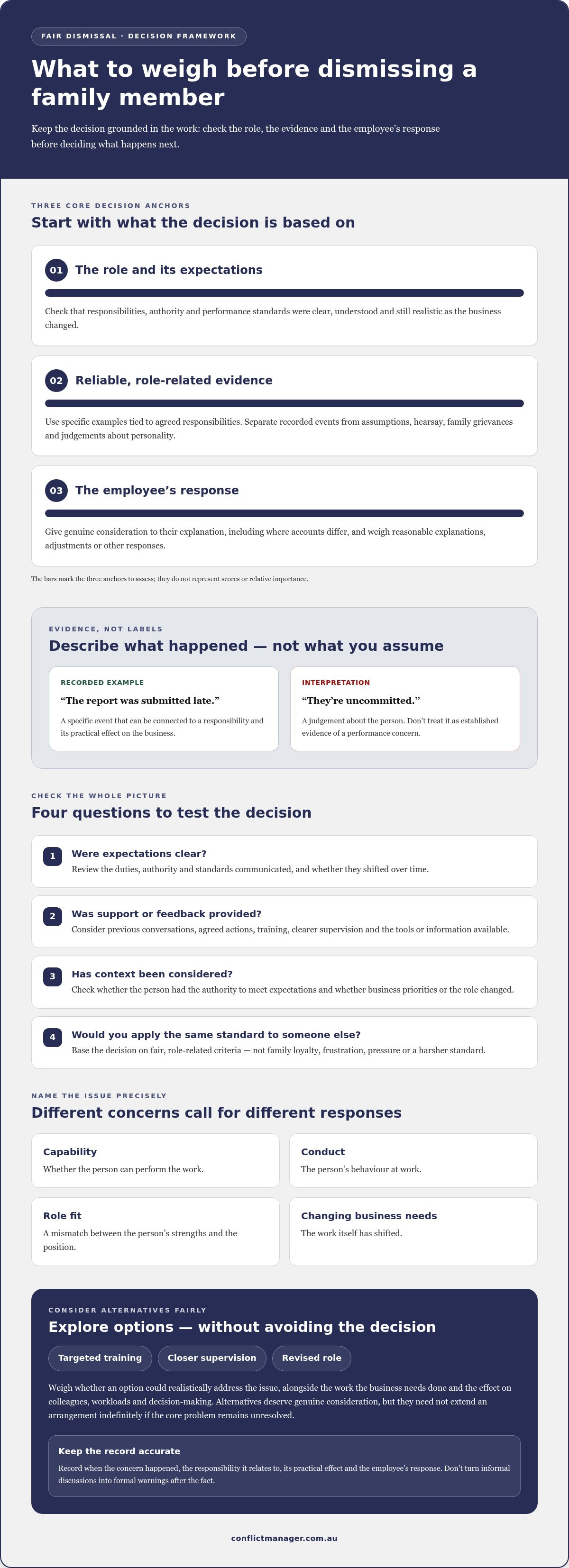
A difficult period or isolated mistake doesn’t automatically justify dismissal. Look for a sustained pattern, or a serious concern, that affects agreed responsibilities and hasn’t improved after appropriate feedback or support. Ask yourself:
- Were the role’s expectations clear and understood?
- Can you support the concerns with specific, relevant evidence?
- Have reasonable explanations, adjustments or other responses been considered?
- Would you take the same concern seriously if a non-family employee held the role?
If the answers are unclear, pause before deciding. The aim isn’t to find a predetermined reason to dismiss someone. It’s to establish what is happening and which response is proportionate. A general overview of unfair dismissal laws in Australia may provide context, but it can’t determine whether a particular employment decision is fair or compliant.
Separate the family relationship from the employee’s role
Family loyalty can blur authority. A manager may avoid direct feedback to preserve peace, while a relative may experience ordinary accountability as personal rejection. Bring the discussion back to the work: what the role requires, what has happened and what needs to change.
Apply the same standards you would use for someone else in that position, while considering relevant individual circumstances. Consistency doesn’t mean treating every person identically. It means basing the decision on fair, role-related criteria rather than giving a family member indefinite exceptions or holding them to a harsher standard.
Identify what the concern is actually about
Name the issue precisely. Capability concerns are about whether the person can perform the work; conduct concerns are about their behaviour at work. Role fit may reflect a mismatch between the person’s strengths and the position, while changing business needs may mean the work itself has shifted. These are different problems and call for different responses.
Use concrete examples tied to agreed responsibilities. For instance, describe missed reporting deadlines or repeated errors in a defined task, rather than labelling someone “careless” or referring to an old family disagreement. Separate what you observed or recorded from assumptions, hearsay and judgements about personality. This helps you assess whether clearer expectations, support, a different role or dismissal is the appropriate next step.
That distinction is central to how to fire a family member fairly. A decision grounded in the actual work is more considered than one driven by accumulated resentment, and it gives the employee a clearer understanding of the concern.
What should you assess before deciding to dismiss a family member?
Before making a decision, build a clear picture of the job as it exists now, not just as it was first imagined. Review the responsibilities, decision-making authority and performance expectations the employee was given. Compare them with specific examples of work, feedback already provided and support offered. This helps distinguish a performance pattern from an unclear role or a business that has changed around the person.
Keep evidence separate from interpretation. A dated record that a report was submitted late is a fact; calling the employee “uncommitted” is an interpretation. Family grievances, rumours and second-hand accounts may raise questions worth investigating, but shouldn’t be treated as established evidence. Record the employee’s explanation too, including where accounts differ.
Review expectations, evidence and prior conversations
Check that duties, authority and standards were communicated clearly, and whether they shifted over time. For each concern, record when it happened, which responsibility it relates to, its practical effect on the business and the employee’s response. Summarise previous conversations, agreed actions and support, such as training or clearer supervision. Keep the record accurate. Don’t turn informal discussions into formal warnings after the fact.
Context matters. A family member may have been given responsibility without the authority to make decisions, or the business may have changed priorities since the role was established. Consider whether expectations remained realistic and whether the employee had the tools and information to meet them. Review the circumstances as well as the performance.
Consider alternatives without avoiding the decision
Consider whether targeted training, closer supervision or a revised role could realistically address the issue. Weigh each option against the work the business needs done and the effect of the current arrangement on colleagues, workloads and decision-making. Alternatives deserve genuine consideration, but they aren’t a reason to extend an arrangement indefinitely if the core problem remains unresolved.
For an employment decision, process and legal obligations are related but distinct. The Fair Work Ombudsman’s guidance on unfair dismissal can help you understand the relevant framework. The employee’s circumstances and applicable workplace arrangements matter. A documented assessment supports a reasoned decision, but doesn’t by itself establish legal compliance.
Before deciding, check:
- Were the duties, authority and performance standards clear?
- Do dated examples support each concern, and is the business impact identifiable?
- Has the employee’s response been recorded and considered?
- Did role expectations or business conditions change?
- Could support or a revised role address the issue in practice?
- What effect would retaining the current arrangement have on the team and operations?
This checklist makes how to fire a family member fairly a more disciplined assessment, rather than a decision shaped by pressure or accumulated frustration. If family dynamics make it difficult to review the evidence together, neutral family conflict resolution can help structure the discussion and clarify next steps.
How can you manage a fair process and check Australian employment obligations?
A fair management process gives the employee a clear account of the concerns and a genuine chance to respond. Legal compliance is a separate question: a careful conversation or written record doesn’t, by itself, establish that a dismissal is lawful. Treat these as parallel responsibilities. Manage the situation consistently and humanely, while checking the employment rules that apply before deciding what to do.
A practical sequence can help keep the process deliberate:
- Review the evidence. Confirm that the concerns relate to the role, and distinguish what you know from what still needs clarification.
- Explain the concerns. Meet privately, describe specific work issues and their impact, and avoid personal criticism or family history.
- Hear the response. Invite the employee to explain their perspective, ask questions and provide relevant context. Listen before forming a conclusion.
- Assess the next step. Consider the response and whether further support, a review period, a role change or dismissal is appropriate. Record the reasoning accurately.
Structure the conversation and give a genuine opportunity to respond
Choose a private setting where the discussion won’t become a family gathering or a public workplace confrontation. Explain the purpose of the meeting and the concerns in plain, work-related terms. Give the employee time to respond without interruption. Their explanation may reveal missing context, but assess it against the evidence rather than accepting or dismissing it because of the family relationship.
If continued employment remains under consideration, agree on practical expectations and a suitable review point. Be specific about what needs to change and how progress will be assessed. Avoid imposing a fixed warning sequence or timetable simply because it worked elsewhere. The appropriate process depends on the facts, the nature of the concern and the circumstances.
Check the Australian employment context before acting
Before taking action, verify the employee’s employment arrangement and the current obligations that may apply. Check coverage under a modern award or enterprise agreement, relevant National Employment Standards, notice and final entitlements, and any protections connected with the circumstances. Eligibility and requirements can vary, so don’t assume that a family relationship changes the employee’s workplace rights.
The Fair Work Ombudsman’s unfair dismissal guidance explains key aspects of Australia’s framework, including that eligibility depends on the circumstances. Also consider whether the decision could engage other workplace protections, such as rights relating to complaints, leave or discrimination. If the position is uncertain or the consequences are significant, obtain independent employment-law advice before acting.
Documentation can help show what was raised, what the employee said and how the decision was reached. It isn’t a guarantee of compliance, and neither is issuing a warning or holding a particular number of meetings. In how to fire a family member fairly, a sound process means hearing the person and testing the decision; compliance means separately confirming that the applicable Australian requirements have been met.
How do you communicate the decision and provide a dignified exit?
Once the decision is made, communicate it clearly and privately, without turning the meeting into a debate about the family’s history. A concise message gives the employee room to understand the outcome and helps you stay aligned with the reasons already considered. Compassion matters, but so does clarity. Ambiguity can prolong uncertainty for the employee and the business.
Deliver the decision with clarity and respect
State the outcome and the principal work-related reasons plainly. For example: “We’ve decided to end your employment because the requirements of the role haven’t been met despite the support and feedback provided.” Adapt the wording to the documented rationale and actual circumstances. Acknowledge that the conversation is difficult, then explain the next steps without revisiting every disagreement or blaming other family members.
Allow the person time to respond and ask questions. Their reaction may be emotional; you can recognise that without reopening a decision you’re authorised to make. Don’t promise a reference, a different role or a future reversal unless you have the authority and intention to honour it. Keep the discussion professional, even when the relationship is personal.
Plan the employment transition separately from family contact
Prepare a practical handover covering current responsibilities, work in progress, business information and system access, subject to applicable obligations. Confirm employment details such as notice, final pay and outstanding entitlements against the relevant arrangements before communicating them. If a contractual or legal question arises, avoid guessing and seek appropriate independent advice.
Agree who will tell colleagues, when they’ll be told and what can be shared. Keep the explanation brief and protect the former employee’s privacy. Operational clarity is useful, but colleagues don’t need personal or sensitive details. Avoid announcing the decision at a family gathering or using one to negotiate employment matters. Separating the two gives everyone a better chance to engage with the family relationship outside the workplace decision.
A short written confirmation can record the outcome and practical arrangements after the meeting. Keep it consistent with what was said and within the decision-maker’s authority. The aim isn’t to make the exit painless; it’s to reduce confusion and avoid adding unnecessary indignity.
In how to fire a family member fairly, the message and transition should reflect the same principles: specificity, respect, composure and consistency. The employee’s role may end, but that doesn’t determine their place in the family. Give that relationship space to be addressed separately, without using family loyalty to obscure the employment decision.
If the employment decision is straining communication among relatives who are also business stakeholders, explore family conflict resolution to help structure the conversation and clarify workable next steps.
How can neutral facilitation help the family and business move forward?
The employment decision belongs to the employer or authorised decision-maker. A neutral facilitator doesn’t take that responsibility away, determine whether the dismissal was legally correct or provide legal advice. Their role is to structure a conversation when the decision has led to competing accounts, strained communication or conflict among people who remain connected through family and business.
This distinction matters. A facilitated discussion can help participants clarify what needs attention next, but it can’t guarantee agreement, restore trust or ensure a relationship returns to how it was. Progress may be more modest: a clearer boundary, a calmer way to communicate or an agreed approach to a practical issue.
When a neutral facilitator may be useful
Consider facilitation when conversations keep circling back to old grievances, relatives hold sharply different accounts of what happened, or tension is spilling into wider family relationships. A facilitator can provide a structured setting, help participants hear each other’s perspectives and keep discussion focused on the issues they’re ready to address. This can be useful where family members also have business or ownership roles.
Neutrality isn’t a verdict. The facilitator doesn’t decide who is right, reverse the employment outcome or guarantee reconciliation. The aim is to make difficult dialogue more orderly, so people can identify concerns and consider practical next steps without confusing facilitation with legal representation or employment decision-making.
Create boundaries and next steps after the employment decision
Start by separating essential business communication from personal contact. For example, a former employee may direct handover questions through an agreed business contact, while family members decide separately how they want to communicate outside work. Clear boundaries can reduce mixed messages and help colleagues understand where operational responsibility now sits.
Agree on the practical details that are appropriate to discuss, such as:
- Who will manage outstanding work or business queries?
- Which communication channels should be used for work-related matters?
- What information can be shared with other relatives or colleagues?
- When, if at all, will the family revisit unresolved personal issues?
These arrangements don’t need to settle every disagreement. They provide a structure for immediate communication and leave room for people to decide what contact feels workable over time. If participants aren’t ready to discuss a personal matter, acknowledge that boundary rather than pressing for resolution in the same conversation.
Knowing how to fire a family member fairly includes considering what happens after the employment relationship ends. Expert-led family conflict resolution can support clearer dialogue and help relatives explore workable boundaries, without promising a particular outcome. If direct conversations remain difficult, discuss a structured family conflict resolution process with Conflict Manager.
Move forward with clarity and care
The decision to end a family member’s employment can mark a turning point, not the end of every possibility for a respectful family relationship. What follows depends on the boundaries people establish and the conversations they’re able to have. Give those conversations time and structure rather than expecting one meeting to resolve everything.
Knowing how to fire a family member fairly includes recognising when the next challenge is no longer the employment decision itself, but its impact on the family and business. Conflict Manager provides expert-led conflict resolution, mediation and facilitation for families and organisations across Australia, with a focus on clarity, stability and sustainable next steps. A neutral process can help people address unresolved communication and consider a way forward, without guaranteeing agreement.
If you’re ready to approach the next conversation with more structure, explore a structured approach to family conflict resolution. A difficult transition can still be handled with care, and clearer communication can create room for a steadier future.
Frequently Asked Questions
Can you legally fire a family member in Australia?
Yes, a family member can be dismissed, but their family connection doesn’t remove ordinary workplace obligations. The decision may need to account for the employee’s contract, award or enterprise agreement, applicable notice requirements and protections against unfair dismissal or prohibited reasons for termination. Eligibility for an unfair dismissal claim depends on factors including service and award or agreement coverage. Check current Fair Work Ombudsman guidance and get independent employment-law advice if the circumstances are complex.
Should you give a family member a formal warning before dismissal?
Not every situation calls for the same warning process. For ongoing performance concerns, clear feedback and a genuine opportunity to improve may be important; serious misconduct can involve different considerations. Small businesses may also need to consider the Small Business Fair Dismissal Code. Don’t assume a warning is always required, or that issuing one automatically makes a dismissal fair. Check the rules that apply to the employee and the circumstances before acting.
What should you document before dismissing a relative?
Keep accurate records that show how the decision developed. These may include the role description, relevant contract or workplace instrument, dated examples of concerns, correspondence, meeting notes, the employee’s explanations and any agreed follow-up. Record who made the decision and the work-related reasons for it. Separate direct observations from information reported by others, and store records securely with access limited to people who need them for a legitimate business purpose.
How do you tell a family member they are being dismissed?
Tell them privately, in a meeting arranged for that purpose, and state the decision and its main work-related reason plainly. For example: “We’ve decided to end your employment because the role’s requirements haven’t been met.” Use wording that accurately reflects the circumstances. Allow them to respond, then explain the next steps and provide written confirmation. Keep the conversation separate from family gatherings, and don’t disclose personal details to colleagues.
Can mediation prevent a family relationship from breaking down after dismissal?
No process can guarantee that a family relationship will remain intact or recover after dismissal. Mediation may help relatives discuss the impact, clarify boundaries and agree how to manage necessary contact, particularly where they still share business or family responsibilities. It doesn’t decide whether the dismissal was lawful or replace employment-law advice. Participants may leave with greater understanding or practical next steps, even if they don’t reach agreement on every issue.
What if the family member refuses to accept the dismissal?
Stay composed and avoid turning disagreement into a family argument. Restate the decision, give the employee written information about the outcome and relevant employment arrangements, and keep a record of what was communicated. Refusal to agree doesn’t resolve questions about whether the process complied with workplace obligations. If the person challenges the decision, raises a workplace-rights concern or disputes entitlements, seek independent employment-law advice promptly and respond through the appropriate process.


