

What if the first step towards resolving a shareholder dispute is to slow the conversation down, rather than choose a side? When disagreements over control, strategy or financial interests disrupt decisions, communication and business continuity, it’s understandable to want a quick answer. But working out how to resolve shareholder disputes starts with separating the interests at stake from governance questions and potential legal issues.
Unresolved conflict can make a business harder to run and relationships harder to repair. The challenge is identifying what’s driving the disagreement and choosing a proportionate process. A dispute about future direction may call for a different conversation from concerns about profit distributions, share valuation or exclusion from decisions.
This guide explains common causes of shareholder disputes in Australia and compares practical pathways, from direct discussion and neutral facilitation to mediation and formal legal processes. You’ll learn how to clarify the issues, prepare for a more productive discussion and work towards an outcome that supports business continuity. When conversations have become stuck or emotionally charged, structured, neutral support can help bring the underlying interests into view.
Key Takeaways
- Shareholder conflict can stem from competing expectations about strategy, distributions, access to information or control. Pinpointing the trigger helps keep the discussion focused.
- Separate commercial interests, governance arrangements and legal questions before deciding which resolution process may fit.
- Understanding how to resolve shareholder disputes means matching the pathway to the situation, from direct discussion to structured facilitation, mediation or formal legal processes.
- Prepare for a more constructive conversation by gathering relevant records, identifying interests and distinguishing observable events from assumptions about motives.
- When discussions become stuck or emotionally charged, neutral facilitation can help shareholders clarify issues and consider workable next steps.
How shareholder disputes begin, and when they need a resolution process
A shareholder dispute is a disagreement that affects ownership interests, company decisions or the working relationship between shareholders. It describes the issue, not the people involved. Shareholders can have legitimate, differing views without either person being unreasonable. The difficulty arises when those differences impede the company’s decisions or day-to-day work.
Disagreements may concern the company’s direction, how much profit to distribute or reinvest, access to information, control over decisions, or whether each shareholder’s contribution is recognised. A difference over expansion, for example, may appear to be an argument about growth. Underneath it, one shareholder may be concerned about risk, while another believes reinvestment is essential to the company’s future.
What issues commonly sit behind a shareholder dispute?
Expectations often diverge over growth, risk and returns. One shareholder may favour retaining profits to fund expansion; another may rely on distributions or prefer a more cautious approach. Tension can also develop when shareholders disagree about the value of their shares, who should make key decisions, or what information should be shared and when.
Unclear roles can magnify an initial difference. If shareholders also work in the business, they may hold different assumptions about authority, workload or how their contributions should influence decisions. Personal history can shape how a business conversation is heard, particularly where trust has been strained. But reducing the dispute to a personality clash can obscure the practical interests that need attention.
The company’s constitution and any shareholders’ agreement may set out decision-making arrangements or steps for addressing disagreements. A Shareholders' Agreement commonly records arrangements between shareholders, though the relevant terms depend on the document itself. Understanding what arrangements exist can help distinguish a difference in expectations from a question about how an agreed process applies.
When does shareholder conflict become difficult to manage internally?
A one-off disagreement may be resolved through a focused conversation. A deliberate process becomes more useful when the same issue returns without progress, information is withheld or decisions are repeatedly left unresolved. These patterns can delay approvals, unsettle staff and draw attention away from customers and operations.
Look at what is happening in the discussion. Are conversations circling back to old grievances instead of addressing the decision at hand? Are shareholders communicating through allies, or has every exchange become more defensive? These signs don’t prove that agreement is impossible. They do suggest that informal discussion may no longer be creating enough clarity or room for each perspective to be heard.
Early structure can help keep the conversation business-focused. State the decision that needs to be made, share relevant information in advance and set clear ground rules for discussion. If direct conversations remain stuck or emotionally charged, neutral facilitation can help shareholders surface their interests and consider workable next steps. The aim isn’t to erase differences, but to stop them from silently shaping every decision.
Recognising these patterns is a practical starting point for how to resolve shareholder disputes: identify what is at stake, then consider whether the current way of discussing it is helping the company move forward.
Separate commercial, governance and legal issues before choosing a pathway
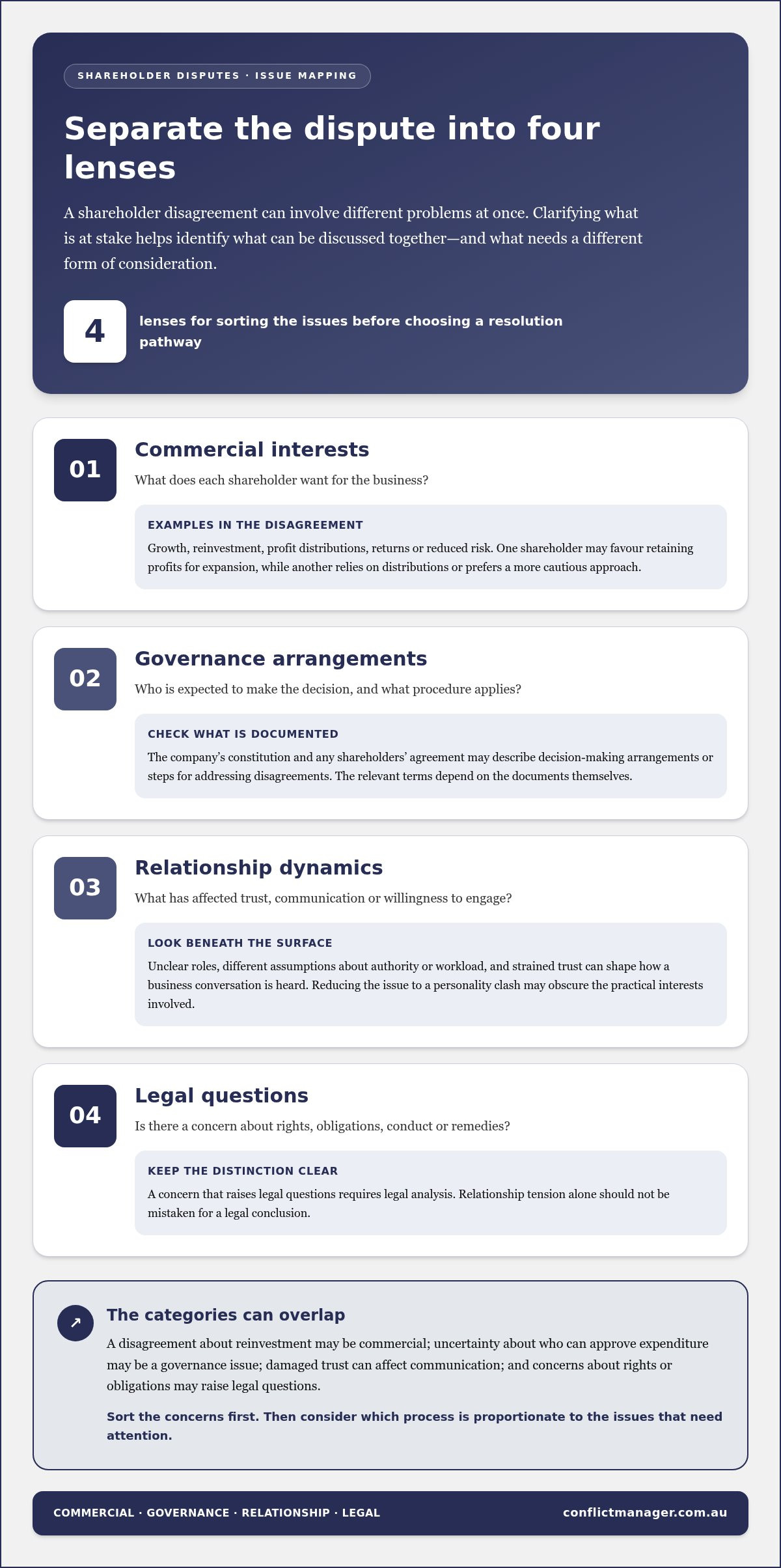
A shareholder dispute can contain several different problems at once. A disagreement about reinvestment may be commercial; uncertainty over who can approve expenditure may be a governance issue; damaged trust may affect communication; and an allegation about rights or obligations raises legal questions. Treating every concern as one conflict can blur what needs to change and which process might help.
The clearer the type of dispute, the easier it is to choose a proportionate process without mistaking relationship tension for a legal conclusion. Start by sorting the concerns into four lenses:
- Commercial interests: What does each shareholder want for the business, such as growth, distributions or reduced risk?
- Governance arrangements: Who is expected to make the decision, and what procedure applies?
- Relationship dynamics: What has affected trust, communication or willingness to engage?
- Legal questions: Is there a concern about rights, obligations, conduct or remedies that requires legal analysis?
The categories can overlap, but separating them helps shareholders identify what they can discuss together and what needs a different form of consideration.
How do company documents shape the conversation?
A company’s constitution and any shareholders’ agreement may describe decision-making arrangements, shareholder rights or steps for addressing a dispute. Not every company has a shareholders’ agreement, and having documents doesn’t guarantee that every disagreement will be resolved by following them.
Locate the relevant clauses and note the question each one appears to address. For example, a disagreement over a major business decision may prompt shareholders to look for provisions about approvals or voting. Identifying the wording can give the discussion a clearer focus, but don’t treat a preliminary reading as a conclusion about its legal effect. That depends on the document and circumstances.
Where do facilitation and legal questions differ?
Facilitation supports the conversation. A neutral facilitator can help shareholders define the issues, hear different perspectives and explore practical next steps. The process can make it easier to discuss interests and working arrangements, but it doesn’t determine legal rights or decide whether a party has breached an obligation.
Those questions may involve the Corporations Act 2001 (Cth), company documents and the particular facts. They require separate legal analysis. ASIC provides information about companies and regulation, but it isn’t a private mediator or decision-maker for shareholders seeking to settle an internal disagreement. The Australian Securities and Investments Commission (ASIC) is a useful reference for general company information, not a substitute for advice about a specific legal position.
Keeping these roles distinct helps shareholders choose how to resolve shareholder disputes without expecting a facilitated conversation to settle legal questions. Where communication needs structure, neutral stakeholder facilitation can help shareholders clarify issues and engage more constructively, while legal rights and obligations remain a separate matter.
Compare shareholder dispute resolution pathways without treating them as interchangeable
There isn’t one route that suits every shareholder dispute. The right process depends on what needs attention, how well the parties can communicate and whether the disagreement involves legal rights as well as business interests. Options can be used at different stages, rather than treated as a fixed ladder where one must always follow another.
| Pathway | Purpose and structure | When it may be considered |
|---|---|---|
| Direct negotiation | A direct, relatively informal discussion to clarify concerns and explore an agreed way forward. | When shareholders can communicate constructively and identify the decision or issue they need to address. |
| Structured facilitation | A neutral person organises the discussion, helps define issues and supports participants to hear each other’s interests. | When conversations have stalled, become circular or are difficult to keep focused on business matters. |
| Mediation | A structured, consensual process in which a neutral mediator assists the parties to explore possible agreement. | When shareholders are willing to engage in a facilitated process but need more structure to work through the dispute. |
| Formal legal processes | Processes for addressing legal rights or remedies, with steps and outcomes determined by the relevant legal framework. | When an issue is urgent, contested or rights-based, and requires legal assessment. |
When might direct discussion or neutral facilitation help?
Direct discussion may work if each shareholder can set out the issue, listen to the other perspective and stay focused on the question that needs resolving. A simple agenda can help: identify the decision, record the different views, then agree what information or next step is needed.
If the conversation keeps breaking down, facilitation adds structure without deciding who is legally or commercially right. A neutral facilitator can help participants clarify what they need from the discussion and keep the exchange purposeful. Mediation doesn’t necessarily mean compromising or surrendering a position. It creates space to explore whether a workable agreement exists; the parties retain their own perspectives and choices.
When might formal legal processes need consideration?
Some matters call for legal assessment, particularly where a shareholder raises a concern about rights, obligations or possible remedies, or where timing and business decisions are pressing. Formal legal processes differ from consensual resolution: they may involve prescribed steps and decisions made under the applicable legal framework, rather than an outcome shaped only through discussion.
These pathways aren’t always mutually exclusive. Parties may use facilitation to improve communication while obtaining separate legal advice on a specific issue. That distinction is central to how to resolve shareholder disputes proportionately: use conflict resolution to support communication and define issues, not as a substitute for advice on legal rights.
Prepare for a shareholder dispute conversation with a clear five-step process
A focused conversation is easier to prepare for when participants know what needs attention and what they hope to achieve. Use this sequence to turn a broad disagreement into a discussion with a clear purpose. Keep legal questions separate from matters the participants can work through together.
- Define the issue. State the specific decision, conduct or business impact in dispute. “We need to agree how profits will be used this year” gives the conversation a clearer focus than “You never listen”. Separate observable events, such as a decision that was deferred, from assumptions about why another shareholder acted as they did.
- Gather relevant records. Collect documents that help clarify the issue, such as meeting notes, relevant correspondence, financial information or company documents. Keep the material focused and identify what each item is intended to explain. Avoid using a document bundle to overwhelm or score points.
- Identify interests. Each shareholder can set out their position, then consider what matters beneath it. A request for a particular distribution, for example, may reflect a need for financial certainty; a preference to retain profits may reflect a concern about business continuity. Ask what a workable outcome would need to address.
- Set discussion boundaries. Agree the purpose, scope, participants and ground rules before meeting. Decide how documents will be shared and how expectations about confidentiality will be handled. Keep the agenda to issues participants can discuss and progress together.
- Agree next actions. Close by recording decisions, unresolved questions, who will do what and when the matter will be reviewed. If a legal or time-sensitive concern arises, note it for separate consideration rather than trying to determine rights or obligations through facilitation.
How should shareholders frame the issue and their interests?
Useful framing is specific and neutral. Each person should be able to describe the decision or impact that concerns them, what they need the discussion to address and what information might help. This doesn’t require agreement about the history of the dispute. It creates a shared reference point while allowing each shareholder to explain their interests and desired outcome.
What should be agreed before a facilitated meeting?
Confirm who needs to participate and what the meeting is intended to cover. Agree how relevant records will be circulated, what expectations apply to handling information and how actions will be documented afterwards. A concise agenda can prevent the conversation from expanding into every past grievance. If the scope includes a rights-based or urgent question, distinguish it clearly from the issues suitable for facilitated discussion.
Preparation won’t guarantee agreement, but it can make the conversation more purposeful and easier to follow. If shareholders would benefit from a structured process for a difficult discussion, explore a structured approach to difficult stakeholder conversations.
How neutral facilitation can help resolve a shareholder dispute
When shareholders understand the issue but can’t have a productive conversation about it, a neutral facilitator can provide structure. Conflict Manager guides stakeholders to clarify concerns, communicate more effectively and work towards sustainable outcomes. The facilitator doesn’t take sides or decide who is right. Their role is to help participants examine the issues and consider practical next steps.
What can stakeholders expect from a facilitated process?
The discussion begins with the concerns each participant wants addressed and a useful scope for the conversation. This helps distinguish the matters shareholders can explore together from questions that need separate consideration. If the disagreement involves several topics, a facilitator can help bring them into view without letting one concern overwhelm the rest.
Structure matters when emotions are running high or priorities compete. A facilitator can guide turn-taking, clarify what has been heard and bring the conversation back to its purpose when it drifts into accusation or repeated history. Shareholders can explain the interests behind their positions, ask questions and consider possible next steps in a more deliberate setting.
The process supports discussion; it doesn’t guarantee agreement. Participants remain responsible for the choices they make, and facilitation doesn’t provide legal representation or determine legal rights. If the conversation raises a legal question, that issue can be identified for separate assessment rather than treated as settled through the facilitated process. This distinction keeps expectations clear and the discussion focused.
For shareholders considering how to resolve shareholder disputes, neutral support can be particularly useful when direct conversations have become stuck or emotionally charged. A clearer exchange may help participants understand both the points of difference and the interests they share, even if they don’t reach agreement on every issue.
How can an outcome support business continuity?
Where participants reach agreement, make the next steps concrete. Record what has been agreed, who is responsible for each action and how progress will be reviewed. For example, shareholders might identify who will provide further information, what decision remains open and how they will return to it. Clear responsibilities reduce the risk of the same uncertainty resurfacing.
Durable arrangements need to reflect the company’s practical requirements as well as the interests of the shareholders involved. An option that addresses one concern but leaves other participants unable to support the way forward may not be workable over time. A facilitator can help the group test proposed steps against the issues raised, while leaving decisions with the participants.
Progress also depends on what happens after the conversation. Shareholders can agree how they’ll communicate about outstanding matters, raise emerging concerns and revisit actions if circumstances change. Consistent follow-through helps keep the discussion connected to business decisions rather than allowing unresolved issues to disrupt them again.
If a structured, neutral conversation could help shareholders move forward, discuss a structured approach to resolving shareholder conflict.
Choose a constructive next step
A shareholder dispute doesn’t need to be resolved in one conversation. A useful next step may simply be to agree on the decision that can’t remain open, what needs to be understood before it can move forward, and how the shareholders will discuss it. That shift from blame to process can create room for clearer choices while the business continues its work.
Knowing how to resolve shareholder disputes includes recognising when an independent structure could help. Conflict Manager provides expert-led conflict resolution and stakeholder facilitation for organisations navigating structural change and high-emotion situations, with an approach centred on clarity and sustainable outcomes. Facilitation supports communication and consideration of workable options; it doesn’t replace legal advice or make decisions for shareholders.
If internal discussions are no longer moving the matter forward, take the next step with care. Discuss a structured approach to resolving shareholder conflict and begin creating space for a more productive conversation.
Frequently Asked Questions
Can a shareholder dispute be resolved without going to court?
Yes, shareholders can sometimes resolve a dispute through discussion, facilitation or mediation without court proceedings. Whether an agreement is possible depends on the issues, the parties’ willingness to participate and any relevant company arrangements. For example, shareholders may agree on a process for sharing information or revisiting a business decision. If the dispute raises legal rights or urgent risks, obtain legal advice about those questions separately.
Is mediation suitable for a shareholder dispute?
Mediation may be suitable when shareholders are willing to discuss the issues but need a structured, neutral process. It can help parties explore concerns such as access to company information or how to approach a disputed decision. It isn’t a determination of who is legally right, and participation doesn’t require anyone to accept a proposal. Whether it fits depends on the dispute and the parties’ readiness to engage.
What happens if shareholders cannot agree on a business decision?
Start by checking the company’s constitution and any shareholders’ agreement for provisions relevant to that decision, such as approval or voting arrangements. Don’t assume a particular shareholder can decide alone without understanding the applicable documents and circumstances. If the disagreement creates a deadlock, record the decision that remains unresolved and its effect on the business. The parties can then consider a suitable discussion process and obtain legal advice where needed.
Can a majority shareholder force a minority shareholder to sell?
Not simply because they hold a majority. Whether a shareholder can be required to sell depends on the company’s governing documents, any applicable agreement and the circumstances. Some arrangements may address transfers or compulsory sale events, but their operation should not be assumed from a shareholding percentage alone. Before acting on a proposed sale or transfer, have the relevant documents and legal position assessed in context.
Does ASIC resolve disputes between shareholders?
Generally, ASIC doesn’t mediate or decide private disagreements about how a proprietary company is run. Its role is to regulate companies and markets, rather than determine every disagreement between owners. A concern with broader regulatory or public implications may raise different considerations, but an internal dispute about a company decision is not automatically an ASIC matter. Identify the issue first, then consider whether it concerns private rights, governance or regulatory conduct.
Is an agreement reached through mediation legally binding in Australia?
It can be, depending on the agreement’s wording, the parties’ intention and how it is recorded or formalised. A discussion that ends with an apparent understanding may not address all the details needed for a clear, workable arrangement. Before relying on an outcome, shareholders should consider documenting the agreed terms and obtaining legal advice about its effect, including whether any further company approvals or steps are needed.
When should shareholders consider getting legal advice during a dispute?
Consider legal advice when the disagreement involves a possible breach of rights or obligations, a proposed share transfer, potential legal action or a decision with significant consequences for the company. It can also be prudent before signing a settlement or taking an irreversible step. In particular, ask about any applicable deadlines early, as time limits can depend on the type of claim and circumstances. Facilitation can support communication, but it cannot assess legal rights.


