

Early conflict resolution matters because the choices people make before any formal process begins shape everything that follows. In Australia, a dispute that is understood, named and addressed early is far easier to steer. This article explains why acting early counts, what early action looks like, and how Conflict Manager works for its clients.
Key Takeaways
- Early conflict resolution means understanding a conflict and responding to it before formal grievances, mediation or court take over.
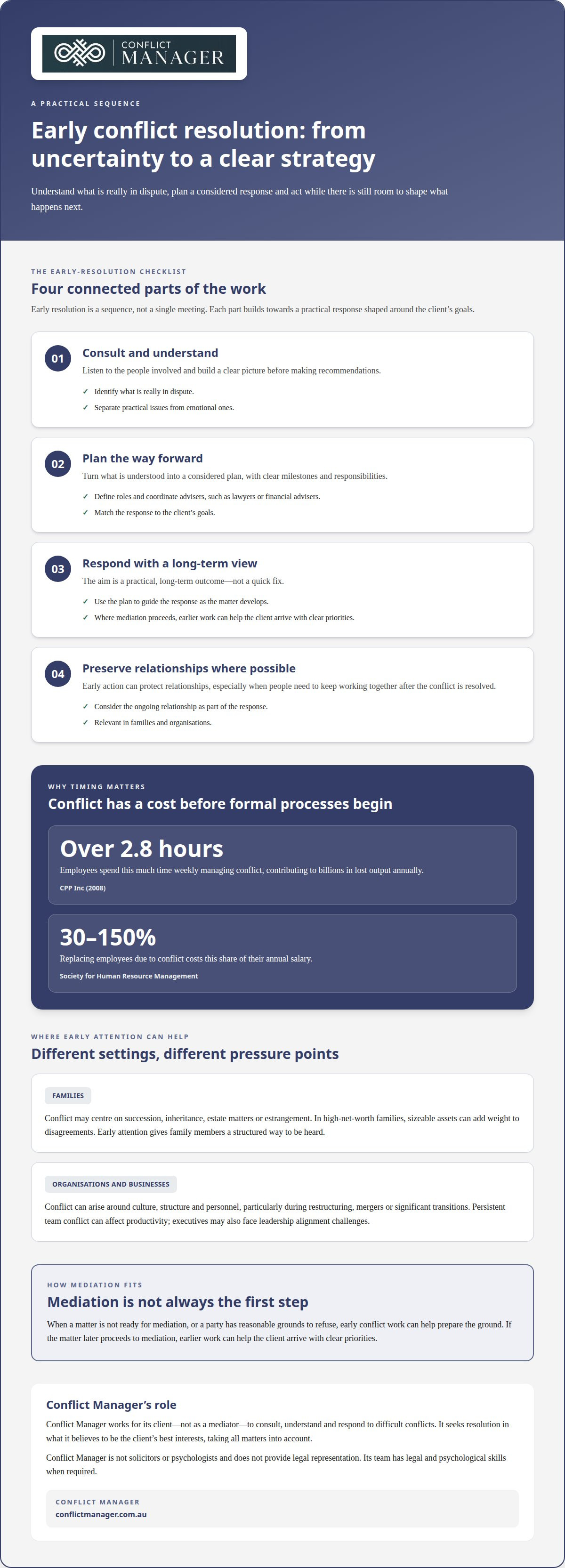
- Unresolved conflict carries a measurable cost: employees spend over 2.8 hours weekly managing conflict, costing billions in lost output annually (CPP Inc 2008).
- Replacing employees due to conflict costs 30-150% of their annual salary (Society for Human Resource Management).
- Conflict Manager works for its client, not as a neutral mediator, to resolve conflict in what it believes are the client's best interests.
Why early action matters
Conflict rarely begins as a formal dispute. It starts as friction: a disagreement over a decision, an unspoken grievance, a change that nobody explained well. Early on, there is still room to choose how to respond.
Once a conflict hardens, positions are usually set. Early resolution works while the people involved are still talking and the issues are still being defined.
The cost of leaving conflict alone
The figures are plain. Employees spend over 2.8 hours weekly managing conflict, costing billions in lost output annually, according to CPP Inc (2008). Replacing employees due to conflict costs 30-150% of their annual salary, according to the Society for Human Resource Management.
Those costs build quietly, well before any formal process starts. They are one reason to act while the conflict is still manageable.
Why internal efforts can struggle
People inside a conflict are rarely placed to see it clearly. Emotions run high, loyalties pull in different directions, and every conversation carries history. An external view brings structure and objectivity to a situation that has become clouded.
What early conflict resolution involves
Early resolution is not a single meeting. It is a sequence of steps that turns uncertainty into actionable strategy.
Understanding the conflict first
The first step is to consult and understand. That means listening to the people involved, identifying what is really in dispute, and separating the practical issues from the emotional ones. A clear picture of the conflict comes before any recommendation.
Planning and responding
From there, a plan sets out clear milestones. Roles are defined, advisers such as lawyers or financial advisers are coordinated, and the response is matched to the client's goals. The aim is a practical, long-term outcome rather than a quick fix.
Preserving relationships where possible
Early action protects relationships. This matters most in families and in organisations where people must keep working together after the conflict is resolved.
Early action in families and organisations
Families
Family conflict often centres on succession, inheritance, estate matters or estrangement. In high-net-worth families, sizeable assets add weight to every disagreement. Addressing these tensions early gives family members a structured way to be heard. You may find these guides useful: resolving blended family estate disputes and discussing inheritance with ageing parents.
Organisations and businesses
Organisations face conflict around culture, structure and personnel, especially during restructuring, mergers or significant transitions. Teams in persistent conflict see productivity suffer. Executives may also face leadership alignment challenges. Early attention to these issues is a form of crisis prevention before formal grievances arise. See managing conflict during organisational change and the conflict management plan for business.
Where mediation fits
Mediation has a place, and it is not always the right first step. When a matter is not ready for it, or a party has reasonable grounds to refuse, early conflict work can prepare the ground. Our guide on when mediation is not the right choice covers this in more detail.
Where a matter does proceed to mediation, the work done earlier means the client arrives with clear priorities.
Conflict Manager: Family Conflict Resolution
Conflict Manager works for its client, not as a neutral mediator between the parties. Our focus is to consult, understand and respond, so that difficult conflicts can be resolved in what we believe are the client's best interests, taking all matters into account.
Conflict Manager is not a law firm or a psychology practice, although our team has legal and psychological skills when they are required. We do not provide legal representation.
To discuss how early action could help with your situation, contact Conflict Manager or visit conflictmanager.com.au.
Frequently Asked Questions
What is early conflict resolution?
It is the practice of understanding and responding to a conflict before it becomes a formal grievance, mediation or court matter.
Why not wait for mediation?
Waiting leaves the conflict to develop on its own. Early work gives you time to clarify the issues and your goals before any formal process begins.
Does Conflict Manager act as a mediator?
No. Conflict Manager works directly for its client, in a strategic and consultative way, to resolve the conflict in the client's best interests.
Is Conflict Manager a law firm or a psychology practice?
No. Conflict Manager is not a law firm or a psychology practice, although its team has legal and psychological skills when they are required.
Who can benefit from early conflict resolution?
Families dealing with succession, estate or estrangement matters, and organisations facing structural change, leadership alignment challenges or persistent team conflict.
How do I get started?
Contact Conflict Manager to discuss your situation.


