

What if disagreement during a change is telling you something the plan needs to address, rather than simply signalling resistance? Managing conflict during organisational change means looking beyond the tension to understand what is driving it. A concern about unclear communication needs a different response from a substantive objection to new roles, priorities or processes.
When discussion becomes personal or decisions stall, it’s understandable to want the disruption to stop quickly. But treating every concern as resistance can deepen mistrust, while leaving conversations unresolved can undermine implementation. Employees may also stay silent if they fear that speaking up will carry consequences.
This guide explains how to identify the source of conflict and respond with a consistent, fair process. You’ll learn how to distinguish communication gaps from genuine concerns, structure conversations so stakeholders can clarify what matters, and establish decisions and follow-through. Where internal relationships or reporting lines make discussion difficult, neutral facilitation can help create space for a focused conversation. The aim is clear communication, workable next steps and stronger working relationships throughout the change.
Key Takeaways
- Change can unsettle roles, expectations and established ways of working. Treat tension as a signal to investigate, not as proof of its cause.
- For managing conflict during organisational change, define the issue, identify who is affected and clarify what needs to be resolved.
- Match the response to the situation: a manager-led discussion, structured team conversation or neutral facilitation may suit different circumstances.
- Use a clear process to prepare, listen, clarify concerns, agree actions, communicate decisions and review progress.
- Keep unresolved issues visible in change governance, with a named owner, clear follow-through and a scheduled review.
Why conflict emerges during organisational change
Organisational change can unsettle roles, expectations, relationships and established ways of working. Even when the intended direction is clear, people may be unsure about what will happen to their responsibilities, who can make decisions or how new processes will work in practice. Those questions can create friction before the change is fully implemented.
Change-related conflict is disagreement or tension connected to an organisational transition, its effects or the way it is managed. It can take the form of productive challenge, an unresolved concern or escalating interpersonal tension. These situations need different responses. A considered objection may expose a risk or practical problem. An unresolved concern may persist because nobody has clarified it. Personal exchanges may mean the way people are discussing the issue also needs attention.
Conflict isn’t proof that change has failed. It can reveal uncertainty, competing priorities or a gap between the intended design and day-to-day work. The Conflict Management Principles overview offers further context on how different approaches can shape responses to disagreement. For leaders, the first task is to understand what the disagreement concerns before deciding how to address it.
What changes when an organisation changes?
Responsibilities, decision rights, workflows and reporting relationships may all shift. The same change can have different effects depending on a person’s role and circumstances. One employee may gain a clearer remit while another faces extra handovers or uncertainty about approvals. Those differing impacts can produce competing views without either person simply opposing change.
Hypothetical example: A team introduces shared responsibility for customer handovers. One employee sees the change as better coordination; another is unsure who owns follow-up decisions. Their disagreement may point to an unclear workflow, not a lack of commitment. A practical first step is to map who completes each handover, who makes follow-up decisions and where responsibility passes from one person to another.
When does disagreement become a conflict to manage?
Look for observable patterns: the same disagreement remains unresolved across discussions, communication breaks down, or decisions are repeatedly reopened without new information. These signs suggest the issue is affecting the work and needs a clearer process.
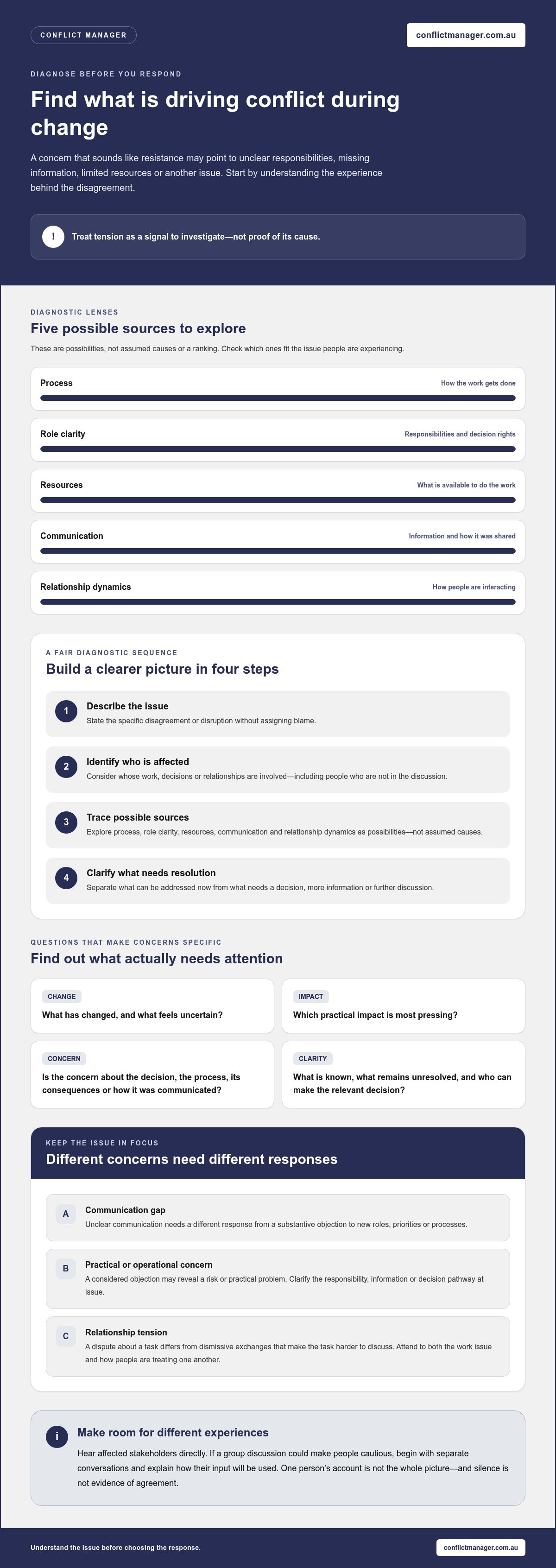
Separate disagreement about the change from tension about how people are treating one another. A dispute about who approves a task differs from dismissive exchanges that make it harder to discuss the task. Both deserve attention, but they may need different responses. Silence isn’t evidence of agreement; people may have questions they haven’t raised. Managing conflict during organisational change starts with noticing these distinctions rather than labelling dissent as resistance.
Diagnose the source before managing conflict during organisational change
The same disagreement can have different causes. A concern that sounds like resistance may reflect unclear responsibilities, missing information, limited resources or a decision pathway that hasn’t been explained. Before choosing a response, establish what’s happening and what needs to change.
Identify the source before selecting a response. A fair process depends on addressing the issue people are actually experiencing.
Use this sequence to build a clearer picture:
- Describe the issue: State the specific disagreement or disruption without assigning blame.
- Identify who is affected: Consider whose work, decisions or relationships are involved, including people not present in the discussion.
- Trace possible sources: Explore process, role clarity, resources, communication and relationship dynamics as possibilities, not assumed causes.
- Clarify what needs resolution: Separate what can be addressed now from what requires a decision, more information or further discussion.
Hear affected stakeholders directly. If a group discussion could make people cautious, begin with separate conversations and explain how their input will be used. This can bring different experiences to light without treating one person’s account as the whole picture. In managing conflict during organisational change, neutrality matters: the aim is to understand the issue, not to build a case against someone.
Which questions reveal the underlying concern?
Ask what has changed, what feels uncertain and which practical impact is most pressing. Then clarify whether the concern is about the decision itself, the process used to reach it, its consequences or how it was communicated. Check what information is known, what remains unresolved and who has authority to make the relevant decision. For example, ask which responsibility is unclear, what information would help, and what effect the issue is having on the work. Specific questions turn general frustration into an issue that can be examined.
How can leaders separate change issues from relationship issues?
A practical disagreement may ease once people have clearer information, responsibilities or decision pathways. If communication breakdown or strained interactions continue after the operational question is clarified, the relationship dynamic may also need attention. These issues can overlap. Distinguishing them isn’t about assigning blame; it helps leaders choose a proportionate response and avoid expecting a process fix to resolve a personal breakdown, or vice versa.
A simple record can support the next step: note the concern, who is affected, what is known, what remains open and who can decide. Where reporting lines or internal relationships make candid discussion difficult, neutral stakeholder facilitation can help stakeholders clarify concerns and identify workable next steps.
Choose a fair response to conflict during organisational change
The right response depends on what the disagreement involves, who is affected and whether people can speak candidly. A direct conversation may be enough for a practical misunderstanding. A wider team issue may need a structured discussion, while entrenched positions or disputed authority can make neutral facilitation more appropriate. Match the process to the situation, rather than assuming dissent is misconduct.
Use this comparison to guide the choice. Decision-makers remain accountable for organisational choices, whichever conversation format is used.
| Situation | Response | Facilitator | Follow-up |
|---|---|---|---|
| A contained concern between people who can speak openly | Direct manager-led discussion | The manager, if they aren’t personally involved in the dispute | Record agreed actions. The authorised decision-maker confirms any decision or explains what remains open. |
| A shared issue affecting a team’s work or handovers | Structured team conversation with a clear purpose and balanced opportunity to contribute | A manager or chair able to guide discussion impartially | Summarise areas of agreement, unresolved questions and who will make or communicate decisions. |
| Discussions have stalled, positions are entrenched, or the leader is part of the dispute | Neutral stakeholder facilitation | A neutral facilitator structures dialogue without taking ownership of organisational decisions | Decision-makers consider the issues raised, clarify next steps and communicate their decisions. |
When is an internal conversation appropriate?
A manager-led discussion can work when the concern is contained and those involved can participate openly. Set a clear purpose, give each person balanced time to explain their view, and record agreed actions. The manager should listen without implying that listening settles the matter. They should distinguish concerns they can address from decisions that sit with another authorised person.
For a team-wide issue, a structured conversation can bring different accounts into view. Its limitation is that people may hold back if the chair has a stake in the outcome or controls decisions about their roles. If authority, reporting lines or personal relationships are contested, an internal leader may be too involved to provide a credible process.
When can neutral facilitation help?
Consider neutral facilitation when discussion repeatedly stalls, people have become fixed in opposing positions, or a leader’s involvement makes impartial chairing difficult. A facilitator can structure dialogue, help stakeholders clarify concerns and identify workable next steps. They don’t take decision-making away from the organisation; leaders retain responsibility for choices, communication and implementation.
For support with a structured discussion, Explore Conflict Manager’s facilitation approach.
Build a practical process for managing conflict during organisational change
A consistent process makes it easier to respond fairly, even when the concern is emotionally charged or has implications for the change plan. Adapt the steps to the issue, while making responsibility for each decision and action clear.
- Prepare: The responsible manager or facilitator defines the purpose, identifies who should be heard and gathers relevant information, such as the change decision, affected roles and unresolved questions. Confirm who has authority to make organisational decisions.
- Listen: The manager or facilitator invites affected stakeholders to describe their concerns and practical impacts. Allow different accounts to be heard, and explain how information will be handled rather than promising absolute confidentiality.
- Clarify: The facilitator or manager summarises the issues and checks that participants recognise their views in the summary. Separate matters that can be addressed through discussion from matters requiring an organisational decision.
- Agree actions: Participants identify workable next steps where possible. The relevant decision-maker determines issues within their authority, or names who will decide and what information is still needed.
- Communicate: The responsible leader shares agreed actions, decision ownership and the timing of the next update with affected stakeholders. Explain what is known and what remains undecided.
- Review: The manager or process owner checks whether actions occurred and whether the original concern has changed, remains open or needs a different response. Set a review date instead of leaving follow-through informal.
A written conflict resolution policy can make this process easier to apply consistently. It should explain how people can raise concerns, who receives them, what response process follows, how confidentiality is bounded and when the policy will be reviewed. Keep records proportionate and focused: concern raised, agreed action, owner, decision-maker and review date.
How should leaders communicate during the process?
Give affected teams a consistent account of what’s known, what remains undecided and when they can expect an update. Consistency doesn’t mean every person has the same experience; make room for questions and different impacts. Be precise about how information will be shared, and don’t promise an outcome or confidentiality beyond what the process can responsibly support.
How can leaders check whether the response is working?
At review, confirm whether actions were completed and ask whether the initial concern has shifted or remains unresolved. Invite feedback on fairness, clarity and participation. Agreement isn’t the only measure of progress: stakeholders may still disagree while understanding the decision, next steps and who is accountable for them.
For support establishing a structured approach to organisational conflict, Discuss a structured approach with Conflict Manager.
Sustain organisational change with clear decisions and supported dialogue
A difficult conversation is useful only if its outcomes remain visible afterwards. During change, unresolved concerns can be lost among competing priorities unless leaders carry them into the appropriate governance process. Record the issue, who owns the next step, who can make the relevant decision and when it will be reviewed. This prevents an open question from being mistaken for a resolved one.
Sustainable outcomes don’t require universal agreement. They may mean a clarified decision, a practical adjustment or a shared understanding of what happens next, even where people continue to hold different views. In managing conflict during organisational change, reliable follow-through is the test: visible action, named responsibility, clear communication and a scheduled review.
What should happen after a difficult conversation?
Summarise decisions and actions in neutral language. Avoid character judgements; focus on what was raised, what was agreed and what remains unresolved. Assign an owner to each action and set a review point. Share relevant outcomes with affected stakeholders while respecting appropriate confidentiality, and make clear which matters can be communicated and which cannot.
Bring unresolved issues into change governance with enough context for decision-makers to act. If circumstances shift, or agreed actions don’t address the concern, revisit it rather than relying on an outdated record. A short status update can distinguish between work in progress, a decision still required and an issue that has been addressed.
How can an external facilitator support a change process?
When internal relationships or reporting lines make dialogue difficult, external facilitation can provide structure and a neutral perspective. A facilitator helps stakeholders express competing views, clarify where their concerns differ and identify workable next steps. This can make discussion more focused, particularly when internal efforts have stalled or participants find it difficult to speak openly.
Facilitation supports the conversation; it doesn’t transfer organisational authority. Leaders remain responsible for decisions, communicating their rationale and implementing agreed changes. They can use the facilitator’s work to understand stakeholder perspectives and consider what action is within their remit, while keeping accountability clear.
Conflict Manager provides organisational conflict guidance and stakeholder facilitation to help organisations clarify issues and work towards sustainable outcomes. Learn about stakeholder facilitation.
Carry clarity and accountability into the next phase
Conflict during change is information to examine, not a verdict on the people involved or the change itself. A sound response starts by identifying what is driving the concern, then choosing a fair conversation process that fits the situation. Keep unresolved issues visible, assign responsibility for next steps and review whether actions have addressed the underlying concern.
That discipline helps leaders maintain trust even when stakeholders don’t agree on every decision. Managing conflict during organisational change is less about forcing consensus and more about making concerns heard, decisions clear and follow-through dependable.
When internal dialogue needs more structure, Conflict Manager provides expert guidance for organisational disputes and structural change, with stakeholder facilitation focused on clarity and sustainable outcomes.
With a clear process and steady follow-through, teams can move through change with greater confidence in how concerns are heard and addressed. Discuss stakeholder facilitation with Conflict Manager.
Frequently Asked Questions
What causes conflict during organisational change?
Conflict can arise when people are uncertain about responsibilities, decisions, resources or the practical effects of a proposed change. It may also reflect concerns about how the change is being managed, rather than opposition to the change itself. For example, a team member may question a new workflow because approval responsibilities aren’t clear. Listen for the specific concern before choosing a response; treating every concern as resistance can obscure problems that need attention.
How should managers handle conflict during organisational change?
Start by describing the issue without blame, then hear from the people affected and clarify the concern or decision at its centre. Managing conflict during organisational change may call for a direct conversation, a structured team discussion or neutral facilitation, depending on the circumstances. After the discussion, confirm actions, owners and review points. Keep people informed about what’s known, what remains undecided and when they can expect an update.
Can conflict be positive during organisational change?
Disagreement can bring overlooked risks, competing needs or implementation problems into view. Its value depends on whether people can raise concerns constructively and whether leaders respond with clarity and follow-through. Not every conflict is helpful, and it shouldn’t be left unresolved simply because it may contain useful information. The aim isn’t to eliminate differences; it’s to understand what they signal and address the underlying issue where possible.
When should an organisation use a neutral facilitator?
Consider neutral facilitation when discussions repeatedly stall, positions become entrenched or the people expected to manage the conversation are involved in the dispute. A facilitator can structure dialogue, support balanced participation and help stakeholders clarify their concerns. This can make competing perspectives easier to understand without transferring decision-making authority. Leaders remain responsible for determining the change, making organisational decisions and communicating outcomes to those affected.
What should a conflict resolution policy include during organisational change?
A practical policy or protocol should explain how people can raise concerns, who responds, how conversations are structured and how agreed actions are reviewed. It should also set out confidentiality boundaries and how unresolved issues reach an appropriate decision-maker. Keep the process accessible and proportionate to the concern. Review the protocol as the organisation changes so responsibilities, access points and communication pathways remain clear for affected people.
How can leaders tell whether conflict is about the change or a relationship?
Clarify whether the concern centres on a decision, process, role, resource or consequence, then consider whether difficult interactions continue beyond that practical issue. The two can overlap: a change to responsibilities may intensify tension between colleagues. Avoid drawing conclusions from silence or a single disagreement. Listening separately to affected people can help clarify which matters need a decision, which need a structured conversation, and whether both responses are required.
What should leaders do if conflict continues after a change decision?
Restate what has been decided, what remains open and who owns the next step. Record the concern and agreed actions, then set a review point to assess whether the practical impact has changed. If the issue remains unresolved, identify whether further information, a different decision or a more structured discussion is needed. Ongoing disagreement doesn’t automatically mean the decision or conversation has failed, but it does call for clear follow-through.


