

What happens after everyone leaves the mediation room, when old communication habits and unresolved tension are still there? Rebuilding business relationships after mediation takes more than reaching an agreement. It means turning commitments into consistent, observable actions in the day-to-day work.
It’s reasonable to feel cautious. You may be unsure how to raise an issue without reigniting conflict, or concerned that agreed actions will lose momentum once the formal process ends. A workable relationship doesn’t require instant trust or the absence of disagreement. It needs clear expectations, steady communication and room for confidence to build over time.
This guide explains how to turn mediation outcomes into practical commitments, establish communication that supports follow-through and discuss remaining tensions constructively. It also covers how structured reviews can keep progress visible, and when neutral facilitation may help if direct conversations become difficult. The aim isn’t to return to business as usual overnight, but to create a more reliable way of working together.
Key Takeaways
- Rebuilding business relationships after mediation means restoring workable cooperation, not expecting the relationship to return to exactly how it was before.
- Turn broad agreements into practical actions by recording who is responsible, what they’ll do and when progress will be reviewed.
- Use structured check-ins to address emerging concerns without reopening every detail of the original dispute.
- If an agreed action slips, check the shared record, discuss its impact and agree on a clear next step.
- Notice whether setbacks are isolated or recurring, and consider neutral facilitation when repeated friction makes direct conversations difficult.
Rebuilding business relationships after mediation starts with realistic expectations
A dispute can be resolved while the working relationship still feels uncertain. People may remain cautious, communication may feel more formal, and familiar routines may have changed. That doesn’t mean mediation has failed. It means the parties are adjusting to a different way of working after a period of friction.
Rebuilding a business relationship after mediation means restoring enough clarity, respect and cooperation to work together reliably, without requiring the relationship to return to how it was before. The goal is a functional business relationship, not necessarily personal closeness or agreement about every part of the past.
Mediation gives parties a structured process for addressing a dispute and reaching decisions. Putting those decisions into practice is a separate phase, where confidence develops through the way people work together over time.
What does rebuilding a business relationship after mediation mean?
Look for observable signs of cooperation. People share relevant information reliably, understand who is responsible for decisions and complete agreed actions consistently. For example, if two business partners agree on a clearer approval process, progress is visible when both follow it, even if they still interpret the original disagreement differently.
Constructive work doesn’t depend on settling every difference of memory or opinion. Professional respect means engaging appropriately and recognising each party’s role. Cooperation means being able to make and carry out decisions together. Neither requires personal closeness, immediate warmth or complete trust.
Why an agreement does not automatically restore trust
An agreement records decisions. It can clarify expectations, responsibilities and next steps, but it can’t change established behaviour or reassure people that it will change. That evidence comes from what happens afterwards.
Trust tends to build through repeated conduct over time: information is shared when expected, commitments are met, and concerns are raised without being dismissed or escalated. One conversation may establish an intention. Consistent actions make that intention credible.
Caution isn’t proof that the relationship is beyond repair. It can be a sensible response to uncertainty. For business owners and leaders, the practical test is whether agreed actions are being followed through. Confidence may take longer to catch up. Keeping those measures separate helps everyone assess progress without demanding immediate reconciliation or treating every awkward interaction as a setback.
How to turn mediation outcomes into everyday business practices
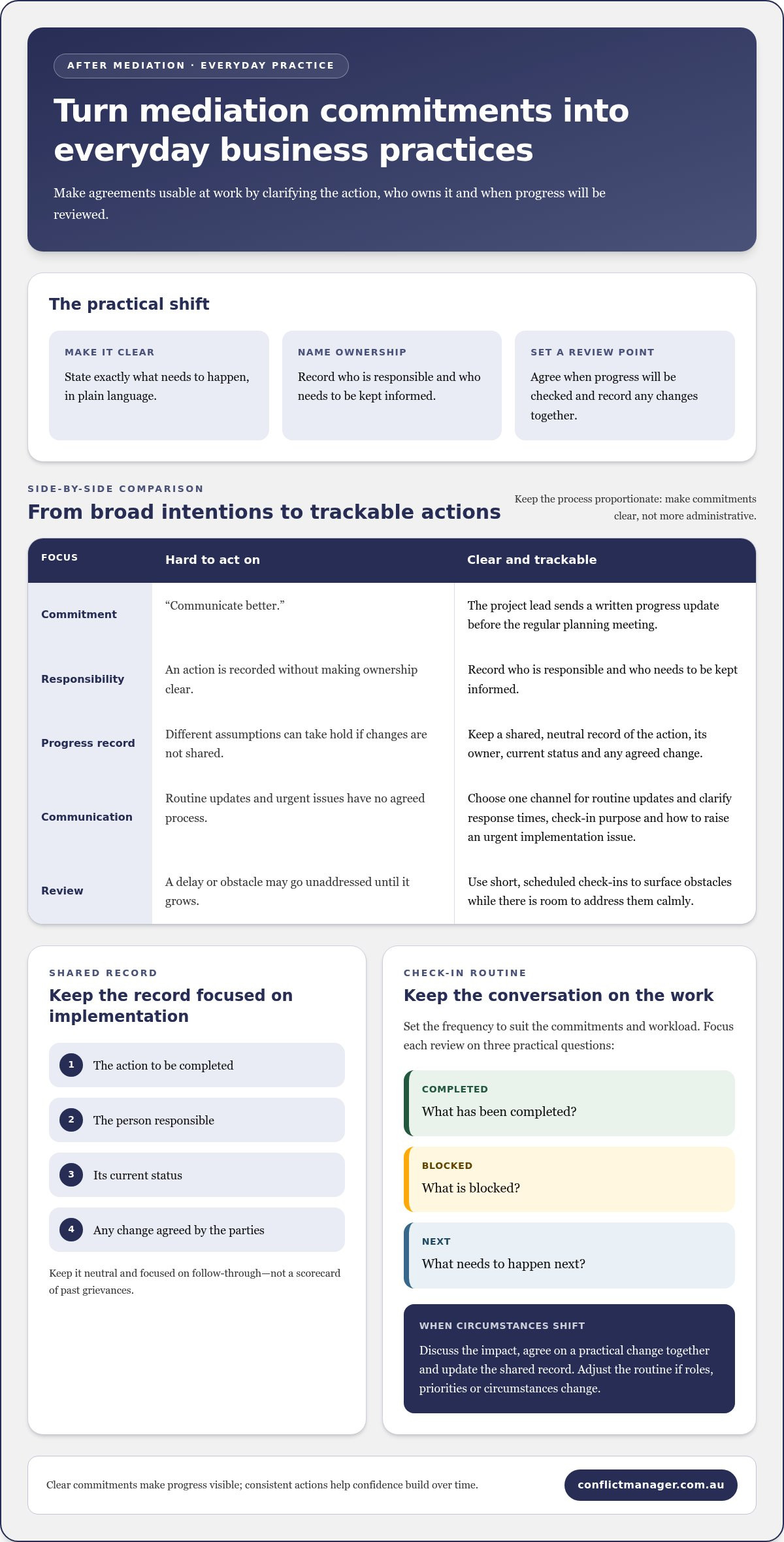
An agreement becomes useful in daily work when people can see what needs to happen, who is responsible and how progress will be checked. Keep the process proportionate. The aim is to make commitments clear, not to add another layer of administration.
Clear ownership and agreed review points turn commitments into actions that can be tracked and adjusted. Document each commitment, assign an owner, set a review point and record any changes agreed by the parties.
Make mediated commitments specific and trackable
Restate each commitment in plain language and check that everyone understands it the same way. Broad intentions such as “communicate better” are difficult to act on. A more specific commitment could be that the project lead sends a written progress update before the regular planning meeting.
For each action, record who is responsible, who needs to be kept informed and when progress will be reviewed. Keep the shared record neutral and focused on implementation: the action, its owner, its current status and any agreed change. It should support follow-through, not become a scorecard of past grievances.
If responsibilities or business conditions change, update the record together. This helps keep it useful and reduces the risk of different assumptions taking hold.
Agree on communication and review routines
Choose one agreed channel for routine updates, such as a shared email thread or project workspace, and clarify what belongs there. Set practical expectations for response times, the purpose of check-ins and how to raise an urgent implementation issue. A defined process helps prevent an ordinary delay from turning into a wider dispute about communication.
Short, scheduled check-ins can surface obstacles while there is still room to address them calmly. Keep the discussion focused: what has been completed, what is blocked and what needs to happen next? Set the frequency to suit the commitments and workload, rather than adding meetings for their own sake. Adjust the routine if roles, priorities or circumstances shift, and record any changes everyone agrees to.
For example, if a supplier handover depends on information from two business partners, the record could identify who supplies each item and when they’ll review readiness together. If a deadline becomes unrealistic, the people involved can discuss the impact and agree on a revised date through the same routine.
This structure makes rebuilding business relationships after mediation more practical: people can focus on their work while commitments remain visible. If direct coordination is difficult across several stakeholders, stakeholder facilitation can help establish a clear process for communication and review.
Repairing trust after mediation without reopening the dispute
Repair doesn’t require another full account of what went wrong. Repeatedly revisiting disputed details can pull people back into familiar positions, especially when their interpretations haven’t changed. Instead, focus on acknowledging the effects that still matter to the work and agreeing how to handle them differently from here.
For example, a person might say, “When decisions changed without notice, I couldn’t plan my team’s work. I need changes to be shared through our agreed process.” This describes an impact and a practical need without claiming to know the other person’s motives. Keep the conversation anchored to future working arrangements and existing commitments. If it becomes circular or starts escalating, pause and return to the agreed process rather than pressing for immediate agreement.
Rebuilding business relationships after mediation can involve acknowledgement, consistent conduct and clear boundaries without promising reconciliation. People may cooperate professionally while trust remains cautious, or personal closeness may never return. Assess progress by how the parties communicate and deal with differences over time.
Choose a follow-up approach that fits the situation
Direct check-ins can work well when parties can speak candidly, stay focused on practical matters and raise concerns without the discussion becoming adversarial. Neutral facilitated follow-up may be useful when communication repeatedly breaks down, interpretations of the agreement are contested, or commitments continue to be missed. A facilitator can structure the discussion so stakeholders clarify the issue and identify workable next steps.
| Self-managed follow-up | Neutral facilitated follow-up |
|---|---|
| Useful when communication is steady and the parties can address concerns directly. | Useful when conversations become circular, contested or difficult to manage. |
| Parties set the agenda, discuss progress and agree on adjustments themselves. | A neutral facilitator guides the discussion and helps clarify shared next steps. |
| May suit routine matters that can be resolved through ordinary check-ins. | May help when repeated friction is affecting implementation or cooperation. |
Facilitation supports progress. It doesn’t mean mediation has failed. It can provide structure when direct conversations no longer produce clarity, so attention can return to responsibilities and future conduct rather than renewed arguments about the past. Neither approach guarantees trust will be restored. Each offers a way to address implementation and communication with greater purpose.
A practical plan for handling setbacks after business mediation
A missed action can create concern, particularly when the dispute is recent. Responding promptly and proportionately helps keep a practical problem from becoming a new argument about intent. Start with what can be verified, then follow the agreed process.
Use this sequence:
- Identify the issue: State which action was delayed or not completed, without assuming why.
- Check the shared record: Confirm what was agreed, who owns the action and when it was due.
- Discuss the impact: Explain how the delay affects the work or other commitments.
- Agree a next step: Confirm whether the action remains workable, and record any change to its owner, timing or review point.
A calm, specific opening can help: “The information wasn’t ready for the handover meeting, which has delayed the next step. Is the current deadline still realistic?” This invites an explanation and keeps attention on resolving the practical issue. If business conditions have changed, discuss revised timing or responsibilities openly rather than relying on an informal assumption that the original commitment no longer applies.
Distinguish a delay from a pattern
A one-off delay, followed by a clear explanation and a workable adjustment, may need nothing beyond an update to the shared record. Repeated missed actions, recurring communication breakdown or ongoing disagreement about responsibilities may indicate that the current arrangements need more structured attention. Look at the pattern and its effect on the work, not just one difficult exchange.
Use the agreed escalation route before frustration spills into informal workplace channels. Keep the discussion focused on the relevant commitment or working arrangement. If direct conversations repeatedly stall, a facilitated stakeholder discussion can provide structure for clarifying the issue and agreeing on practical next steps.
Use an early review to reset expectations
At an early post-mediation review, check the essentials together. Keep the tone factual and the record current.
- Which commitments have been completed, delayed or changed?
- Are the responsible people and timeframes still realistic?
- What impact has any setback had on other work?
- What is the next action, who owns it and when will it be reviewed?
- Does the current communication or escalation process need adjusting?
Handled this way, a setback becomes information for improving the working arrangement, rather than automatic evidence that rebuilding business relationships after mediation is impossible. If recurring friction is making follow-through difficult, neutral facilitation for your stakeholders can support a more structured discussion.
Sustaining business relationships after mediation with structured support
Progress after mediation is best judged by what happens in the work, not by statements of goodwill alone. Are agreed actions being completed? Do people share relevant information clearly, understand their responsibilities and raise differences without returning to blame? These behaviours suggest the relationship is becoming more workable, even if some caution remains.
Review the arrangements as well as the interactions. Commitments should remain clear, proportionate and practical for the people responsible for carrying them out. Business priorities can shift, roles can change and a process that once made sense may need adjustment. Continued disagreement isn’t necessarily a problem if stakeholders can discuss it constructively, make decisions and keep essential work moving.
How to review whether the relationship is improving
At regular review points, consider whether communication is reliable, responsibilities remain understood and agreed actions are being completed. Look for patterns in day-to-day coordination, not just one smooth meeting or difficult exchange. If a commitment repeatedly creates confusion, clarify the expectation and update the working arrangement rather than relying on goodwill to fill the gap.
Choosing the right level of follow-up support
Ordinary check-ins are often sufficient when actions are straightforward and people can raise concerns directly. Keep them purposeful: review what’s progressing, identify any obstacle and agree what happens next. As communication stabilises, the parties may need less structure.
Repeated friction calls for more attention. If stakeholders are struggling to agree on responsibilities, interpret commitments differently or have conversations that regularly stall, neutral facilitation can provide a structured way to clarify the issues and identify workable next steps. It isn’t a sign that mediation has failed. It’s a considered option when direct follow-up isn’t creating enough clarity.
Conflict Manager provides conflict resolution and stakeholder facilitation to help businesses clarify communication and work through complex dynamics. For leaders and business owners, rebuilding business relationships after mediation is an ongoing practice: maintain what works, review what doesn’t and adjust the process when circumstances change. The measure isn’t perfect agreement, but a reliable capacity to coordinate and manage disagreement.
If a business relationship remains difficult to manage, you can discuss a business conflict with Conflict Manager and explore what structured support may help clarify next steps.
Build a steadier way of working together
Rebuilding business relationships after mediation is a gradual process grounded in what people do next. Clear commitments, named responsibilities and regular reviews help turn an agreement into everyday practice. When a setback occurs, address its practical impact and agree on a proportionate next step rather than assuming the worst.
Progress doesn’t depend on complete trust or agreement about the past. Reliable follow-through, clear communication and the ability to manage differences constructively are stronger signs that the relationship is becoming workable. If direct check-ins no longer create clarity, structured support can help stakeholders find a more productive way forward.
Conflict Manager provides expert guidance for internal business disputes and structural change. Through stakeholder facilitation, conversations can focus on clarity, stability and sustainable outcomes. If you’re working through a complex business relationship, discuss a clearer path forward with Conflict Manager.
With steady follow-through and the right support when needed, a difficult transition can become a more manageable way of working together.
Frequently Asked Questions
Can a business relationship recover after mediation?
Yes, a business relationship can become workable again after mediation, although it may not return to its previous form. Recovery can mean communicating reliably, understanding responsibilities and completing agreed actions, even if the parties still disagree about parts of the dispute. Focus on observable cooperation rather than expecting immediate closeness or complete trust. If people can manage differences respectfully and keep essential work moving, the relationship may be on a steadier footing.
How do you rebuild trust after mediation at work?
Rebuilding business relationships after mediation relies on consistent behaviour over time, not reassurance alone. Make commitments specific, follow through, communicate changes promptly and raise concerns through an agreed process. For example, if a manager commits to sharing decisions before a project meeting, trust can grow as that happens consistently. Acknowledge the practical impact of past issues without assuming motives, and set boundaries that help everyone work together professionally.
What should happen after a business mediation agreement?
Translate the agreement into clear actions. Record each commitment in plain language, identify who is responsible, note who needs updates and set a review point. Agree on a channel for routine communication and how to raise implementation problems. At check-ins, review what is complete, what is delayed and whether responsibilities or timing need adjustment. Keep the record focused on current actions and agreed changes, rather than using it to revisit past grievances.
What if one party does not follow the mediation agreement?
Start by checking the shared record and identifying the specific action that was missed. Raise its effect on the work without assuming why it happened, then ask whether the commitment remains practical and agree on a next step. Record any revised action, owner or timeframe. A one-off delay may need a straightforward adjustment. Repeated missed commitments or stalled conversations may call for structured follow-up, including neutral facilitation.
How long does it take to rebuild a business relationship after mediation?
There’s no fixed timeframe for rebuilding a business relationship after mediation. The pace depends on the history of the dispute, how complex the working arrangements are and whether people follow through consistently. Rather than setting a deadline for trust, review practical signs of progress: clear communication, completed commitments and disagreements handled constructively. If progress stalls, clarify expectations and consider whether a more structured review would help.
Should we use another mediator after business mediation?
Not necessarily. If direct communication is functional and parties can resolve routine issues through agreed check-ins, further facilitation may not be needed. If discussions repeatedly stall, commitments are interpreted differently or stakeholders struggle to clarify responsibilities, neutral facilitation can provide a structured process for identifying workable next steps. Conflict Manager’s stakeholder facilitation and organisational conflict management can support clarity and stability as parties put agreements into practice.


