

If the other party isn’t following your mediated agreement, should you return to mediation or pursue formal enforcement? The answer depends less on what was discussed than on how the outcome was recorded. Returning to mediation may help when both sides are willing to clarify commitments or negotiate revised arrangements, but a mediator can’t compel compliance.
It’s understandable to expect an agreement reached together to be honoured. But informal notes, a parenting plan, a signed agreement and a court-approved consent order don’t necessarily have the same legal effect. Start by identifying exactly what document you have and what it says before deciding whether to reopen discussions or explore enforcement.
This article explains how the form of a mediated agreement can affect its legal significance, when a formal process may be relevant, and how to assess whether another facilitated conversation could help. It distinguishes negotiating a change from seeking compliance with an existing obligation. Where constructive discussion remains possible, an impartial facilitator can help clarify disputed commitments and explore workable terms, while keeping mediation separate from legal processes.
Key Takeaways
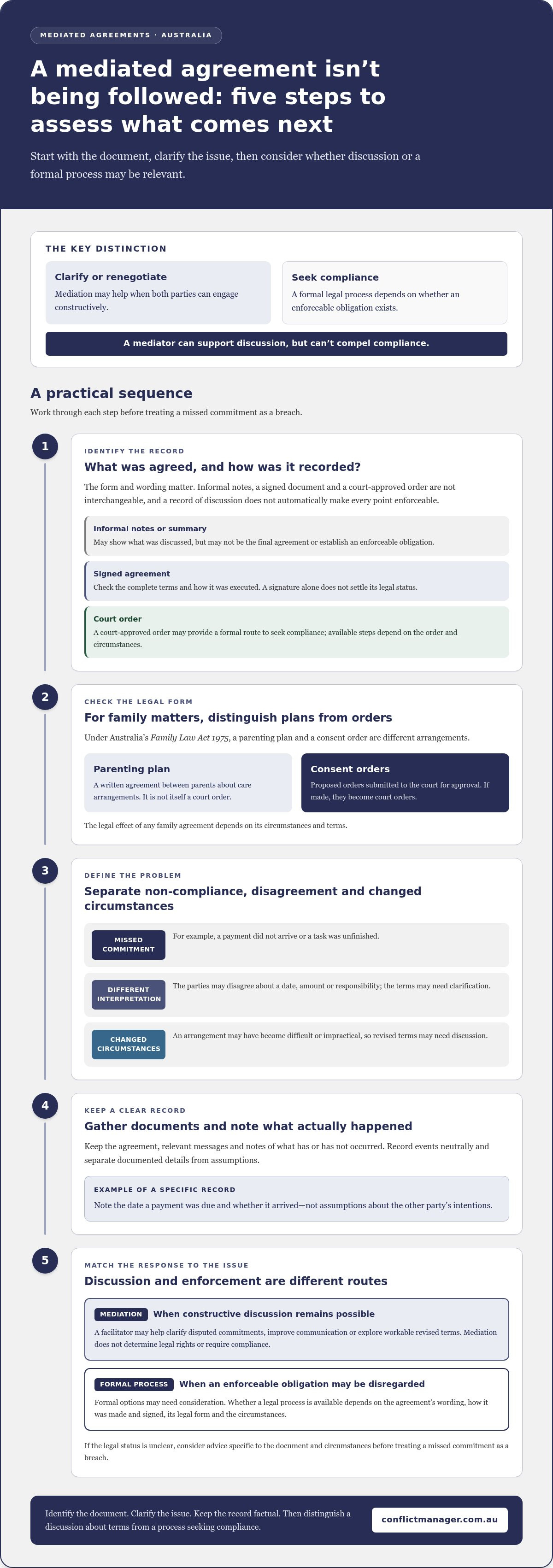
- Identify what was agreed and how it was recorded. The document’s form, wording and context can affect its legal significance.
- Distinguish seeking compliance through a formal legal process from negotiating a clarification or revised arrangement.
- Returning to mediation may help when both parties can engage constructively, but mediation can’t compel anyone to comply.
- Before choosing a next step, gather relevant documents, identify the disputed commitment and separate documented details from assumptions.
- An impartial facilitator can support clearer communication and focused discussion. Questions about legal rights and enforcement are separate.
Mediated agreement not being followed? Start by identifying the outcome
It can be unsettling to rely on an agreement, then see a commitment missed or interpreted differently. Before deciding what to do, identify the outcome the parties actually reached and how it was recorded. Mediation may result in informal notes, a signed document or, in some circumstances, an agreement formalised through a court process. These records aren’t interchangeable. The document’s form and wording matter.
The process is built around parties reaching their own resolution. The Mediation overview describes this central feature: a mediator helps people work towards agreement rather than imposing a decision. That distinction remains important afterwards. Returning to mediation may help parties clarify or renegotiate an issue, but it doesn’t require anyone to comply.
What does “enforce a mediated agreement” mean?
There’s a difference between asking someone to honour an outcome and seeking a formal legal remedy. Enforcement means using an applicable legal process to seek compliance with an obligation that is legally enforceable. Whether that route is available depends on the circumstances, including the agreement’s wording, how it was made and signed, and its legal form.
A record of discussions may help establish what was considered, but it doesn’t automatically make every point enforceable. Nor should you assume a signed agreement has the same effect as a court order. In Australian family matters, different documents can have different legal consequences. If the legal status is unclear, consider getting advice specific to the document and circumstances before treating a missed commitment as a breach.
Is the issue non-compliance, disagreement or changed circumstances?
Be precise about what has happened. A missed payment or unfinished task may appear to be non-compliance. But if the parties disagree about a date, amount or responsibility, the immediate issue may be how to interpret the terms. Circumstances can also change, making an arrangement difficult or impractical even if both parties originally intended to follow it.
These distinctions can help determine the next step. If the wording is unclear, a structured conversation may help establish what each person understood. If circumstances have shifted, the parties may need to discuss revised arrangements. If an enforceable obligation is being disregarded, formal options may need consideration. Mediation can support constructive discussion, but it can’t determine legal rights or compel compliance.
Keep relevant records, including the agreement, messages and notes of what has or hasn’t occurred. Record events neutrally and separate what is documented from what you believe was intended. For example, note the date a payment was due and whether it arrived, rather than making assumptions about the other party’s intentions. Calm, specific communication can preserve room for resolution while you work out whether the issue calls for clarification, renegotiation or a formal response.
How the agreement’s form can affect enforcement in Australia
The record of mediation is a starting point, not a complete answer. Informal notes, a signed settlement document and a court order may carry different weight, but the label alone doesn’t determine the legal effect. The context, precise wording, how the document was made and the law that applies all matter.
| Form of record | What to consider |
|---|---|
| Informal notes or summary | May help show what was discussed, but may not be the final agreement or establish an enforceable obligation. |
| Signed agreement | Check the complete document, its terms and how it was executed. A signature doesn’t automatically settle its legal status. |
| Court order | A court-approved order may provide a formal route to seek compliance. The available steps depend on the order and circumstances. |
Parenting plans, consent orders and other family agreements
Under Australia’s Family Law Act 1975, a parenting plan and a consent order are distinct arrangements, not interchangeable names for the same outcome. A parenting plan is a written agreement between parents about care arrangements; it isn’t itself a court order. Consent orders are proposed orders submitted to the court for approval. If made, they become court orders, which can affect the options available if a term isn’t followed. The legal effect of any family agreement depends on its circumstances and terms.
Signed settlement documents and organisational agreements
For a business or organisational dispute, review the final signed document, not just the mediator’s notes or an email summarising the discussion. Check whether the agreed terms were incorporated into another document and whether it includes a dispute-resolution clause explaining what happens if a disagreement arises. Contracts and settlement arrangements vary, so don’t assume every mediated outcome is a standard contract or has the same enforcement route.
The US Department of State provides a broader overview of international frameworks for the enforcement of settlement agreements. It offers context, not guidance on Australian law. The relevant Australian rules depend on the agreement and dispute involved.
Once you’ve identified the document, you can better assess whether the issue calls for legal clarification, a formal process or renewed discussion. Returning to mediation may help parties clarify terms or negotiate workable changes, but it doesn’t convert an agreement into a court order or compel compliance. Where communication has stalled, structured family conflict resolution can help parties work through differing understandings and explore a constructive way forward.
Returning to mediation or seeking enforcement: which route fits?
The right next step depends on what is disputed, whether the other party is willing to engage and what legal form the agreement takes. Renewed mediation can help parties reach clarity or revise arrangements, but it can’t make someone comply. Legal advice may help explain how a document should be understood, while a formal legal process may be relevant where an enforceable obligation is disputed or ignored.
When returning to mediation may be constructive
A further mediation may be useful if both parties are prepared to participate and there’s room to resolve the issue through discussion. That might mean clarifying an ambiguous term, working through a practical obstacle or considering revised commitments because circumstances have changed. A neutral facilitator can keep the conversation focused on the specific point in dispute, each party’s concerns and workable options, rather than allowing earlier conflict to dominate.
Before agreeing to changes, identify what needs to be different and how any revised outcome will be recorded. Depending on the document and circumstances, it may be sensible to have the new terms reviewed so they’re properly reflected in the relevant agreement or order. Mediation supports agreement; it doesn’t determine legal rights.
When a formal enforcement question needs legal advice
Legal guidance may be important if there’s an urgent risk, a safety concern, repeated non-compliance or an alleged breach of a court order. It can also help where the parties dispute whether the agreement has legal effect or what a term requires. The appropriate steps depend on the document, the facts and the relevant Australian law, so avoid assuming that a particular court process or remedy applies.
Online guidance about failure to comply with a mediation agreement can introduce general issues, but it isn’t a substitute for advice about an Australian agreement. Different legal systems treat settlement documents differently. A solicitor can explain the implications of the specific terms and available options.
Use a simple decision check: Is the main problem unclear wording, a practical barrier, changed circumstances or refusal to honour a clear commitment? Is the other party willing to discuss it? Is there an immediate safety or legal concern? Your answers can help distinguish a negotiation problem from an enforcement question, while recognising that one route doesn’t always rule out the other.
Conflict Manager facilitates communication and helps parties explore clear, sustainable outcomes. It doesn’t provide legal representation or compel compliance. If constructive discussion remains possible, returning to mediation may help clarify the disputed commitment or consider revised terms. Keep questions about legal effect or enforcement separate and seek advice suited to the circumstances.
Preparing for mediation or the next step
Preparation creates clarity. Before deciding whether to resume discussions or take another route, organise what you know, what remains disputed and what outcome you’re seeking. A concise, factual record can help you explain the issue without letting frustration set the agenda.
Build a clear record of the agreement and what happened
Gather the signed outcome, any notes or record from mediation, relevant court orders and later written communications. Keep the complete documents, not just selected extracts. Then create a dated timeline of the commitments, actions taken, missed steps and unresolved points. This makes it easier to distinguish the original terms from later discussions or assumptions.
Separate evidence from interpretation. For example, note “the transfer had not arrived by the date in the document” rather than “they never intended to pay”. Record what you observed and what was communicated, and label anything you’re unsure about as an assumption. Mediation communications may be subject to confidentiality protections, but the rules and circumstances matter. Get legal advice before sharing mediation material or disclosing sensitive information beyond its intended audience.
Set a focused agenda for a return to mediation
If discussion seems possible, prepare a short agenda that keeps attention on the issue rather than the history of the conflict. For each disputed commitment, note:
- The practical issue: which term or action needs attention?
- The impact: what has the unresolved matter affected?
- The clarification needed: what do you need to understand or agree?
- Possible options: what arrangements could address the issue?
Consider who needs to participate and who has authority to make decisions. In a family matter, identify the people directly responsible for the arrangement. In an organisational dispute, consider which stakeholders can agree to changes or put them into effect. A facilitator can help structure the conversation, but mediation isn’t a substitute for formal enforcement when enforcement is the relevant concern.
Keep any initial communication proportionate and specific. State the term as you understand it, describe what has happened and invite a response or discussion. Avoid threats, accusatory language and public disclosure of private material. If there’s an immediate safety concern or a legal deadline, seek appropriate advice rather than relying on mediation alone.
If the parties are ready to discuss the issue constructively, arrange facilitated conflict resolution to bring the concerns and possible next steps into a focused conversation.
Use mediation for clarity, not to promise enforcement
A further conversation can create space to address what has stalled, but it has clear limits. A mediator helps people communicate, identify the interests behind their positions and explore workable outcomes. They don’t decide who is legally right, interpret an order as a court would or compel a party to follow an agreement.
What a neutral facilitator can contribute
When parties are willing to engage, a facilitator can give the discussion structure. They can bring attention back to the unresolved issue, make room for each perspective and help distinguish a practical barrier from a disagreement about what the agreed terms mean. That distinction can shift the conversation from blame towards what, if anything, the parties are prepared to do now.
For example, stakeholders may disagree about how a responsibility should be carried out, even if they share the same broad goal. A facilitator can help clarify the differing expectations and support discussion of workable arrangements. Any outcome remains the parties’ choice. If they reach revised terms, they can record them clearly and consider whether further review is appropriate for the agreement’s legal form.
A considered next step when the agreement has stalled
Renewed mediation and legal advice serve different purposes. Mediation may help parties negotiate or restore a practical working arrangement. Legal guidance can help explain the status of a document, the implications of an alleged breach or the options available if formal enforcement is being considered. In some situations, both kinds of support may be relevant, but one doesn’t replace the other.
A measured sequence can help: identify the document and the term in question, seek legal guidance if its effect or enforcement is uncertain, then consider facilitated dialogue if the parties can still negotiate constructively. If there’s an urgent risk or safety concern, prioritise appropriate advice rather than assuming a conversation will resolve it.
Conflict Manager supports families and organisations through difficult conversations, including situations where parties need to clarify expectations or explore sustainable ways forward. The facilitator’s role is to guide discussion, not provide legal representation or guarantee compliance. If a structured conversation may help, discuss a structured path forward.
Choose a measured next step
When an agreement isn’t being followed, begin with the document and the specific commitment in question. Its form and wording can affect the options available, so distinguish a request to honour the outcome from a formal enforcement question. If legal effect or an alleged breach is uncertain, seek advice suited to your circumstances.
Returning to mediation may help when the parties are willing to clarify a disputed term, address practical barriers or negotiate revised arrangements. It can create a more focused conversation, but it can’t decide legal rights or compel compliance. The aim is to understand what can be resolved through discussion and what may need a separate legal pathway.
Conflict Manager supports families and organisations through conflict resolution, with stakeholder facilitation focused on clear communication and sustainable outcomes. If a constructive conversation feels possible, discuss a structured path forward. A careful next step can help restore direction, even when the way ahead isn’t yet settled.
Frequently Asked Questions
Can a mediated agreement be legally enforced in Australia?
It may be, depending on the agreement’s form, wording and circumstances. A written record of mediation isn’t automatically equivalent to a court order. Some agreements may operate as contracts, while family law arrangements can have different legal effects depending on how they’re formalised. Consent orders, once made by a court, are court orders. Review the actual document and get advice specific to it before assuming what can be enforced.
What happens if someone does not follow a mediated agreement?
First, identify the exact commitment and check the document recording it. The issue might be a missed obligation, a disagreement about what the wording means or changed circumstances affecting what’s practical. Keep relevant communications and note what has happened factually. Depending on the agreement’s legal status, next steps may include seeking clarification, discussing revised arrangements or exploring a formal legal process. The appropriate response depends on the document and situation.
Can I return to mediation if the other party breaches our agreement?
Yes. If both parties are willing to take part, returning to mediation may help clarify the disputed term, address a practical obstacle or negotiate revised arrangements. A neutral facilitator can structure the discussion and help each person explain their understanding. Mediation doesn’t determine whether a legal breach has occurred or compel compliance. If the agreement is a court order or its legal effect is contested, consider getting legal advice about your options.
Are parenting plans enforceable in the same way as consent orders?
No. Under Australia’s family law framework, parenting plans and consent orders are different arrangements. A parenting plan is a written agreement between parents, but it isn’t itself a court order. Consent orders are proposed to the court for approval; if made, they become orders of the court. The legal consequences depend on the circumstances, so don’t treat the two documents as interchangeable. Get advice about the specific arrangement if its effect is unclear.
Do I need a lawyer to enforce a mediated agreement?
Whether you need a lawyer depends on the agreement, the issue and the process involved. You may seek legal advice to understand whether the document creates an enforceable obligation and what options may apply. This can be particularly useful if the agreement’s meaning is disputed, a court order may not have been followed or the matter is urgent. A lawyer can advise on legal rights; a mediator’s role is to facilitate discussion, not provide legal representation.
Can a mediator make someone comply with an agreement?
No. A mediator helps participants communicate, clarify interests and explore outcomes they may choose to accept. They don’t decide legal rights, rule that a party has breached an agreement or force anyone to carry out a commitment. If participants reach a revised arrangement, its terms should be recorded appropriately. Where the concern is compliance with a legally enforceable obligation, mediation may support discussion, but it doesn’t replace any applicable formal process.
Should I return to mediation or take the matter to court?
It depends on what has gone wrong and whether constructive discussion remains possible. Returning to mediation may suit a disagreement about meaning, a practical barrier or a willingness to revise terms. Legal advice may be important where there’s urgent risk, repeated non-compliance, an alleged breach of a court order or uncertainty about legal effect. These routes serve different purposes. Identify the document and disputed commitment before deciding which next step fits.


