

What if a disagreement about who takes over the farm is only one part of a larger conversation? Resolving family farm succession conflict often means looking beyond a single decision to questions of leadership, ownership, contribution and fairness. When these issues are tangled together, even a practical discussion can feel personal. Family members may worry that speaking openly will damage their relationships.
That concern is understandable. Farm succession involves both the continuity of the business and the different needs of the people connected to it. A will or other estate planning documents may address the transfer of assets, but succession planning also considers how knowledge, management and leadership will pass on. These questions can be difficult to separate when family members are already under strain.
This guide explains why succession discussions become contentious and how to create a structured conversation about roles, expectations and options. It also looks at how an impartial facilitator can help family members hear one another, identify underlying concerns and agree on clear next steps, while leaving legal and financial advice to the relevant professionals.
Key Takeaways
- Farm succession disagreements can involve family relationships, day-to-day operations and ownership decisions, with tension in one area spilling into another.
- Resolving family farm succession conflict doesn’t require choosing sides or committing to a sale. A structured process can clarify the issues before decisions are made.
- Prepare for a more constructive discussion by setting its purpose, identifying who needs to participate and grouping the questions that need attention.
- Focus on the concerns and interests behind each person’s position rather than opening with fixed demands.
- Facilitated discussions can help the family explore options and agree on practical next steps, even if reaching consensus takes more than one conversation.
Why family farm succession conflict can emerge before a handover
Planning a farm transition carries weight. Current operators may be considering when to step back, while the next generation wonders whether there’s a future for them in the business. Other family members may be concerned about ownership, fairness or the farm’s continuity. These expectations can surface well before anyone agrees on a handover.
Farm succession conflict is disagreement about future roles, control, ownership, leadership or the continuity of a family farm. It doesn’t necessarily mean relatives can’t work together or want the farm to change hands. An argument about who makes a decision, for instance, may also reflect a wish to be recognised, feel secure or remain part of the family’s future.
Succession planning encompasses the transition of management and ownership, including in family businesses such as farms. In practice, a handover raises distinct questions: how the farm will operate, how family members relate to one another, and what formal ownership or governance decisions may be needed. Formal decisions can require legal and financial advice. Resolving family farm succession conflict, meanwhile, calls for clear discussion of the interests and expectations involved.
Which succession questions commonly become points of tension?
Family members may disagree about who should lead, contribute labour or take operational responsibility, and when those changes should happen. A prospective successor might expect more authority before taking on greater responsibility, while a current operator may prefer a gradual transition. Relatives who don’t work on the farm day to day may also have expectations about ownership, decision-making or how their interests will be considered.
Why family history and farm operations are hard to separate
Roles built over many years can shape how a proposed change is understood. A request for clearer decision-making may sound like a challenge to the current operator’s experience. An offer to take on more work may be heard as a demand for control. Practical questions about who does what can carry a deeper message about trust, recognition, security or belonging.
The visible disagreement may not reveal the whole issue. Two relatives can agree that the farm should continue, yet differ over what continuity means: keeping existing practices, sharing leadership or creating a path for someone new to take responsibility. Tension doesn’t prove that a family is unwilling to preserve the farm or its relationships. It may signal that connected concerns need to be separated and understood before workable decisions can take shape.
How farm succession conflict develops across family, business and ownership
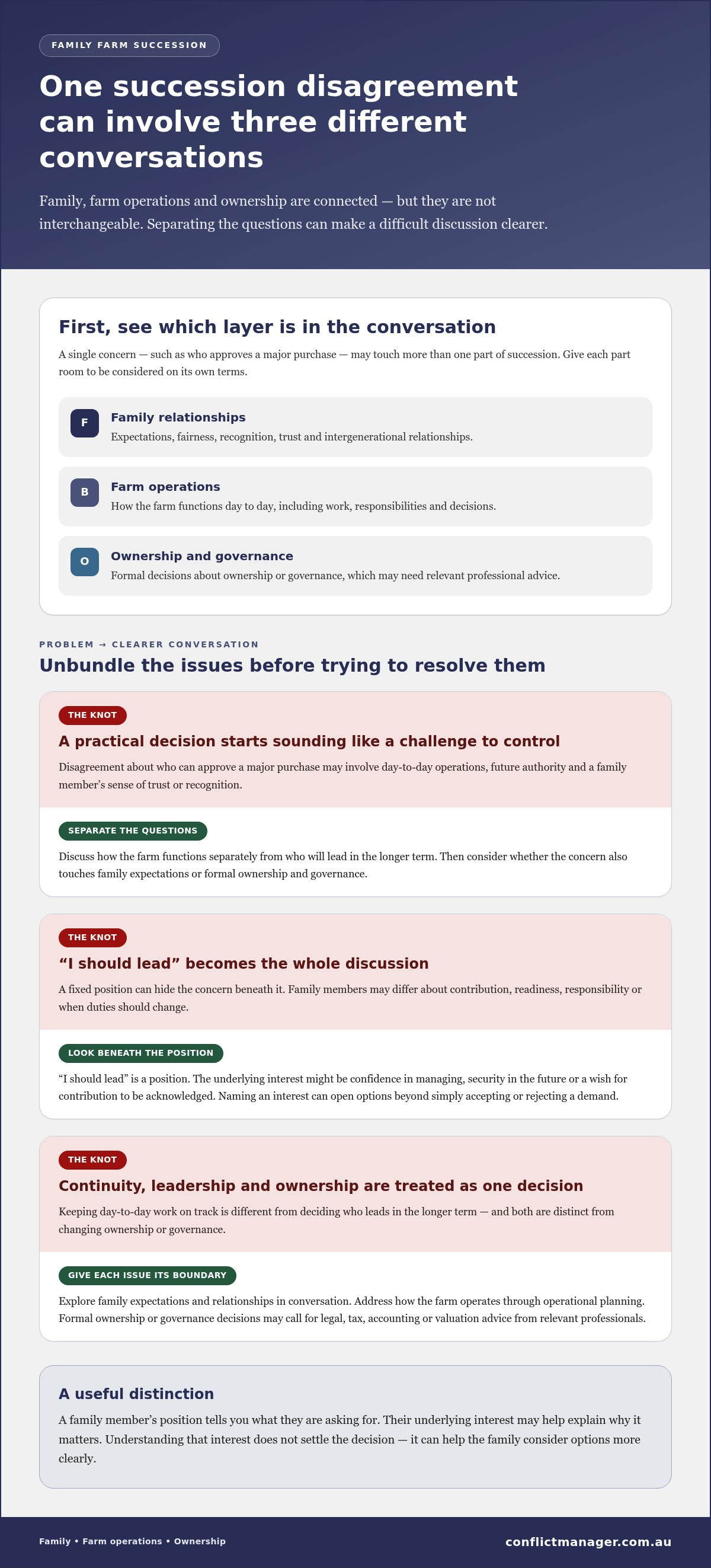
A succession disagreement rarely stays within one category. A concern about who can approve a major purchase may involve daily operations, the future allocation of authority and a family member’s sense of trust or recognition. Treating every disagreement as one large dispute can make it harder to identify what needs to be discussed, and by whom.
Separating family, business and ownership questions gives a complex discussion clearer boundaries, so each issue can be considered on its own terms. The layers remain connected, but they aren’t interchangeable. A family conversation can explore expectations and relationships. Operational planning can address how the farm functions. Formal decisions about ownership or governance may need specific professional advice.
Family relationships and intergenerational expectations
Different generations may assess fairness, contribution and readiness in different ways. One person may see years of work as the basis for greater responsibility; another may believe readiness should be demonstrated through experience or a gradual transfer of duties. Don’t assume someone’s view based on their age or role. Past decisions and perceived recognition can also shape how a new proposal is received, even when it’s intended to solve a practical problem.
It can help to distinguish a person’s stated position from the interest beneath it. “I should lead” is a position. The underlying interest might be confidence in their ability to manage, security in their future or a wish to have their contribution acknowledged. Naming the interest doesn’t settle the decision, but it can open up options beyond simply accepting or rejecting a demand.
Farm continuity, leadership and formal decisions
Keeping day-to-day work on track is different from deciding who will lead in the longer term. Both are distinct from deciding how ownership or governance should change. If these questions are bundled together, a practical discussion about responsibilities can quickly become a debate about control. Separating them helps the family see which decisions they can explore together and which call for legal, tax, accounting or valuation advice from relevant professionals.
Family Business Australia is a sector organisation that families may find relevant when considering family-business issues. For the facilitation dimension, this discussion of a farm succession facilitator outlines how a neutral person can bring structure to transition conversations. That structure can help participants explore concerns without treating facilitation as a substitute for technical advice.
When these conversations are difficult to organise, family conflict resolution support can provide a more impartial setting to clarify concerns and possible next steps. This is one practical way to approach resolving family farm succession conflict without expecting a single conversation to settle every question.
Does resolving family farm succession conflict mean choosing sides or forcing a sale?
No. Resolving family farm succession conflict is about making difficult discussions more workable, not deciding to sell the farm or favour one family member. A structured conversation can clarify the issues and explore possible options, while the family remains responsible for decisions about its future.
This distinction matters when conversations have become tense. Without a clear process, informal discussions can circle around the same positions: one person argues they should lead, another defends the current arrangement, and concerns about ownership or continuity remain unresolved. A neutral facilitator can organise participation, help each person express their concerns and keep discussion focused on the questions the family needs to address. The facilitator doesn’t decide who owns or runs the farm, compel agreement or determine the outcome.
What a neutral facilitator can and cannot do
A facilitator provides structure for dialogue. They can help the family identify the topics in dispute, hear different perspectives and distinguish areas for discussion from matters requiring technical advice. They don’t replace legal, accounting, tax or financial professionals, whose advice may be needed to assess the implications of particular options. Facilitation also doesn’t provide legal representation or transfer decision-making authority away from the family.
Impartiality means supporting a fair process, not guaranteeing that everyone will agree or reconcile. It also shouldn’t be taken as a promise about confidentiality protections. Before proceeding, families can clarify how the process will work and what it can reasonably address.
When a structured conversation may be useful
Consider whether a more formal discussion could help if conversations repeatedly stall, become difficult to manage or leave some stakeholders feeling unheard. It may also be useful when the family needs to understand its concerns before weighing options, rather than trying to settle operational, relationship and ownership questions all at once.
There’s no need to rush towards a final decision just because a conversation has begun. A first step might be agreeing on what needs discussion, who should be involved and which questions require professional input. If family members aren’t sure they’re ready, they can first clarify what a constructive next conversation might involve.
How to prepare for a constructive conversation about farm succession
A useful meeting doesn’t have to resolve every succession question. Its purpose might be to clarify one or two priorities, hear the concerns behind different views and agree on what should happen next. Preparation helps keep the conversation focused, especially when participants bring different expectations to the meeting.
Set a clear purpose and workable agenda
Choose a specific starting point, such as how operational responsibilities might change or what information the family needs before discussing ownership options. Agree on who should take part and what each person hopes the discussion will address. Simple ground rules can help: let each person finish speaking, make space for different perspectives and record unresolved questions without treating them as failures.
Invite participants to describe what matters to them rather than opening with a fixed demand. For example, instead of insisting on a particular leadership outcome, someone might explain that they want greater responsibility and a clear way to demonstrate readiness. That gives the family more to work with than opposing positions alone.
Sort concerns, options and professional advice needs
Before the meeting, group the topics so that relationship concerns, farm operations, leadership and ownership aren’t treated as one decision. Note which matters can be explored through discussion and which depend on legal, financial, tax, accounting or operational advice. The family can identify the questions it needs answered without trying to resolve technical matters in the meeting.
Use this short checklist to prepare:
- Purpose: What one or two questions should this conversation address?
- Participants: Who needs to be involved, and what perspective will each person bring?
- Concerns: What does each person want understood, beyond their preferred outcome?
- Information: What facts or professional advice are needed before options can be assessed?
- Next steps: How will the family record agreements, open questions and who will follow them up?
Keep the record practical. Capture what participants agree on, what remains unresolved and who is responsible for each follow-up. This creates a shared reference point instead of relying on different memories of what was said.
If discussions have become difficult to organise, an impartial facilitator can help establish a clear process for hearing concerns and working through the agenda. For support with structuring a family conflict resolution conversation, Conflict Manager guides stakeholders through difficult discussions towards clarity and sustainable next steps. A considered process can support resolving family farm succession conflict without requiring the family to settle every decision at once.
How facilitated family farm succession discussions can create a clearer path forward
Once the family has identified the issues, the next challenge is turning competing views into a process for considering what might work. Facilitation gives stakeholders a structured way to do that. It doesn’t promise agreement or prescribe a particular farm outcome. Instead, it helps the family move from a broad, difficult dispute towards clearer questions and practical next steps.
A facilitated discussion may begin by clarifying what each person wants addressed and which concerns sit beneath their stated positions. The conversation can then follow agreed topics, with space for participants to explain their perspectives, ask questions and consider options. This structure can help prevent one disagreement from taking over the whole discussion.
From competing positions to options the family can examine
A fixed position can sometimes point to a deeper interest. A family member asking to lead the farm may be seeking a defined opportunity to demonstrate capability; someone resisting a change may be concerned about continuity or security. Understanding these interests can give the family options to examine without assuming any particular leadership, ownership or inheritance arrangement is right.
The family can assess options against practical questions: Would the farm be able to operate effectively? Do the people involved have the capacity and willingness to take on the proposed responsibilities? What further legal, financial, tax or operational advice is needed to understand the implications? These questions help distinguish a possibility worth exploring from a decision ready to be made.
Choosing practical next steps without overstating certainty
Progress doesn’t have to mean instant consensus. A useful discussion may clarify one decision, identify where views remain different or define what the family needs to discuss next. Recording these points helps stakeholders share an accurate understanding of what was agreed and what remains open.
A practical record might capture:
- decisions or areas of shared understanding reached during the discussion;
- unresolved questions and the information needed to assess them;
- who will seek relevant professional advice or provide further information; and
- the next conversation needed to continue the process.
Formal documents and legal or financial decisions require advice from relevant professionals. Facilitation supports the family’s discussion and decision-making process; it doesn’t replace that expertise. For families considering resolving family farm succession conflict, this distinction can keep dialogue focused while technical questions are addressed appropriately.
Conflict Manager provides family conflict resolution and facilitation to help stakeholders work through difficult discussions towards clarity and sustainable next steps. Discuss a structured path forward to explore whether facilitation may suit your family’s situation.
Take the next step towards a workable farm transition
Farm succession discussions are easier to approach when relationship concerns, operational questions and formal decisions are recognised as connected but distinct. A clear purpose, space for each stakeholder to explain what matters and a record of unresolved questions can help the family move forward without forcing an immediate decision.
Resolving family farm succession conflict doesn’t mean choosing sides or guaranteeing consensus. It means creating a fairer structure for understanding the issues, exploring options and identifying where professional legal or financial advice is needed. Even a clearer next conversation can be meaningful progress.
Conflict Manager provides family conflict resolution and stakeholder facilitation, guiding stakeholders through difficult discussions towards clarity and sustainable outcomes. If an impartial process could help your family organise its next conversation, discuss a structured path forward.
With thoughtful preparation and the right support, your family can take the transition one considered step at a time.
Frequently Asked Questions
How do you resolve conflict over who takes over a family farm?
Start by separating questions about leadership, day-to-day responsibilities and ownership. Give each stakeholder a chance to explain their concerns and priorities. Resolving family farm succession conflict is more manageable when discussion moves beyond fixed positions, such as “I should lead”, to the interests behind them, such as readiness, recognition or continuity. Record what’s agreed, what remains unresolved and where professional advice is needed before decisions are made.
Can mediation help with family farm succession disagreements?
Mediation or impartial facilitation can help family members discuss succession issues in a more structured setting. A neutral third party can organise the conversation, support participation and help clarify the issues and possible next steps. This can be useful when informal discussions repeatedly stall or become difficult to manage. It doesn’t guarantee agreement or determine the farm’s future, and it doesn’t replace legal, financial or tax advice where that’s needed.
What happens if siblings disagree about inheriting or running the farm?
First, distinguish disagreement about inheritance or ownership from questions about who works on the farm and who manages its operations. Siblings may have different expectations, contributions and concerns, so don’t assume equal treatment means the same arrangement for everyone. List the disputed questions, identify what information is needed and discuss the issues separately. Decisions about ownership, wills or other formal arrangements should be considered with relevant legal and financial professionals.
When should a family start discussing farm succession?
Begin when the family can have a considered conversation, rather than waiting until an urgent change leaves little room to explore options. Starting early can give stakeholders time to discuss roles, leadership, continuity and the information they need before assessing choices. There’s no single timetable that suits every farm. A useful first discussion may simply identify the issues and agree who should contribute to the next conversation.
Does mediation decide who owns or operates the farm?
No. Mediation and facilitation provide a process for discussion; they don’t determine ownership, appoint a farm leader or compel family members to agree. Participants remain responsible for considering and making decisions about their future. A facilitator can help clarify where views differ and what options may warrant further consideration. Formal ownership and financial decisions may have legal or tax implications, so seek advice from relevant professionals before acting.
How can a family discuss farm succession without damaging relationships?
Agree on a clear purpose and a few ground rules before the discussion. Give each person time to speak without interruption, and ask them to explain what matters to them rather than only stating what they want. Keep relationship concerns distinct from operational or ownership questions, and note unresolved issues without demanding an immediate answer. If conversation becomes hard to manage, an impartial facilitator can help provide structure, though no process can guarantee how people will respond.
What is the difference between farm succession planning and succession conflict resolution?
Farm succession planning is the broader work of considering how management, leadership and ownership may transition. It can involve family discussions, operational planning and formal legal or financial decisions. Succession conflict resolution focuses on addressing disagreement that makes those discussions difficult. It can help stakeholders express concerns, clarify competing expectations and identify next steps, while professional advisers address technical matters such as legal documents, tax and financial arrangements.


