

The more formal process isn’t automatically the better fit. In collaborative law vs mediation for business disputes, the key question is how the people involved need to make decisions, not simply which process sounds more structured.
When communication becomes difficult to manage internally, choosing a path can feel like another risk. You may want to protect a working relationship while addressing complex commercial issues. A process that doesn’t fit the dispute could add strain instead of clarity.
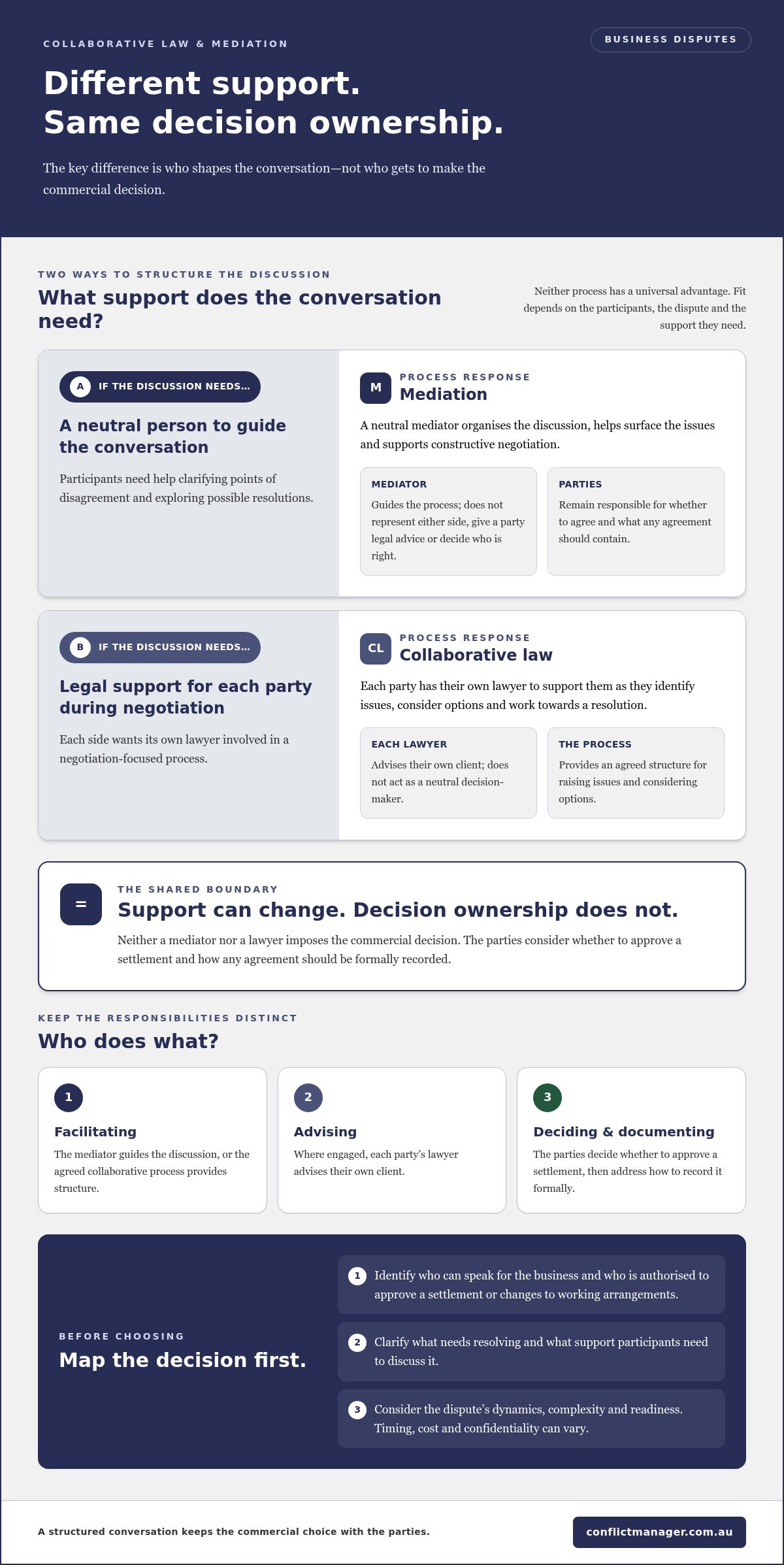
The roles differ: collaborative law generally involves each party’s lawyer in negotiations, while mediation uses a neutral mediator to guide the discussion. In either process, business decision-makers retain responsibility for the outcome.
This guide compares how the approaches work, where each may suit a dispute and what to weigh before choosing. You’ll consider the decision-makers, the type of disagreement and the support participants need. Neutral facilitation can give difficult conversations structure without taking commercial decisions out of the parties’ hands.
Key Takeaways
- Compare collaborative law vs mediation for business disputes by looking at who participates and how decisions are supported, rather than choosing by label alone.
- Map everyone with authority or a stake in the outcome before selecting a process.
- Separate relationship tension from disagreement about commercial rights or obligations to clarify what the dispute needs.
- Consider how complexity, readiness and professional support may shape the process. Timing, cost and confidentiality can vary.
- Neutral facilitation can structure difficult discussions while leaving commercial decisions with the parties.
Collaborative Law vs Mediation for Business Disputes: What Is Being Compared?
An unresolved business dispute can unsettle more than a single decision. It may strain working relationships, delay commercial choices and affect organisational stability. When internal discussions stop making progress, a structured process can help participants address the issue while keeping control of the outcome in their hands.
Both approaches sit within the broader field of Alternative dispute resolution (ADR), but they organise support differently. Mediation centres on a neutral facilitator. Collaborative law involves lawyers supporting their respective clients in negotiation. Neither has a universal advantage: the better fit depends on who needs to participate, the dispute’s dynamics and what the parties want to resolve.
What does mediation mean in a commercial dispute?
Mediation gives business stakeholders a structured setting to discuss issues and explore possible resolutions. A neutral mediator organises the conversation, helps participants clarify points of disagreement and supports constructive negotiation. The mediator doesn’t represent either side, advise a party on its legal position or decide who is right.
The parties retain responsibility for deciding whether to reach an agreement and what it should contain. They may seek separate legal advice alongside mediation, for example, to understand contractual rights or assess proposed terms. Mediation supports the discussion but doesn’t replace legal advice.
What does collaborative law mean outside family disputes?
In collaborative law, each party has their own lawyer to support them through a negotiation-focused process. The lawyers help their clients identify issues, consider options and work towards a resolution. This differs from direct negotiation without a defined collaborative framework, and from mediation, where a neutral person guides the discussion rather than acting as either party’s lawyer.
In a business setting, company owners might use the process to resolve a disagreement about future operations, with each receiving legal support as they negotiate. The lawyers advise their own clients; they don’t act as neutral decision-makers. The process name, agreements and professional arrangements can vary, so Australian legal details should be considered in the context of the specific circumstances rather than assumed from practices in another country.
The central distinction is structural, not a promise of a particular result. Mediation brings neutral process guidance; collaborative law builds legal support into each party’s negotiations. Neither a mediator nor a lawyer imposes a commercial decision. The collaborative law vs mediation for business disputes question is best approached by identifying the support participants need and the decision they’re trying to reach.
How Collaborative Law and Mediation Structure a Business Dispute
The process determines who helps shape the conversation, but not who owns the commercial decision. Before choosing a process, distinguish between the people who can speak for a business and those authorised to approve a settlement or changes to working arrangements.
Who is in the room, and what does each person do?
In mediation, the participating businesses or stakeholders meet with a neutral mediator. Depending on the dispute, participants might include company owners, directors, managers or others directly affected by the issue. Separate lawyers may also support individual parties, but they don’t become the mediator or represent the other side.
A mediator structures the discussion, helps surface the points that need resolution and keeps attention on constructive options. They don’t decide the merits of a commercial disagreement. The number of participants and the involvement of advisers depend on the dispute and how the process is designed.
Collaborative discussions are organised around each party’s lawyer-supported negotiation. Cornell Law School’s overview of collaborative law describes the general model, but shouldn’t be treated as a guide to Australian legal requirements: terminology and professional arrangements can differ. In a business matter, identify the relevant decision-makers as well as any advisers or other participants the parties agree would be useful.
How are discussions and decisions managed?
Mediation creates a facilitated space to examine interests and possible options. For example, a dispute between business partners might involve an immediate question about operational responsibilities and a longer-term concern about how they’ll work together. A mediator can help keep these threads clear while the parties assess which arrangements are workable.
Collaborative discussions use lawyers to support their respective clients as they negotiate. The agreed process shapes how issues are raised and options considered. This can provide a defined structure for parties who want legal support during negotiations, while leaving the substance of any proposed commercial arrangement for them to decide.
Three responsibilities remain distinct:
- Facilitating: the mediator guides the discussion, or the agreed collaborative process provides its structure.
- Advising: each party’s lawyer advises their own client, where engaged.
- Deciding and documenting: the parties consider whether to approve a settlement, then address how any agreement should be formally recorded.
Exploring an option isn’t the same as accepting it, and neither process guarantees agreement. For organisations that need neutral structure around difficult stakeholder conversations, organisational conflict management can support a clearer resolution process while leaving commercial decisions with the parties.
Collaborative Law vs Mediation: A Business Dispute Comparison
Both processes involve negotiation, but they aren’t interchangeable. Mediation adds a neutral person to organise discussion; collaborative law centres on lawyer-supported negotiations between parties. This distinction matters when a dispute involves several stakeholders, complex commercial obligations or decisions about how people will continue working together.
| Consideration | Mediation | Collaborative law |
|---|---|---|
| Neutrality | A neutral mediator supports the discussion and doesn’t represent either party. | Each party’s lawyer supports their own client; lawyers aren’t neutral facilitators. |
| Legal representation | Parties may seek separate legal advice alongside the process. | Lawyers are involved in supporting each party’s negotiations. |
| Structure | The mediator guides discussion and helps parties explore possible options. | The parties negotiate within an agreed process, with legal support. |
| Party control | Parties decide whether to agree and what a proposed resolution contains. | Parties retain responsibility for settlement decisions. |
| Potential fit | May suit parties who need a neutral structure for difficult conversations. | May suit parties seeking lawyer-supported, direct negotiation. |
Neither route is invariably faster or cheaper. Timing and cost depend on the dispute, participants and process arrangements. Privacy and confidentiality shouldn’t be assumed to operate identically in every situation; the relevant terms and legal context matter. A process may create room to address a working relationship, but it can’t guarantee that the relationship will be preserved.
Where does mediation tend to fit a business dispute?
Mediation may be useful when communication has stalled and stakeholders need help discussing operational choices, responsibilities or future working arrangements. A neutral facilitator can structure the conversation without taking sides. Mediation may not be suitable in every circumstance, particularly if meaningful participation isn’t possible or legal considerations call for another approach.
Where might a collaborative law process be considered?
Parties may consider collaborative law when they want lawyers to support them through direct negotiation, especially where rights, obligations or detailed documentation are central. The process can provide legal input during discussions, but no single protocol should be assumed to apply to every Australian business dispute. Independent legal advice can help parties understand their circumstances and options.
For collaborative law vs mediation for business disputes, the practical question is which structure best serves the participants and the decision at hand. Choose based on process needs, not on the assumption that negotiation alone makes the approaches equivalent.
How to Choose Between Collaborative Law and Mediation for Your Business
Choose based on the decision you need to make, the people who must make it and the support they need. Start by separating relationship tension from disagreement about commercial rights or obligations. A strained working relationship may call for help structuring communication; a contested contractual issue may also require legal input.
What should business stakeholders assess before choosing?
Work through these essentials before selecting a process:
- Clarify the issue: Is the main barrier communication, competing business interests, an unresolved legal question or a combination?
- Map decision-makers: Identify who can participate for each business and who has authority to approve a proposed outcome.
- Assess readiness: Can participants engage voluntarily, listen to different perspectives and consider options in a structured discussion?
- Identify process needs: Decide whether the discussion needs a neutral facilitator, lawyer-supported negotiation or both forms of support.
Low trust doesn’t automatically rule out facilitated resolution, but it makes the context important. Consider whether participants can take part meaningfully and whether the process can address the underlying concerns. Repeated conversations that produce no clear options, or organisational change that is intensifying friction, may signal a need for more structure. If participation or legal concerns arise, pause to consider suitability before proceeding.
How do the process features match your needs?
| What matters most | Mediation may fit where… | Collaborative law may fit where… |
|---|---|---|
| Neutrality | Stakeholders need a neutral person to organise difficult discussions. | Parties want direct negotiation supported by their own lawyers. |
| Legal input | Parties can obtain separate legal advice as needed alongside facilitated discussion. | Each party wants legal support during negotiations. |
| Stakeholder complexity | The central need is to structure communication among relevant participants. | Parties want lawyer-supported negotiations around rights, obligations or detailed issues. |
| Decision-making | Participants want to explore options with a facilitator while retaining control of the decision. | Participants want to negotiate within an agreed process with their lawyers’ support. |
This is a guide, not a rule. The collaborative law vs mediation for business disputes choice depends on the circumstances, and legal questions may call for independent advice. Neither route guarantees agreement or restores trust; each provides a different structure for addressing the dispute.
If internal discussions have stalled, explore expert-led organisational conflict support from Conflict Manager. Neutral facilitation can help stakeholders clarify the issues and work towards sustainable arrangements, while leaving commercial decisions with the parties.
A Structured Next Step: Expert Mediation and Facilitation with Conflict Manager
The right process is the one that fits the participants, the decisions they need to make and the dispute’s particular demands. Comparing collaborative law vs mediation for business disputes can clarify the available structures, but a label alone won’t resolve questions about who needs to take part or what support the discussion requires.
Conflict Manager provides expert-led mediation, facilitation and organisational conflict management for stakeholders working through internal disputes and organisational change. A neutral facilitator can establish a clear structure for difficult conversations, help participants listen to different perspectives and guide them towards considered next steps. The facilitator supports the resolution process, not the commercial decision. Responsibility for deciding what happens remains with the parties.
How neutral facilitation can support business stakeholders
When repeated internal discussions aren’t progressing, an external facilitator can help bring focus to the conversation. For example, stakeholders dealing with a change in responsibilities may need to clarify immediate operational concerns while considering how they’ll work together afterwards. Facilitation can separate these issues, surface different perspectives and keep attention on practical matters that need discussion. It doesn’t guarantee agreement or a particular outcome.
What to prepare before an initial conversation
A clear outline can make it easier to identify what the dispute needs. Consider noting:
- The issue: What has happened, and what decisions need attention?
- The stakeholders: Who is affected, and who can participate or make decisions?
- Different perspectives: Which facts are agreed, and where do accounts or interpretations differ?
- Practical aims: What would greater clarity, stability or a workable arrangement look like?
This preparation isn’t about reaching a conclusion in advance. It gives the conversation a considered starting point and helps distinguish shared facts from unresolved questions. If legal rights or obligations are central, independent legal advice can help parties understand those issues alongside facilitated discussions.
Conflict Manager helps organisations and stakeholders create structure around difficult conversations and work towards clear, sustainable outcomes. To discuss a business conflict and consider a structured way forward, Discuss a structured path forward.
Choose a Clearer Path Forward
The choice between collaborative law vs mediation for business disputes comes down to the structure your stakeholders need. Consider who must participate, how decisions will be made and whether the discussion needs a neutral facilitator or lawyer-supported negotiation. Neither process guarantees agreement, but a well-considered fit can help keep attention on the issues and practical next steps.
When internal conflict or organisational change makes progress difficult, expert-led mediation, facilitation and conflict management can bring structure to stakeholder conversations. Conflict Manager supports organisations through these challenges with a focus on clarity, stability and sustainable outcomes, while leaving commercial decisions with the parties.
You don’t need to have every answer before taking a measured next step. Discuss a structured path forward with Conflict Manager and begin creating space for a more considered conversation.
Frequently Asked Questions
Is collaborative law used for business disputes in Australia?
Collaborative law may be considered for business disputes in Australia, but the terminology and arrangements can vary. It generally describes lawyer-supported negotiation within an agreed process, rather than one standard approach that applies to every commercial matter. Before relying on this process, parties should understand how it would operate in their circumstances and obtain independent legal advice about relevant rights, obligations and agreements.
Can business parties use mediation and collaborative law together?
Parties may use different forms of support at different stages, but how mediation and collaborative law can be combined depends on the arrangements and circumstances. For example, stakeholders might use mediation to clarify communication issues, then consider lawyer-supported negotiation for unresolved commercial terms. The processes have distinct roles, so it’s important to understand who will facilitate discussion, who provides each party with legal advice and how decisions will be made.
How does mediation work in a business dispute?
Mediation brings business parties together with a neutral mediator who structures discussion and helps participants explore possible ways forward. A dispute might concern operational responsibilities, a commercial arrangement or how stakeholders will work together during organisational change. The mediator doesn’t represent either party or decide the outcome. The parties decide whether to agree and what any proposed resolution should contain, and may seek separate legal advice as needed.
What is the main difference between collaborative law and mediation?
The central difference in collaborative law vs mediation for business disputes is the kind of support built into negotiations. Mediation involves a neutral facilitator who guides the conversation without representing either side. Collaborative law generally involves each party having their own lawyer to support negotiation within an agreed process. Both approaches leave decisions with the parties, but their structure, professional roles and suitability for a particular dispute can differ.
Does a mediator give legal advice or decide the outcome?
No. A mediator facilitates discussion and helps participants consider options, but doesn’t act as either party’s legal representative or impose a decision. Each business party remains responsible for deciding whether to settle and what terms to accept. If a participant needs advice about contractual rights, legal obligations or the implications of proposed terms, they can seek advice separately from a lawyer who represents their interests.
Can mediation help when business partners have lost trust?
Mediation may help when trust has weakened, but low trust alone doesn’t determine whether it’s suitable. A neutral facilitator can structure difficult conversations, clarify different perspectives and help partners examine practical issues, such as decision-making or future working arrangements. The context matters: participants need to be able to take part meaningfully. Mediation can support a more considered discussion, but it can’t guarantee agreement or restore the relationship.
Is an agreement reached through mediation automatically binding?
Don’t assume that a mediation outcome is automatically binding in every situation. Its legal effect can depend on the agreement’s wording, how it is recorded and the circumstances in which it is made. Before relying on proposed terms, parties should consider obtaining independent legal advice about documenting the agreement and its implications. A mediator can guide the resolution process, but doesn’t determine enforceability or provide a legal ruling.


