

What if your first mediation session doesn’t require you to have every answer? Preparing for your first mediation session is less about building a perfect case and more about understanding the issues, your priorities and what you may be open to discussing.
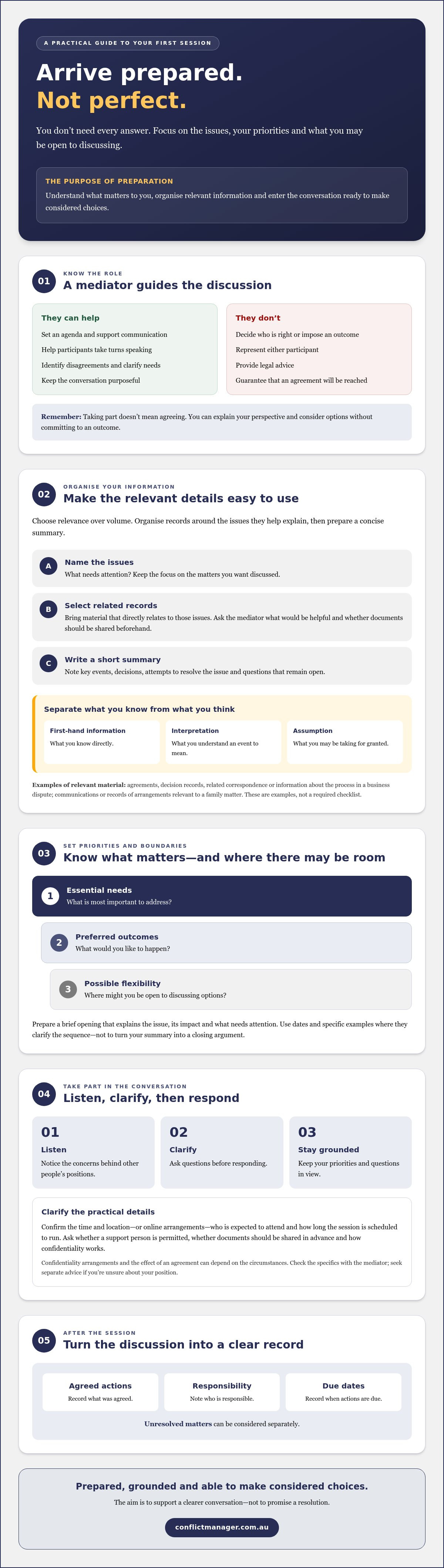
It’s understandable to feel uncertain about what to bring, how the conversation will unfold or whether you’ll be expected to reach an agreement. A mediator helps structure the discussion and support communication; they don’t decide the outcome for you. You can take part without having every point settled in advance.
This guide explains how to organise relevant documents and information, describe your concerns clearly and identify practical priorities and possible options. It also outlines what to ask about the process, including how confidentiality works, so you can arrive with a clearer sense of what to expect. The aim is not to promise a resolution, but to help you enter the conversation prepared, grounded and able to make considered choices.
Key Takeaways
- When preparing for your first mediation session, organise relevant records around the issues they help explain, then note key events and unanswered questions.
- Separate essential needs from preferred outcomes and identify where you may have room to negotiate.
- Listen for the concerns behind others’ positions and ask clarifying questions before responding.
- After the session, record agreed actions, who is responsible and when they’re due; unresolved matters can be considered separately.
Preparing for your first mediation session: understand the purpose and process
When a conversation has become difficult to manage directly, a neutral structure can help people slow down, clarify what is at issue and consider possible ways forward. Mediation provides that structure: participants discuss a dispute with the support of a neutral third party. It can create space for progress, but it doesn’t guarantee settlement. The Mediation overview describes the process and its use across different settings.
One distinction matters from the outset: the mediator guides the conversation, but doesn’t decide who is right or impose an outcome. That applies whether the discussion involves family dynamics, a workplace or other organisational tensions. Preparing for your first mediation session means understanding the process and your own concerns, not proving your case to the mediator or arriving with a complete solution.
What does a mediator do in a first session?
A mediator may help participants set an agenda, take turns speaking, identify points of disagreement and clarify what each person needs from the discussion. Their role is to support communication and keep the conversation purposeful. They don’t represent either participant, provide legal advice or make a decision on the group’s behalf. Beforehand, ask how the mediator sees their role, what the session format involves and how participants can raise concerns if the discussion becomes difficult.
Attending isn’t the same as agreeing. You may take part, explain your perspective and consider options without committing to a particular outcome. Whether an agreement is reached is a separate question. If a proposal has legal or other significant consequences, consider what independent advice you may need before accepting or formalising it.
What should you clarify before the session?
Practical details can reduce uncertainty. Confirm the time and location, or the online arrangements, who is expected to attend and how long the session is scheduled to run. If you may need a support person, ask whether that is permitted rather than assuming the same approach applies everywhere.
Ask whether documents should be shared in advance, what information will be useful and how confidentiality is handled. Don’t assume every process offers the same protections or that records become confidential simply because they’re discussed. Procedures, confidentiality arrangements and the effect of any agreement can depend on the circumstances. Check the specifics with the mediator, and seek separate advice if you’re unsure about your position.
A few direct questions before the meeting can establish a steadier foundation. You’ll know what to expect, what to bring and what decisions, if any, are yours to make. That clarity leaves more attention for the conversation itself.
How to organise your information before your first mediation session
Preparation is about making relevant information easier to use, not assembling a file that proves every point. Start by naming the issues you want addressed. Then select records that relate directly to them and prepare a concise summary. This approach can keep the discussion focused, particularly when a family or organisational conflict has accumulated a long history.
A short chronology can provide useful structure. Note key events, decisions and attempts to resolve the issue, along with questions that remain open. Keep separate what you know first-hand, what you understand or believe it means, and what you’re assuming. For example, a dated email is a record; your view about why it was sent is an interpretation. Distinguishing the two helps you raise concerns without presenting assumptions as established facts.
- Issues: What needs attention?
- Records: What directly relates to those issues?
- Summary: What should the mediator and other participants understand first?
Which documents and details should you bring?
Choose relevance over volume. For a business dispute, useful material might include agreements, records of decisions, related correspondence or information about the process in question. For a family matter, it could include communications or records of arrangements that directly relate to the issue. These are examples, not a required checklist. Ask the mediator what would be helpful and whether documents should be shared beforehand or brought to the session.
How can you explain your perspective clearly?
Prepare a brief opening that sets out the issue, its impact and what needs attention. Use dates and specific examples where they clarify the sequence. Avoid turning the summary into a closing argument: its purpose is to orient the conversation, not answer every possible challenge. Write down the questions you need answered and the points you don’t want to overlook. You can refer to your notes without reading a prepared statement word for word.
Before finalising your material, check that each item supports an issue you intend to raise. Remove duplicates and mark anything you’re uncertain about as a question to clarify. If a family or workplace conversation feels difficult to structure alone, family and organisational conflict support may offer a neutral setting for working through the issues.
Set priorities, options and boundaries before mediation
Preparation isn’t about deciding in advance what the other person must accept. It’s about knowing what matters most to you, where there may be room to move and what you’d need to consider before making a decision. When preparing for your first mediation session, separate essential needs from preferred outcomes and negotiable points. That distinction can help you stay focused if the discussion takes an unexpected turn.
How do you decide what matters most?
Rank the issues you want addressed and note why each matters. Consider practical consequences, the relationship and any future family or working arrangements affected by the outcome. Then explain your priorities without assuming others share them. A clear account of what an issue means to you can make it easier to explore options without treating disagreement as a lack of concern.
It can also help to distinguish a stated position from the interest beneath it. For example, a team member might say, “I need to keep reporting to the same manager.” That’s a position. The underlying interest could be continuity, clear responsibilities or confidence that decisions will be heard. Once the interest is understood, participants may be able to consider more than one way to address it. This doesn’t mean abandoning a boundary; it means checking whether different arrangements could meet the same essential need.
For each issue, jot down:
- Essential: What can’t be compromised without an unacceptable consequence?
- Preferred: What would be a good outcome, but isn’t the only workable one?
- Flexible: What could change if another option meets the underlying need?
Try generating several possible options before deciding whether any one proposal works. A first suggestion is a starting point for discussion, not necessarily a final offer. Consider what would make each option practical, fair and sustainable for the people who need to live or work with it.
What is a realistic outcome if you do not agree?
Think through possible next steps if no agreement is reached. You might need further discussion, additional information or advice from a relevant professional. Identify what you would need to know before choosing a path, and distinguish a genuine limit from an opening position that could change as you learn more. An alternative is there to support clear decision-making, not to threaten or pressure the other person.
If legal, financial or specialist questions could affect your choices, seek independent professional advice rather than relying on the mediator to answer them. Knowing your options can help you participate with greater confidence, while leaving space for a workable agreement to emerge.
First mediation: what to expect and how to participate
There isn’t one standard script for a mediation session. Depending on the matter and the mediator’s approach, it may begin with introductions and an explanation of the process, then move to the issues each person wants to discuss. The conversation may explore concerns and possible options before closing with agreed next steps, or a plan for what still needs attention. Ask the mediator beforehand what format to expect so the first moments feel less uncertain.
Once discussion begins, aim to understand before you respond. Listen for the concern behind a statement, not only the wording, and ask a clarifying question if something is unclear. For example: “Could you explain what you’d need to feel confident about that arrangement?” A question can reveal useful information without requiring you to accept the other person’s view.
Preparing for your first mediation session can help you feel steadier, but it doesn’t mean you have to respond immediately to every proposal. Take notes, ask for time to consider an option and check that you understand what is being suggested. You can say, “I’d like to think that through before I respond.”
How can you stay constructive when emotions rise?
Strong reactions can signal that an issue matters; they don’t make your concern invalid. If the conversation becomes difficult, pause long enough to identify the point you want understood, then respond to that issue rather than every phrase that upset you. A prepared request can help: “Could we take a short break?” or “I’d like to return to that point after we clarify this one.” Respectful boundaries support discussion without asking you to suppress legitimate concerns.
If you lose track of the conversation, ask the mediator to restate the question or summarise what has been discussed. You can also say that you need a moment to collect your thoughts. Confirm in advance how pauses are handled, since arrangements can vary.
Can you bring a support person or adviser?
Check the attendance arrangements with the mediator before inviting anyone. A support person’s presence or participation may need to be agreed, and expectations can differ between processes. Clarify whether they may speak, take notes or simply provide support. If you need legal, financial or other specialist guidance, arrange independent advice. It can inform your decisions, but it doesn’t replace the mediation conversation.
If a neutral structure could help with a difficult family or organisational conversation, explore family conflict resolution and stakeholder facilitation as possible forms of support.
After your first mediation session: review decisions and choose your next step
Once the session ends, take time to separate what was decided from what remains open. A constructive conversation can still leave important questions unanswered, and an apparent agreement may need clarification before anyone acts on it. As with preparing for your first mediation session, careful follow-through helps keep expectations clear and reduces the risk of different people leaving with different understandings.
What should you do if the session ends with agreement?
Record each agreed action, who is responsible and the timeframe. If the discussion covered several issues, note them separately so the record is easy to check. Confirm the summary with the relevant participants and ask how any agreement will be documented. If a point is unclear, raise it before treating it as settled.
Don’t assume that an agreement has a particular legal effect or is enforceable in a particular way. That depends on the circumstances and how the agreement is made. If the terms could affect legal rights, finances or other significant interests, consider seeking independent professional advice before committing or taking action. The mediator can guide the discussion, but isn’t a substitute for specialist advice about your individual position.
What if some issues remain unresolved?
List the open questions and what would help move each one forward. That might mean gathering further information, getting independent advice, arranging another discussion or considering a different process. Set out any agreed follow-up steps, even if the central issue remains unsettled. A clear record can prevent the next conversation from simply restarting the same argument.
Sometimes, the difficulty is not a lack of discussion but a pattern that keeps conversations stuck. Repeated conversations may circle around the same positions, while strained relationships or complex family assets and organisational decisions make progress harder. In these situations, external facilitation can provide a neutral structure for addressing the issues. It doesn’t guarantee agreement, but it can help participants clarify concerns and consider practical next steps.
Conflict Manager supports families and organisations through conflict resolution and stakeholder facilitation. If internal conversations remain difficult or the stakes feel complex, you can discuss your situation with Conflict Manager as a considered next step.
Take your next step with clarity
Preparing for your first mediation session doesn’t mean having every answer or guaranteeing an agreement. It means arriving with relevant information, a clear sense of your priorities and questions about how the process will work. During the conversation, you can listen, ask for clarification and take time to consider proposals before responding.
Afterwards, record any agreed actions and identify what still needs discussion or independent advice. A clear next step can help maintain momentum, whether or not everything is resolved in one session.
When family or organisational discussions remain difficult, neutral professional support may help create a more structured conversation. Conflict Manager provides family conflict resolution, organisational conflict management and stakeholder facilitation, with an emphasis on clarity and sustainable outcomes. You can explore whether this support may suit your circumstances by discussing your situation with Conflict Manager.
You can enter the conversation prepared without carrying the responsibility for every outcome. Start with what matters, stay open to workable options and take the process one step at a time.
Frequently Asked Questions
What should I bring to my first mediation session?
Bring a concise summary of the issues, relevant supporting records and a list of questions or priorities. A short chronology of key events and decisions can help you explain what happened without losing focus. Choose documents that relate directly to the matters being discussed rather than bringing every available record. Before the session, ask the mediator whether anything should be shared in advance and how documents should be presented.
Do I need a lawyer for my first mediation session?
Not every participant needs a lawyer present, and arrangements vary between mediations. A mediator facilitates discussion but doesn’t act as your legal representative or provide legal advice. Independent legal advice may help you understand your options, responsibilities or the implications of a proposed agreement. Ask the mediator what participation arrangements apply, and consider getting advice if legal questions could affect your decisions or the terms under discussion.
What happens if we cannot reach an agreement in mediation?
If you don’t reach an agreement, the session may still clarify the issues, identify areas of common ground and show what remains unresolved. Possible next steps could include further discussion, seeking relevant professional advice or considering another process. The appropriate path depends on your circumstances and any applicable arrangements. Before the session ends, ask how unresolved matters will be recorded and what options may be available afterwards.
Can I bring a support person to mediation?
Possibly, but check with the mediator before inviting someone. Attendance arrangements can differ, and a support person’s role may need to be agreed in advance. Explain why their presence would help, then clarify whether they may speak, take notes or simply accompany you. If you need legal or other specialist guidance, ask separately about the appropriate adviser. Don’t assume a support person can attend or participate without approval.
How do I prepare emotionally for mediation?
Decide what you want the mediator and other participants to understand, and write down any points you’re concerned about overlooking. Consider what may be difficult to hear and prepare a response, such as asking a clarifying question or requesting a break. You don’t have to agree with another person’s account of events. Preparing for your first mediation session can help you stay focused while recognising the seriousness of the discussion.
Do I have to agree to a settlement during mediation?
No, discussing a proposal doesn’t necessarily mean you must accept it. Take time to understand the terms, ask questions and consider whether they address your concerns. If you’re unsure about the implications, seek relevant independent advice before making a decision. The process and effect of an agreement depend on the circumstances, so clarify these with the mediator and an appropriate adviser rather than assuming that every mediation works the same way.
How long does a first mediation session take?
There’s no single duration for every first mediation session. The time required may depend on the number of participants, the issues involved, the process and whether breaks are needed. Ask the mediator how much time has been set aside and whether further sessions might be considered. If you can, leave some flexibility in your schedule afterwards. That can help you participate without feeling rushed by an immediate commitment.


