

Mediation isn’t always the safest or most effective route to resolution. In Australia, knowing when mediation is not the right choice matters when safety is at risk, someone can’t negotiate freely, urgent court intervention is needed, or a participant is using the process to delay or harass. For separating families, Family Dispute Resolution is a mediation process covered by the Family Law Act 1975, according to the Australian Government, Federal Register of Legislation.
It’s understandable to feel pressure to take part, especially when a dispute has reached a stalemate. Attending mediation doesn’t mean you must agree to a settlement, and some circumstances can make the process unsuitable or unsafe. Knowing when mediation is not the right choice helps distinguish a difficult negotiation from one that cannot proceed fairly.
This article explains factors that can affect mediation, including family violence, power imbalances, court-related urgency and bad-faith participation. It also outlines how suitability is assessed and why recognising a barrier early can help you identify a more appropriate next step.
Key Takeaways
- Safety concerns, abuse or a serious power imbalance can make mediation unsuitable; recognising these conditions helps clarify whether negotiation is safe and fair.
- A court direction to attend mediation does not require you to accept a settlement, and urgent legal issues may call for a different response.
- Suitability depends on whether each participant can understand the issues, communicate and make choices without undue pressure.
- Repeated delay, harassment or a refusal to engage genuinely can undermine the process and signal that mediation may not resolve the dispute.
Domestic and family violence, abuse, and power imbalances
For separating families, family dispute resolution (FDR) uses a trained practitioner to help parties discuss issues and try to reach agreement without court. The Australian Government, Federal Register of Legislation states that this process is covered by the Family Law Act 1975.
Family violence and child abuse
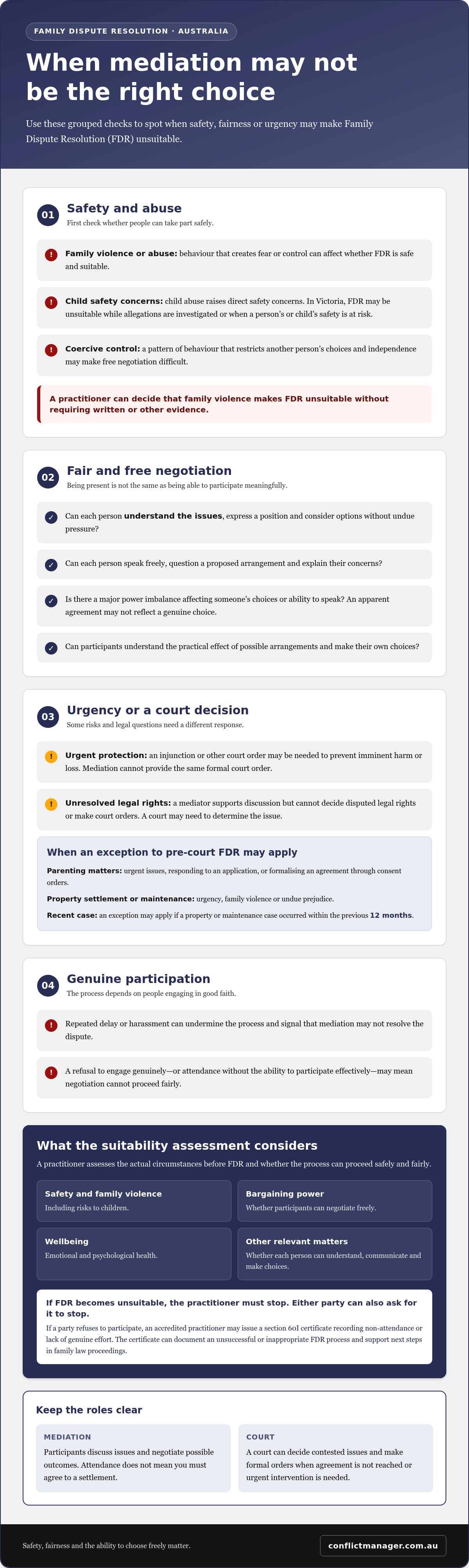
Family violence involves abuse or behaviour that creates fear or control; child abuse raises direct concerns about a child’s safety. Both can affect whether Family Dispute Resolution (FDR) is suitable and whether someone can participate safely. A practitioner assesses these risks before mediation proceeds. In Victoria, FDR may be unsuitable while child-abuse allegations are being investigated or when a person’s or child’s safety is at risk.
Coercive control and safety risks
Coercive control is a pattern of behaviour that can restrict another person’s choices and independence. Mediation may be appropriate where family violence, coercive control or safety risks are involved only if an assessment finds the process suitable. Violence or risk can make it unsafe or inappropriate. A practitioner can decide that family violence makes FDR unsuitable without requiring written or other evidence.
Power imbalances and free negotiation
A power imbalance exists when one person has substantially more influence over another’s choices or ability to speak freely. If a major imbalance prevents free negotiation, mediation may not be suitable: an apparent agreement might not reflect a genuine choice. The assessment considers equality in bargaining power, safety, risks to children, and participants’ emotional and psychological health.
Screening and safety measures
Before FDR, a practitioner assesses suitability by considering family violence, safety, negotiation power, children’s risks, participants’ wellbeing and other relevant issues. What screening and safety measures are available? This assessment determines whether mediation can proceed safely; the practitioner must stop if it becomes unsuitable or either party asks. If one party refuses to participate, an accredited practitioner may issue a section 60I certificate recording non-attendance or lack of genuine effort. If FDR is unsuccessful or inappropriate, the certificate can document that outcome and support the next steps in family law proceedings.
Court-ordered mediation
Being directed to attend mediation doesn’t mean you have to agree to a settlement. Australian family law also recognises exceptions where court involvement may be needed sooner.
Exceptions to pre-court mediation
Exceptions allow some people to apply for court orders without first attempting family dispute resolution. Separated parents generally attempt it before seeking parenting orders, but exceptions include urgent issues, responding to an application, or formalising an agreement through consent orders. For property settlement or maintenance, urgency, family violence or undue prejudice can provide exceptions. A recent property or maintenance case may also matter: an exception applies if one occurred within the previous 12 months.
Urgent intervention and court orders
Urgent intervention means seeking a court decision before mediation can safely or effectively address a risk. An injunction or other order may be needed to prevent imminent harm or loss. A dispute requiring immediate protection may not suit mediation, because discussion cannot provide the same formal court order. A court can direct parties to mediate, but neither party can be forced to accept a settlement.
Issues requiring a court decision
A court decision may be needed when parties cannot resolve a legal issue by agreement. Mediation supports discussion and negotiated options; a mediator cannot decide disputed legal rights or make court orders. For example, if parties disagree about which orders should apply and cannot find common ground, a court can determine the issue. Complex legal questions can make mediation one part of the process, rather than a substitute for a court decision.
Mediation and court proceedings
Mediation and court proceedings differ in who controls the outcome: participants negotiate in mediation, while a court decides contested issues. Mediation may avoid some formal steps, while court proceedings involve an application and the court process. The time required depends on the complexity and issues in dispute. Signing without independent legal advice can leave you unclear about an agreement’s meaning, consequences or practical effect. Understand each term before deciding whether to sign.
Assessing participants’ ability to negotiate
A useful assessment asks whether each person can understand the issues, express a position and consider options without undue pressure. In Australian family dispute resolution, the practitioner considers whether participants can negotiate freely. Attendance alone does not prove meaningful participation. Someone may be present but unable to take part effectively if fear, distress or unequal influence shapes every response.
The practitioner assesses family violence, safety, equality in bargaining power, risks to children, emotional and psychological health, and other relevant matters. These factors help determine whether FDR is appropriate for the dispute and the participants. For example, if someone cannot question a proposed parenting arrangement or explain their concerns, the practitioner must consider whether negotiation can proceed fairly. The assessment looks at the actual circumstances, not simply whether both people say they are willing to attend.
Participation also requires enough understanding to consider the practical effect of possible arrangements. A genuine attempt means engaging with the discussion and options, rather than attending without taking part. If someone cannot participate effectively, or the process becomes inappropriate, the practitioner can end FDR. An accredited practitioner may issue a section 60I certificate when FDR is considered inappropriate or is unsuccessful. For a person applying for parenting orders, a valid certificate is generally used with the application unless the court grants an exemption; it remains valid for 12 months.
These decisions matter because mediation helps participants explore agreement, but it doesn’t decide disputed issues or make court orders. If someone can’t understand or freely weigh proposed terms, pressure to settle may deepen the dispute rather than resolve it. An assessment can identify this limit before an agreement is reached and distinguish a temporary difficulty engaging from circumstances that prevent safe, genuine negotiation.
Bad-faith participation and harassment
Mediation depends on participants engaging with the dispute, rather than using the process to obstruct or intimidate. In Australian family law, evidence that someone intends to delay proceedings or harass another party may indicate they aren’t participating in good faith. For example, attending solely to prolong negotiations or unsettle the other participant can undermine the process without genuinely considering an agreement.
Conflict alone doesn’t prove bad faith. A participant may reject a proposal, disagree about what happened or need time to consider an application without acting improperly. The distinction is whether someone engages with the issues or uses each discussion to frustrate progress. Consider the pattern: repeated conduct aimed at delay or harassment carries more weight than one tense exchange or unresolved disagreement.
That pattern can affect whether mediation remains appropriate. If conduct makes discussions unsafe, prevents meaningful participation or turns sessions into a source of ongoing pressure, the mediator can consider whether the process should continue. In Australia, mediation must stop if it is no longer appropriate in the circumstances or if either party asks the mediator to end it. Protection and a workable process take priority over attendance at any cost.
Where family dispute resolution does not proceed, an accredited practitioner may issue a section 60I certificate if a party fails to attend or make a genuine effort, or if mediation is inappropriate. This records the process outcome; it doesn’t itself decide the dispute or make court orders. Keep a clear record of relevant communications and conduct, such as messages showing an expressed intention to delay, so concerns can be explained accurately during assessment. Repeated unsuccessful attempts may also indicate that further sessions are unlikely to resolve the issues.
If hostile conduct is affecting a family dispute, consider structured family conflict resolution to bring greater clarity to difficult discussions.
Conflict Manager: Family Conflict Resolution
Conflict Manager provides Family Conflict Resolution for families facing disputes that need careful, structured discussion. It can help when communication has stalled, family members need clarity around competing concerns, or tensions continue beyond formal mediation. The focus is on helping families work through conflict and identify a constructive way forward, not on deciding legal rights or making court orders.
If safety is at immediate risk or court intervention is needed, prioritise those needs before considering facilitated discussions. For complex family dynamics affecting relationships or shared decisions, Conflict Manager can bring structure to the conversation. Contact Conflict Manager to discuss Family Conflict Resolution.
Choose a constructive next step
Understanding when mediation is not the right choice can help you stop trying to force a process and identify what the situation needs next. That may mean clarifying the decisions still to be made, who needs to be heard, or what boundaries would make a discussion workable. Ultimately, knowing when mediation is not the right choice is about finding a process that fits the circumstances, not simply keeping talks moving.
Conflict Manager offers Family Conflict Resolution, Organizational Conflict Management and Stakeholder Facilitation for family, workplace and stakeholder disputes. If you’re ready to explore a structured way forward, contact Conflict Manager to discuss the circumstances you’re facing.
A difficult impasse doesn’t have to define what happens next. A clearer view of the needs and limits involved can help you take the next step with greater confidence.
Frequently Asked Questions
What are some reasonable grounds to refuse mediation services?
Reasonable grounds can include an immediate safety concern, an inability to participate freely, or a need for urgent court protection. For example, threats may make a private discussion unsafe. Explain the specific concern and how it affects participation, rather than relying only on a general objection. In family disputes, an accredited practitioner can assess whether Family Dispute Resolution is unsuitable.
When is mediation unsuitable or unlikely to work in Australia?
Mediation may be unsuitable when safety risks or severe distress prevent meaningful participation, or when the dispute requires a decision only a court can make. It may also be unlikely to help after repeated attempts have failed, particularly if the same issues remain unresolved and neither party is engaging with options. Consider whether discussion can realistically move the matter forward, rather than treating attendance as progress.
When should urgent court orders be sought instead of mediation in Australia?
Urgent court orders may be needed when immediate intervention is required to prevent imminent harm or loss. For example, if waiting for mediation could leave someone exposed to danger or an important asset at risk, discussion alone may not provide timely protection. An injunction or other court order can address urgent needs. Mediation can be considered separately once immediate risks are managed.
Can mediation resolve disputes involving fraud, serious misconduct or a need for a legal precedent?
Mediation can support discussion about practical issues arising from alleged fraud or serious misconduct, but it cannot establish guilt or create a legal precedent. If the parties need a formal finding, an authoritative interpretation of the law, or an enforceable court order, negotiation may not meet that need. The key distinction is whether the goal is a private agreement or a decision with legal authority.
Are there Australian legal exemptions from compulsory family dispute resolution before applying to court?
Yes. Separated parents may be exempt in situations including urgency, family violence or child-abuse allegations, inability to participate effectively, responding to an application, or formalising agreement through consent orders. Property and maintenance matters can have exceptions for urgency, family violence, undue prejudice, or a related court case in the previous 12 months. The applicable exception depends on the type of application and circumstances.


