

What if the hardest part of a family holiday home dispute isn’t deciding who gets which week, but agreeing on rules everyone can live with? Resolving disputes over a family holiday home often means balancing holiday dates, guests, upkeep and expenses, while old grievances can turn practical decisions into personal ones.
Shared ownership can bring shared enjoyment, but that depends on having arrangements people understand. Without them, differences over how the property is used or maintained can grow into wider questions about fairness, responsibility and the home’s future. A calm, structured conversation can shift the focus from fixed positions to the interests behind them.
This guide explains why disagreements escalate and how to clarify the issues that matter to each person. You’ll learn how families can develop workable arrangements for use, maintenance and future decisions, while making room for difficult choices and preserving relationships where possible. When discussions have stalled, neutral facilitation can provide a steady process for moving towards clarity without dictating the outcome.
Key Takeaways
- Separate questions of ownership, access and family expectations to see where the disagreement is centred.
- Map recurring decisions about bookings, guests, upkeep and spending before trying to settle them.
- Choose a resolution approach that fits the issue, from a direct discussion to facilitated conversation or separate legal advice.
- Make resolving disputes over a family holiday home more constructive by preparing each person’s needs, constraints and possible areas of compromise.
- Use a clear process to record agreed actions and review arrangements, while recognising that facilitation guides discussion rather than deciding the outcome.
Why disputes over a family holiday home become so personal
A family holiday-home dispute is a disagreement about shared access, responsibilities, decisions or the property’s future, shaped by the relationships and expectations of the people involved. The visible issue might be a booking or a repair bill. Beneath it, someone may be seeking recognition for past contributions, reassurance that decisions are fair or a sense that they still belong.
That extra meaning matters. A holiday home can hold memories of family gatherings, connect people to a place and represent continuity across generations. Its practical value is only part of what is at stake. If a conversation treats the property as a set of dates and bills alone, participants may feel their attachment or contribution has been dismissed.
What families commonly disagree about
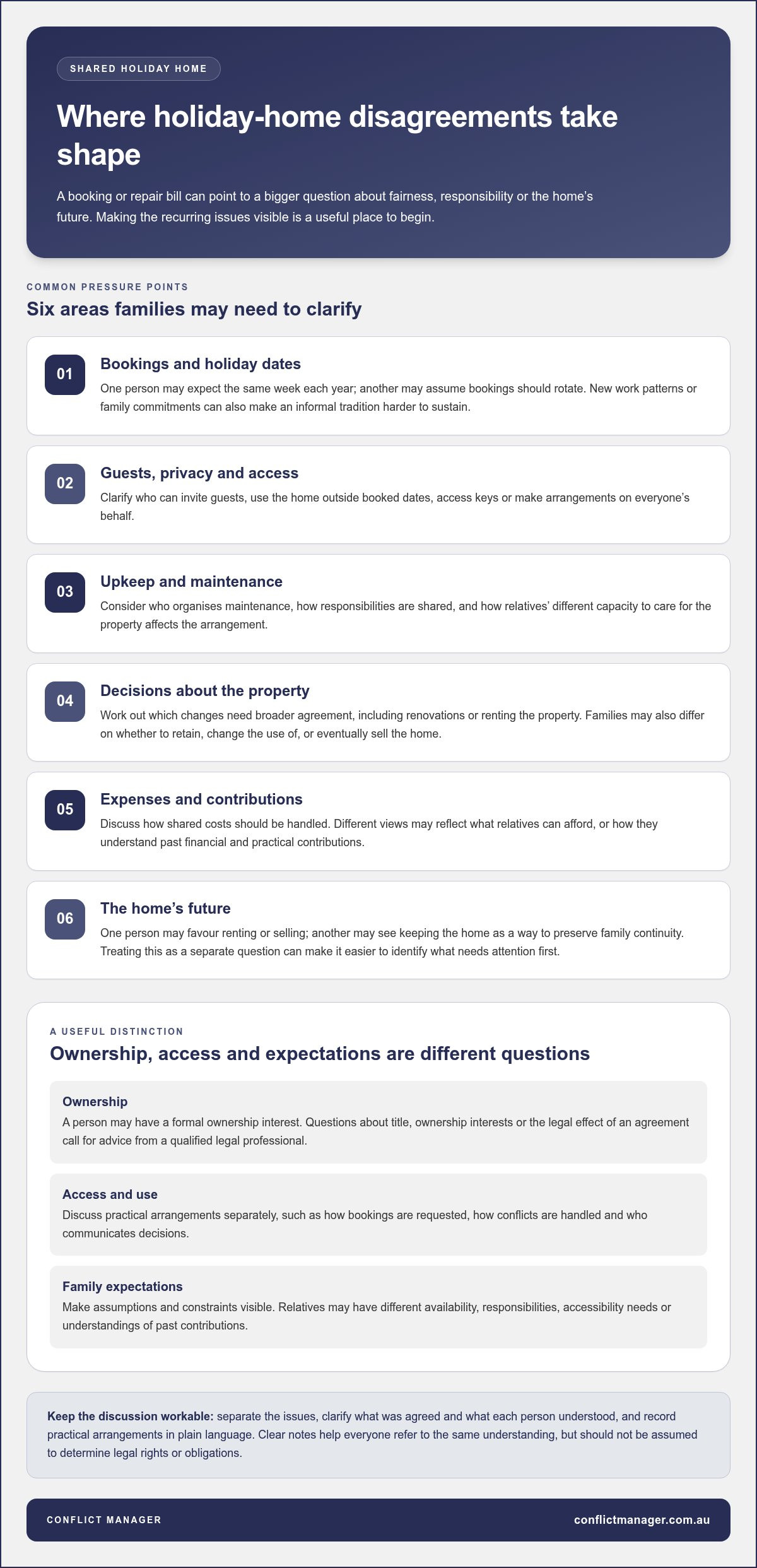
Some disputes grow from recurring details that were never clearly agreed. One person may expect the same holiday week each year, while another assumes bookings should rotate. Guest rules, privacy and access to keys can raise similar questions: who can invite others, use the home outside booked dates or make arrangements on everyone’s behalf?
- Upkeep: Who organises maintenance, and how are responsibilities shared?
- Decisions: Which changes need broader agreement, including renovations or renting the property?
- Expenses: How should shared costs be discussed and handled?
Disagreements can also concern whether the family should retain the home, change how it is used or eventually sell it. These are separate decisions. Treating them as one argument can make it harder to identify what needs to be resolved first.
Why practical disagreements can reopen family history
Present-day expectations may be influenced by earlier contributions. A relative who helped fund a renovation might believe that effort should carry weight in later decisions. Another may remember providing practical care or regularly organising the property. Each account can feel valid to the person holding it, even if the family never formed a shared understanding.
Assumptions about ownership and entitlement can also differ. One family member may see frequent use as an established privilege; another may expect access to be shared more evenly. Neither assumption, on its own, settles what the arrangement should be. It helps to distinguish what is known, what was agreed and what each person understood, without deciding that one account tells the whole story.
This is why resolving disputes over a family holiday home involves more than finding a compromise on dates or costs. A measured conversation can make space for the practical question and the concern beneath it. Family mediation is a non-confrontational and progressive approach to resolving disputes within families, focusing on future-oriented problem-solving strategies. A structured, neutral process can help relatives clarify what needs attention and discuss next steps without requiring everyone to share the same version of the past.
How ownership, use and family expectations shape holiday-home disputes
Ownership, access and family expectations overlap, but they are not the same question. A person may have a formal ownership interest, while relatives hold different beliefs about who can stay, make decisions or use the home at particular times. Keeping these questions distinct helps families identify what they can agree between themselves and what may need separate legal consideration.
Shared ownership alone does not resolve everyday expectations about when, how or by whom a family holiday home is used. Without a clear understanding of roles, routine matters can become contested: who confirms bookings, arranges a repair or approves spending? Resolving disputes over a family holiday home starts with making these assumptions visible, rather than treating one person’s interpretation as the shared rule.
The difference between ownership and agreed use
Informal traditions can feel settled until circumstances change. A family may have routinely given one household the same summer week, for example, but new work patterns or family commitments can make that custom difficult to sustain. Discussing access separately from ownership gives relatives room to consider a new booking arrangement without assuming that it changes anyone’s legal position.
Once an arrangement is discussed, record the practical details in plain language: how bookings are requested, how conflicts are handled and who communicates decisions. Clear notes help everyone refer to the same understanding, but shouldn’t be assumed to determine legal rights or obligations. Questions about title, ownership interests or the legal effect of an agreement call for advice from a qualified legal professional.
The recurring pressure points behind competing positions
People’s capacity to use and care for a property varies. One relative may live closer and handle urgent tasks; another may have limited holiday availability or need particular accessibility features. A fair discussion makes these constraints explicit rather than assuming identical use or contributions will suit everyone. It also recognises that relatives may have different views about maintenance, improvements and what each can afford to contribute.
Future plans can sharpen these differences. One person may favour renting or selling the home, while another sees retaining it as a way to preserve family continuity. Before debating a preferred outcome, clarify what each option would mean in practical terms: who would manage the property, how decisions would be made and which issues need independent legal advice.
- Use: Agree how dates are requested, allocated and changed.
- Responsibilities: Clarify who coordinates routine upkeep and how larger decisions are raised.
- Contributions: Discuss expenses openly, including how differing capacities will be considered.
Where these conversations repeatedly stall, facilitated family conflict resolution can provide a neutral structure for clarifying interests and considering workable arrangements. The process supports discussion; the decisions remain with the family.
Compare practical options for resolving a shared holiday-home dispute
There isn’t one process that suits every disagreement. A straightforward booking issue may be settled through a direct conversation; a recurring deadlock about use or upkeep may need a neutral person to structure the discussion. Questions about ownership rights or formal documents call for separate legal advice. These approaches can complement each other, but they serve different purposes.
A structured conversation doesn’t have to make a family dispute more adversarial. Setting an agenda, giving each participant space to explain their concerns and keeping discussion focused on decisions can reduce uncertainty. Mediation supports that discussion. The mediator doesn’t decide who gets the property, set family rules or impose an outcome.
| Option | May suit when | Likely focus | Further advice may be relevant for |
|---|---|---|---|
| Direct family discussion | Participants can listen and address a defined issue respectfully. | A practical arrangement, such as a booking process or a maintenance task. | Uncertainty about ownership rights or the effect of formal documents. |
| Facilitated conversation or mediation | Talks repeatedly stall, participation feels uneven or discussions become personal. | Clarifying interests, managing dialogue and exploring possible arrangements. | Legal questions that arise while considering options. |
| Separate legal advice | There are questions about rights, obligations or existing documents. | Understanding the legal position and the implications of proposed steps. | Any family negotiation that also needs a shared practical agreement. |
When a family conversation may be enough
If everyone can take part constructively, keep the discussion narrow. For instance, agree how requests for a particular holiday period will be made before trying to resolve every disagreement about the property’s future. Record the decision in plain language, including who will do what, by when and when the arrangement will be reviewed.
When neutral facilitation or legal advice may help
Repeated stalemates, interruptions or a sense that one person’s view carries more weight can make a family-led discussion difficult to sustain. A neutral facilitator can establish a fair process, clarify competing interests and help participants consider options without choosing for them. Legal advice is a separate resource when rights or documents are in question.
When resolving disputes over a family holiday home, match the process to the issue. A family may discuss practical arrangements with support while obtaining independent legal advice on a specific legal question. Keeping those roles clear can prevent uncertainty about the process from becoming another source of conflict.
Prepare a fair process for resolving holiday-home disagreements
A fair discussion needs more than goodwill. It needs a defined issue, enough information for people to participate meaningfully and a clear way to turn decisions into actions. Keep the first conversation focused on future arrangements rather than deciding who was at fault for past events. Earlier experiences may matter, but they don’t all need to be resolved before the family can make one practical decision.
Clarify, listen, decide, record and review: this sequence helps turn a difficult conversation into arrangements the family can revisit.
Set up a conversation that gives each person room
Before meeting, agree who needs to participate and which decision is on the agenda. Choose a format that allows everyone to contribute, and set expectations for listening, pausing if tension rises and noting issues that remain unresolved. Share relevant booking calendars, maintenance details or expense information in advance, so the conversation can focus on choices rather than competing recollections.
Turn discussion into arrangements the family can revisit
Use the discussion to create practical guidance, not a vague promise to “work it out later”. Write down the process for booking dates, expectations for guests, who coordinates routine upkeep and how spending or larger decisions will be raised. Include how the family will respond to changes and urgent repairs, then agree when to review the arrangements as circumstances evolve.
A useful process for resolving disputes over a family holiday home can follow these steps:
- Define the issue. State the decision that needs attention, such as how to allocate a particular holiday period. Keep separate topics on a list for another discussion.
- Prepare individually. Ask each participant to identify what they need, what constraints they face and where they could compromise. Someone with limited leave or accessibility needs may have a different practical priority from a relative with more flexibility.
- Agree how to talk. Set a time, format and agenda. Decide how everyone will have a chance to speak, and whether a pause is appropriate if the conversation becomes unproductive.
- Explore options and decide. Compare possible arrangements against the needs raised. Be clear about what’s agreed, what isn’t and whether any question needs separate consideration.
- Record and review. Note actions, who is responsible and any timeframes. Set a review point so the family can adjust the arrangement if availability, responsibilities or circumstances change.
Fairness doesn’t always mean identical arrangements. It means making relevant needs and constraints visible, considering them openly and being clear about how the family reached its decision. If discussion keeps circling without progress, expert-led family conflict resolution can bring structure to the conversation while leaving decisions with the family.
How expert-led mediation can help a family move forward
When family discussions keep circling, changing the structure of the conversation can help. In expert-led mediation, a neutral facilitator guides the process so each participant can explain their perspective, hear how others understand the issue and identify what needs a decision. The facilitator doesn’t take sides or decide who should use, manage or retain the property.
The aim is not to erase difficult feelings. A holiday home can carry strong personal meaning, and frustration or disappointment may surface as relatives discuss practical options. A measured process makes room for those responses while keeping the conversation anchored to the decisions in front of the family. Participants can pause, clarify a point or return to an unresolved issue without letting emotion determine the direction of the whole discussion.
What a facilitated conversation can address
Facilitation can help relatives bring competing expectations about access, responsibilities and the property’s future into one conversation. A facilitator may help distinguish shared interests, such as keeping the home in good condition, from genuine differences, such as how often it should be available to each household. Difficult options can be explored without assuming that the family will reach agreement or favour a particular outcome.
For example, if some relatives want to retain the home and others are considering renting or selling, the discussion can clarify the reasons behind each position and which questions need separate attention. Participants may identify practical next steps, agree to gather information or recognise that a legal issue requires independent legal advice. Facilitation supports family decision-making; it doesn’t determine ownership rights, interpret formal documents or replace legal advice.
That distinction matters. Resolving disputes over a family holiday home may involve both relationship dynamics and questions about property rights. A facilitator can help organise the family discussion, surface underlying interests and make decisions clearer, while legal questions remain with a qualified legal professional. The process offers structure, not a predetermined answer.
A considered next step when discussions are stuck
Before seeking support, identify the decisions that remain unresolved and the people who need to take part. Note where discussion tends to stall, what information is missing and what a workable next step might look like. This gives the conversation a clearer starting point, especially when family members have different understandings of what needs to be settled first.
Conflict Manager provides expert-led family conflict resolution and mediation to help families work through difficult discussions. The facilitator guides the process, while participants retain responsibility for their choices. If your family is ready to address a stalled conversation, contact Conflict Manager to discuss a family conflict-resolution engagement.
Choose a steadier way forward
The next step doesn’t need to settle every question about the property. Begin by deciding what the family needs to address first, who should be part of that conversation and what would make the process feel fair. That shift can move attention away from winning a position and towards considered decisions about the future.
Resolving disputes over a family holiday home can be especially demanding when the property represents a sizable family asset and emotions are running high. Conflict Manager provides expert-led mediation and facilitation for family disputes, including situations involving significant assets. The focus is on bringing structure to difficult conversations and supporting clarity, stability and sustainable outcomes, without predetermining what the family should decide.
If your family is ready to approach the conversation with greater structure, contact Conflict Manager about family conflict resolution. A facilitated process can make room for difficult choices while helping the family work towards a more considered path forward.
Frequently Asked Questions
How do you resolve a dispute over a family holiday home?
Start by identifying the specific decision causing difficulty, rather than trying to settle every issue at once. For example, separate a disagreement about next summer’s bookings from a longer-term discussion about renovations. Gather relevant records, such as booking messages or maintenance invoices, and invite each participant to explain what they need and why. If discussion remains stuck, a neutral facilitator can help organise it. Obtain legal advice for questions about rights or formal documents.
Can family mediation help with a disagreement about a shared holiday house?
Yes. Family mediation can help relatives discuss a shared holiday house with support from a neutral facilitator. It may be useful if conversations repeatedly stall or some people find it difficult to participate fully. The mediator guides the discussion and helps clarify the issues, but doesn’t decide who is right or require the family to reach agreement. Participants remain responsible for their choices, and legal questions can be addressed separately with a qualified legal professional.
What happens if one family member will not discuss the holiday home?
If a relative won’t take part, you can still clarify the decisions that need attention and make a calm, specific invitation to discuss them. Explain the practical issue, such as an upcoming booking or repair, and offer a structured format that may feel more manageable than an open-ended family meeting. Avoid presenting silence as agreement. If participation remains unlikely, seek independent legal advice about the options relevant to your circumstances and any formal arrangements.
How can siblings divide holiday-home dates fairly?
Agree on a clear booking method before requests for popular dates arise. Siblings could rotate priority for peak periods each year, then allocate remaining dates by agreement. Set a request deadline, explain how overlapping requests will be handled and allow swaps if everyone affected agrees. A shared calendar can make bookings visible and reduce misunderstandings. Review the arrangement after a season, especially if work, caring responsibilities or family circumstances have changed.
What if one relative pays more towards maintaining the family holiday home?
First, distinguish contributions agreed as shared expenses from payments one person chose to make or offered as a gift. Review invoices and any messages about what was intended, then discuss how future costs should be approved, recorded and allocated. A larger contribution doesn’t, by itself, settle questions about ownership or decision-making. If relatives disagree about the legal significance of payments or existing documents, get advice from a qualified legal professional.
Can one co-owner force the sale of a family holiday home?
There isn’t a universal answer. Whether a co-owner can seek a sale, and what may happen next, depends on the ownership arrangements, relevant documents and the circumstances. Don’t assume that a family discussion or mediation can compel a sale: a mediator helps participants explore options but doesn’t make a legal order. A co-owner considering this step should obtain independent legal advice about their position and the potential pathways available.
Is an agreement reached through family mediation legally binding?
Not necessarily. Whether an agreement reached in mediation is legally binding depends on factors such as its terms, how it is recorded and the relevant circumstances. A written summary can help family members understand what they decided, but shouldn’t be assumed to have a particular legal effect. If the agreement concerns ownership, payment obligations or a future sale, obtain independent legal advice about whether further documentation or formal steps are appropriate.


