

What if the disagreement about Mum or Dad’s care is being driven by more than the care decision itself? Managing conflict over care for aging parents can bring sibling tensions, unequal workloads and concerns about money or family history into the same conversation. When that happens, even practical questions about support or living arrangements can feel difficult to resolve.
It’s understandable to want a clear answer, especially when one person feels they’re carrying most of the responsibility. But moving quickly towards a solution can leave your parent’s wishes and wellbeing out of the discussion, or allow older grievances to overshadow what’s needed now.
This guide explains how to identify what’s driving disagreement, keep your parent involved and separate immediate care questions from past conflict. You’ll also find ways to clarify family responsibilities and agree on a process for decisions that remain unresolved. When discussions repeatedly stall or escalate, neutral facilitation can give the conversation structure and support more sustainable outcomes.
Key Takeaways
- Care disagreements can involve more than the level of support needed. Clarify whether the issue is care, roles, living arrangements or decision-making.
- In managing conflict over care for aging parents, distinguish your parent’s stated preferences from assumptions relatives may make on their behalf.
- Compare care options against practical priorities such as safety, independence, daily support and family responsibilities.
- Keep family conversations focused by agreeing on one decision, sharing relevant information and setting clear discussion boundaries.
- When discussions repeatedly stall or escalate, neutral facilitation can help clarify concerns and explore workable outcomes.
Why families disagree about care for ageing parents
Care decisions rarely arrive in a quiet moment. A parent’s needs may be changing, the right level of support may be uncertain, and family members may bring years of shared history to a conversation about what should happen next. Under pressure, a practical question can quickly become personal.
Conflict may centre on the care itself, who takes responsibility, whether a parent continues living at home, or how decisions are made. These issues can overlap, but they are not identical. One sibling may be worried about safety, while another is focused on preserving independence. Both concerns can be sincere. Disagreement alone doesn’t show that someone cares less.
The care decision is one question; the relationship conflict surrounding it is another. Separating the two gives families a clearer starting point for managing conflict over care for aging parents. It helps prevent each concern from being treated as evidence of disloyalty or neglect.
Which care decisions most often create family tension?
Disagreement often gathers around four practical questions: how much support is needed, whether home remains workable, how tasks will be shared, and how costs should be discussed. Each can carry a different meaning for each person. A proposal for more help at home might sound to one sibling like a way to protect familiar routines, and to another like an unnecessary intrusion.
Families may also be working from different snapshots. The sibling who visits often might notice difficulties with everyday tasks; someone who visits less often may see a parent managing confidently during occasional visits. Neither view necessarily captures the whole picture. The broader role and pressures of Family caregivers can also shape how relatives experience and interpret their responsibilities.
Try naming the actual point of difference. Is the family uncertain about the support required, the preferred living arrangement, who will do what, or how financial concerns will be considered? For example, “Who can help with weekly shopping?” is easier to work through than a general accusation that someone is making the wrong choice.
How family history and unequal effort shape the disagreement
Old roles can reappear under pressure. A sibling who was once seen as the responsible one may be expected to coordinate everything, while another may feel their views are routinely discounted. Distance, work commitments and caring capacity influence what each person can contribute, but they don’t always determine how effort is perceived.
Some contributions are easy to see: attending appointments, preparing meals or helping with errands. Others are less visible, such as arranging calls, keeping track of changing information, worrying about what may happen and staying emotionally available. When these forms of effort go unrecognised, frustration can build even if everyone believes they’re trying to help.
Resentment deserves acknowledgement, but it isn’t automatic proof of bad faith. Ask what feels unfair and what specific responsibility or decision lies beneath that feeling. This helps distinguish the immediate care question from longstanding hurt, making room to address each without allowing one to erase the other.
How to centre your parent’s wishes while assessing care needs
Your parent’s preferences should be a meaningful part of the decision, not a detail added after relatives have settled on a plan. Care discussions are more grounded when the person who will live with the outcome has a clear voice in shaping it. Their participation can take different forms, depending on how they communicate and what circumstances make a conversation manageable.
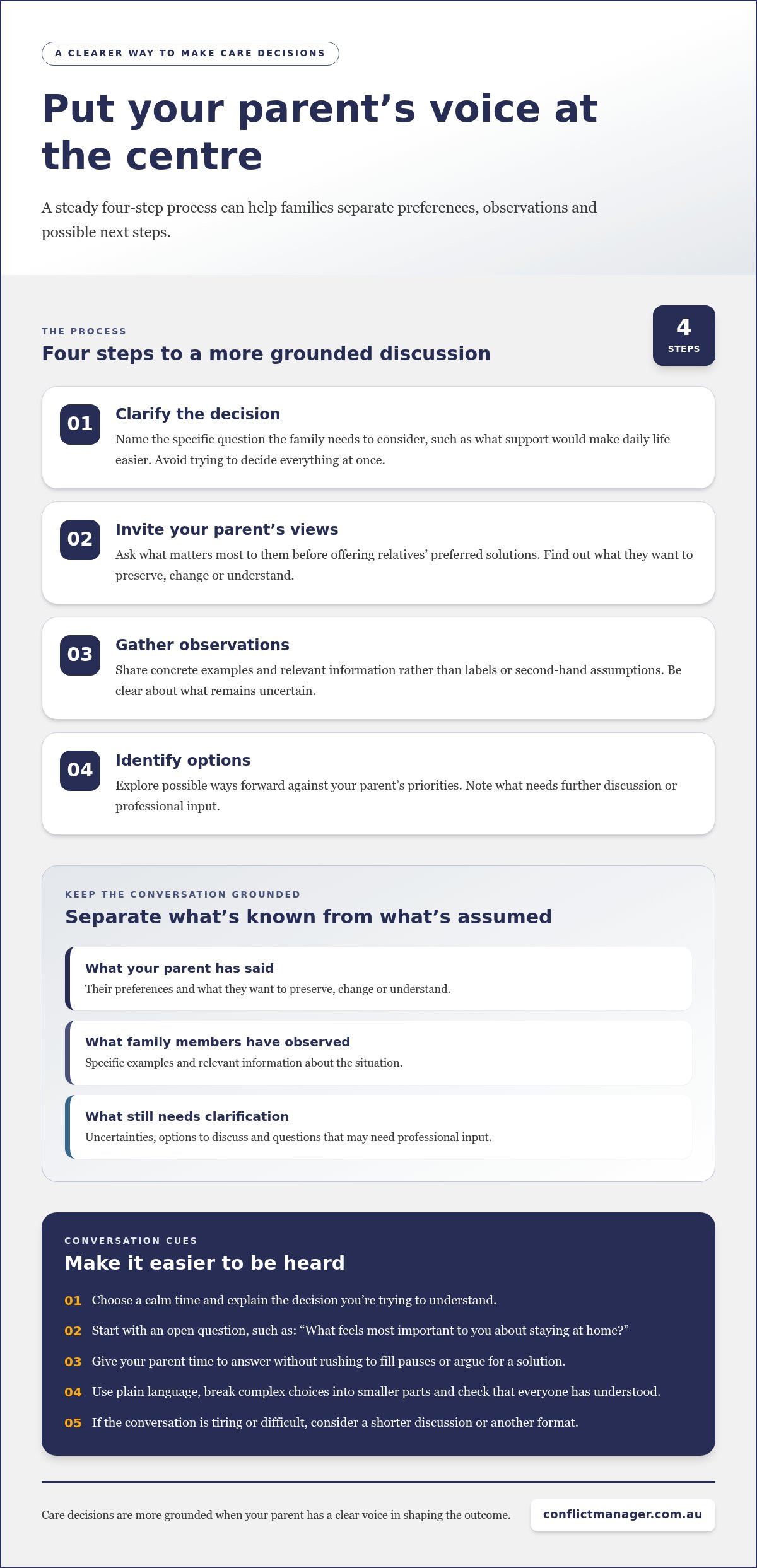
A steady process can help keep preferences, observations and possible responses distinct:
- Clarify the decision. Define the specific question the family needs to consider, such as what support would make daily life easier. Avoid opening with a broad demand to decide everything at once.
- Invite your parent’s views. Ask what matters most to them before offering relatives’ preferred solutions. Find out what they want to preserve, change or understand.
- Gather observations. Share concrete examples and relevant information, rather than relying on labels or second-hand assumptions. Identify what remains uncertain.
- Identify options. Explore possible ways forward against your parent’s priorities, then note what needs further discussion or professional input.
This sequence supports managing conflict over care for aging parents by creating a shared reference point: what your parent has said, what family members have observed and what still needs clarification. A relative’s belief that “Mum would never want that” may reflect concern, but it isn’t the same as asking Mum directly.
How to have a respectful conversation with your parent
Choose a calm time and explain the decision you’re trying to understand. Start with an open question, such as, “What feels most important to you about staying at home?” Give your parent time to answer without rushing to fill pauses or argue for a solution. Use plain language, break complex choices into smaller parts and check that everyone has understood what was said. If the conversation is tiring or difficult, consider whether a shorter discussion or another format would help.
How to distinguish observations from assumptions
Keep the discussion specific. “The shopping hasn’t been done on the last two visits” describes an observation; “You can’t manage” turns it into a judgement. Record relevant changes or incidents in neutral language, including what happened and when. Avoid using one incident to predict what must happen next.
Some questions call for input beyond the family’s observations. Note what you need to understand, then seek appropriate guidance from relevant health professionals. Relatives shouldn’t make clinical conclusions about decision-making capacity based on disagreement or a difficult conversation. If there are concerns, leave that assessment to appropriately qualified professionals.
When relatives are struggling to keep the conversation focused on your parent’s expressed wishes, family conflict resolution can provide a structured setting to clarify concerns and explore workable next steps.
How to compare care options without turning the discussion into a family contest
Comparisons work best when each arrangement is measured against the same priorities, rather than argued for by the sibling who proposed it. A simple table makes trade-offs visible: what the parent values, what support an option may involve, who could take responsibility and what the family still needs to find out.
Use the table to organise discussion, not to manufacture a winner. Add only options the family is genuinely considering, and describe them in neutral terms. The examples below are prompts, not recommendations. To make the comparison useful, apply the same questions to each option and mark unknown details instead of treating them as settled facts.
| Option being considered | Parent’s priorities | Support needed | Responsibilities | Unresolved questions |
|---|---|---|---|---|
| Support while living at home | Which routines, relationships or preferences could this preserve? | What daily tasks or practical support may be needed? | Who is willing and able to coordinate or help? | What information is still needed about feasibility? |
| Another living arrangement under consideration | What matters most to the parent about their day-to-day life? | What support would be available, and what might still be required? | Which tasks would family members take on? | What details need clarification before comparing? |
What to compare when the family considers different care arrangements
For each option, consider safety, independence, daily support, relationships and practical feasibility. Ask how it may affect familiar routines, social connections and your parent’s stated preferences. If a relevant assessment or professional advice is available, use it to help the family understand needs, not as a substitute for your parent’s voice. Mark missing details as questions rather than filling gaps with assumptions.
Keep financial considerations visible in the comparison, including what the family needs to understand about affordability and contributions. Discuss the practical issue directly. A concern about costs doesn’t, by itself, establish that a relative is being selfish or trying to control the decision. Separating the financial question from assumptions about motive can make it easier to examine both fairly.
How to make responsibilities and review points explicit
A workable arrangement depends on more than choosing an option. Match each task to a person’s actual capacity, availability and willingness. Record who will do what and when the responsibility begins; don’t treat silence as agreement. Set a point to check how the arrangement is working, and agree what changes or concerns should prompt an earlier conversation.
This record gives the family something concrete to revisit as circumstances change. It can also reveal where a plan depends on an unconfirmed assumption, such as a relative being available regularly. For families managing conflict over care for aging parents, clear responsibilities and review points shift attention from competing claims towards what can realistically be sustained.
How to prepare for a family conversation when siblings cannot agree
A useful family conversation doesn’t need to resolve every source of tension. It needs a clear purpose, enough shared information to discuss that purpose and a process that prevents the discussion from drifting into old disputes. Preparation helps each person arrive knowing what’s on the table and what can wait.
Before meeting, work through this short sequence:
- Define one decision. State the immediate question in plain language, such as what support the family should explore next. Avoid trying to settle every future care decision in one conversation.
- Gather relevant facts. Collect information connected to that decision, including your parent’s expressed preferences and any specific observations the family needs to discuss. Mark what remains uncertain.
- Set a focused agenda. Identify the decision, the main concerns each person wants heard and the next step the group hopes to agree on. Decide in advance which broader issues are outside today’s discussion.
Inheritance questions, past resentments and other family disagreements can feel urgent, but they may not help resolve the immediate care issue. Acknowledge that these matters exist without letting them take over. Keeping them separate isn’t the same as dismissing them; it gives each concern a more appropriate place and focus.
How to set an agenda that keeps the discussion focused
Open by stating what the family is discussing and what doesn’t need to be resolved today. Agree on simple boundaries, such as taking turns, not interrupting and pausing if people become too upset to continue productively. Give each participant space to explain their concerns before the group responds. Close by summarising what’s agreed, what remains an open question and when or how the family will continue the conversation.
A written agenda can help keep the meeting anchored. For example, if the decision is what support to explore, the agenda might include your parent’s priorities, observations that need clarification and who will gather further information. It doesn’t need to include every disagreement between siblings.
What to do when the conversation stalls or escalates
Notice when the discussion shifts from the care decision to personal attacks or accusations. Suggest a pause, then return to the shared concern: understanding what would support your parent’s wellbeing. Family members may still weigh independence, practical needs or other priorities differently. The aim is to make those differences clear, not to force instant agreement.
Afterwards, send a neutral written summary of the points discussed. Separate agreed actions from unresolved questions, and invite corrections if someone has understood an exchange differently. Specific notes can reduce misunderstandings and give the next conversation a clearer starting point.
If repeated attempts to talk keep stalling or escalating, a structured family conflict resolution conversation can help participants clarify concerns and explore workable next steps. This can be a considered option when managing conflict over care for aging parents has become difficult to do productively within the family alone.
When neutral family mediation can help resolve conflict over parent care
Some families can make progress through direct conversation. Others find that each discussion circles back to the same disagreement, becomes more heated or ends before everyone has been heard. At that point, the challenge may be not only the care decision itself, but the family’s ability to discuss it constructively.
Neutral family mediation offers a structured setting for that conversation. A facilitator helps participants clarify the issues, hear one another’s concerns and explore practical ways forward. The facilitator doesn’t decide what care a parent should receive or take sides. The aim is to support a clearer process, not to promise that every family will reach agreement.
Signs a neutral facilitator may be useful
Consider additional structure if arguments repeatedly return to the same unresolved points, one person dominates discussions, or family members avoid raising important concerns because they expect the conversation to escalate. These patterns can leave decisions stalled and key perspectives unheard.
It can help to introduce facilitation before positions become more entrenched. A neutral person can establish a shared focus and make space for each participant to explain what matters to them. Seeking support doesn’t mean a family has failed to communicate; it can be a considered response when current conversations aren’t working.
What a structured mediation conversation can focus on
A facilitated discussion can begin by identifying which issues need attention and what decisions are in front of the family. Participants can explain their concerns, describe what information they’re relying on and identify where they see the situation differently. The facilitator helps keep the conversation organised, so a disagreement about one practical question doesn’t automatically become a judgement about someone’s character or commitment.
Different perspectives don’t have to disappear for a useful discussion to take place. Family members may continue to place different weight on independence, support needs or practical constraints. With a clearer exchange, they can look for areas of shared concern, note what remains unresolved and consider possible next steps.
If participants reach a workable agreement, the discussion can clarify who will take responsibility for agreed actions and how the family will review progress. If agreement isn’t reached, mediation can still help make the outstanding questions more precise, so the family has a clearer basis for further discussion or specialist advice. It supports the decision-making process; it doesn’t replace relevant professional advice or make decisions on the family’s behalf.
For families managing conflict over care for aging parents, a neutral process can create room for careful discussion without requiring everyone to share the same view. Explore family conflict resolution support with Conflict Manager to consider a structured way forward.
Give the next conversation a clearer direction
You don’t need to resolve every family tension before taking a constructive next step. Begin with the care question that needs attention now, and consider what would make it possible for each person to participate calmly and meaningfully. Even a difficult discussion can move forward when its purpose and boundaries are clear.
Managing conflict over care for aging parents is not about forcing consensus. It’s about creating a fair process where your parent’s perspective remains central and family members can work towards decisions they can sustain. Conflict Manager provides expert-led family mediation, facilitation and conflict management to help families clarify concerns and work towards practical outcomes.
Explore a structured approach to family conflict resolution and take a considered step towards a more constructive path forward.
Frequently Asked Questions
What should I do when my siblings disagree about our parent’s care?
Agree on one immediate question to address, rather than trying to settle every concern at once. For example, the family might first decide what information is needed before discussing a change in support. Invite each sibling to state their main concern and what they’re basing it on. Managing conflict over care for aging parents becomes more manageable when people can distinguish verified information from worries, preferences and unanswered questions.
How do you include an ageing parent in care decisions when siblings disagree?
Ask your parent how they’d like to take part, then adapt the conversation to suit them. They may prefer a one-to-one discussion first, written information to consider, or a trusted support person present. Check that they can hear, understand and respond in the chosen setting, and allow time rather than expecting an immediate answer. If communication needs are unclear, ask an appropriate professional about ways to support their participation.
Can family mediation help with disagreements about an older parent’s care?
Yes. Mediation can help when relatives find it difficult to discuss care without arguments taking over. A neutral facilitator guides the conversation, helps identify the issues each person wants addressed and supports a fair opportunity to speak. The family remains responsible for its choices, and mediation can’t guarantee agreement. It may still help clarify what the disagreement is about and identify a useful next step, even if views remain different.
What if an ageing parent refuses the care their family thinks they need?
Start by asking what concerns them about the proposed support, rather than treating refusal as the end of the discussion. They may be worried about privacy, cost, unfamiliar people or losing control of daily routines. Explore whether a smaller change or different approach would address those concerns. If there are immediate safety worries or questions about health, seek guidance from an appropriate health professional, without making assumptions about your parent’s decision-making ability.
How can siblings share caregiving responsibilities fairly when they live in different circumstances?
Fairness doesn’t have to mean that every sibling does the same tasks. One person may be nearby, while another has work or caring commitments that limit visits but can contribute in other ways. Identify recurring needs, then ask each sibling what they can reliably take on, such as arranging appointments, handling calls or helping with practical expenses. Make commitments specific and revisit them if someone’s capacity or circumstances change.
What should I do if I am worried an older parent is being mistreated or financially exploited?
Take the concern seriously and focus on specific signs, such as unexplained changes in finances, missing belongings or a parent seeming afraid of someone. If anyone is in immediate danger, call 000. Otherwise, speak privately with your parent if it’s safe to do so and seek guidance from a relevant state or territory elder abuse service, or the Older Persons Advocacy Network. Avoid confronting a suspected person if that could increase risk.
Can a family make care decisions if one sibling will not take part in discussions?
A sibling’s absence doesn’t necessarily resolve who has authority to make a particular decision. Keep a clear record of attempts to involve them, the information shared and any response, while continuing to centre your parent’s views. Don’t assume that one relative can decide on another person’s behalf. If authority is uncertain, get independent legal advice; a family facilitator can help maintain discussion but doesn’t determine legal decision-making powers.


