

What if the best way to decide who gets what is to pause before dividing anything? Learning how to divide family assets without fighting starts with a shared picture of what’s included, what it may be worth and which questions are still unresolved. That can be difficult when family members see contributions differently or old grievances shape practical decisions. Wanting a calm discussion doesn’t mean giving up your interests. It means making room to consider them clearly.
This article sets out a practical process for moving from disagreement towards clear next steps. You’ll learn how to organise asset information, identify the principles that matter to each person and discuss options without turning relatives into opponents. It also explains when separate legal or financial advice may be important, and how neutral facilitation can help when family members can’t make progress alone. The goal is to give your family structure for a difficult conversation and help everyone consider a path forward with greater clarity.
Key Takeaways
- Start with the circumstances and decisions ahead, not assumptions about blame or entitlement.
- Build an asset inventory that records ownership, available information and unanswered questions.
- Compare principles such as contribution, need and continuity before deciding what a fair outcome could look like.
- Use a focused agenda, specific questions and written action points to keep difficult discussions productive.
- Understanding how to divide family assets without fighting can help you recognise when impartial facilitation may support progress.
How to divide family assets without fighting: start with the situation, not blame
Dividing assets among people with a shared history can carry more weight than a spreadsheet shows. A home, business or collection of family possessions may represent security, years of work or a sense of belonging. When relatives disagree about what is fair, a practical decision can start to feel like a judgement about who cared more or contributed enough. Acknowledge the tension, then give the discussion a clear purpose.
A constructive process relies on information people can examine, principles they understand and respectful decision-making. That doesn’t mean everyone will agree or that a fair outcome must be equal. It means participants can see what is being considered and how proposals are assessed. If you’re working out how to divide family assets without fighting, start by defining the situation and the decision in front of you.
Which family asset situation are you navigating?
An inheritance discussion, shared family wealth and relationship separation may all involve assets, but they aren’t interchangeable situations. An estate may involve decisions about a deceased person’s assets. A family business or trust may have its own ownership structure and decision-making arrangements. Separation raises different personal and legal considerations. The relevant documents and circumstances affect which options are available, so don’t assume a principle used in one context applies automatically to another.
Make the first question specific. Are you deciding how to manage a jointly held property, whether a family business should continue under shared ownership, or how to discuss proposed arrangements following separation? A clearly framed decision helps distinguish what needs a family conversation from what may require separate legal or financial advice.
Why asset discussions can become personal
People may begin with different ideas of fairness. One person may focus on equal shares, another on years of work in a family business, and someone else on present financial need or preserving an asset for the next generation. Each may believe their starting point is obvious. If those assumptions remain unspoken, the discussion can quickly feel like a contest over whose account of the family counts.
Assets can carry meanings beyond their financial value. A family home may stand for stability; a business interest may feel like recognition of long service; an inheritance may bring old comparisons between siblings back into view. Acknowledge those feelings without letting them decide the practical question. It can help to name the distinction: “We’re discussing what to do with this asset, not measuring anyone’s love, loyalty or sacrifice.”
Some writing on divorce uses the concept of equitable distribution to describe a fair division that isn’t necessarily equal. It can prompt the question of whether fairness and sameness mean the same thing, but it isn’t a rule for every Australian family or situation.
A fair process makes the information visible, the principles discussable and the decisions respectful. It doesn’t promise identical outcomes. That gives family members a steadier basis for moving forward, even when they see the past differently.
Prepare a clear family asset picture before negotiating a division
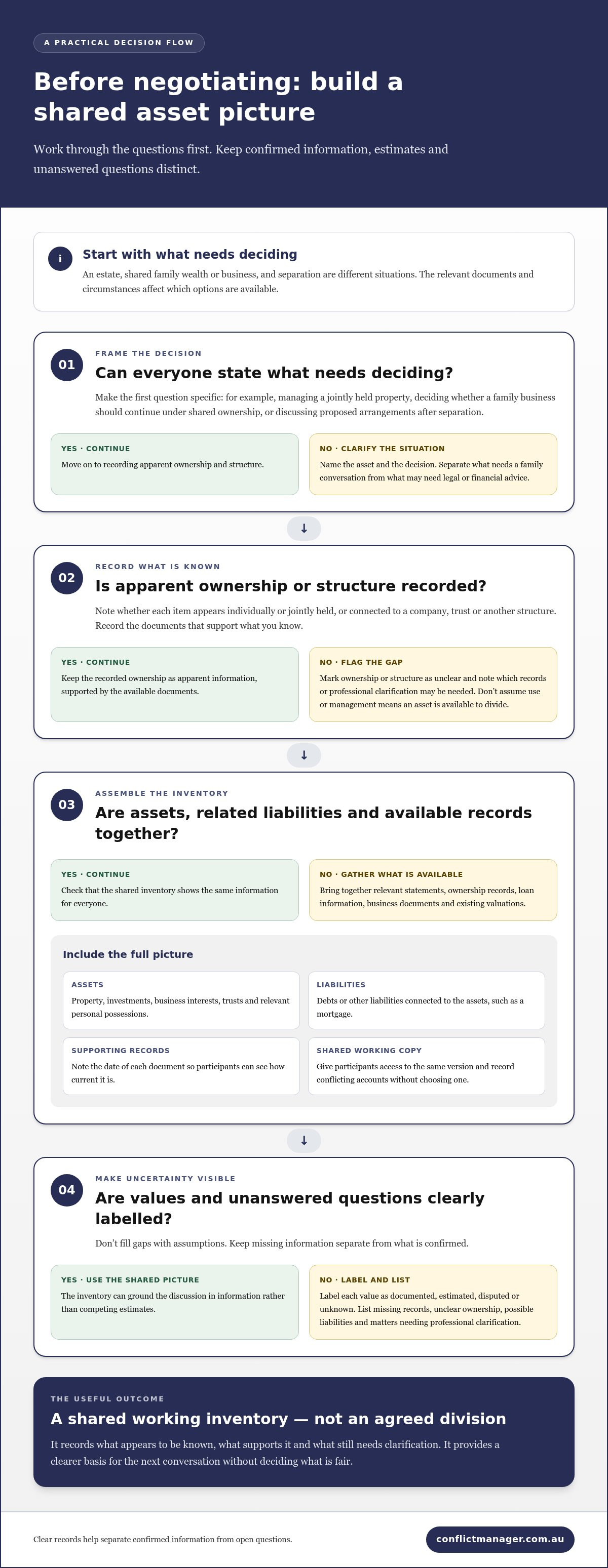
Negotiations are harder when family members are working from different records, memories or assumptions. Before discussing who should receive what, create a shared picture of the assets, ownership and outstanding questions. This won’t settle what a fair outcome looks like, but it can ground the conversation in information rather than competing estimates.
Use a sequence that makes gaps visible instead of filling them with assumptions:
- Identify the assets and liabilities. List property, investments, business interests, trusts and relevant personal possessions, alongside debts or other liabilities connected to them.
- Record apparent ownership. Note whether each item appears to be individually or jointly held, or connected to a company, trust or other structure. Record the documents that support what you know.
- Gather available information. Bring together relevant statements, ownership records, loan information, business documents and existing valuations. Record each document’s date so participants can see how current it is.
- List unanswered questions. Flag missing records, unclear ownership, possible liabilities and matters that need professional clarification. Keep these separate from confirmed information.
Completeness matters. A property may have a mortgage; an investment may sit within a particular ownership structure; a business interest may involve documents that need careful review. Don’t assume an asset is available to divide simply because a family member uses or manages it. Record what appears to be the case, then identify what needs clarification.
Build an asset and liability inventory
A shared spreadsheet or document can provide a practical working record. For each item, include its description, apparent owner, supporting documents, related debt and the person responsible for finding missing information. Give all participants access to the same version, and note conflicting accounts without choosing one. The inventory is a basis for discussion, not proof of ownership or an agreed division.
Agree how information and valuations will be handled
Where practical, set a consistent date for recording information, especially if statements or estimates relate to different periods. Label each value as documented, estimated, disputed or still unknown. If relatives disagree about a property’s worth, record both the disagreement and the basis for each view instead of presenting either figure as settled. Transparent information helps everyone see what is known, what remains uncertain and what needs attention.
Valuation questions can have financial and legal implications. Depending on the asset and family circumstances, a qualified financial, tax or legal adviser may be needed to explain them. Keep that advice distinct from the family’s discussion about priorities and possible arrangements. Preparing a clear record first can help advisers focus on specific questions rather than reconstructing the family’s information.
For families considering how to divide family assets without fighting, preparation creates a calmer starting point, not a predetermined answer. If assembling the information or discussing it together leads to deadlock, family conflict resolution can provide a structured, impartial setting for working through the issues.
What makes a family asset division feel fair to everyone?
Equal shares can look straightforward on paper, but equality and perceived fairness aren’t always the same. One family member may focus on formal ownership, while another points to years of work in a family business or the needs of someone who depends on an asset. These are different principles, not necessarily signs of bad faith.
To move from competing outcomes to a reasoned discussion, ask each person to explain the principle behind their proposal. The table below offers prompts for exploring possible approaches. None is automatically decisive, and the relevant legal position depends on the family’s circumstances and the type of decision being made.
| Principle | Question it raises | Potential trade-off |
|---|---|---|
| Ownership | Who legally owns or controls the asset? | Formal ownership may not address every family member’s expectations or contribution. |
| Contribution | Who contributed work, funds, expertise or care? | Contributions can be difficult to compare, especially when some were unpaid. |
| Present need | Who relies on the asset for housing, income or stability? | Meeting an immediate need may limit another person’s access to value or liquidity. |
| Continuity | Would retaining the asset preserve a business, home or family arrangement? | Continuity can bring ongoing costs, responsibilities or limits on control. |
| Shared objectives | What outcome best supports goals the family has agreed to pursue? | Objectives may differ, or change as circumstances evolve. |
Compare decision principles without turning them into legal rules
A proposal is easier to examine when its reasoning is explicit. “I should keep the business” states an outcome; “I’ve managed its operations, and continuity is a shared priority” explains the principle behind it. Another relative may prioritise present needs or future responsibilities. Ask what evidence and assumptions support each view, then distinguish the family’s preferred approach from legal rights and obligations, which require advice specific to the circumstances.
Several principles may matter at once. A family might value continuity while recognising that one person needs greater access to funds. Rather than declaring one person’s principle the winner at the outset, consider the implications of each approach and whether a combination could address more than one concern.
Consider practical options beyond selling everything
Selling an asset is one possible path, not the only one. The family could explore whether one member retains a property or business interest, whether shared use is workable, or whether a staged decision makes sense. Each option has trade-offs: keeping an asset may preserve continuity but reduce liquidity, while shared ownership may require ongoing coordination about upkeep, control and future decisions.
Before treating an option as a solution, consider what it would require in practice and whether it fits the applicable legal, tax and financial circumstances. For families learning how to divide family assets without fighting, proposals are easier to discuss constructively when they include both the guiding principle and the practical consequences.
How to keep family asset discussions constructive when views differ
Good intentions can lose their footing when a conversation has no boundaries. A defined agenda, a manageable topic and a record of decisions help relatives stay focused, especially when an asset carries a long family history. Agree on the purpose of each discussion before it begins. Leave broader grievances for a separate conversation rather than allowing them to take over every decision.
For each meeting, choose one decision or asset to discuss and define a useful next step. For example, a discussion about a family property might focus on whether it will be sold, retained or used under an agreed arrangement, rather than trying to resolve every question about the wider estate at once.
Set ground rules that protect the conversation
Agree who will participate, what information will be shared and how outcomes will be recorded. Keep a written agenda, give each person time to speak without interruption, and distinguish confirmed facts from concerns and proposals. If an issue falls outside the agreed topic, note it for later instead of reopening it immediately. These boundaries don’t require everyone to agree; they make disagreement easier to examine.
Specific questions invite useful answers. “What would need to be in place for you to consider retaining the property?” is more constructive than “You always get your way.” A proposal should explain its reasoning and practical implications, not simply state what one person wants. Avoid treating silence as agreement or assuming you know why another relative holds a particular view.
- Facts: What information or document supports this point?
- Concerns: What risk or consequence are you worried about?
- Proposals: What option would you like the family to consider?
- Actions: What needs to happen next, and who will follow it up?
Close by recording what was decided, what remains unresolved and any agreed actions. A clear note reduces later disputes about what was said and makes it easier to resume the discussion without starting again.
Respond to impasse without escalating the dispute
If the conversation becomes circular, pause and name the issue neutrally: “We haven’t agreed how ongoing costs would be shared.” Then clarify what’s missing, such as further information, a defined proposal or advice about a legal or financial question. Taking a break can help participants return with greater focus. It isn’t a failure or a sign that the relationship has broken down.
Repeated stalemates, a marked power imbalance or declining trust can make direct discussions difficult to sustain. Neutral facilitation can provide structure, help participants hear the issues more clearly and keep attention on practical decisions. It doesn’t replace legal advice or determine a division, and it can’t guarantee agreement. For support with a difficult family discussion, arrange family conflict resolution through a facilitated process.
Learning how to divide family assets without fighting doesn’t mean avoiding hard conversations. It means recognising when the current approach isn’t helping and creating a more workable way to continue.
When family mediation can help divide assets and agree next steps
Sometimes family members reach a point where another direct conversation is unlikely to shift the discussion. The same questions recur, communication is strained, or complex family dynamics make it difficult for everyone to speak openly. An impartial facilitator can introduce structure, keep attention on the decisions at hand and help participants consider workable options without treating one another as opponents.
Mediation is a process for discussion, not a promise of agreement. A facilitator doesn’t decide who is entitled to which asset or replace legal, tax or financial advice. The family remains responsible for considering its options and obtaining separate professional advice where needed. A calm process can support clearer decisions without determining the legal position.
What a facilitated family asset discussion can involve
The process may begin by clarifying who needs to participate, which issues are in scope and what each person hopes to achieve. The facilitator can then structure turn-taking so concerns are heard and discussion stays connected to decisions, rather than becoming a debate about past grievances. Relevant information and unresolved questions can be identified as the conversation develops.
For example, relatives discussing a family business might need to separate future involvement from concerns about past contributions. A facilitator can help keep those issues distinct so the family can consider each more carefully. Areas of agreement, points still in dispute and actions for later consideration can be captured in a written record.
Turn progress into clear, considered next steps
Progress doesn’t have to mean a final division in one meeting. A family may clarify which options it wants to examine, identify missing information or agree to pause a decision until advice is available. Record provisional understandings as provisional, and distinguish them from final arrangements. This reduces the risk of different interpretations being mistaken for settled decisions.
Where legal rights, tax consequences or financial implications may affect an option, note the specific question and seek advice from an appropriately qualified professional. A facilitator can help the family keep that question visible and return to the discussion with greater clarity, but doesn’t provide legal representation or professional financial advice.
For families considering how to divide family assets without fighting, mediation can offer a structured way to address recurring impasses while keeping the focus on practical decisions and sustainable next steps. It can be particularly relevant for families managing substantial assets alongside internal friction, though no process can guarantee agreement or a particular outcome.
If a neutral process could help your family move from repeated disagreement towards a clearer discussion, explore family conflict resolution with Conflict Manager.
Choose a steadier next step
The next useful move doesn’t have to be a final decision. It may be agreeing on one question to resolve, setting a time to revisit an option or recognising that family members need a more balanced setting to speak openly. A measured pace can protect decision-making, particularly when asset discussions are entangled with long-standing family dynamics.
For families considering how to divide family assets without fighting, a neutral process can shift attention from personal positions towards practical choices. Conflict Manager provides family office mediation for families managing substantial assets and internal friction, using a facilitative approach focused on clarity, stability and sustainable outcomes.
If a structured conversation could help your family move forward, explore a structured approach to family conflict resolution. Take the next step with care and keep open the possibility of a workable path.
Frequently Asked Questions
Is mediation legally binding in Australia?
Mediation itself doesn’t impose a binding decision: the mediator helps participants discuss options but doesn’t decide the outcome. Whether an agreement reached during mediation has legal effect depends on the circumstances and how it’s recorded or formalised. Before relying on a proposed arrangement, especially one involving significant assets or separation, get independent legal advice about what steps may be needed to make it effective and whether it reflects your interests.
Can family members divide assets without selling the family home or business?
Yes, selling isn’t the only option a family can discuss. One person might retain an asset, relatives might agree on shared use for a defined period, or they could consider a staged arrangement. Examine each option in practical terms: can the person retaining the asset manage its costs, and how will others’ interests be addressed? Legal, tax and financial advice can help clarify whether a proposed arrangement is workable.
What happens if one family member refuses to discuss the assets?
Start by finding out what’s behind the refusal, without assuming the person is acting in bad faith. They may be worried about pressure, missing information or the consequences of agreeing too quickly. A neutral written invitation can set out the decision to discuss and offer a structured conversation. If your family is considering how to divide family assets without fighting, facilitation may help reopen dialogue, but it can’t compel participation.
How should a family agree on the value of an asset before dividing it?
For a high-value or disputed asset, consider agreeing on an independent valuation by someone qualified to assess that type of asset. First clarify what is being valued, the valuation date and what information the valuer needs. For a business, relevant financial records and assumptions may affect the assessment. If family members still disagree, record the different views and seek advice on a fair way to resolve the valuation question.
Can a family mediator decide who receives each asset?
No. A family mediator facilitates discussion; they don’t allocate assets, rule on ownership or determine legal entitlements. Participants remain responsible for deciding whether an option is acceptable to them. If they can’t reach agreement, other processes may be relevant depending on the family’s situation. A mediator can help clarify what remains unresolved, while separate legal advice can explain rights, obligations and possible avenues available to those involved.
Do family members need legal advice before agreeing on asset arrangements?
Legal advice can be particularly important before treating an asset arrangement as final, especially where separation, an estate, a trust or a family business is involved. Each person may benefit from understanding how the proposal affects their position and whether it needs formal documentation. A facilitator can support communication but doesn’t provide legal representation. Tax and financial questions may also call for advice from appropriately qualified professionals.
What should we do if we discover an asset or liability was left off the list?
Tell the relevant family members promptly and add the item to the shared record, including any documents that explain it. Note when it was discovered and whether its ownership, value or connection to a liability is still unclear. If discussions or decisions depend on the incomplete list, pause those decisions until the new information has been considered. For a substantial or disputed item, seek relevant professional advice before deciding how it affects arrangements.


