

What if the most damaging response to a leadership dispute is trying to resolve it in the same room where trust has already broken down? An executive impasse can stall decisions, intensify emotion and put professional reputations under pressure. Leadership conflict resolution isn’t about winning an argument. It’s about restoring the conditions leaders need to make sound decisions and support organisational stability.
It’s understandable to want leaders to resolve matters privately. Yet competing responsibilities, long histories and stakeholder concerns can make internal conversations circular or too charged to move forward. A neutral facilitator can establish an impartial structure for discussion and help participants separate the underlying issues from the positions they’ve adopted.
This article sets out a practical framework for addressing high-stakes leadership friction: preparing for a facilitated conversation, identifying the real points of disagreement, rebuilding clarity and working towards a sustainable resolution. Conflict Manager provides expert-led mediation and facilitation to help organisations navigate disputes and structural change. The aim isn’t simply to end the dispute, but to restore progress while respecting each leader’s responsibilities and dignity.
Key Takeaways
- Recognise how power, perspective and pressure can turn executive disagreement into broader organisational disruption.
- Understand why authority and long-standing relationships can make impartial internal conversations difficult.
- Identify when proactive facilitation or mediation may better support high-level stakeholders.
- Use a leadership conflict resolution framework that separates structural issues from personality and makes space for stakeholder perspectives.
- Learn how a neutral third party can help leaders work towards clear, sustainable outcomes while protecting professional legacy and asset integrity.
The Architecture of Leadership Conflict: Beyond Simple Disagreement
At executive level, disagreement rarely sits neatly between two people. It may expose unresolved questions about authority, strategic direction, accountability or who bears the consequences of a decision. Leadership conflict is the friction between vision, responsibility and competing obligations, and it can disrupt an organisation’s ability to act.
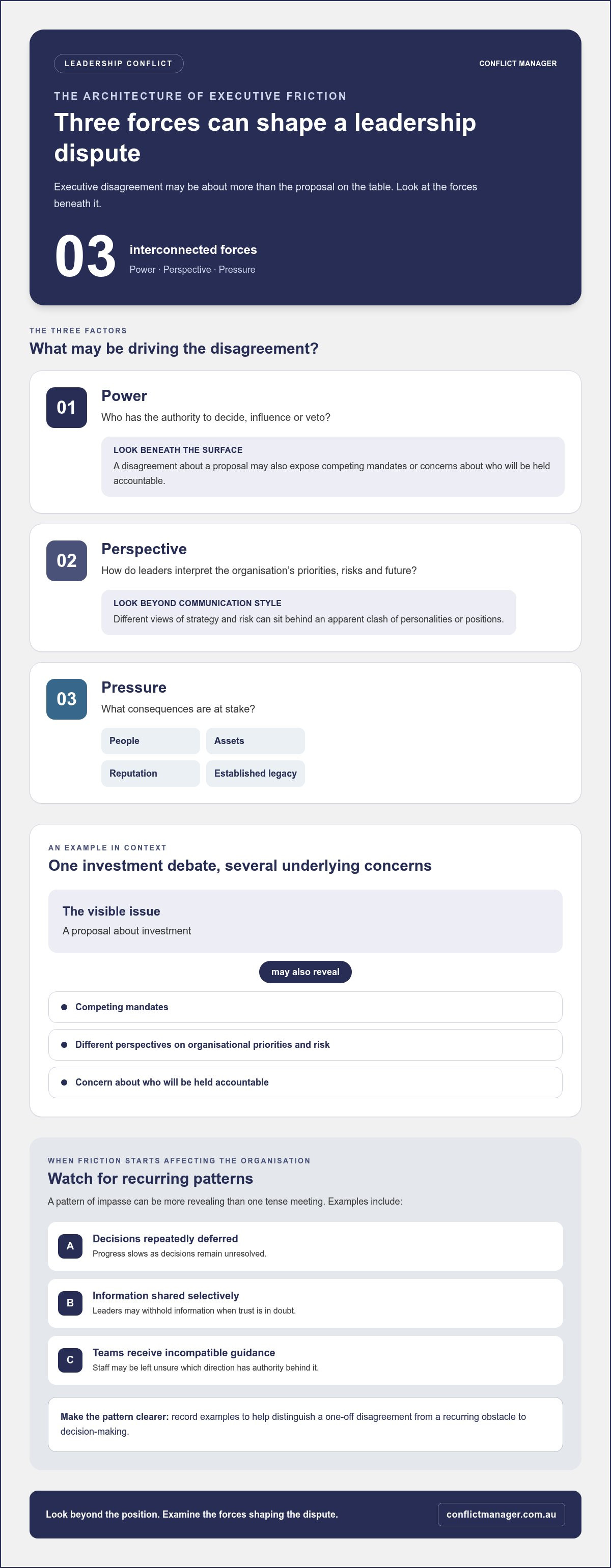
Three forces commonly shape that friction. Power concerns who has the authority to decide, influence or veto. Perspective reflects different interpretations of the organisation’s priorities, risks and future. Pressure comes from the consequences at stake, such as protecting people, assets, reputation or an established legacy. These forces often overlap. A debate about investment, for instance, may appear to be about a proposal while also revealing competing mandates and concerns about who will be held accountable.
That’s why leadership conflict resolution needs to look beyond communication style or personality. Conflict resolution can involve processes such as negotiation and mediation, as outlined in Conflict Resolution: An Overview. At board level, the process also needs to account for the structures and responsibilities shaping the dispute.
The High Cost of Executive Impasse
An impasse changes how decisions are made. When leaders doubt one another’s intentions, they may withhold information, seek extra approval or reopen settled questions. Each action can seem prudent in isolation, but together they slow decisions and leave staff unsure which direction has authority behind it.
The effects can spread across the organisation. Teams may receive conflicting instructions, delay commitments or align themselves with different executives. Managers then spend time interpreting the dispute rather than delivering agreed priorities. Stakeholders may also lose confidence when public statements, strategic choices or leadership transitions appear inconsistent. The risk is not just that a disagreement becomes visible. It’s that the organisation appears unable to govern its own direction.
Look for patterns rather than focusing on one tense meeting: decisions repeatedly deferred, information shared selectively or teams receiving incompatible guidance. These can indicate that the friction is affecting the organisation’s operating structure. Recording examples helps clarify what is happening and whether the issue is a one-off disagreement or a recurring obstacle to decision-making.
Emotional Volatility in High-Stakes Environments
Experience doesn’t make leaders immune to emotion. Senior professionals may have invested years in a strategy, relationship or institution, so a challenge to their judgement can feel like a challenge to that contribution. When sizable assets or a family or organisational legacy are involved, leaders may become more protective, particularly if they believe a decision could weaken what they’re responsible for preserving.
Defensiveness can obscure the practical issue. A discussion about control, for example, may also concern continuity, accountability or confidence in a proposed transition. Naming those underlying concerns can make the disagreement easier to understand without diminishing the stakes.
Internal resolution may no longer be sufficient when participants can’t discuss the issue without returning to accusation, when power imbalances prevent candid contributions or when previous conversations have hardened positions instead of clarifying them. A neutral facilitator can provide an impartial structure for examining both the human dynamics and the organisational factors at play.
Why Internal Resolution Efforts Often Fail at the Board Level
At board level, authority doesn’t automatically create neutrality. A chair, director or senior executive may have the power to convene a discussion while also holding a position, relationship or responsibility affected by its outcome. The people best placed to make a decision may also have personal or organisational stakes that shape how they view the dispute.
Internal conversations can be useful when a disagreement is contained and participants can speak candidly. But if leaders have already formed opposing camps, trying to resolve matters among themselves may reinforce those divisions. Colleagues can be asked to listen, advise or carry messages, and even a well-intentioned intervention may be interpreted as taking a side. The discussion then becomes another arena in which influence is tested.
Standard HR processes can provide consistency and a clear way to raise workplace concerns. Executive disputes, however, may involve overlapping governance responsibilities, long-standing relationships, major strategic decisions or sizable assets. A standard protocol may not be designed to untangle those interconnected issues. Leadership conflict resolution at this level needs to consider both the people involved and the structures influencing the disagreement.
The Burden of Subjectivity
History travels into the meeting. A current disagreement about investment or authority may carry years of previous decisions, perceived slights or trust built through shared work. Participants may interpret a proposal through that history, responding not only to its merits but also to what they believe it signals about their role or contribution.
Internal observers face a similar bind. They may depend on one executive for direction and another for resources, or worry that speaking openly will affect their standing. Supporting one side may feel understandable, but it can harden factions and narrow the information available to decision-makers. A neutral setting gives participants space to explain their perspectives without asking colleagues to act as judges.
Complexity and Structural Change
Restructures, leadership succession and shifts in governance can unsettle established expectations. Long-serving leaders may see a new strategy as a rejection of what they built, while incoming decision-makers may view existing practices as barriers to change. Neither interpretation captures the full picture on its own. Without a process to examine the underlying concerns, either can become a fixed position.
The shift from founder-led decision-making to formal corporate governance can be especially delicate because authority, identity and accountability may all be changing at once. Clarifying who decides, who contributes and how decisions will be communicated can help distinguish process uncertainty from personal opposition. When internal efforts keep circling the same ground, expert-led stakeholder facilitation can provide an impartial structure for difficult conversations and support a sustainable way forward.
Facilitation vs. Mediation: Navigating the Path to Stability
Facilitation and mediation both bring structure to difficult conversations, but they serve different purposes. Facilitation is often proactive: a neutral person guides stakeholders through discussion, clarifies priorities and helps them make decisions before disagreement becomes entrenched. Mediation is generally used once a dispute has taken hold. The mediator helps participants address the conflict directly and work towards an outcome they can accept.
Neither approach decides who is right. The right process depends on the state of the relationships, the urgency of the decisions and whether participants can still work together constructively. For leadership conflict resolution, choosing an appropriate process can shift attention from defending positions to restoring the organisation’s ability to move forward.
The Power of Neutral Facilitation
A facilitator sets a clear process, makes space for each stakeholder’s perspective and keeps discussion connected to the decisions at hand. This can help during strategic planning, governance changes or emerging tension, when leaders need impartial structure before positions harden.
A well-managed conversation gives participants a safer setting to raise concerns without turning the meeting into a contest for influence. The focus stays on clarifying choices, responsibilities and next steps, rather than replaying every past grievance. Before the meeting, it helps to define the decision that needs attention, identify who needs to contribute and agree on how the discussion will be managed.
Formal Mediation for Complex Disputes
When communication has broken down, or a dispute involves significant assets, legacy or strong emotions, structured mediation can help participants address the conflict more directly. A mediator establishes an orderly process, supports balanced participation and helps clarify where interests align or diverge.
If the parties reach common ground, they can record the decisions, responsibilities and next steps in a form suited to their circumstances. The aim is a practical, sustainable outcome that stakeholders understand and that allows the organisation to keep operating.
A neutral third party can lower the temperature by slowing reactive exchanges, setting boundaries for discussion and ensuring each person is heard. They don’t remove the stakes or make decisions on the organisation’s behalf. They help create conditions in which leaders can consider those stakes with greater perspective.
Use this comparison as a starting point:
- Choose facilitation when stakeholders need to make decisions together, clarify priorities or address emerging friction before it becomes a formal dispute.
- Consider mediation when a dispute is established, conversations repeatedly stall or participants need structured support to explore an agreed way forward.
- Consider the complexity of the matter, including the number of stakeholders, the sensitivity of the issues and the effect on organisational stability.
The distinction isn’t absolute. A facilitated discussion may reveal a deeper dispute that calls for mediation, while mediation can help restore enough trust for future facilitated decision-making. Expert-led mediation and facilitation provide a steady, neutral process shaped around the people and issues involved, supporting clarity without compromising professional dignity or organisational integrity.
A Strategic Framework for Leadership Conflict Resolution
High-stakes disputes need more than a well-intentioned conversation. A useful process distinguishes relationship strain from structural problems, gives affected stakeholders a fair opportunity to contribute and turns discussion into decisions that can hold under pressure. Where leadership, family wealth and legacy intersect, it also keeps asset integrity in view without allowing that concern to silence legitimate differences.
This five-step framework creates a deliberate path from uncertainty to practical action. Adapt the steps to the dispute, but build on the clarity established at each stage.
- Objective assessment. Define the issue before deciding who is responsible. Separate observable events, such as a delayed decision or unclear authority, from interpretations about another person’s motives. Then ask whether the friction concerns roles, decision rights, strategy, communication or competing interests. This helps prevent a structural problem from being reduced to a personality clash.
- Stakeholder engagement. Identify who is directly affected and whose input is needed for a workable outcome. Gather perspectives in a neutral environment, with clear expectations about respectful participation and how information will be used. Listening separately at first may surface concerns participants aren’t ready to raise together.
- Strategic facilitation. The difficult middle is where positions meet, emotions rise and progress can stall. A facilitator can keep the discussion focused, summarise areas of agreement and bring participants back to the decision that needs attention. The aim isn’t to force consensus, but to make differences clear enough to work with.
- Outcome definition. Turn discussion into specific, sustainable commitments. Clarify what has been agreed, who is responsible for each action and how unresolved questions will be handled. Where an outcome affects organisational or family assets, record the principles guiding decisions so short-term compromise doesn’t undermine long-term integrity.
- Implementation and monitoring. A resolution needs to work beyond the meeting room. Set review points, decide how progress will be communicated and agree on a way to raise concerns if circumstances change. This gives stakeholders a practical route to address slippage before it becomes a new source of conflict.
Separating Emotion from Asset Integrity
Emotion deserves acknowledgement, not control of the process. Name the pressure in the room, let each participant explain what feels at risk, then return to the decision and its implications. Resolution requires detachment from the problem, not from the people. Examine the issue carefully while recognising the personal meaning attached to a family legacy, a business or its assets.
Governance as a Conflict Preventative
Clear governance can reduce future friction by making decision-making responsibilities, consultation expectations and escalation pathways easier to understand. Leadership teams are better placed to work through conflict when they can challenge a proposal without treating disagreement as disloyalty. Professional facilitation can help stakeholders discuss these arrangements and identify where greater clarity would support continuity through change.
If a leadership dispute is affecting decisions or relationships, engage Conflict Manager for expert-led facilitation to help structure a clear, considered path forward.
Conflict Manager: Restoring Order through Expert Facilitation
In a high-stakes dispute, starting the next conversation can feel difficult. Decisions may be stalled, trust strained and the consequences may extend beyond the people directly involved. Conflict Manager provides expert-led mediation and facilitation for families and organisations across Australia, offering a neutral process when complexity and emotion make progress hard to find.
Effective leadership conflict resolution needs more than a calm room. It requires attention to the human dynamics as well as the structures, responsibilities and assets affected by the dispute. An external facilitator is separate from the organisation’s internal factions and isn’t responsible for defending past decisions. That distance can help stakeholders examine what’s happening with greater perspective and consider a way forward that supports legacy and organisational stability.
Composed Authority in Action
A measured process can lower the temperature without dismissing the stakes. The facilitator establishes a clear structure for discussion, ensures perspectives can be expressed and brings attention back to the decisions that need to be made. This can be valuable when disagreement is entangled with leadership roles, organisational change or the stewardship of significant assets.
Progress doesn’t require every participant to see the past in the same way. It requires enough clarity to understand different concerns, identify where interests overlap and decide what needs to happen next. By keeping the conversation grounded in both people and organisational realities, Conflict Manager helps stakeholders move from competing accounts towards practical options and sustainable outcomes.
Securing Your Organisational Future
Even entrenched disputes can shift when participants have the right conditions to speak and a clear process for working through differences. Addressing friction before it further strains relationships or disrupts governance can help preserve the organisation’s ability to make decisions. An impartial perspective can be useful before every internal avenue has been exhausted.
Expert facilitation offers a structured way to consider difficult questions, including:
- Which decisions or relationships are being affected by the conflict?
- What does each stakeholder need to take part constructively?
- How can an outcome support continuity, asset integrity and professional dignity?
Conflict Manager brings a composed, objective approach to high-emotion situations and disputes involving structural change or sizable assets. The aim isn’t to impose a solution, but to help stakeholders find a clear path towards a resolution that can endure beyond the meeting and support future stability.
For a neutral, expert-led process tailored to your leadership team, enquire about expert facilitation for your leadership team.
Choose a Clearer Way Forward
The next step doesn’t need to settle every point of disagreement. It can create the conditions for a more considered conversation, allowing leaders to protect working relationships while addressing decisions that can’t remain unresolved. Moving from defending positions to building a workable process is where leadership conflict resolution can begin to create lasting value.
If the discussion has become difficult to hold internally, an impartial facilitator can help stakeholders approach it with greater structure and perspective. Conflict Manager supports families and organisations through high-emotion disputes, including situations where significant assets and legacy are at stake. The focus is on helping people move towards clear, sustainable outcomes without losing sight of what they’re working to preserve.
Restore clarity to your leadership team with expert facilitation, and take a measured first step towards renewed trust and forward movement. A difficult impasse need not define what comes next.
Frequently Asked Questions
What is the difference between leadership conflict resolution and general workplace mediation?
Leadership conflict resolution often addresses disputes that affect organisational direction, governance or decision-making. General workplace mediation commonly centres on a disagreement between colleagues or team members. For example, a dispute between executives about who approves a major strategic change may require attention to decision authority as well as communication. The process should reflect the participants’ responsibilities and the wider organisational consequences, rather than treating the issue as a routine interpersonal disagreement.
How long does a typical leadership facilitation process take for a complex organisation?
There isn’t a single standard timeframe for a complex organisation. The process depends on factors such as the number of stakeholders, the issues to be addressed and how readily participants can engage. A focused discussion about decision responsibilities may need less preparation than a dispute involving multiple leaders, organisational change and significant assets. Early scoping can clarify the intended outcomes, who needs to participate and what preparation may support a productive process.
Can leadership conflict be resolved if there is a complete breakdown in trust?
It may still be possible to make progress, even if trust is badly damaged. Resolution doesn’t always mean restoring a close relationship. It can mean agreeing on workable boundaries, clearer decision-making arrangements or reliable ways to communicate. A practical starting point is to identify which interactions are necessary for the organisation to function and what safeguards would make them manageable. A neutral facilitator can help participants explore those conditions without demanding immediate reconciliation.
When is the right time to engage a neutral third-party mediator for a board dispute?
Consider engaging a mediator when board discussions repeatedly end without decisions, participants avoid direct communication or the same issue returns without resolution. Mediation can also help before a scheduled decision with significant organisational consequences, particularly if board members doubt that an internal chair can remain impartial. Early involvement gives stakeholders a structured way to address concerns before positions become harder to shift or the dispute affects wider organisational confidence.
How do you manage high-emotion situations during family office conflict resolution?
Set a clear purpose for each discussion and agree how participants will raise concerns without interruption or personal attacks. In family office conflict resolution, it can help to distinguish the decision being considered from what family members fear it may mean for their role, relationships or shared legacy. A facilitator can keep the conversation orderly, make space for different perspectives and return attention to the practical choices affecting the family and its assets.
What are the benefits of external facilitation over internal management for business owners?
External facilitation provides a process led by someone outside the organisation’s reporting lines and internal alliances. That can make it easier to raise concerns participants may hesitate to discuss with colleagues or directors. An external facilitator can keep the conversation focused, ensure relevant stakeholders are heard and help the group identify next steps, while business leaders retain responsibility for their decisions.
How does professional conflict resolution protect family wealth and legacy?
Professional conflict resolution can support careful discussion of decisions that affect shared assets, family responsibilities and long-term plans. A facilitated process helps participants clarify what they’re deciding, whose perspectives need to be considered and how they’ll communicate the outcome. This can reduce the chance that unresolved interpersonal friction obscures important questions about continuity or stewardship. It supports informed discussion, but it can’t guarantee a particular financial result or remove every source of disagreement.
Is the resolution process confidential for high-profile leadership teams?
Confidentiality arrangements depend on the process and the participants’ circumstances, so they should be discussed and clearly understood before conversations begin. High-profile teams can agree who may receive updates, what information can be shared beyond the room and how any outcomes will be recorded. This helps participants understand the boundaries of the discussion and prepare appropriately. Avoid assuming that every detail will remain private. Clarify expectations for the specific engagement in advance.


