

A conflict plan that appears only after a dispute has escalated is too late to guide the first conversation. If the same disagreements keep returning, an ongoing conflict management plan for business can give managers and employees a consistent way to raise concerns, respond and decide what happens next, without turning every tension into a formal process.
It’s understandable to worry that a written plan could feel bureaucratic or make a sensitive situation harder. Keep it practical: define who is responsible, set proportionate response stages and schedule regular reviews, while allowing room to adapt to the people and circumstances involved. Consistency should make conversations easier to begin, not replace sound judgement.
This guide explains how to build and maintain that operating rhythm, from early conversations through internal escalation, and how to recognise when neutral external facilitation may help. You’ll learn how to assign responsibilities, support constructive discussions before work and relationships are affected, and review recurring patterns so the plan stays useful as your business changes.
Key Takeaways
- Build an ongoing conflict management plan for business around clear responsibilities, communication pathways and proportionate escalation.
- Choose a response that fits the situation, from a direct conversation to manager support or neutral stakeholder facilitation.
- Involve relevant people in shaping the plan, focusing on recurring friction and workable processes rather than blame.
- Review and test the plan over time so it remains practical as your organisation and its needs change.
- Recognise when internal discussions have become strained, and consider how an impartial external perspective may help stakeholders move forward.
Why an ongoing conflict management plan for business needs more than a policy
Unresolved friction rarely stays in one conversation. It can resurface in a project decision, a strained working relationship or a period of organisational change, especially when people aren’t sure how to raise concerns. A conduct policy may set expectations, but it doesn’t necessarily explain what a manager or employee should do when a disagreement starts affecting day-to-day work.
An ongoing conflict management plan for business is a shared operating process. It sets out who responds, what stages a concern may move through, how people communicate and when the approach is reviewed. In short, a conflict management plan guides a business’s response to disagreement. It can support constructive engagement, but it can’t guarantee agreement.
This is different from a general conduct policy, which usually describes expected behaviour, and from one-off mediation, which addresses a particular dispute. A plan connects principles to practical steps over time. It helps people understand the available pathways without requiring every disagreement to become formal or removing the judgement needed to respond to context. The Conflict Management Overview provides useful background on the aims and approaches involved. A business plan translates those broad ideas into roles and practices suited to its organisation.
What an ongoing business conflict plan is designed to do
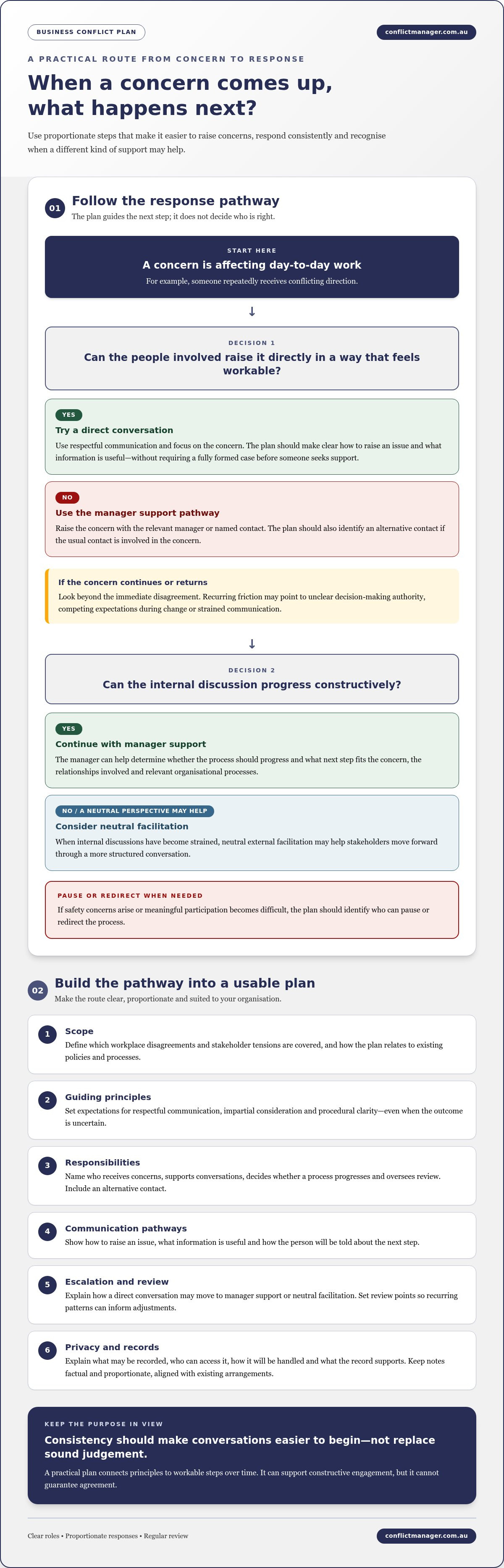
A shared process gives people a clearer route for recognising and raising concerns before positions harden. For example, a team member who repeatedly receives conflicting direction could know whether to speak directly with the colleague, raise the issue with a manager or request a more structured conversation. The plan doesn’t decide who is right. It makes the next step easier to identify.
Clear roles also reduce uncertainty. Employees can understand where to take a concern, while managers know what they’re responsible for and when to seek further support. Those boundaries create consistency, not a script: the response still needs to reflect the concern, the relationships involved and any relevant organisational process. Disagreement remains part of working together; the aim is to engage with it deliberately.
Why recurring conflict needs a consistent response
When similar issues return, inconsistent handling can leave everyone guessing. One manager may address a concern promptly, while another waits for a formal complaint. Stakeholders may then be unsure whether they’ll be heard, who will speak with them or what happens after they raise the issue. A predictable process makes these expectations visible without assuming every situation should follow the same path.
Recurrence can also point to pressures beneath the immediate disagreement: unclear decision-making authority, competing expectations during change, or communication that has become strained. A plan gives an organisation a way to notice those patterns and consider whether the response should address the working arrangement as well as the immediate tension. The document itself won’t remove the underlying pressure. Its value lies in helping people respond coherently, review what is happening and choose a suitable next step.
What to include in an ongoing conflict management plan
A useful plan makes the route from concern to response easy to follow. It should be detailed enough to guide action, yet flexible enough to reflect the organisation’s structure, risk profile and existing policies. An ongoing conflict management plan for business isn’t a universal template: define its boundaries and decision points around the situations your people actually face.
Use this checklist to make the plan practical:
- Scope: Identify the workplace disagreements and stakeholder tensions the plan covers, such as recurring team friction or disputes that arise during organisational change. Explain how it relates to existing policies and processes.
- Guiding principles: Set expectations for respectful communication, impartial consideration and procedural clarity. These principles help people understand how concerns will be approached, even when the outcome is uncertain.
- Responsibilities: Name who receives concerns, supports conversations, decides whether a process should progress and oversees review. Include an alternative contact for a concern involving the usual contact person.
- Communication pathways: Show how someone can raise an issue, what information is useful to share and how they’ll be told about the next step. Keep the route clear without requiring people to present a fully formed case before seeking support.
- Escalation and review: Describe how a direct conversation may move to manager support or neutral facilitation, and who can pause or redirect the process if safety concerns arise or meaningful participation becomes difficult. Set review points so recurring patterns can inform adjustments.
- Privacy and records: Explain what information may be recorded, who can access it, how it will be handled and what the record is intended to support. Keep notes factual and proportionate, and align these expectations with the organisation’s existing privacy and record-keeping arrangements.
Set the scope, principles and ownership
Be specific about who the plan covers. It might guide concerns between colleagues, across teams or involving external stakeholders, while directing other matters to a separate established process. Then assign ownership: a manager may support an initial conversation, while a designated senior person oversees progression and review. Clear responsibility prevents concerns from drifting between roles. Impartiality and respectful communication help keep the process focused on the issue rather than assumptions about intent.
Map response stages and escalation pathways
Set out a proportionate sequence. A routine misunderstanding may be addressed directly, if appropriate, or with a manager’s support. More complex or high-emotion situations may call for a structured discussion or neutral facilitation. The plan should identify who assesses the next step, how participants are informed and who can pause or redirect a process if someone raises a safety concern or meaningful participation becomes difficult. This creates a repeatable pathway without forcing every matter into the same format.
Make the plan usable within the organisation’s existing arrangements, not a competing document. For tailored support with organisational conflict management and stakeholder discussions, Conflict Manager’s conflict management support can help clarify a process suited to the situation.
Compare informal conversations, internal processes and neutral facilitation
Choosing a response is a matter of fit, not formality for its own sake. Consider how complex the issue is, whether people can speak candidly, how power dynamics may affect participation and what decisions are at stake. A direct conversation may be enough for a contained misunderstanding. A strained relationship or disagreement affecting several stakeholders may need more structure.
| Approach | Purpose and suitable circumstances | Strengths | Limitations |
|---|---|---|---|
| Direct conversation | Address a specific, relatively contained concern between people who can engage constructively. | Allows those involved to clarify expectations promptly and speak directly about the issue. | May be difficult where trust is low, the issue is entrenched or one person feels unable to speak openly. |
| Manager-supported internal process | Give a disagreement structure when direct discussion has not helped, or roles and expectations need clarification. | A manager can provide continuity, clarify the work context and agree on practical next steps. | The manager’s existing relationships or position may affect how impartial the process feels. Internal authority may not be enough to address deeper stakeholder tensions. |
| Neutral stakeholder facilitation | Support a structured discussion when internal conversations have stalled, become strained or involve competing perspectives. | An impartial facilitator can guide communication, bring underlying issues into view and help participants consider options. | Facilitation supports discussion, but participants retain responsibility for decisions. It may not be the right process if people can’t participate meaningfully or another organisational process needs to take priority. |
When a direct or internally supported conversation may fit
A direct conversation can suit a clearly bounded issue, such as differing assumptions about who is responsible for a handover, if both people are willing to discuss it respectfully. Agreeing on the specific concern and the practical change being sought can keep the discussion focused. It shouldn’t be treated as the default for every sensitive or entrenched dispute; context matters.
Manager support can help where expectations need clarification or the issue affects team coordination. An internal process offers continuity when the manager’s role is understood and participants can raise concerns with reasonable confidence. If the manager is closely involved in the disagreement, or their authority shapes the decision in question, an alternative pathway may be more appropriate.
When neutral stakeholder facilitation may help
When internal efforts have stalled, an impartial facilitator can create a clearer structure for discussion. They can help participants hear competing perspectives, identify where the disagreement sits and distinguish immediate decisions from underlying relationship or process concerns. That outside perspective can be useful when several stakeholders are affected by a change or decision.
Neutral facilitation adds structure to a difficult conversation without taking decisions away from the people responsible for them. It isn’t a guarantee of consensus. The facilitator supports the process, while stakeholders remain accountable for their choices and next steps. In an ongoing conflict management plan for business, define when this option can be considered, who can initiate it and how the organisation will determine whether it fits the circumstances.
How to build, introduce and maintain the plan
A plan becomes useful through its design and everyday use, not through the act of publishing it. Build the process around recurring friction and existing workplace arrangements, then introduce it in a way that helps people understand what to do. An ongoing conflict management plan for business should be shaped with relevant input, tested in practice and adjusted as the organisation changes.
Design and introduce a plan people can use
Keep plan design focused on the system, not on deciding who was at fault in past disputes. Leaders can invite employees and relevant stakeholders to describe where communication, decisions or handovers tend to become difficult, without asking them to revisit sensitive details in a group. This surfaces practical needs and helps the process feel credible and relevant.
- Map recurring friction. Look for patterns in the types of concern raised, where expectations diverge and which work changes tend to create uncertainty. Focus on themes rather than assigning blame to individuals.
- Review existing pathways. Identify who currently receives concerns and which internal processes already apply. Note gaps, overlap or unclear hand-offs so the plan complements existing arrangements rather than creating competing routes.
- Draft plain-language steps. Explain how a person can raise a concern, what response options may follow and how a matter can move between stages. Use familiar terms, not policy language that obscures the next step.
- Assign ownership and prepare managers. Make responsibilities explicit, including who supports a conversation, oversees the process and handles a concern involving the usual contact. Prepare managers to listen, explain options and avoid promising a particular outcome.
- Introduce and test the process. Ask relevant leaders to explain why the plan exists and how to access it. Use a realistic, low-stakes scenario to check whether people can identify the right pathway and understand what happens next.
Before rollout, make the plan easy to find and explain it through the channels employees already use, such as team briefings or induction materials. Give managers a concise guide to their role and a route for raising uncertainty about the process. Consistent communication helps people see the plan as a practical resource, not an automatic escalation into formal action.
Review whether the process remains useful
Set review points that suit the pace of organisational change and the plan’s actual use. A review after a major restructure may be timely; a stable organisation might choose a different rhythm. The purpose is to learn whether people could use the process, not to count only disputes that ended in agreement.
Review means learning from how the process works, not measuring a guaranteed resolution. Look for recurring obstacles, unclear responsibilities, delays between stages or confusion about how to raise a concern. Use de-identified themes where possible, sharing only the detail needed to improve the process. Update the guidance when reporting lines, stakeholder relationships or internal pathways materially change, then communicate what has been revised.
If your organisation needs support to shape a practical conflict response process, work with Conflict Manager on your conflict plan.
When Conflict Manager can support your business conflict plan
A business can have clear internal pathways and still reach a point where conversations become difficult to navigate. Managers may be closely involved in the issue, stakeholders may hold competing accounts of what has happened, or a structural change may affect several working relationships at once. At that point, conflict resolution consulting or stakeholder facilitation can complement the plan by bringing an impartial perspective to the process.
Conflict Manager supports Australian organisations managing internal disputes and organisational change. Its work can sit at different points in a business conflict plan: clarifying how a response process should operate, or facilitating communication when internal discussions have stalled or become strained. The appropriate role depends on the organisation’s structure, the stakeholders involved and the circumstances of the conflict. Support is tailored to the situation rather than applied as a fixed template.
Support for complex or high-emotion business situations
Some matters are difficult to resolve through ordinary management conversations alone. A disagreement may involve several teams, decision-makers or stakeholders whose working relationship is important to an upcoming change. In high-emotion situations, people can become focused on defending their position, making it harder to identify the underlying concerns or the decision that needs attention.
A neutral facilitator can provide structure for communication, helping participants explain their perspectives and consider the issues affecting them. This can make competing needs easier to understand and clarify possible ways forward, without deciding the outcome on the stakeholders’ behalf. Expert guidance can also help an organisation consider how an internal response pathway fits the dispute or change it is facing. The process doesn’t guarantee agreement; it creates a more considered setting in which the issues can be addressed.
This support can be included in the plan as an option for situations where internal efforts have reached an impasse, impartiality is difficult to maintain internally, or several stakeholder perspectives need to be brought into the discussion. Leaders remain responsible for their organisational decisions, while facilitated communication can help make the decision-making conversation more deliberate.
Taking a considered next step
If your organisation is reviewing its conflict response arrangements, or an internal discussion has become difficult to progress, Conflict Manager provides organisational conflict management and stakeholder facilitation. A conversation can focus on the situation, who needs to be involved and what kind of process may be useful. This creates space to consider the context before settling on an approach.
A sound plan doesn’t need to rely on external support for every concern. It can strengthen internal capability while making room for neutral facilitation when circumstances call for it. Consider how that balance could work in your organisation and how it could support a more consistent response.
Put your plan into practice, one conversation at a time
The value of an ongoing conflict management plan for business is realised in the moments when someone needs to raise a concern, a manager must choose a response or stakeholders need a clearer way to work through a difficult decision. Your next step doesn’t need to be a major rollout. Choose a realistic situation and consider whether people would know where to begin, who should guide the process and when another perspective may be useful.
If that pathway feels uncertain, Conflict Manager’s conflict resolution consulting can support organisations facing internal disputes and organisational change. Stakeholder facilitation can help structure communication, bring focus to the issues and support clarity and sustainable outcomes without taking decisions out of the organisation’s hands.
Explore Conflict Manager’s support for organisational conflict management and discuss how the right process could fit your organisation. Start with one practical improvement, then build from there.
Frequently Asked Questions
Who should own an ongoing conflict management plan in a business?
A senior leader or designated people-and-culture representative should be accountable for keeping the plan current and making sure employees know how to access it. Ownership doesn’t mean that person handles every concern. For example, a department manager might guide a team discussion, while the plan owner monitors whether responsibilities are clear and whether the process needs attention. Include an alternative contact for situations where the usual contact is involved in the conflict.
How often should a business review its conflict management plan?
Set a regular review date, then bring the review forward if the organisation’s structure or internal processes change substantially. A business could also review the plan after a concern reveals confusion about who should respond or what happens next. The aim is to identify practical gaps, such as an outdated reporting line or an unclear handover, and make a focused update rather than revisiting the entire document each time.
Can a small business have an ongoing conflict management plan?
Yes. A small business can use a concise plan that identifies a few clear steps, rather than building a complex policy framework. The ongoing conflict management plan for business might name the owner or manager as the first contact, explain who someone can approach if that person is involved, and set out when a supported discussion or external facilitation may be considered. Simplicity matters, but people still need a credible alternative pathway.
What should a business do when a conflict involves a manager?
Provide a way to raise the concern with someone outside that manager’s direct decision-making role. Depending on the organisation, that could be an uninvolved senior leader, an owner or another designated contact. If the usual internal route isn’t impartial or feels difficult to use, neutral facilitation may help structure communication. The plan should explain how to access this alternative without requiring the person to first raise the issue with the manager concerned.
Does a conflict management plan replace workplace policies or legal advice?
No. A conflict plan should sit alongside relevant workplace policies, not override or bypass them. It can help clarify how people raise concerns and how conversations are approached, while existing processes continue to guide matters they cover. It also isn’t legal advice. If a situation raises questions about legal rights, obligations or formal action, the organisation should seek advice from a qualified legal professional rather than relying on the conflict plan to answer them.
Can an external facilitator help create a business conflict management plan?
Yes. An external facilitator can help leaders and stakeholders shape a process around the organisation’s structure, relationships and recurring challenges. Conflict Manager’s organisational conflict management and stakeholder facilitation can support this work by helping participants discuss the issues and consider practical pathways. The organisation retains ownership of its plan and decisions; external input can provide a structured, impartial perspective while the process is being developed or reviewed.


