

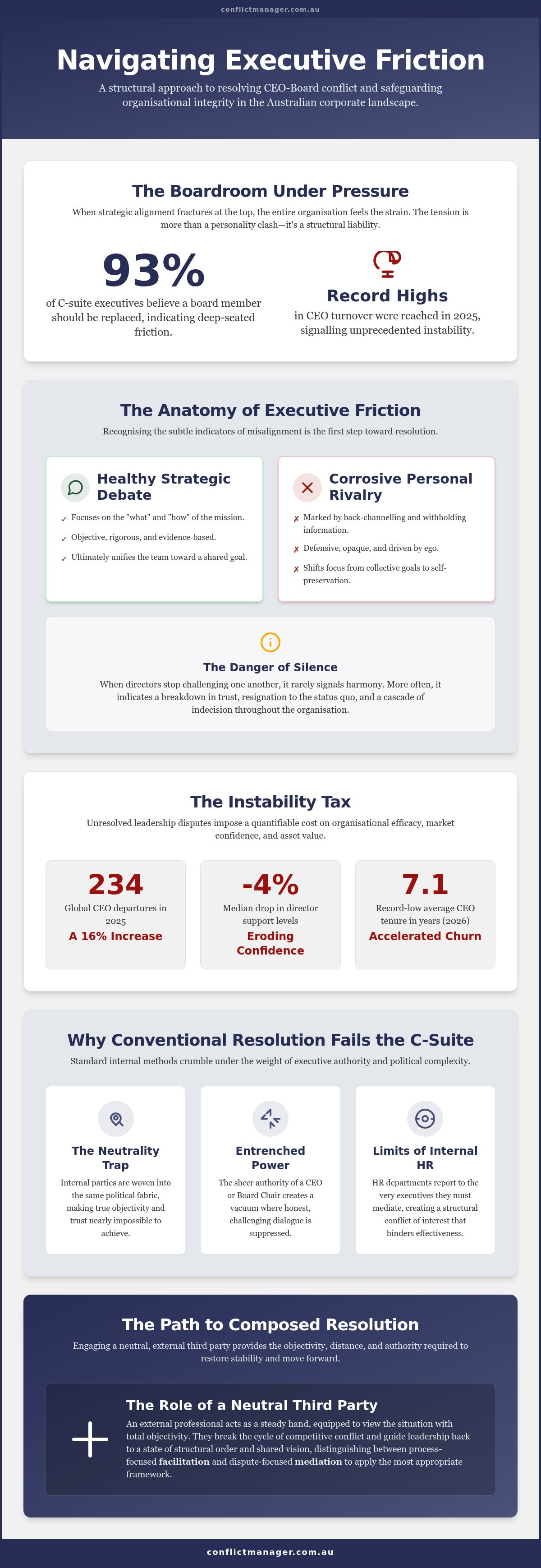
Friction. Stagnation. Risk. When ninety-three per cent of C-suite executives believe a board member should be replaced, the tension isn't just a personality clash; it's a significant structural liability. In the current Australian corporate climate, where CEO turnover reached record highs in 2025, the necessity for effective ceo board conflict resolution has never been more urgent. You likely feel the weight of this friction daily, watching as strategic momentum stalls and the fear of a publicised dispute begins to threaten your organisation's asset value and reputation.
It's natural to feel that internal efforts are no longer sufficient to bridge the gap between the executive suite and the boardroom. We understand that at this level, every decision carries immense weight for your stakeholders and your professional legacy. This article provides a composed, structural approach to navigating these high-stakes disagreements while preserving your organisational integrity. We'll explore how to restore operational stability, establish clear communication channels, and move from a state of volatile complexity toward a vision of lasting, structured resolution.
Key Takeaways
- Recognise the subtle indicators of executive misalignment before strategic friction evolves into a corrosive threat to your organisation's momentum.
- Understand why internal frameworks often lack the necessary distance and authority to facilitate successful ceo board conflict resolution.
- Learn to distinguish between facilitation and mediation to select the most appropriate method for restoring strategic alignment and shared vision.
- Discover how a structural approach to conflict management acts as a safeguard for asset integrity and your long-term professional legacy.
- Gain clarity on the process of engaging a neutral third party to move from a state of disruption toward a vision of composed resolution.
The Anatomy of Executive Friction: Recognising the Signs of Instability
Disruption. Friction. Stagnation. These are the quiet precursors to organisational decay. Recognising the early markers of executive misalignment is the first step toward effective ceo board conflict resolution. While healthy strategic debate is the lifeblood of innovation, it has a distinct signature compared to corrosive personal rivalry. Strategic debate focuses on the "what" and the "how" of the business mission; it's objective, rigorous, and ultimately unifying. Personal rivalry, by contrast, is defensive and opaque. It's marked by backchanneling, the withholding of information, and a shift from collective goals to individual preservation.
Silence in the boardroom often signals deeper, unaddressed structural issues. When directors or executives stop challenging one another, it's rarely because they've reached a state of perfect harmony. More often, it indicates a breakdown in trust or a resignation to the status quo. This friction cascades down through middle management, creating a culture of indecision and anxiety. When leadership is divided, the rest of the organisation loses its compass, leading to a measurable drop in productivity and engagement. It's a heavy price for any firm to pay.
Power Dynamics and the C-Suite
Ego and authority can easily cloud objective decision-making. In high-stakes Australian environments, turf wars between departments often stem from a lack of clarity at the executive level. Different Conflict Management Styles come into play here, but without a neutral framework, these dynamics often become entrenched. High-level stakeholders often struggle to self-correct because they are too close to the human and structural dynamics involved. They require a steady, external hand to view the situation with total objectivity and guide the team back to a state of order.
The Cost of Unresolved Leadership Disputes
The loss of strategic momentum is the most immediate cost of friction. When a board and CEO are at odds, market confidence wavers. In 2025, we saw a record 234 CEO departures globally, a 16 per cent increase from the previous year. This instability directly impacts asset value and the long-term reputation of the firm. The instability tax represents the quantifiable erosion of shareholder value and organisational efficacy caused by leadership friction, manifesting through a median 4 per cent drop in director support levels and a record low average CEO tenure of 7.1 years as of early 2026.
Why Conventional Conflict Resolution Fails the C-Suite
Objectivity. Distance. Authority. These are the structural requirements for navigating a high-level standoff. Standard workplace mediation techniques, while effective for middle management, often crumble when applied to the C-suite. The primary reason is the neutrality trap. Those inside the organisation are rarely perceived as truly objective because they are inevitably woven into the same political and social fabric as the disputing parties.
Existing power structures actively prevent honest dialogue during high-emotion disputes. When a CEO and a Board Chair are at loggerheads, the sheer weight of their authority creates a vacuum where others fear to tread. Effective ceo board conflict resolution isn't about teaching basic communication skills; it's about addressing the fundamental misalignment of power and vision. Research into leader's conflict management styles shows that a leader's competitive stance can poison the emotional climate of the entire executive team. Without a neutral party to break this cycle, the friction becomes a permanent fixture of the corporate culture.
The Limits of Internal Human Resources
Recognising when a conflict has outgrown the capacity of internal departments is a mark of strong leadership. Internal HR professionals face a significant structural hurdle: they report to the very people they are tasked with mediating. This creates a real or perceived risk of taking sides. If an HR Director challenges a CEO's behaviour, they risk their own professional standing. Consequently, executives are far more likely to trust a seasoned, external professional who has no stake in the internal hierarchy and can offer unvarnished truth.
High-Stakes Emotionality in Wealthy Families
In the context of Australian family offices and HNW enterprises, the intersection of family history and corporate governance adds another layer of complexity. Multi-generational friction isn't just about business strategy; it's about legacy, birthright, and decades-old interpersonal dynamics. Standard mediation doesn't account for the psychological depth required to navigate these waters. A bespoke approach is necessary to de-escalate these high-emotion disputes without damaging the family bond or the organisational integrity. For those seeking to restore order, engaging in professional organisational conflict management provides the necessary distance to view these volatile situations with total objectivity.
Facilitation vs. Mediation: Navigating Strategic Disagreement
Clarity. Method. Resolution. Selecting the appropriate intervention depends entirely on the current state of the organisational friction. While the terms are often used interchangeably in casual corporate discourse, they represent distinct paths toward restoring order. Facilitation is a proactive, forward-looking process designed to guide a leadership team toward strategic alignment and a shared vision. It's most effective when the group is functional but lacks a clear, unified direction. Mediation, by contrast, is a corrective measure. It focuses on resolving specific, high-stakes disputes through a structured and confidential negotiation process, often when the relationship between key stakeholders has begun to fray.
Navigating these complexities requires a specific expertise in ceo board conflict resolution that prioritises the long-term health of the business over short-term ego. A neutral hand ensures that all stakeholders feel heard, creating a space where nuanced points can be explored without compromising the final outcome. This structural neutrality allows for a level of objectivity that internal parties simply cannot provide. By choosing the right method at the right time, an organisation can move from a state of stagnant disagreement toward a future of operational stability.
Strategic Facilitation for Leadership Teams
Designing a framework for difficult conversations at the board or executive level requires a deep understanding of human dynamics. Facilitation ensures that every voice is captured with precision, using deliberate pauses and clarifying questions to bring nuance to complex strategic debates. The goal is to move the conversation from winning an argument to achieving a sustainable organisational outcome. When directors are guided through a methodical process, they're more likely to commit to the resulting strategy, even if it differs from their original stance. This alignment is essential for maintaining the confidence of shareholders and employees alike.
The Process of Composed Mediation
When a specific impasse threatens to derail the organisation, composed mediation offers a way forward. This process establishes strict ground rules for confidential, high-stakes dispute resolution, providing a safe environment for honest exchange. The mediator acts as a steady hand, remaining unruffled by the volatility or emotional weight of the situation. Mediation is a structured path toward clarity and asset protection, providing a neutral environment where high-stakes disputes can be untangled without publicised fallout. This focus on confidentiality and structure allows executives to reach resolutions that preserve both their professional reputations and the integrity of the organisation's legacy.
Protecting Organisational Legacy and Asset Integrity
Stability. Continuity. Legacy. These are the pillars of enduring value. When internal friction is left unmanaged, it acts as a corrosive agent on the very foundation of an organisation. Modern governance often focuses on compliance and financial oversight, yet the human element of leadership alignment is equally critical to long-term asset integrity. Effective ceo board conflict resolution ensures that strategic disagreements don't escalate into publicised disputes that devalue the brand or erode the social capital built over decades of operation.
Leadership friction is a significant strategic risk. With fifty-five per cent of public company directors reporting that at least one of their fellow board members should be replaced, the potential for structural instability is high. Professional resolution preserves the social capital of a business, ensuring that the reputation of the firm remains intact even during periods of intense internal debate. It's a methodical process that moves the leadership team from a state of volatile complexity toward a vision of structured, sustainable order.
Structural Stability during Transitions
Mergers, acquisitions, and restructuring are high-pressure environments where friction is inevitable. During these transitions, the risk of operational instability is at its peak as different corporate cultures and power structures collide. Leadership teams must navigate the complexities of integration while maintaining the trust of their high-level stakeholders. External consultants provide a necessary objective view, acting as a steady hand that remains unruffled by the high-stakes nature of the change. This perspective allows the organisation to maintain movement without succumbing to the inertia of internal politics or the fear of a misstep.
Succession Planning and Intergenerational Wealth
For Australian family offices and HNW enterprises, the stakes of conflict are personal and multi-generational. Succession planning is frequently the catalyst for deep-seated tension, as it forces a confrontation with the future of the family legacy. Wealth transfer involves more than just tax structures; it requires the navigation of complex emotional dynamics and historical grievances. Resolving these disputes through a composed, neutral approach is essential for protecting the integrity of the assets. Proactive organisational conflict management is significantly more cost-effective than reactive legal representation, preserving not just the wealth, but the relationships that underpin the entire family legacy.
The Path to Resolution: Engaging a Composed Third Party
Confidence. Reassurance. Action. Taking the first step toward restoring organisational order often feels like the most daunting part of the journey. It requires a willingness to look beyond the immediate friction and acknowledge that the current path is unsustainable. By engaging an external professional, you're not just seeking a temporary truce; you're investing in a methodical process that brings clarity to clouded situations and restores the strategic momentum necessary for long-term success.
Early intervention is critical for preventing irreversible damage to the business and its reputation. When leadership friction is allowed to fester, it creates a vacuum that's quickly filled by speculation and anxiety among stakeholders. Professional ceo board conflict resolution provides a vision of structured resolution, moving the leadership team from a state of volatile complexity toward a vision of calm, operational stability. This transition is essential for protecting the organisational legacy and ensuring that the weight of responsibility doesn't lead to structural collapse.
Selecting the Right External Counsel
A premium, bespoke approach is necessary when dealing with high-net-worth and executive environments. The traits to look for in a consultant include composure, deep expertise, and a sophisticated understanding of human and structural dynamics. You need a steady hand who understands the weight of your responsibility and remains unruffled by high-stakes environments. This wise, external counsellor acts as a neutral third party, viewing the situation with total objectivity while providing a compassionate guide through the friction of interpersonal dynamics without becoming emotionally entangled in them.
The First Step: A Confidential Consultation
Initiating the process without escalating internal tensions is a delicate task. It begins with a confidential consultation to assess the specific needs of the leadership team and the broader organisation. Initial facilitation is vital for setting the stage for long-term stability, as it allows for the quiet, methodical exploration of the issues at hand. This approach ensures that all parties feel heard without the need for publicised disputes or legal confrontation. To begin the journey toward a more stable future, Request a confidential facilitation for your leadership team.
Securing the Future of Your Leadership
Order. Clarity. Movement. Leadership is a significant responsibility; the friction that often exists between a CEO and their board can feel like an insurmountable weight. By moving away from internal fixes and embracing a structural, neutral approach, you can restore the clarity your organisation requires. We've explored how professional intervention protects your legacy and ensures that strategic debate remains a catalyst for growth rather than a source of decay.
Effective ceo board conflict resolution requires more than just a conversation. It demands a composed framework that prioritises asset integrity and operational stability. Whether you're navigating the complexities of a multi-generational family office or managing the stress of a major restructure, the path forward is found through objectivity. Conflict Manager provides specialised facilitation for organisational restructuring and expert mediation for high-net-worth families. Our role is to act as the steady hand, bringing a sense of order to volatile environments and providing the neutral expertise necessary to navigate difficult transitions.
Restore stability to your leadership team with Conflict Manager. You don't have to carry the weight of this friction alone. A vision of structured resolution is within reach.
Frequently Asked Questions
What is the primary difference between HR and an external conflict mediator?
The primary difference is structural neutrality and the level of authority the professional carries. Internal HR departments are part of the organisational hierarchy and report to the leadership they are tasked with mediating. An external mediator provides the necessary distance to view volatile situations with total objectivity. This independence ensures that all parties trust the process and prevents the perception of bias that often hampers internal efforts.
How long does a typical executive team conflict resolution process take?
The duration of a resolution process depends on the complexity of the friction and the number of stakeholders involved. Typically, a structured engagement spans several weeks to a few months. This allows for initial individual consultations followed by staged group facilitation sessions. A methodical approach ensures that the resolution is sustainable rather than a temporary fix, allowing the leadership team to move toward a state of lasting operational stability.
Is executive mediation confidential within the Australian legal framework?
Confidentiality is a cornerstone of the mediation process in Australia. Most engagements are protected by "without prejudice" privilege and specific confidentiality agreements signed by all participants. This legal framework allows executives to speak openly without fear that their statements will be used against them in future litigation. It creates a safe environment for honest exchange, which is a prerequisite for successful ceo board conflict resolution.
Can conflict management help during a multi-generational family business transition?
Conflict management is particularly effective during multi-generational transitions because it addresses the intersection of family dynamics and corporate governance. These transitions often involve decades of interpersonal history that can cloud strategic decision-making. A neutral third party provides a steady hand to de-escalate emotional tension and align the family vision with the organisation's structural requirements, protecting both the family legacy and the asset value.
What happens if one executive refuses to participate in the facilitation?
If an executive is hesitant to participate, the process often begins with individual, confidential discussions to understand their specific concerns. Resistance usually stems from a lack of trust or a fear of being marginalised. A skilled facilitator remains unruffled by this pushback and works to build a foundation of psychological safety. Once the resistant party understands that the process is objective and structured, they are more likely to engage in the collective resolution.
How does leadership friction impact the valuation of an Australian business?
Leadership friction creates a quantifiable instability tax that directly erodes the valuation of an Australian business. Market confidence wavers when there is a perceived lack of alignment at the top, often leading to a drop in share price or a stall in strategic momentum. In 2025, CEO departures reached record levels globally, highlighting how leadership instability can threaten the long-term asset integrity and reputation of a firm in a competitive landscape.
What are the first signs that our executive team needs external facilitation?
The first signs often include a shift from healthy strategic debate to corrosive personal rivalry or, conversely, an eerie silence in the boardroom. You might notice that decisions are being made through backchannels rather than in formal meetings. When strategic momentum stalls and trust among high-level stakeholders begins to fray, it's a clear indicator that your team requires a composed, external hand to restore order and clarity to the situation.
Can mediation prevent a family trust dispute from reaching court?
Mediation is a highly effective tool for preventing family trust disputes from escalating into publicised and costly court battles. It provides a private, structured forum where families can untangle complex grievances and reach a mutually agreeable settlement. By addressing the root causes of the friction before litigation begins, mediation preserves the social capital of the family and prevents the irreversible damage often caused by the adversarial nature of the legal system.


