

Stability. Integrity. Continuity. Only 12% of family businesses successfully navigate the transition to the third generation; a sobering statistic that underscores the fragility of even the most robust commercial empires. When a family business succession planning conflict arises, the friction often feels insurmountable. You likely feel the weight of this legacy every day, as the fear of asset erosion during litigation becomes a constant source of anxiety. It's a heavy burden, particularly when intergenerational misunderstandings begin to cloud your professional judgement and threaten the structural integrity of the firm.
We understand that the preservation of your legacy requires more than just legal documents; it demands a sophisticated approach to human and organisational dynamics. This guide offers a clear path to resolution, demonstrating how professional facilitation can safeguard your operations while mending strained relationships. You'll discover how to move from a state of disruption toward a vision of structured, lasting order by separating emotional history from strategic governance. By introducing a steady, neutral hand, it's possible to maintain operational stability and ensure your business remains a source of pride rather than a point of contention.
Key Takeaways
- Establish structural objectivity by separating family dynamics from commercial logic to bypass emotional triggers and resolve boardroom paralysis.
- Protect your family’s reputation and asset base by choosing the confidentiality of professional facilitation over the public exposure of litigation.
- Implement proven strategies to navigate a family business succession planning conflict, ensuring it’s possible to ring-fence operations during periods of friction.
- Recognise why internal efforts often don't succeed and how a neutral third party provides a methodical path toward a sustainable future.
- Learn how a Family Charter acts as a foundational framework to define boundaries and preserve both the business and your most important relationships.
The Fragility of Succession: Why Family Business Disputes Escalate
Tradition. Ambition. Legacy. These pillars support the most enduring family business structures, yet they also create the fault lines where internal pressure builds. The intersection of deep-seated family loyalty and cold commercial logic is a natural friction point. It's here that a family business succession planning conflict often takes root, as the intimate bonds of kinship collide with the objective demands of the market. While healthy disagreement can foster innovation, an unresolved dispute quickly transitions into a state of destructive friction that threatens the very existence of the going concern.
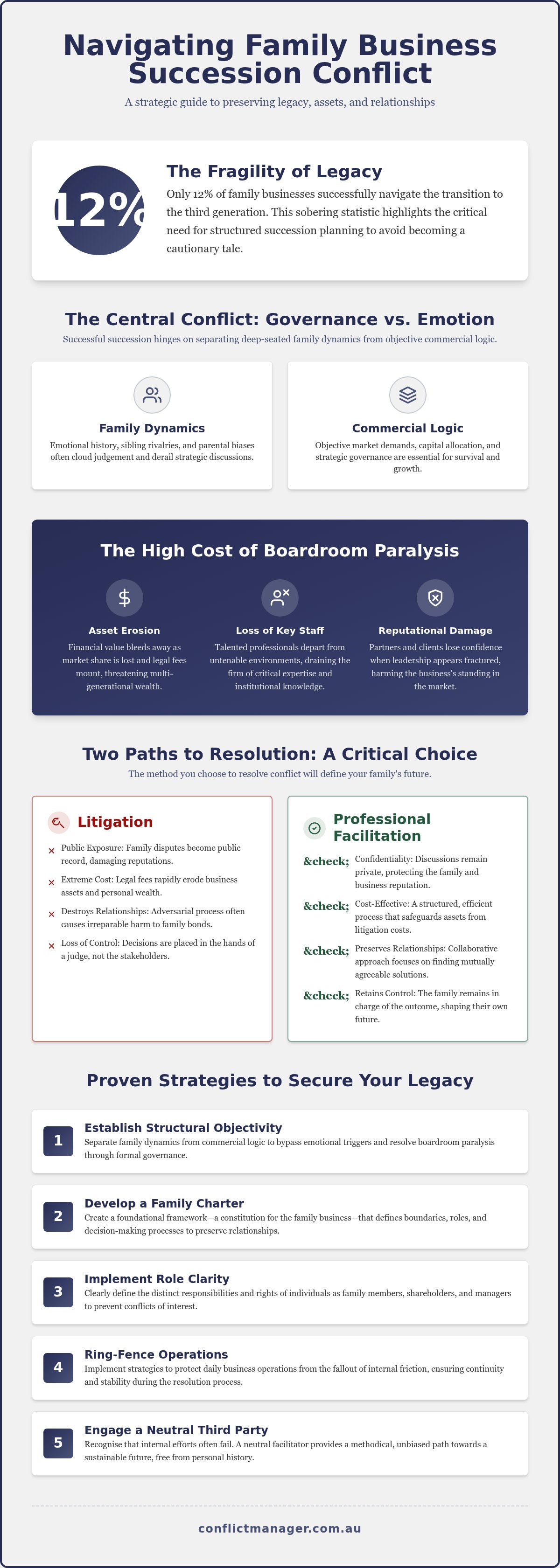
When conflict remains unaddressed, the boardroom often falls into a state of total paralysis. Crucial decisions regarding capital allocation or market expansion are deferred indefinitely because stakeholders cannot reach a consensus. This stagnation is not merely an internal inconvenience; it carries tangible external risks:
- Asset Erosion: Financial value bleeds away as the firm loses its competitive edge and market share.
- Loss of Key Staff: Talented professionals often depart when they find the internal environment untenable.
- Reputational Damage: External partners and clients may withdraw support when they sense a lack of unified leadership.
The High Cost of Conflict in Australian Family Offices
In the context of Australian family offices, the stakes are exceptionally high. Disputes don't just affect the balance sheet; they complicate the management of complex family trusts and the timing of distributions. We see significant financial leakage where legal fees and operational downtime bleed the business dry, often at the expense of multi-generational wealth. Maintaining intergenerational succession requires a level of structural integrity that simple legal documents cannot provide on their own.
Common Triggers: From Succession to Strategy
The transition from founder control to a sibling partnership represents a critical danger zone for many organisations. Differing visions for the future of the firm often create a profound structural misalignment that internal teams are ill-equipped to resolve. Succession friction is a primary driver of Australian business disputes. Without a neutral framework, these strategic differences can easily devolve into personal grievances that fuel a family business succession planning conflict for years.
Governance vs. Emotion: Separating the Family from the Firm
Logic. Structure. Objectivity. These are the essential tools required to dismantle the emotional volatility of a legacy dispute. While family bonds are the foundation of any successful enterprise, they often become the primary source of friction during a transition. To preserve the firm, one must establish structural objectivity. This process involves consciously bypassing emotional triggers that have often been decades in the making.
Many high-net-worth families in Australia rely on informal kitchen table discussions to resolve strategic issues. While these may work for minor operational matters, they frequently fail when addressing a deep-seated family business succession planning conflict. The lack of a formal environment allows old sibling rivalries or parental biases to surface, clouding the commercial reality of the firm. Research suggests that achieving constructive conflict in family business depends on having the right structural guardrails in place.
A Family Charter or Constitution serves as this necessary guardrail. It acts as a foundational document that defines the boundaries between kinship and commerce. Central to this is the concept of Role Clarity. Stakeholders must learn to separate their identity as a family member from their responsibilities as a shareholder or a manager. Each of these roles carries distinct rights and obligations; conflict typically occurs when the needs of one role are prioritised over the strategic health of another. For families struggling to navigate these complexities, seeking expert stakeholder facilitation can provide the neutral perspective needed to implement these frameworks effectively.
Establishing Clear Decision-Making Frameworks
Defining who has the final word in specific commercial areas is paramount. Formalising board meetings is a critical step in this process, as it shifts the conversation from the emotional to the analytical. By adhering to a professional agenda in a dedicated setting, the likelihood of disruptive outbursts decreases. A clear framework lowers the pulse of a boardroom dispute by grounding every discussion in objective business outcomes.
The Role of Independent Governance
Introducing non-family directors or independent advisors brings a sense of composed authority to the table. These external perspectives are vital for neutralising long-standing sibling or parental biases that might otherwise go unchecked. This level of independent governance is directly linked to the long-term integrity of the family office, ensuring that decisions are made with the firm's future in mind rather than its past.
Mediation vs. Litigation: Choosing the Reassuring Path
Privacy. Discretion. Control. These are the first casualties when a family business succession planning conflict enters the Australian court system. Unlike the confidential nature of professional mediation, litigation exposes the private mechanics of a family office to the public record and competitor scrutiny. This exposure often leads to irreparable reputational damage that can take years to rebuild. Choosing a path of discretion is not just about family harmony; it's a strategic commercial decision to protect the brand's standing in the market.
The Australian legal system operates on a binary of winners and losers. While a court can provide a final judgement, it rarely provides a sustainable path forward for a continuing business. In many cases, the rigid application of law necessitates the liquidation of assets to satisfy competing claims, effectively ending the family legacy. Professional facilitation offers a reassuring alternative. It focuses on asset integrity and the preservation of the going concern, ensuring the business remains a viable entity for the next generation.
Time is a critical factor in business stability. Court proceedings in Australia can stretch over several years, during which the firm remains in a state of operational paralysis. Mediation is significantly more efficient, often reaching a resolution in a fraction of the time. This speed allows the family to return their focus to the market rather than the courtroom, preventing the slow erosion of value that occurs during prolonged legal combat.
The Quiet Authority of Professional Mediation
Facilitation is a methodical de-escalation of tension. A neutral third party doesn't simply listen to the demands of each stakeholder; they identify the core interests and fears driving those positions. There's a profound psychological benefit to this process. It allows family members to feel heard and validated without the aggressive cross-examination of a legal setting. This environment of quiet authority encourages stakeholders to move away from entrenched positions toward a collective vision for the future.
Why Legal Representation Often Escalates the Dispute
Many families fall into the adversarial trap by engaging solicitors as their primary means of communication during a dispute. In a litigation context, solicitors are professionally bound to adopt a hard-line stance to protect their client's legal rights. This posturing often leads to a permanent severance of intergenerational ties. While a lawyer can provide legal clarity on a trust deed, they cannot provide the emotional resolution required to maintain a functional family dynamic. It's the difference between winning a case and saving a legacy.
5 Strategies for Navigating Succession Planning Conflict
Order. Resolution. Stability. To successfully navigate a family business succession planning conflict, one must move beyond reactive arguments toward a structured, strategic framework. This transition requires five specific interventions designed to protect both the firm's balance sheet and the family's shared history. By adopting a methodical approach, stakeholders can shift their focus from past grievances to future continuity.
The first step is immediate de-escalation through the appointment of a neutral facilitator. By introducing a steady, external hand, stakeholders can manage communication without the interference of long-standing emotional biases. This allows the group to address the technical aspects of the transition while a professional manages the interpersonal friction.
Ring-fencing Business Operations
Maintaining the integrity of the going concern is essential during periods of internal friction. Operational ring-fencing ensures that the day-to-day business continues to function, protecting the firm's valuation and market position. When communicating with staff and clients, it's vital to present a unified front. Staff need reassurance that leadership is stable, while clients must feel that their interests remain the priority. Maintaining a sense of composure in front of external stakeholders prevents the internal dispute from becoming a public liability.
Mapping Stakeholder Interests
Resolution depends on identifying what each party actually wants, which often differs from what they say they want. Interest mapping uncovers hidden motivations such as a fear of being pushed out or a deep-seated desire for a lasting legacy. Active managers may seek control and growth, whereas passive shareholders might prioritise liquidity and risk mitigation. Professional conflict consulting uses empathy as a tool for discernment, allowing the facilitator to understand the weight of these emotions without becoming entangled in them.
Governance reform follows this discovery. Updating the family charter ensures that the structural misalignment that led to the current dispute is corrected. Governance reform is the most effective way to ensure a family business succession planning conflict does not recur in the next generation. Finally, the process culminates in drafting sustainable agreements. These resolutions must be both legally sound and emotionally viable to ensure they're durable over the long term. If your organisation is currently facing these challenges, engaging in professional family conflict resolution provides the methodical path needed to restore order.
The Logical Conclusion: Engaging an External Counsellor
Clarity. Stability. Continuity. These outcomes are often the first to vanish when internal friction takes hold of a legacy enterprise. Despite the best intentions of stakeholders, internal efforts to resolve a family business succession planning conflict often fail because the participants are too emotionally entangled in the outcome. It is difficult to apply cold commercial logic when the person across the boardroom table is also a sibling, a parent, or a child. This proximity creates a blind spot that prevents even the most sophisticated leaders from seeing a clear path forward.
Conflict Manager serves as the steady hand required to navigate these volatile transitions. We provide a sense of composed authority that brings order to organisational friction, acting as a neutral third party capable of viewing the situation with total objectivity. Our role is to bridge the gap between complexity and a vision of structured resolution. By engaging an external counsellor, high-net-worth families can ensure that sizable assets are managed with the professional discernment they require, rather than being subjected to the whims of interpersonal dynamics.
What to Expect from Professional Facilitation
The process of professional facilitation is defined by a methodical move from disruption toward an analytical explanation of the underlying issues. We don't simply manage the argument; we build trust through a logical sequence of objective guidance. This progression feels inevitable and calming for stakeholders who have been trapped in circular arguments for years. The ultimate outcome is a sustainable path forward that protects the structural integrity of the business while preserving the family bonds that founded it. It is a transition from a state of reactive crisis to one of proactive governance.
Taking the First Step Toward Resolution
Introducing the idea of mediation to a reluctant family member requires a delicate, objective approach. It is helpful to frame the intervention not as a sign of failure, but as a strategic investment in the firm's longevity. Acting before the dispute reaches a point of no return is critical for asset protection. A quiet, professional approach preserves long-term asset integrity by resolving issues behind closed doors, far from the public gaze of the Australian court system. By taking this first step, you are choosing to prioritise the health of the legacy over the heat of the moment. We understand the weight of your responsibility and provide the stability needed to carry it forward.
Restoring Order to the Family Office
Integrity. Continuity. Resolution. Protecting the structural foundation of a legacy business requires more than just shared history; it demands a commitment to objective governance and professional de-escalation. By separating family dynamics from commercial strategy, you safeguard the firm against the decision paralysis that often accompanies a family business succession planning conflict. Choosing the quiet authority of mediation over the adversarial nature of litigation ensures that your assets remain intact and your reputation remains unblemished in the Australian market.
Conflict Manager provides expert-led mediation for high-net-worth families, offering the composed, neutral, and objective guidance necessary to navigate even the most volatile transitions. As specialists in multi-generational dispute management, we focus on sustainable outcomes that honour your past while securing your future. We provide the steady hand needed to move from a state of internal friction toward a vision of lasting organisational order.
Achieve clarity and stability-discuss your situation with Conflict Manager today. It's time to return your focus to the future of the business.
Frequently Asked Questions
What is the difference between family business mediation and a standard legal dispute?
Family business mediation prioritises the underlying interests and long-term relationships of stakeholders rather than just their legal rights. Unlike a standard legal dispute where a judge imposes a binary outcome, mediation allows families to co-author a resolution that preserves the going concern. This process addresses the complex human dynamics and emotional history that trust deeds and shareholder agreements often overlook.
Can a family business really survive a major dispute between siblings or generations?
Survival is entirely possible when the organisation moves from emotional reactivity toward structural objectivity. A family business succession planning conflict doesn't have to be terminal if a neutral framework is established before the friction reaches a point of no return. Success depends on the willingness of stakeholders to separate their personal identities from their professional responsibilities within the firm.
How long does the professional conflict resolution process typically take in Australia?
Professional conflict resolution is significantly faster than navigating the Australian court system. While litigation can stretch over several years, a mediated resolution often reaches a conclusion within a matter of weeks or months. This efficiency is critical for maintaining operational stability and preventing the erosion of the firm's market value during a family business succession planning conflict.
Is a Family Charter legally binding if a dispute goes to court?
A Family Charter is primarily a governance framework and a statement of intent rather than a legally binding contract. While it sets the moral and strategic direction for the family, specific commercial obligations are usually formalised through separate shareholder agreements or trust deeds. The Charter provides the essential context that guides legal interpretation and ensures that future decisions align with the family's core values.
What happens if one family member refuses to participate in mediation?
Facilitation can still proceed with a subset of stakeholders to establish a preliminary framework for order. The facilitator's role is to create an environment where the benefits of participation clearly outweigh the risks of exclusion. Often, seeing a move toward structured resolution encourages reluctant members to join the process once they realise their interests are being handled with objectivity and respect.
How do we keep the dispute confidential to protect our business reputation?
Confidentiality is a foundational element of the mediation process and is protected by strict non-disclosure agreements. All discussions and documents produced during facilitation are private, ensuring that sensitive financial data and internal friction never enter the public record. This discretion is vital for maintaining the trust of clients, staff, and external partners while the family works toward a resolution.
How much does professional conflict management cost compared to litigation?
Engaging in professional conflict management is substantially more cost-effective than pursuing a resolution through the courts. Beyond the direct savings on legal fees, mediation prevents the financial leakage associated with operational downtime and the potential loss of key staff. It represents a strategic investment that preserves the capital and integrity of the family office rather than depleting it through prolonged legal combat.


