

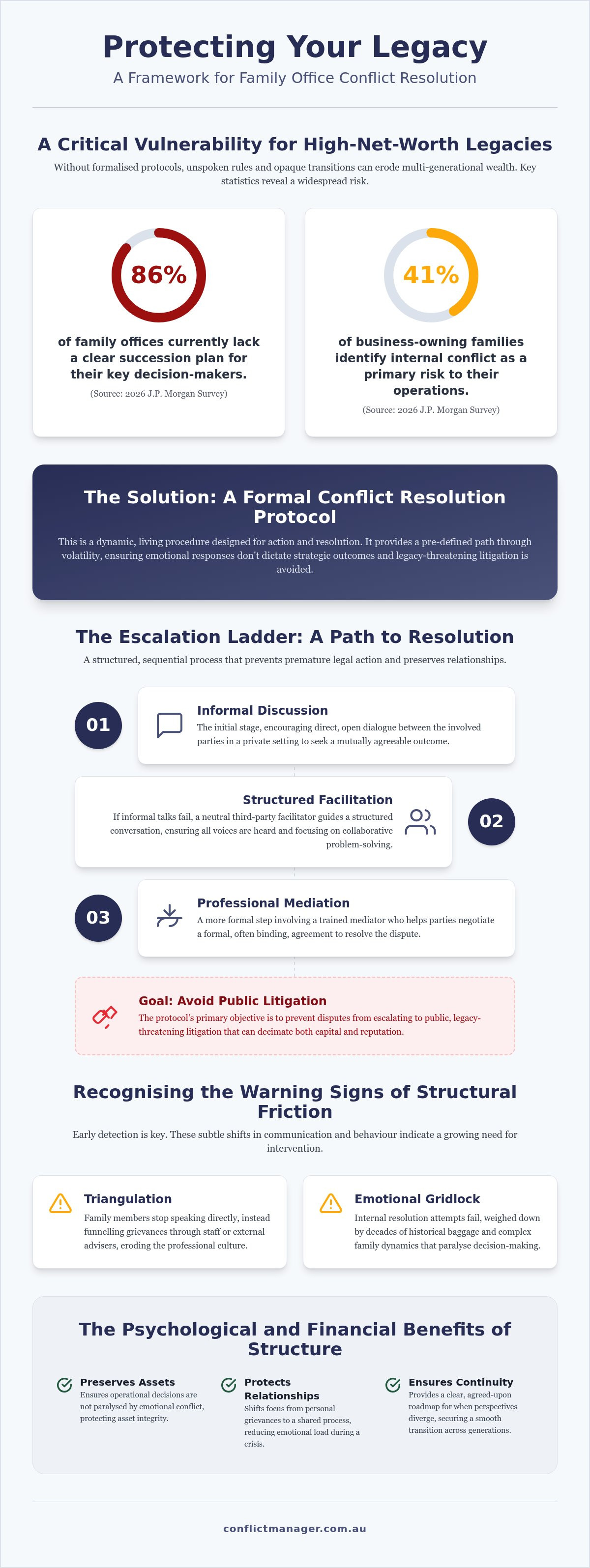
Did you know that 86 per cent of family offices currently lack a clear succession plan for their key decision-makers? This striking figure from a 2026 J.P. Morgan survey reveals a significant vulnerability in the architecture of many high-net-worth legacies. When internal alignment falters, the risk to continuity becomes palpable. You likely recognise the emotional exhaustion that comes with recurring disputes, or perhaps you worry about how public litigation might tarnish a hard-earned reputation. It's a common concern; 41 per cent of business-owning families now identify internal conflict as a primary risk to their operations. Establishing family office conflict resolution protocols is no longer just a luxury of the ultra-organised; it's a vital necessity for those who wish to transition control without friction.
We agree that the preservation of a legacy requires more than just financial acumen. It demands a steady hand and a clear, agreed-upon roadmap for when perspectives inevitably diverge. This guide will teach you how to design professional protocols that protect your assets and your relationships across generations. We'll explore the logical progression from informal negotiation to structured facilitation, providing you with the tools to maintain order and stability within your family office.
Key Takeaways
- Understand why formalised structures are essential to prevent the erosion of multi-generational wealth caused by unspoken rules and opaque transitions.
- Learn the systematic process for establishing family office conflict resolution protocols, including an escalation ladder that moves from informal discussion to professional mediation.
- Discover how to navigate intergenerational friction by shifting from traditional decision-making toward a model of collaborative governance.
- Gain a practical framework for conducting stakeholder audits and values alignment sessions to ensure the family's core mission is protected.
- Recognise the strategic value of a neutral third party to manage high-emotion transitions while preserving both assets and relationships.
The Necessity of Structure in High-Stakes Family Environments
Legacy. Continuity. Stewardship. These concepts form the bedrock of multi-generational wealth, yet they remain inherently fragile without a formalised operational structure. Many families operate on a foundation of implicit trust and historical precedent. While this may suffice during periods of growth, it often fails during the high-pressure environment of a leadership transition. When communication lacks a clear framework, minor disagreements regarding investment strategy or lifestyle distributions can rapidly metastasise into systemic dysfunction.
Understanding what is a family office is essential for recognising its dual nature as both a private family sanctuary and a professional investment entity. This intersection is where "unspoken rules" typically become the primary source of friction. A founder's intuitive decision-making style might work for decades, but it often creates a vacuum of clarity for the next generation. Without establishing family office conflict resolution protocols, the cost of inaction is high. A 2026 J.P. Morgan survey found that 41 per cent of business-owning families view internal conflict as a top-three risk to their continuity. Left unaddressed, these disputes often escalate from private disagreements to public, legacy-threatening litigation that can decimate both capital and reputation.
Order. Clarity. Resilience. These are the psychological benefits of a pre-agreed framework. By defining how disagreements will be handled before they occur, families can significantly reduce the emotional load during a crisis. It shifts the focus from personal grievances to a shared, objective process, allowing the family to navigate volatile situations with a sense of composed authority.
Beyond the Family Charter: Why Protocols Matter
A Family Charter is a valuable document for outlining vision and values, but it's often too static to manage active disputes. Protocols differ because they are living procedures designed for movement and resolution. They maintain asset integrity by ensuring that operational decisions aren't paralysed by emotional gridlock. By establishing family office conflict resolution protocols early, you create a professionalised environment where private bonds are respected without compromising the office's structural integrity or its investment mandates.
Recognising the Warning Signs of Structural Friction
Structural friction often begins with subtle shifts in communication. You might notice "triangulation," where family members stop speaking directly to one another and instead funnel grievances through family office staff or external advisers. This places employees in an impossible position and quickly erodes the professional culture. Internal attempts at resolution frequently fail because they're weighed down by decades of historical baggage and complex sibling or parental dynamics. A neutral third party provides the objectivity needed to bypass these patterns, offering a steady hand when internal efforts have reached their natural limit.
Defining the Core Components of a Family Office Conflict Protocol
Structure. Clarity. Resolution. A Conflict Resolution Protocol is more than a list of rules; it's a dynamic architecture for managing human friction within a sophisticated financial framework. At its core, this protocol is a formalised, agreed-upon set of procedures designed to identify and address disputes before they threaten the family's shared mission. By establishing family office conflict resolution protocols, you provide the organisation with a pre-defined path through volatility, ensuring that emotional responses don't dictate strategic outcomes.
The "Escalation Ladder" serves as the central pillar of this framework. It defines clear, sequential stages that a dispute must pass through, beginning with informal dialogue and moving toward more structured interventions. This approach prevents the premature involvement of legal counsel, which can often harden positions and lead to irreparable relational damage. Instead, the focus remains on movement and reconciliation, honouring the private bonds of the family while maintaining the professional standards of the office. For those seeking a steady hand to guide this process, professional stakeholder facilitation can provide the objectivity needed to keep these discussions productive.
Discretion remains paramount in high-net-worth environments. A robust protocol must explicitly address the "sanctity of the room," ensuring that all discussions remain confidential to protect the family's public reputation. Furthermore, the framework must define specific roles and responsibilities. It must be clear who has the authority to trigger the protocol—whether it's the Family Council chair, a managing director, or a designated elder—to prevent the process from being stalled by the very conflict it's meant to resolve.
The Escalation Framework: From Kitchen Table to Mediation
Stage 1 focuses on facilitated internal dialogue, often led by the Family Council, to resolve issues at the source. If a resolution remains elusive, Stage 2 introduces neutral third-party facilitation to provide a fresh, objective perspective. Finally, Stage 3 involves formal mediation. This is a structured process that aims for a binding agreement while preserving the legal rights of all parties as a last resort, ensuring that asset integrity is never compromised by indefinite gridlock.
Governance and Documentation
For these protocols to hold weight, they must be integrated into the family's broader governance documents, such as the Family Constitution or specific Trust Deeds. This ensures the procedures aren't viewed as optional suggestions but as core operational requirements. Including "Sunset Clauses" and scheduled regular reviews allows the protocol to evolve alongside the family's changing needs and generational shifts. Drafting this language requires precision; it must be professional, clear, and entirely free from ambiguity to provide the sense of order that high-stakes environments demand.
Navigating the Intergenerational Friction Point
Control. Legacy. Transition. These three forces often collide during the shift from a founder-led office to a multi-generational structure. The most common objection encountered in high-net-worth environments is the belief that "we can handle things ourselves." While this sentiment suggests a strong sense of loyalty, it often acts as a significant barrier to professional growth. Internal efforts at resolution frequently rely on historical power dynamics rather than objective criteria, which can lead to resentment among the rising generation. Establishing family office conflict resolution protocols shifts the focus from patriarchal or matriarchal decree to collaborative governance, providing a stable platform where all voices are heard without compromising the office's mission.
Disparate risk appetites and differing values are natural as a family expands. A founder may prioritise capital preservation and traditional industries, while the second or third generation might seek engagement with sustainable investments or emerging technologies. Without a formalised framework, these differences in perspective can lead to strategic paralysis. Protocols act as a neutral arbiter, allowing for the healthy expression of divergent views while ensuring that the final decision-making process remains logical and transparent. This sense of order is vital for maintaining equilibrium when the family's emotional landscape becomes volatile.
The Founder’s Dilemma: Relinquishing Control with Confidence
Succession is rarely a single event; it's a gradual process of stewardship transfer. For the senior generation, establishing family office conflict resolution protocols creates a necessary safety net. It ensures their vision is formalised into a professional architecture that survives their direct involvement, yet remains adaptable to modern market realities. A neutral mediator can validate the founder's concerns regarding wealth preservation while facilitating a structured path for the next generation to assume responsibility. This professionalisation allows the founder to step back with confidence, knowing the legacy is protected by process rather than just personality.
Empowering G2 and G3 within a Professional Framework
Younger family members often struggle to find their voice within a system dominated by a singular historical figure. A professional framework provides a voice for G2 and G3 without undermining existing authority, replacing "entitlement" with objective performance protocols. When roles are defined by merit and accountability rather than family rank, friction decreases. This culture of accountability ensures that every stakeholder understands their responsibilities, fostering a sense of shared ownership that transcends the kitchen table and thrives in the boardroom.
A Five-Step Guide to Formalising Resolution Procedures
Professionalisation. Resilience. Discipline. Moving from the conceptual need for order to a functional framework requires a methodical approach. The process of establishing family office conflict resolution protocols is not merely a drafting exercise; it is a transformative journey that aligns the family's human capital with its financial objectives. This five-step roadmap provides the tactical structure needed to move from internal friction toward a state of sustainable resolution. For families ready to begin this transition, engaging professional stakeholder facilitation ensures that the initial audit remains objective and productive.
Step 1 & 2: Building the Foundation of Trust
The journey begins with a comprehensive Stakeholder Audit. This involves conducting private, one-on-one interviews to surface hidden grievances and identify the primary "pain points" that currently disrupt the office's operations. Objectivity is the anchor here. An external facilitator can view these volatile dynamics with total neutrality, allowing family members to speak freely without fear of reprisal. Once these individual perspectives are understood, the focus shifts to Values Alignment. By facilitating a structured Legacy Workshop, the family can define its core mission and non-negotiables, creating a shared vision that transcends individual interests and provides a clear benchmark for future decision-making.
Step 3, 4 & 5: From Theory to Operational Reality
Step 3 is the Drafting phase, where you create a bespoke protocol that reflects the family’s unique dynamics and historical context. This document should define the "Escalation Ladder" discussed earlier, ensuring the language is professional and free from ambiguity. During Step 4, Ratification and Integration, you must collaborate with legal and financial advisors to ensure the protocol is robust and properly embedded within your broader governance documents. This isn't a secret document; it should be communicated clearly to family office staff and external stakeholders to foster a culture of transparency.
Finally, Step 5 involves Training and Simulation. A 2025 survey of 160 family office professionals revealed that 74 per cent had observed an increase in intra-family conflict, yet few offices practice their response. Practising the protocol in a low-stakes environment before a crisis hits is essential. It builds "muscle memory" for the resolution process, ensuring that when high-stakes disagreements arise, the family defaults to the agreed-upon procedures rather than emotional reactions. Establishing a permanent Review Board ensures these protocols remain fit for purpose as the family grows and new generations enter the office.
Integrating Professional Facilitation into Family Governance
Stability. Objectivity. Resolution. While the previous sections outlined the structural requirements for establishing family office conflict resolution protocols, the human element remains the most volatile component. A neutral third party acts as the steady hand required to navigate high-emotion transitions with total composure. Unlike legal representation, which is inherently adversarial and often results in a "winner takes all" outcome, expert-led mediation seeks a collective path forward. Conflict Manager provides the total objectivity that internal stakeholders simply cannot achieve; we view the situation from an external vantage point that is unclouded by historical grievances or family rank. This ensures that the friction of interpersonal dynamics does not derail the office's strategic investment mandates or damage the family's public standing.
The Role of the Wise Counsellor
Difficult conversations are the ones most frequently avoided until they metastasise into crises. A professional facilitator provides a safe, structured space for these dialogues, acting as a necessary buffer between competing interests. By bringing a sophisticated corporate register and deep psychological insight to the family table, the counsellor moves stakeholders from a state of disruption toward a vision of structured resolution. This balance between efficiency and thoroughness allows for the navigation of complex transitions without becoming emotionally entangled in them. It's about creating a professionalised environment where private bonds are respected, yet the business of the family office proceeds with unruffled precision. This approach preserves the family unit while simultaneously safeguarding asset integrity, achieving sustainable outcomes that legal arbitration often fails to deliver.
Next Steps: Securing Your Family’s Future
Proactivity is the hallmark of a resilient legacy. It's far more effective to begin the process of establishing family office conflict resolution protocols during a period of relative calm, rather than attempting to build the architecture in the heat of an active dispute. When introducing the concept of professional facilitation to other family members, it helps to frame the initiative as a commitment to the office's professionalisation and the family's long-term harmony. It's a strategic investment in the structural integrity of the legacy, designed to lower the collective pulse and build trust through a logical sequence of governance. For those ready to move toward a state of order and stability, contact Conflict Manager for a confidential discussion on your family office governance.
Securing Your Multi-Generational Legacy
The transition from implicit trust to explicit structure represents the hallmark of a truly professionalised family office. You've seen how the absence of a formalised framework can leave a legacy vulnerable to the erosion of unspoken rules and historical grievances. By prioritising collaborative governance and a clear escalation ladder, you ensure that strategic decisions remain objective and resilient. Establishing family office conflict resolution protocols is not merely a defensive measure; it's a proactive investment in the structural integrity of your family's future.
At Conflict Manager, we provide the composed, neutral facilitation required to navigate high-net-worth environments with total discretion. Our national Australian expertise focuses on managing multi-generational friction to achieve sustainable outcomes that prioritise both asset integrity and private family bonds. We act as the steady hand, guiding you from complexity toward a state of lasting order and stability. With the right procedures in place, you can face the future with a sense of calm and confidence.
Secure your family legacy with expert-led facilitation and mediation.
Building a resilient legacy is a journey of stewardship. We're here to help you navigate that path with clarity and professional precision.
Frequently Asked Questions
What is the difference between a family constitution and a conflict resolution protocol?
A family constitution is a broad statement of values and vision, while a conflict resolution protocol provides the tactical, step-by-step procedures for managing specific disputes. Think of the constitution as the compass and the protocol as the map. While the constitution sets the direction, the protocol outlines the exact path to take when friction arises, ensuring that emotional responses don't dictate strategic outcomes.
Why should we hire an external mediator instead of using our family lawyer?
An external mediator provides a neutral, non-adversarial environment that focuses on reconciliation, whereas a family lawyer is often bound by fiduciary duties to specific individuals or entities. Lawyers are trained for advocacy and legal protection. In contrast, a mediator is trained to facilitate dialogue and uncover underlying interests. This neutrality is essential for preserving relationships during high-emotion transitions and preventing the hardening of positions.
Can these protocols be legally binding within an Australian family trust structure?
Yes, these protocols can be integrated into trust deeds or shareholder agreements to make them legally binding under Australian law. By formalising these procedures within the governing documents of the family office, you ensure they carry the weight of a core operational requirement. This structural integration provides a clear legal basis for the resolution process, protecting the integrity of the assets while honouring the family's shared mission.
How do we introduce formal protocols without making family members feel untrusted?
Frame the introduction of these protocols as a commitment to the professionalisation and long-term health of the family legacy. It isn't about a lack of trust; it's about providing a necessary safety net for future generations. Positioning the project during a period of relative calm demonstrates foresight and stewardship, showing that the goal is to protect everyone's interests and maintain order before a crisis occurs.
What happens if a family member refuses to follow the agreed-upon resolution protocol?
If a member refuses to follow the protocol, the governance structure typically triggers a pre-defined secondary stage, such as mandatory external facilitation or professional mediation. By establishing family office conflict resolution protocols that include clear consequences for non-compliance, you maintain the authority of the process. This ensures that personal grievances don't stall the office's operations or lead to prolonged strategic paralysis that decimates capital.
How often should a family office review and update its conflict management procedures?
We recommend a comprehensive review of conflict management procedures every three to five years, or whenever there is a significant generational transition. Regular updates ensure the protocols remain fit for purpose as the family grows and its investment mandates evolve. This discipline prevents the framework from becoming a static document that fails to address modern market realities or the changing needs of the family council.
How long does it typically take to establish a comprehensive set of protocols?
The timeline for establishing family office conflict resolution protocols generally spans three to six months, depending on the complexity of the family structure. This period allows for individual stakeholder audits, values alignment workshops, and the careful drafting of bespoke procedures. It's a methodical process that prioritises thoroughness to ensure the final framework is robust, transparent, and widely accepted by all family members.
Is professional mediation suitable for small family offices or just large organisations?
Professional mediation is vital for small family offices, where interpersonal dynamics are often more concentrated and impactful. While larger organisations might have more complex assets, smaller offices frequently face higher emotional stakes due to the proximity of the stakeholders. A neutral third party provides the same steady hand and objective clarity, regardless of the size of the family's balance sheet or the number of beneficiaries involved.


