

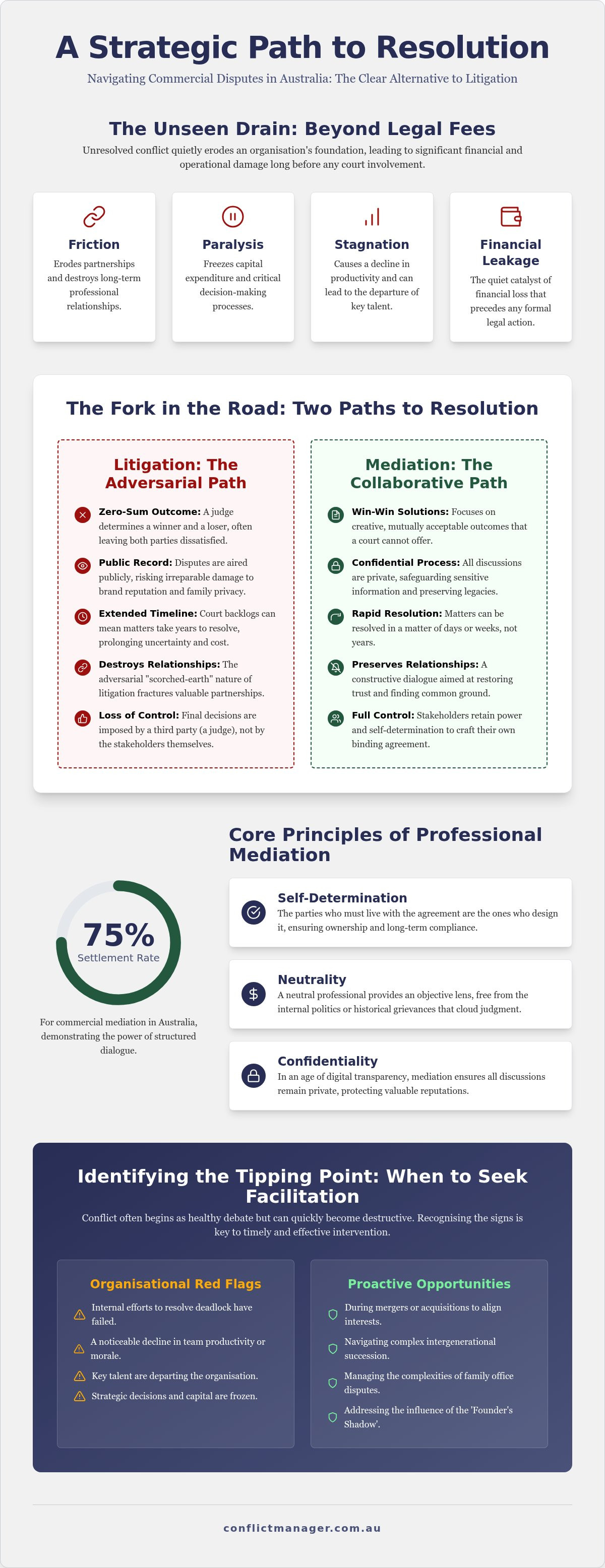
The most expensive outcome of a commercial dispute isn't the legal fee; it's the paralysis of the organisation. Silence. Friction. Stagnation. These are the quiet catalysts of financial leakage that occur long before a matter reaches a courtroom. For those seeking business mediation services, the objective is rarely just a settlement; it's the restoration of a functional legacy. With commercial mediation settlement rates in Australia reaching 75 per cent, the logic of choosing a structured dialogue over a public trial is both strategic and practical.
You likely understand that a public legal battle poses a significant risk to your brand's reputation and your family office's privacy. It's a heavy burden to carry when years of partnership or multi-generational history are at stake. This article explores how a sophisticated, non-litigious approach provides a path toward sustainable, legally sound agreements across Australia. We'll examine the logic of external intervention, the mechanics of stakeholder facilitation, and how to transition from a state of volatile complexity toward a vision of renewed strategic clarity and structural stability.
Key Takeaways
- Learn how to maintain total control over your dispute's outcome through a voluntary, confidential process that prioritises privacy over public record.
- Discover how business mediation services Sydney protect high-value commercial partnerships and family legacies from the destructive nature of litigation.
- Identify the methodical steps of a professional intake and opening statement designed to move stakeholders from emotional friction toward logical resolution.
- Understand the specific dynamics of family office disputes, including the complexities of intergenerational succession and the influence of the 'Founder’s Shadow'.
- Explore why creative, win-win solutions are a more sustainable alternative to the zero-sum results typically delivered by the Australian court system.
Understanding Business Mediation Services for Complex Organisations
Disruption. Friction. Stagnation. These are the markers of organisational conflict that, if left unaddressed, erode the very foundations of a commercial enterprise. Business mediation is a voluntary and confidential process where a neutral professional facilitates a dialogue between parties to reach a mutually acceptable resolution. Unlike the rigid structures of the Australian court system, this approach prioritises the restoration of clarity over the assignment of blame. By choosing business mediation services Sydney, organisations can bypass the adversarial nature of litigation. This prevents the "litigation bloodbath" that frequently consumes liquid assets and destroys long-term professional relationships.
The fundamental difference between mediation and litigation lies in the locus of control. In a courtroom, a judge or magistrate determines the final outcome based on legal precedent; this often leaves both parties dissatisfied with a zero-sum result. In mediation, the power remains with the stakeholders. This self-determination is essential for understanding the mediation process as a strategic tool rather than a legal fallback. It allows for creative, bespoke solutions that a court simply cannot provide, such as restructured shareholding agreements or revised operational protocols that respect the nuances of a family office.
The Core Principles of Professional Mediation
Professional mediation operates on a foundation of three critical pillars. First is confidentiality. In the age of digital transparency, a public court battle can cause irreparable damage to a brand's legacy; mediation ensures all discussions stay behind closed doors. Second is neutrality. An external mediator has no stake in the outcome, providing an objective lens that internal HR or legal teams often lack. Finally, self-determination ensures that the people who must live with the agreement are the ones who design it. This ownership is the key to long-term stability and compliance within the organisation.
When to Seek External Facilitation
Identifying the tipping point is vital. Conflict often begins as healthy debate, but it can quickly transition into destructive friction when personal egos or historical grievances cloud strategic objectives. When internal efforts to resolve a deadlock reach a stalemate, the cost of indecision begins to mount. You might notice a decline in productivity, a freeze on capital expenditure, or the departure of key talent. Expert business mediation services Sydney act as a steady hand during these volatile transitions. Beyond crisis management, proactive facilitation is increasingly used during mergers or intergenerational succession to align disparate interests before they solidify into entrenched disputes.
The Strategic Advantages of Expert-Led Dispute Resolution
Litigation is a blunt instrument. While the Australian court system is designed to resolve points of law, it's often ill-equipped to handle the delicate nuances of a family office or a long-standing commercial partnership where the preservation of trust is as vital as the distribution of assets. Government guidance on how to prevent and manage business disputes suggests that early intervention is the most effective way to protect a company's interests. By opting for a facilitated dialogue, organisations can preserve commercial relationships that are simply too valuable to destroy through the scorched-earth tactics of legal warfare. It's about moving from a posture of defence to one of constructive resolution.
Time is a finite resource. The Australian court system currently faces significant backlogs, with some commercial matters taking years to reach a final hearing. In contrast, utilising business mediation services Sydney allows boards to bypass these procedural delays and achieve a resolution in a matter of days or weeks. This speed doesn't come at the cost of thoroughness. Mediation offers a level of flexibility that a court cannot mandate. Agreements can include non-financial clauses, such as formal apologies, confidentiality extensions, or revised communication protocols. These elements are often more critical for long-term stability than a simple monetary settlement.
Maintaining Structural Integrity
Internal friction often leads to the fragmentation of leadership teams. When a dispute becomes entrenched, the "power versus logic" dynamic takes over, where decisions are made based on leverage rather than the health of the organisation. A mediator acts as a steady hand, navigating these volatile human elements to ensure that structural changes are met with clarity rather than resistance. Engaging in professional stakeholder facilitation ensures that these dynamics are managed with total objectivity, preventing the "Founder’s Shadow" from casting a permanent chill over the board's decision-making capabilities.
The Financial Case for Mediation
The true cost of conflict is rarely found on a single line item. It's a compound expense. You must account for the erosion of management time, the loss of key staff who find the environment untenable, and the missed opportunities that occur when leadership is distracted by legal minutiae. Unlike the open-ended nature of litigation, where costs can spiral unpredictably, mediation operates within a more contained financial framework. This allows for better capital allocation and budget certainty during periods of transition. The return on investment for mediation is ultimately measured by the preservation of asset value and the comprehensive mitigation of long-term reputational risk.
Navigating High-Emotion Friction in Family Offices and Boards
Legacy. Identity. Capital. These three forces often collide within the Australian family office. When family bloodlines intersect with high-value asset management, the resulting friction is rarely just about the balance sheet. It's about history. It's about the future. Intergenerational succession frequently triggers the "Founder’s Shadow," where the transition of power feels like a loss of purpose for one generation and a barrier to innovation for the next. In these high-stakes environments, high emotions don't just cloud judgment; they can lead to prolonged indecision that bleeds corporate resources and erodes trust between long-term partners. Expert business mediation services Sydney provide the necessary distance to view these volatile situations with total objectivity.
A mediator acts as a steady hand, navigating the psychological undercurrents without becoming emotionally entangled in the family's internal dynamics. This professional presence brings a sense of order during periods of high stress, ensuring that the weight of responsibility doesn't lead to structural collapse. By acknowledging the difficult reality of interpersonal friction, leadership teams can transition from a state of disruption toward a methodical, logical resolution. It's about protecting the brand legacy while ensuring the organisation remains agile enough to navigate difficult transitions.
Conflict in the Family Office Environment
Disputes within a family office often stem from disparate visions for the family's wealth and influence. Without a neutral third party, these disagreements can stall critical operations. Common areas of friction include:
- Investment Strategy: Aligning the risk appetites between conservative founders and growth-oriented successors who wish to pivot into new markets.
- Active vs. Passive Shareholders: Resolving the inherent tension between family members working daily in the business and those who are purely passive beneficiaries.
- Philanthropic Direction: Navigating disagreements over lifestyle spending versus long-term philanthropic goals that define the family's public legacy.
Protecting the family's long-term stability requires more than just legal contracts; it requires structured, private communication protocols. These protocols allow for the airing of grievances in a controlled environment, preventing public litigation that could damage the brand's reputation.
Boardroom and Leadership Team Facilitation
Personality clashes within a board don't just affect internal morale; they threaten the very core of corporate governance. When a CEO succession or a significant ownership exit is on the horizon, the pressure can cause even the most seasoned leaders to retreat into defensive postures. Professional stakeholder facilitation creates a neutral space where "hard truths" can be voiced without causing permanent damage to the organisation's integrity. By engaging business mediation services Sydney, boards can ensure that structural changes are met with clarity rather than resistance, allowing the leadership team to refocus on core strategic objectives.
The Mediation Process: A Methodical Path to Resolution
Structure. Sequence. Resolution. A successful outcome is never accidental; it's the result of a disciplined framework designed to lower the emotional temperature while elevating strategic clarity. When engaging business mediation services Sydney, the journey begins with a comprehensive initial intake. This phase allows the mediator to assess the readiness of all parties and define the precise scope of the dispute. It's a foundational step that ensures the process isn't derailed by peripheral grievances before the real work begins. Once the ground rules are established during the opening statement, the dialogue transitions into a controlled environment where respectful and productive communication becomes possible.
Effective mediation relies on the strategic interplay between joint sessions and private caucuses. While joint meetings facilitate transparency, private caucuses provide a confidential space to build trust and explore sensitive information that may not be ready for the main table. This movement is essential for shifting stakeholders from rigid, adversarial positions toward their underlying interests and needs. By peeling back the layers of corporate posturing, the facilitator helps parties identify areas of mutual benefit that were previously obscured by friction. The goal is to move toward a final agreement that is sustainable, clear, and enforceable under Australian law.
Preparation: Setting the Stage for Success
The pre-mediation phase is often where the most significant breakthroughs are seeded. It's a critical time for identifying hidden agendas and ensuring that all participants are approaching the table with an honest intent to resolve the matter. Choosing the right environment is equally vital. A neutral, professional setting helps lower the pulse and signals that the session is a serious commercial undertaking rather than a continuation of boardroom hostilities. Organising the necessary data and documentation beforehand ensures that every decision made during the session is informed and grounded in reality.
Sustainable Outcomes and Implementation
A handshake is merely a beginning. For a resolution to hold, it must be supported by a structured implementation plan that outlines specific actions, timelines, and responsibilities. Follow-up sessions play a crucial role here, acting as a safeguard to ensure the agreement remains intact as the organisation navigates the post-conflict transition. Within this framework, a sustainable outcome is defined as one that survives the first 12 months of implementation without a return to previous patterns of friction. To begin restoring order to your organisation, consider the benefits of professional organizational conflict management.
Why Professional Facilitation is the Logical Alternative to Litigation
Litigation is a zero-sum game. In an Australian court, a judge's decision is final, often leaving one or both parties with a result that ignores the practical needs of the enterprise. By contrast, business mediation services Sydney offer a platform for creative, win-win solutions that a court simply cannot mandate. This process empowers leaders to take ownership of the outcome rather than ceding their authority to a third party. It's a logical choice for those who value their brand's legacy over a public legal victory. Choosing mediation is a strategic pivot from being a passive participant in a legal process to becoming an active architect of the resolution.
The impact of court proceedings on long-term family and business reputations in Australia is often irreversible. Once a dispute enters the public record, the nuances of a family office or board dynamic are laid bare for competitors and the media to observe. Mediation preserves the privacy of these high-asset environments. It provides a confidential forum where stakeholders can address difficult realities without the fear of reputational leakage. This ensures that the organisation's internal friction doesn't become a permanent stain on its public legacy.
The Composed Approach to Conflict
A calm, methodical approach is the most effective way to de-escalate high-stakes business disputes. A mediator who remains unruffled by complex human and structural dynamics acts as a steady hand, guiding parties through the friction of interpersonal dynamics. This transition from a state of disruption to a vision of structured resolution requires a facilitator who understands the weight of responsibility without becoming emotionally entangled. It's about restoring order when internal efforts have reached a stalemate. By lowering the pulse of the room, the mediator allows logic to prevail over entrenched egos.
Engaging a Neutral Third Party
Specialist expertise in family office and organisational conflict is essential for navigating the "Founder’s Shadow" and other unique structural pressures. Introducing the idea of mediation to a hostile party is best handled by framing the process as a strategic mechanism for asset protection. It's not about winning an argument; it's about securing the organisation's future. Conflict Manager serves as the steady, objective partner needed to navigate these difficult transitions with quiet confidence. To begin this process and restore stability to your leadership team, you can Contact Conflict Manager to organise a confidential consultation.
Restoring Order and Protecting Your Legacy
The path from organisational friction to strategic clarity requires a steady hand and a methodical framework. Choosing professional business mediation services Sydney ensures that your brand's legacy and your family office's privacy remain protected from the public record. We've examined how expert-led facilitation allows stakeholders to retain control over their outcomes while avoiding the zero-sum results of the Australian court system.
Conflict Manager acts as a neutral, objective presence for Australian organisations navigating high-emotion, high-asset environments. As specialists in high-net-worth family office conflict, our approach focuses on sustainable, clear agreements supported by fixed-fee structures for total budget certainty. Taking the first step toward resolution doesn't have to be a leap into the unknown; it's a logical transition toward structural stability. Secure a confidential consultation with Conflict Manager today to begin restoring order to your leadership team. A vision of structured resolution is within reach.
Frequently Asked Questions
What is the difference between business mediation and legal arbitration?
Mediation is a facilitative process where parties retain total control over the final agreement. In contrast, legal arbitration is a determinative process where an independent arbitrator makes a binding decision similar to a judge. While arbitration focuses on legal rights and evidence, business mediation services Sydney prioritise commercial interests and the restoration of functional working relationships. It's a choice between having a solution imposed upon you or designing one yourself.
How long does the business mediation process typically take in Australia?
The duration of the process depends on the complexity of the dispute and the readiness of the stakeholders. While the actual mediation conference often concludes within one to two days, the entire engagement typically spans four to six weeks. This timeframe includes the essential intake sessions and the drafting of the final agreement. It's a methodical progression that ensures no structural detail is overlooked during the transition toward resolution.
Do we need to have our lawyers present during the mediation sessions?
Legal representation isn't a mandatory requirement for mediation, but it's often advisable in high-value commercial disputes. Lawyers typically serve as advisors rather than primary negotiators, allowing the stakeholders to maintain direct communication. This structure ensures that any resulting agreement is legally sound while keeping the focus on strategic clarity. It's a balance of professional guidance and personal ownership of the organisation's future direction.
Is a mediated agreement legally binding in a commercial dispute?
A mediated agreement becomes legally binding once all parties have signed a written settlement contract. While the discussions within the room remain confidential and "without prejudice," the resulting document is an enforceable commercial contract. This provides the structural stability needed for the organisation to move forward with confidence. If one party fails to uphold their obligations, the agreement can be enforced through the Australian court system.
What happens if one party refuses to participate in mediation?
Mediation is a voluntary process that requires the consent of all stakeholders to proceed. If one party refuses to participate, the mediator cannot compel their attendance. However, many Australian courts now mandate that parties attempt alternative dispute resolution before a matter can proceed to trial. Refusal to engage in good faith can lead to cost penalties in subsequent litigation, making mediation a logical first step for most enterprises.
Can mediation help with intergenerational conflict in a family office?
Professional facilitation is specifically designed to navigate the high-emotion friction inherent in family offices. It provides a structured environment to address intergenerational succession and the "Founder’s Shadow" without damaging family bloodlines. By separating personal grievances from commercial objectives, the process helps families protect their legacy and assets. It's an essential tool for ensuring that multi-generational history doesn't become a barrier to future growth.
How do we choose the right mediator for a high-stakes board dispute?
Selecting the right mediator requires looking beyond basic qualifications to find a specialist in board dynamics and organisational change. You should prioritise professionals with National Mediator Accreditation System (NMAS) certification and a proven history in high-asset environments. The ideal candidate acts as a steady hand, remaining unruffled by volatile atmospheres. They should possess the discernment to view complex human and structural dynamics with total objectivity.
What are the costs involved in professional business mediation services?
Costs for business mediation services Sydney vary based on the mediator's experience and the duration of the engagement. Industry data from 2026 indicates that private commercial mediators in Australia typically charge between A$3,000 and A$10,000 per day, a fee usually shared between the parties. Pre-mediation intake sessions often cost an average of A$250 per participant. These structures provide a predictable alternative to the open-ended financial leakage associated with prolonged litigation.


