
What if the greatest threat to your family business isn't the market, a difficult competitor, or a shifting economy, but the people sitting across from you at the dinner table? When family conflict threatens business stability, the consequences reach far beyond a single disagreement. Relationships fracture. Decisions stall. And the enterprise that generations worked to build begins to feel precarious.
You already know how uniquely painful this territory is. Personal history, shared sacrifice, and deep emotional investment make family disputes unlike any other kind of organisational friction. The stakes are high on every level, and the difficulty of separating the personal from the professional can leave even the most capable leaders feeling exposed and uncertain about the path forward.
This article is here to change that. Drawing on proven approaches to conflict resolution within family businesses, you'll find clear, practical strategies for establishing structure, restoring communication, and protecting the stability of your business without sacrificing the relationships that matter most. From understanding the root dynamics of family disputes to knowing when external guidance becomes essential, what follows is a measured, step-by-step guide to navigating one of the most complex challenges a business leader can face.
Key Takeaways
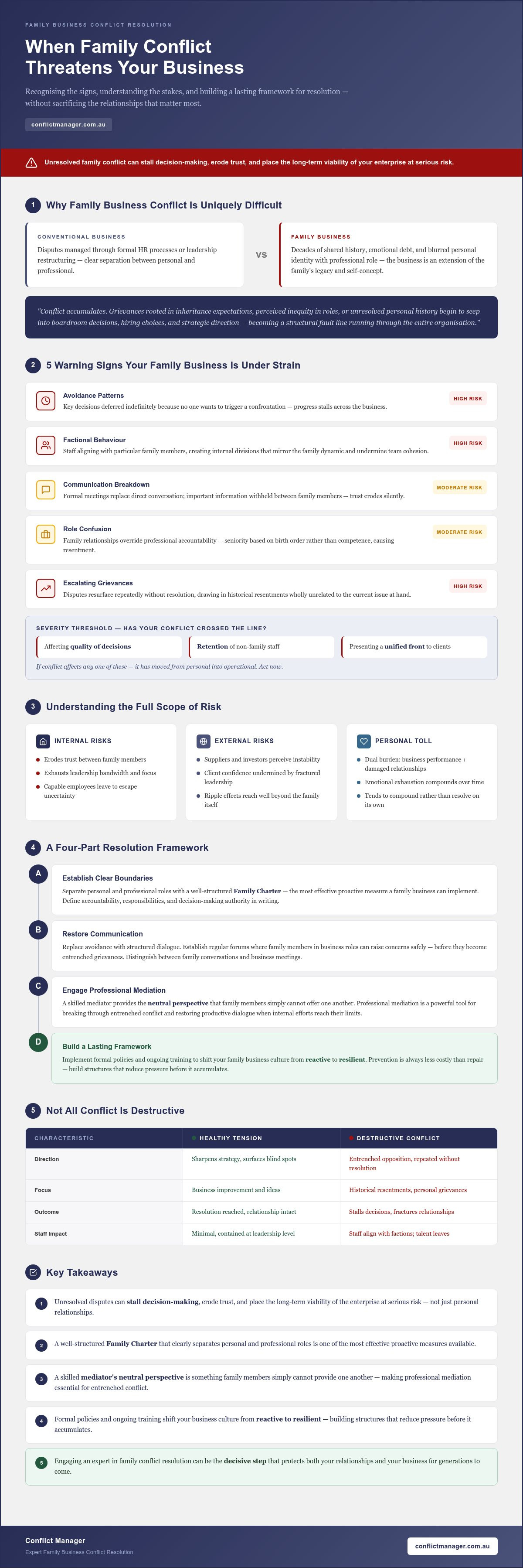
- When family conflict threatens business stability, the consequences extend well beyond interpersonal tension - unresolved disputes can stall decision-making, erode trust, and place the long-term viability of the enterprise at serious risk.
- Establishing clear boundaries between personal and professional roles, supported by a well-structured family charter, is one of the most effective proactive measures a family business can implement.
- A skilled mediator provides the neutral perspective that family members simply cannot offer one another - making professional mediation a powerful tool for breaking through entrenched conflict and restoring productive dialogue.
- A lasting conflict resolution framework - one that includes formal policies and ongoing training - transforms how your family business responds to friction, shifting the culture from reactive to resilient.
- When internal efforts reach their limits, engaging an expert in family conflict resolution can be the decisive step that protects both your relationships and your business for generations to come.
Understanding the Impact of Family Conflict on Business
Family conflict within a business context is rarely a single, isolated event. It accumulates. Grievances rooted in inheritance expectations, perceived inequity in roles, or unresolved personal history begin to seep into boardroom decisions, hiring choices, and strategic direction. Over time, what started as a private disagreement becomes a structural fault line running through the entire organisation.
The complexity here is distinctive. In a conventional corporate environment, interpersonal disputes can often be managed through formal HR processes or leadership restructuring. In a family business, those same mechanisms are complicated by decades of shared history, emotional debt, and the blurring of personal identity with professional role. The business isn't just a workplace; it's an extension of the family's legacy, values, and self-concept. That makes the friction far harder to contain.
Recognising the Signs of Family Conflict
Not all disagreement is destructive. Healthy tension between family members can sharpen strategy and surface blind spots. The concern arises when conflict shifts from productive challenge to entrenched opposition. Common indicators that a family business is under genuine strain include:
- Avoidance patterns - key decisions being deferred indefinitely because no one wants to trigger a confrontation
- Factional behaviour - staff aligning with particular family members, creating internal divisions that mirror the family dynamic
- Communication breakdown - formal meetings replacing direct conversation, or important information being withheld between family members
- Role confusion - family relationships overriding professional accountability, with seniority based on birth order rather than competence
- Escalating grievances - disputes that resurface repeatedly without resolution, drawing in historical resentments unrelated to the current issue
Assessing severity requires honest observation. If conflict is affecting the quality of decisions, the retention of non-family staff, or the business's ability to present a unified front to clients and partners, it has moved beyond the personal into the operational.
Understanding the Stakes
When family conflict threatens business stability, the risks extend in every direction simultaneously. Internally, prolonged disputes erode trust between family members, exhaust leadership bandwidth, and create an atmosphere of uncertainty that capable employees will eventually leave to escape. Externally, suppliers, investors, and clients are perceptive. A business that appears fractured at its leadership level signals instability, regardless of its financial position.
The emotional toll is equally significant and often underestimated. Family members who are also colleagues carry a dual burden: the professional pressure of business performance and the personal weight of damaged relationships. That combination is genuinely exhausting, and it tends to compound over time rather than resolve on its own.
Consider the well-documented case of Lowy family tensions within Westfield, or the protracted disputes within the Murdoch family over succession, both of which illustrate how conflict at the ownership level creates ripple effects that reach well beyond the family itself. These examples are instructive not because they represent failure, but because they demonstrate how even highly sophisticated families and businesses struggle to contain conflict once it becomes entrenched.
The path forward begins with clear-eyed recognition of what's actually at stake, and a willingness to treat conflict resolution with the same rigour applied to any other strategic business challenge.
Proactive Strategies for Managing Family Conflict
Prevention is always less costly than repair. When family conflict threatens business stability, the most resilient organisations are rarely those that respond best under pressure; they're the ones that built structures to reduce pressure in the first place. Proactive conflict management isn't about eliminating disagreement. It's about ensuring that when tension arises, the business has the architecture to contain it before it compounds.
Setting Boundaries Between Family and Business
The absence of clear boundaries is one of the most common structural vulnerabilities in family businesses. When the dinner table and the boardroom operate by the same unspoken rules, professional accountability tends to erode quietly over time. Role confusion, as noted earlier, is a reliable warning sign. The remedy begins with deliberate separation.
Practical boundary-setting looks like this in practice:
- Designated business forums: Formal meetings with set agendas, documented minutes, and defined decision-making authority, kept entirely separate from family gatherings
- Role-based accountability: Titles, responsibilities, and performance expectations defined by function rather than family position
- A family charter: A written document that outlines governance principles, succession expectations, dividend policies, and the process for resolving disputes, agreed upon during a period of relative calm rather than in the middle of a crisis
- Communication protocols: Clear norms about which channels are used for business matters, and which are reserved for personal connection
The Baillieu family's long-standing presence across Australian business and civic life offers a useful reference point. Families who sustain multi-generational enterprises consistently cite the presence of formal governance structures as a stabilising force, not a bureaucratic imposition.
Encouraging Open Communication
Structure alone isn't sufficient. Boundaries create the container; communication determines what happens inside it. Families that invest in genuine dialogue, rather than performative transparency, are far better equipped to surface concerns before they calcify into grievances.
Regular family business meetings, when run well, serve a dual purpose. They create a predictable forum for raising operational concerns, and they normalise the idea that disagreement is a legitimate part of the process rather than a personal threat. The key is facilitation. Without a clear structure, these meetings can quickly become a venue for relitigating old disputes rather than addressing current ones.
Training family members in active listening and structured dialogue is an investment that pays consistent returns. Empathy isn't a soft skill in this context; it's a strategic asset. When family members feel genuinely heard, the impulse to escalate diminishes considerably.
Building a culture of ongoing feedback, rather than reserving difficult conversations for moments of crisis, shifts the entire dynamic. Concerns are addressed while they're still manageable. Trust accumulates incrementally. And the business develops a genuine capacity for self-correction. If you're unsure where to start, speaking with a family conflict resolution specialist can help you identify the right framework for your specific situation.
The Role of Mediation in Family Conflict Resolution
There's a point in many family business disputes where internal effort simply isn't enough. The goodwill is there, perhaps, but the history isn't. Every attempt at resolution carries the weight of prior grievances, and the people best positioned to help are also too deeply embedded in the conflict to offer genuine neutrality. This is precisely where professional mediation earns its place.
A mediator doesn't make decisions for the parties involved. That distinction matters. Their role is to create the conditions under which productive dialogue becomes possible again: structuring conversations, managing emotional temperature, surfacing underlying interests rather than fixed positions, and guiding the parties toward outcomes they've genuinely shaped themselves. The result, when the process is handled well, tends to be more durable than any resolution imposed from the outside.
The particular value of a neutral third party in a family business context is that they carry no stake in the outcome and no history with the family. They can name dynamics that family members are too close to see clearly. They can hold the space for difficult conversations without the interaction collapsing into personal grievance. And they can reframe entrenched positions in ways that make movement feel possible rather than threatening.
When to Consider Mediation
Not every disagreement warrants external intervention. But when family conflict threatens business stability at the operational level, the threshold for seeking mediation has almost certainly been crossed. Specific indicators include:
- Repeated failed attempts at internal resolution, where the same disputes resurface without meaningful progress
- Breakdown in direct communication between key family members, with information now filtered through intermediaries or withheld entirely
- Business decisions being held hostage to interpersonal tension, creating strategic paralysis
- Non-family staff becoming caught in the crossfire, affecting retention and workplace culture
- Legal action being considered as a first resort rather than a last one
Families who engage mediation early, before positions fully harden, consistently achieve better outcomes. The process doesn't require that everyone enters the room in agreement; it requires only that they're willing to be heard and to listen.
Choosing the Right Mediator
Selecting the right mediator is not a minor administrative step. It's a decision that shapes the entire trajectory of the process. For family business disputes specifically, relevant expertise matters considerably. A mediator who understands governance structures, succession dynamics, and the psychological complexity of family enterprises brings a qualitatively different capability to the table than a generalist.
Trust and rapport are equally critical. If one or more parties feel that the mediator is biased, even without justification, the process loses its foundation. Before engaging anyone, it's worth asking directly:
- What experience do you have with family business disputes specifically?
- How do you manage situations where one party is significantly more dominant than the others?
- What does a typical process look like, and how do you measure a successful outcome?
- How do you handle an impasse?
Conflict Manager brings expert-led mediation to exactly these situations, with a focus on sustainable outcomes rather than short-term settlements. When family conflict threatens business stability at its deepest level, that distinction between a quick fix and a lasting resolution is everything.
Creating a Lasting Conflict Resolution Framework
Resolving a specific dispute is one thing. Building the organisational capacity to manage conflict well over time is another matter entirely. When family conflict threatens business stability repeatedly across different issues and different generations, the problem is rarely a shortage of goodwill. It's a shortage of structure. A lasting framework transforms conflict management from a reactive scramble into a deliberate, embedded practice.
Implementing a Conflict Resolution Policy
A formal conflict resolution policy gives every family member a shared reference point, one that exists independently of any particular personality or power dynamic. Its authority comes from the fact that it was agreed upon in calmer conditions, before anyone had a stake in the outcome of a specific dispute.
An effective policy typically addresses:
- Defined escalation pathways: clear steps that distinguish between minor operational disagreements and disputes requiring formal intervention
- Designated roles: who facilitates early-stage conversations, who has authority to call for external mediation, and who remains neutral when a dispute involves senior family members
- Timelines: specific timeframes within which each stage of the process must be completed, preventing disputes from stalling indefinitely
- Documentation standards: how disputes are recorded, what information is retained, and how outcomes are communicated across the business
- Confidentiality provisions: protecting the dignity of all parties while maintaining appropriate transparency with affected stakeholders
Introducing the policy requires care. Presenting it as a governance document rather than a response to any current tension reduces defensiveness considerably. All family members, regardless of seniority, should be held to the same standards. Selective adherence undermines the policy's credibility faster than any disagreement could.
Training and Development
Policy without capability is an incomplete solution. Family members need practical skills to engage with conflict constructively, and those skills don't develop by accident. Structured training in negotiation, active listening, and interest-based problem-solving equips people to use the framework effectively rather than circumvent it when pressure builds.
External workshops and seminars offer particular value here. Removing family members from the business environment, even briefly, creates the psychological distance needed to absorb new approaches without the interference of existing dynamics. Programs that combine skills development with scenario-based practice tend to produce the most durable results.
The feedback loop matters too. Scheduling an annual review of the conflict resolution policy, informed by any disputes that arose during the year, ensures the framework evolves alongside the business rather than becoming an outdated document that no one references. Continuous improvement isn't a corporate cliché in this context; it's what separates businesses that sustain themselves across generations from those that don't.
If you're ready to build a framework that genuinely holds under pressure, speak with the team at Conflict Manager about developing a conflict resolution approach tailored to your family business.
Next Steps: Engaging Conflict Manager for Professional Support
Knowing that a problem exists and knowing what to do about it are two very different things. When family conflict threatens business stability at a level that internal effort can no longer contain, the most consequential decision a family can make is a simple one: reach out before the situation becomes irreversible.
Why Engage a Professional?
The case for external support isn't about admitting defeat. It's about recognising the limits of what proximity allows. Family members, regardless of their individual capability or goodwill, are embedded in the very dynamics they're trying to resolve. That embeddedness makes genuine neutrality structurally impossible, not a personal failing.
Conflict Manager brings expert-led mediation specifically tailored to family disputes, with particular experience navigating the high-stakes environment of family businesses. That distinction matters. General conflict resolution skills, applied without an understanding of succession pressure, ownership complexity, or the psychological weight of shared legacy, tend to address symptoms rather than causes.
Common concerns about engaging a third party are worth addressing directly:
- "It signals weakness." Experienced families understand that early intervention reflects strategic clarity, not vulnerability.
- "We can handle it ourselves." Perhaps. But if you could have, you likely would have by now.
- "It will make things worse." Unmanaged conflict compounds. A structured process, guided by someone with no stake in the outcome, reduces that risk considerably.
Sustainable outcomes, not short-term settlements, are the standard Conflict Manager works toward. That orientation shapes everything from how initial conversations are structured to how agreements are documented and followed through.
How to Get Started
The first step is a conversation, not a commitment. Contacting Conflict Manager through conflictmanager.com.au opens an initial consultation focused on understanding your specific situation before any process is recommended. You won't be handed a generic framework. The approach is shaped by the particular dynamics, relationships, and business context you bring to the table.
Confidentiality is foundational to everything that follows. What's discussed remains protected, and all parties can engage with that assurance in place from the outset.
Timing is the one variable families consistently underestimate. When family conflict threatens business stability, the window for measured, structured resolution narrows the longer intervention is delayed. Positions harden. Trust erodes further. Options that were available six months earlier quietly disappear.
The steadiest path forward begins with a single, considered step. Reach out to Conflict Manager today and take that step with the right support alongside you.
Building a Business That Endures Beyond the Conflict
When family conflict threatens business stability, the path forward rarely reveals itself without deliberate effort. What this article has made clear is that the right structures, the right communication habits, and the right external support don't just resolve disputes; they build the kind of organisational resilience that protects everything you've worked to create.
The core insight is straightforward: conflict left unaddressed compounds. Early intervention, whether through a family charter, professional mediation, or a formal conflict resolution framework, consistently produces better outcomes than waiting for the situation to resolve on its own. It won't.
Conflict Manager brings expert-led mediation tailored for family dynamics, proven strategies for sustainable resolution, and genuine experience with high-stakes family business disputes. The first conversation costs nothing except the willingness to begin.
Your business and the relationships at its centre are worth protecting. Contact Conflict Manager today to discuss your family business conflicts and take the steadiest step forward you can make.
Frequently Asked Questions
What are common signs of family conflict in a business setting?
The most telling signs include key decisions being deferred without explanation, informal alliances forming among staff that mirror family divisions, and a gradual shift from direct conversation to communication through intermediaries. You might also notice that meetings become tense or unproductive, or that certain topics are consistently avoided despite their strategic importance.
Role confusion is another reliable indicator. When a family member's position in the business reflects their place in the family hierarchy rather than their professional competence, resentment tends to build quietly over time. Left unaddressed, these patterns compound into something far more disruptive than any single disagreement.
How can family members effectively communicate during disputes?
Effective communication during disputes starts with separating the forum from the friction. Business matters should be raised in designated professional settings with structured agendas, not at family gatherings where personal history can easily overwhelm the conversation. Keeping the focus on interests rather than positions, asking what each party actually needs rather than arguing about what they want, tends to open more productive dialogue.
Active listening is equally important. That means genuinely absorbing what the other person is saying before formulating a response, rather than simply waiting for your turn to speak. Families who build this habit during calmer periods find it considerably easier to draw on when tensions rise.
What is the role of a mediator in resolving family conflicts?
A mediator's role is to create the conditions for productive dialogue, not to make decisions on anyone's behalf. They structure conversations, manage emotional intensity, and help parties surface the underlying interests driving their positions. Because they carry no history with the family and no stake in the outcome, they can name dynamics that those inside the conflict are too close to see clearly.
In a family business context specifically, a skilled mediator understands the layered complexity of shared ownership, succession pressure, and legacy expectations. That specialist knowledge shapes how they frame questions and guide the process, making the difference between a surface-level settlement and a resolution that actually holds.
When should a family business seek external help for conflict resolution?
When family conflict threatens business stability at the operational level, that threshold has almost certainly been crossed. Specific triggers include repeated failed attempts at internal resolution, strategic decisions being stalled by interpersonal tension, non-family staff becoming caught in the dispute, or any situation where legal action is being considered prematurely.
Timing matters considerably. Families who engage external support before positions fully harden consistently achieve better outcomes than those who wait. Early intervention preserves options that prolonged conflict quietly closes off, and it signals to the broader organisation that leadership is taking the situation seriously.
What are the benefits of establishing a conflict resolution policy?
A formal conflict resolution policy gives every family member a shared reference point that exists independently of any particular personality or power dynamic. It defines escalation pathways, assigns responsibility for facilitating early-stage conversations, and sets timeframes that prevent disputes from stalling indefinitely. Critically, it was agreed upon before anyone had a stake in the outcome of a specific dispute, which gives it genuine authority.
The broader benefit is cultural. Businesses with a clear policy shift from reacting to conflict with improvised measures to managing it through a deliberate, embedded process. That shift builds organisational resilience across generations, not just a resolution to the current problem.
How can I maintain harmony in a family business?
Harmony in a family business is maintained through structure, not goodwill alone. Clear governance, defined roles based on professional competence, and regular forums for raising concerns before they become grievances all reduce the conditions under which conflict takes root. A well-drafted family charter, agreed upon during a period of relative calm, provides a stable foundation that doesn't depend on everyone being in a good mood.
Investing in ongoing communication skills and scheduling periodic reviews of your governance arrangements also matters. Harmony isn't a fixed state you achieve once; it's something you actively maintain by ensuring the business evolves its structures alongside its relationships. If you're unsure where to begin, speaking with a specialist in family conflict resolution can help clarify the most practical starting point for your situation.


