

85 per cent of employees experience some form of workplace conflict. Friction. Tension. Disruption. These forces often feel like an inevitable tax on productivity, yet the true cost is far more personal. When high-stakes friction begins to simmer, the risk of losing key talent or facing Fair Work claims becomes a heavy burden for any leader. De-escalating conflict in the workplace is not merely about dampening the noise; it's about restoring the structural integrity of your team through a neutral, objective lens.
You likely feel the weight of these disputes, knowing that a single mismanaged conversation can ripple through your organisational culture for years. It's a stressful reality that demands more than just a quick fix. This guide provides a methodical, composed approach to navigating high-stakes friction, offering you the tools to move from emotional volatility toward a state of grounded clarity. We'll examine a step-by-step framework for dialogue that restores stability and preserves the professional relationships essential to your business legacy.
Key Takeaways
- Reframe de-escalation as a strategic leadership competency rather than a reactive response to prevent the long-term erosion of your organisational culture.
- Cultivate the "Steady Hand" mindset to maintain objectivity and professional authority when de-escalating conflict in the workplace.
- Apply a methodical framework to establish clear boundaries and use objective inquiry to reveal the core drivers of interpersonal friction.
- Recognise the specific indicators that signal when internal efforts may be compromised by hierarchy, personal history, or complex family dynamics.
- Understand how professional facilitation by a neutral third party can restore stability and preserve your business legacy during high-stakes disputes.
Understanding the Dynamics of De-escalating Conflict in the Workplace
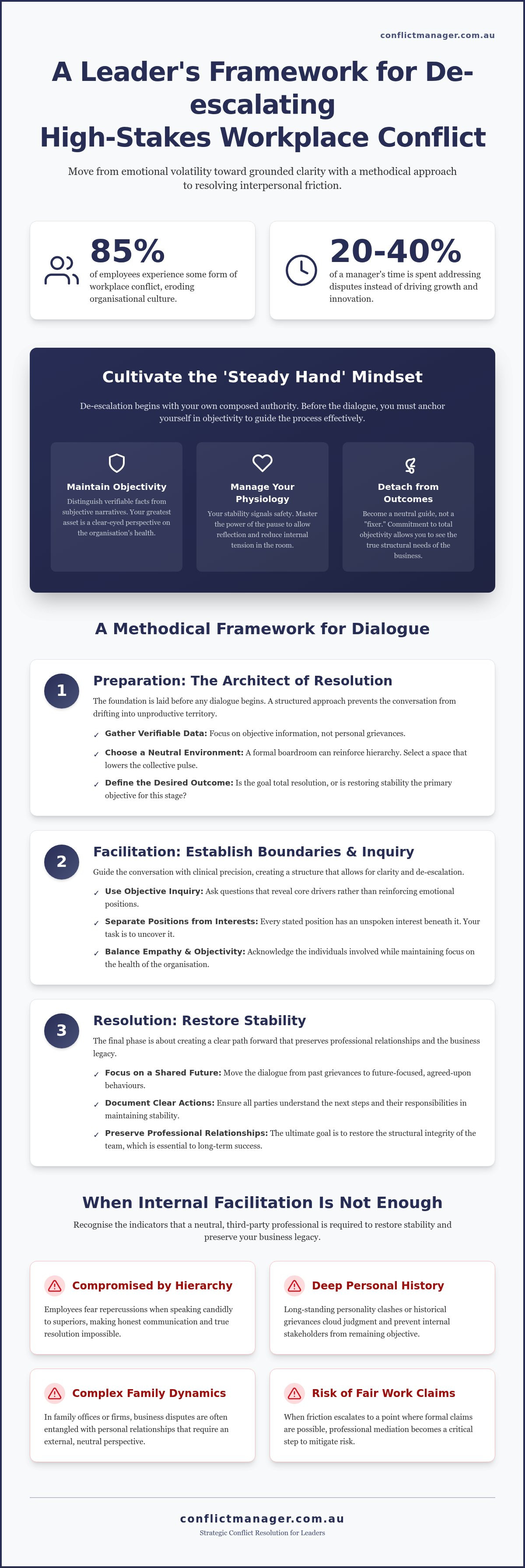
Leadership is often tested not in times of growth, but in the quiet moments of rising tension. For the seasoned professional, de-escalating conflict in the workplace is viewed as a strategic leadership competency rather than a reactive crisis tool. It is a discipline of movement and structural integrity. When friction is ignored, it doesn't simply dissipate. Instead, it erodes the foundation of Australian organisational culture, leading to a loss of key talent and a decline in collective focus. Research indicates that managers spend between 20 per cent and 40 per cent of their time addressing these disputes. This is a significant diversion of energy that could be better spent on innovation and growth.
Effective De-escalation techniques require more than just a calm voice; they demand a clinical understanding of how human systems respond to pressure. Discernment is vital. A leader must distinguish between a simple need for feedback and a high-stakes structural conflict that threatens the business legacy. This process requires a balance between empathy for the individuals involved and a clear-eyed objectivity regarding the health of the organisation. Clarity. Order. Resolution. These are the pillars of a composed approach to friction.
The Anatomy of Workplace Friction
Friction often begins with a misalignment of expectations. However, in complex environments like family offices or high-net-worth firms, these issues frequently mask deep-seated personality clashes or historical grievances. Structural transitions, such as leadership changes or mergers, act as significant triggers. These shifts often prompt defensive behaviours as individuals feel their status or security is at risk. When emotions run high, rational decision-making is often the first casualty, stalling business progress and clouding the path toward a resolution.
Why Traditional Management Styles Often Fail
Many leaders fall into the "fixer" trap. They attempt to resolve complex, multi-layered disputes with quick, superficial solutions that fail to address the underlying dynamics. In many Australian businesses, internal hierarchies create a power imbalance that makes honest communication difficult. Employees may fear the repercussions of speaking candidly to their direct superiors. This is where internal efforts often struggle under the weight of personal history. Navigating these high-stakes environments requires a neutral, composed perspective that internal stakeholders, by their very nature, cannot always provide.
Preparation: Cultivating Composed Authority Before the Dialogue
Preparation is the silent architect of resolution. Before a single word is spoken, the leader must cultivate a state of composed authority. This is the "Steady Hand" approach. It's a deliberate mental anchoring that ensures you remain unruffled by the emotional volatility of others. In high-stakes environments, de-escalating conflict in the workplace begins with the leader's ability to distinguish between objective facts and the subjective narratives that stakeholders often present as truth. A sea of opinions can easily drown a logical process. You must gather verifiable data points rather than collecting personal grievances. This objectivity is your greatest asset.
The environment you choose dictates the tone of the engagement. A formal boardroom might reinforce rigid hierarchies, whereas a neutral, quiet space can lower the collective pulse. Timing is equally critical. Approaching a volatile situation when fatigue is high or deadlines are looming often leads to further disruption. Finally, you must define the desired outcome with precision. Is the immediate goal a total resolution, or is the restoration of organisational stability sufficient for this stage? Clarity of purpose prevents the dialogue from drifting into unproductive territory.
The Psychology of Composure
Stability. Presence. Breath. These are the physical markers of a leader who is ready to facilitate. When you manage your physiological response, you signal safety to the room. The power of the pause is equally vital. Silence is not a vacuum; it's a sophisticated tool that allows participants to reflect and de-escalate their own internal tension. By detaching from a specific outcome, you become a neutral guide capable of seeing the structural needs of the business clearly. This detachment doesn't imply a lack of care, but rather a commitment to total objectivity.
Mapping the Stakeholder Landscape
Every stated position has an unspoken interest beneath it. Understanding these hidden drivers is essential for de-escalating conflict in the workplace effectively. You must consider the ripple effects of the conversation on the wider organisation. A resolution that satisfies two individuals but alienates the rest of the team is not a sustainable win. Identifying potential roadblocks, such as defensive reactions or historical biases, allows you to prepare your responses with precision. For complex disputes where internal history makes neutrality difficult, engaging Organizational Conflict Management specialists can provide the objective distance required for a truly sustainable result.
A Methodical Framework for De-escalating Heated Workplace Conflict
Navigating a volatile dispute requires more than intuition. It demands a vessel. Establishing a methodical framework for de-escalating conflict in the workplace ensures that the process remains focused on resolution rather than retribution. The first step involves establishing the container. You must set the rules of engagement and define professional boundaries before the dialogue begins. This structure provides the safety necessary for participants to lower their guard. Once the container is set, move to objective inquiry. Use open-ended questions to uncover the underlying drivers of the friction. Ask "how" or "what" to invite explanation, avoiding the accusatory "why" that often triggers defensiveness.
The third step is validating perspectives. This is an act of recognition, not necessarily agreement. You are honouring the reality of their experience while maintaining your own objectivity. From this point of validation, you can begin bridging the gap. Identify shared interests, such as the long-term stability of the firm or the preservation of a family legacy. Finally, document the outcome. Clarity is the antidote to future misunderstandings. Ensuring every party leaves with a written sense of order and accountability prevents the friction from resurfacing in the weeks to follow.
Non-Defensive Communication Techniques
Attacks are rarely about you. They are usually expressions of unmet needs or structural frustrations. Reframing these attacks allows you to stay composed. If a stakeholder expresses anger, listen for what is not being said. Active listening in high-pressure environments requires a steady presence and a rhythmic, measured pace of speech. Use commas and semicolons to create a sophisticated cadence that suggests you are unruffled by the heat of the moment. This approach signals that you are a neutral guide, capable of viewing the situation with total objectivity. It suggests both efficiency and thoroughness in your leadership.
Navigating High-Emotion Moments
Volatility can be managed without being dismissed. When emotions peak, recognise that the rational mind has temporarily disengaged. You must de-escalate the volatility by maintaining the role of the wise counsellor. If progress stalls due to high emotion, take a tactical break. A ten-minute reset can preserve the work already done and allow participants to regain their composure. This pause is a strategic tool in de-escalating conflict in the workplace, providing the space needed for clarity to return to the room. It ensures the dialogue remains a path toward resolution rather than a spiral into further chaos.
Recognising the Threshold: When Internal Facilitation is Not Enough
There is a point where internal efforts reach their limit. For an Australian executive or a family office principal, de-escalating conflict in the workplace often feels like a personal responsibility. Yet, the very position that gives you authority can also be the barrier to true neutrality. When personal history or complex internal hierarchies are present, stakeholders may perceive even the most objective leader as a biased participant. This perception of bias is a significant roadblock. It prevents the psychological safety required for a sustainable resolution to emerge. Clarity remains elusive when the facilitator is also the person who signs the paycheques.
Identifying conflict fatigue is essential for the health of your firm. If your leadership team is spending more time managing interpersonal friction than executing strategy, the cost of the dispute has already exceeded the cost of external help. The financial implications are stark. Research indicates the average cost of a formally escalated conflict for a company is approximately A$160,000. Engaging a neutral third party early in the process isn't a sign of failure; it's a strategic move to preserve business value and protect the business legacy before the damage becomes irreversible.
The Family Office and Private Wealth Context
Multi-generational friction requires a nuanced lens that traditional HR frameworks often lack. In a family office, the intersection of blood ties and fiduciary duties creates a unique pressure. You aren't just managing employees; you're navigating the complexities of a shared history. Protecting the family legacy while addressing modern organisational needs requires a facilitator who understands these dualities. A specialised approach ensures that structural stability is maintained without damaging the foundational relationships of the family. It's about movement. It's about structural integrity during difficult transitions.
The Value of Total Objectivity
An external facilitator brings a level of objectivity that internal leaders cannot replicate. They see the blind spots created by years of shared experience and unspoken assumptions. This presence often has a reassuring effect on anxious or defensive stakeholders, as it signals that the process will be fair and clinical. By focusing on sustainable outcomes rather than quick fixes, professional mediation ensures the resolution outlasts the current dispute. If you find yourself at this threshold, exploring Stakeholder Facilitation can provide the unruffled, expert perspective needed to restore order and move the organisation from complexity toward a vision of structured resolution.
Restoring Stability: The Strategic Value of Professional Mediation
Resolution. Stability. Order. These are the outcomes that emerge when a volatile situation is met with a structured methodology. Once you've recognised that internal facilitation has reached its limit, the transition to professional mediation becomes a strategic necessity. De-escalating conflict in the workplace through an external lens allows for a reset of the organisational pulse. It moves the focus away from individual grievances and toward the structural integrity of the business. This process isn't about a quick fix; it's about building a foundation that can withstand future pressures.
A bespoke resolution roadmap is essential for Australian business dynamics. Every organisation has its own history, hierarchy, and cultural nuances. A generic approach often fails because it ignores these underlying layers. By tailoring the mediation process to your specific environment, we ensure that the path forward is both practical and sustainable. Closing the loop is the final, critical phase. Monitoring progress ensures that the agreements made during mediation are being upheld and that the resolution remains firm over time. This ongoing attention prevents a relapse into old patterns of friction.
The Conflict Manager Approach
Our method is built on the principle of composed authority. We guide stakeholders through volatile transitions by acting as a steady hand in the room. Clarity. Order. Preservation. These are our priorities. We focus on protecting significant family assets and the long-term viability of the organisation. Providing national Australian coverage, we specialise in complex disputes where the stakes are high and the dynamics are multi-layered. We bring a sense of order during periods of high stress, allowing clarity to emerge from a clouded situation.
Next Steps for Leaders
Assessing your current situation with total confidentiality is the first step toward resolution. You don't need to have all the answers before you reach out. The first conversation is designed to provide you with a clear understanding of the process and what to expect when you engage a resolution specialist. It's an opportunity to view your situation with total objectivity. If the friction in your firm has become a burden, it's time to seek a path toward grounded stability. Discover how our composed approach to mediation can restore clarity to your organisation.
Restoring Your Organisational Rhythm
Leadership requires the wisdom to know when a situation has moved beyond internal capacity. We've explored how cultivating a "Steady Hand" and applying a methodical framework are essential first steps for any executive. However, the true mark of a sophisticated leader is the discernment to recognise the threshold where personal history or internal hierarchy hinders total objectivity. De-escalating conflict in the workplace is an art of movement and structural integrity. It demands a vessel that only a neutral, expert third party can provide. When the stakes involve your business legacy or significant family assets, the cost of a mismanaged conversation is simply too high.
Conflict Manager serves as that steady hand. As specialists in high-net-worth family office disputes and expert-led mediation for Australian businesses, we focus on sustainable, long-term outcomes. Our priority is the preservation of your legacy and the restoration of order within your team. You don't have to navigate these volatile transitions alone. Secure a composed resolution for your organisation today and move toward a future defined by clarity rather than friction. Your business stability is well within reach.
Frequently Asked Questions
What is the best way to start a difficult conversation at work?
Start by stating the objective facts and the desired outcome without emotional bias. Clear intent provides a sense of safety for all parties. It's often helpful to frame the dialogue as a collaborative effort to restore organisational flow. This approach prevents the conversation from feeling like an interrogation and instead positions it as a path toward structural stability.
How do I facilitate a conversation between two employees who do not get along?
Establish a "container" by setting firm rules of engagement before the discussion begins. You must act as a neutral guide who focuses on professional interests rather than personal grievances. Encourage each party to speak to the shared business goals that require their cooperation. This redirection shifts the focus from interpersonal friction toward the functional needs of the firm.
When should a manager step back and hire a professional mediator?
Step back when your position in the hierarchy or your personal history with the parties makes true neutrality impossible. If a dispute involves high-net-worth assets or complex family dynamics, the risk of perceived bias is high. Hiring a professional mediator is a strategic choice when the cost of continued friction exceeds the cost of expert intervention.
How can I stay calm when a workplace conversation becomes emotional?
Maintain composure by consciously managing your physiological response, such as your breathing and posture. Use silence as a facilitative tool; it allows the emotional energy in the room to dissipate naturally. By detaching from a specific personal outcome, you remain a steady hand capable of viewing the volatility with total objectivity.
What are the risks of avoiding difficult conversations in a family business?
Avoiding these talks in a family office can lead to the erosion of your business legacy and the integrity of shared assets. Unresolved tension often bubbles over into legal disputes or Fair Work claims; these can be both costly and public. Proactive resolution is essential to preserve the structural stability of the family unit and the fiduciary health of the enterprise.
Can de-escalating conflict in the workplace be done remotely?
Yes, de-escalating conflict in the workplace can be achieved through digital platforms provided there is a heightened focus on structure. Video conferencing is essential to capture non-verbal cues that are often lost in text or audio. You must be even more intentional with pauses and the establishment of engagement rules to compensate for the lack of physical presence.
How do I ensure the resolution from a difficult conversation is sustainable?
Sustainability is achieved through clear documentation and a defined monitoring process. Every resolution should include specific actions, timelines, and accountability measures that are agreed upon by all parties. Closing the loop with regular check-ins ensures that the new patterns of behaviour are becoming ingrained in the organisational culture.
What is the difference between facilitation and mediation in an Australian workplace?
Facilitation is generally a proactive process designed to guide a group toward a specific goal or through a structural transition. Mediation is a more formal, reactive intervention used to resolve a specific dispute between parties. In an Australian context, both aim to restore order, but mediation often concludes with a more formalised agreement or deed.


