

Legacy. Stability. Discretion. The most significant risk in a high-stakes dispute isn't the financial cost; it's the quiet erosion of a reputation built over decades. When internal arguments turn circular and complex trust or corporate structures feel like an impenetrable maze, the pressure to find an exit often leads to rushed decisions. Understanding how to choose a conflict mediation service requires more than just finding a neutral party. You need a steady hand that understands the weight of your responsibility and the intricate human dynamics of your specific environment.
It's exhausting to manage the friction of interpersonal dynamics while fearing that a public misstep might cause irreparable damage to your organisation. You deserve a sense of order during periods of high stress. This article provides a methodical framework for selecting a mediator who possesses the professional discernment to navigate these volatile transitions with composed authority. We'll examine how to identify a practitioner who respects the nuances of Australian family offices and governance, ensuring a structured path forward that reduces emotional friction and preserves your legacy.
Key Takeaways
- Recognise why preserving your family or organisational legacy requires a strategic intervention that prioritises asset integrity and long-term stability.
- Learn how to choose a conflict mediation service by evaluating a practitioner’s ability to manage high-register corporate dynamics and sensitive family governance.
- Familiarise yourself with the Australian accreditation landscape to ensure your mediator meets the rigorous standards required for high-stakes dispute resolution.
- Evaluate specific mediation styles to determine whether a facilitative or evaluative approach best serves your unique interpersonal or financial situation.
- Implement a methodical selection framework that moves your team or family away from circular conflict and toward a sustainable, professional resolution.
The Weight of Choice: Why Professional Mediation Matters
Conflict. Stagnation. Risk. These three forces often operate in the shadows of successful Australian organisations and high-net-worth families. When a dispute takes root, the immediate instinct is frequently to manage the fallout internally; yet, this approach often overlooks the long-term cost of unresolved tension. Professional mediation serves as a strategic intervention. It's a deliberate choice to prioritise the preservation of organisational and family integrity over the temporary satisfaction of being "right".
Unresolved conflict carries hidden burdens that can cripple even the most robust structures. Asset erosion occurs when decision-making becomes paralysed by internal friction. Reputational risk increases as the circle of those aware of the dispute expands. A seasoned mediator acts as a neutral architect of clarity, providing a stable foundation where stakeholders can address complex human dynamics without the fear of public exposure. Understanding What is Mediation? is the starting point for any leader looking to move from disruption toward a structured resolution.
The decision regarding how to choose a conflict mediation service rests on identifying a professional who understands that high-stakes environments require more than simple compromise. It demands a practitioner who can view volatile situations with total objectivity while respecting the weight of responsibility held by the parties involved. This external perspective is essential for breaking the circular arguments that often exhaust internal resources.
The Limits of Internal Resolution
Internal attempts at resolution often fail because the participants are too close to the source of the heat. In family offices, emotional entanglement clouds objective decision-making. History, shared trauma, or legacy expectations create a lens that distorts reality. Within leadership teams, an "echo chamber" effect often takes hold during periods of structural change; this makes it nearly impossible for authority figures to remain neutral. When the person tasked with resolving the conflict is also a stakeholder in the outcome, the process lacks the necessary perceived fairness to stick.
Defining Success in High-Stakes Mediation
Success in this register isn't merely about reaching an agreement. It's about achieving a sustainable, long-term outcome that protects the underlying relationships. For families and private wealth structures, confidentiality and discretion are non-negotiable requirements. A successful mediation process provides a structured path forward that reduces emotional friction while ensuring the organisational legacy remains intact. It moves the conversation beyond the immediate disagreement toward a vision of structural stability and future growth.
Understanding the Australian Mediation Landscape
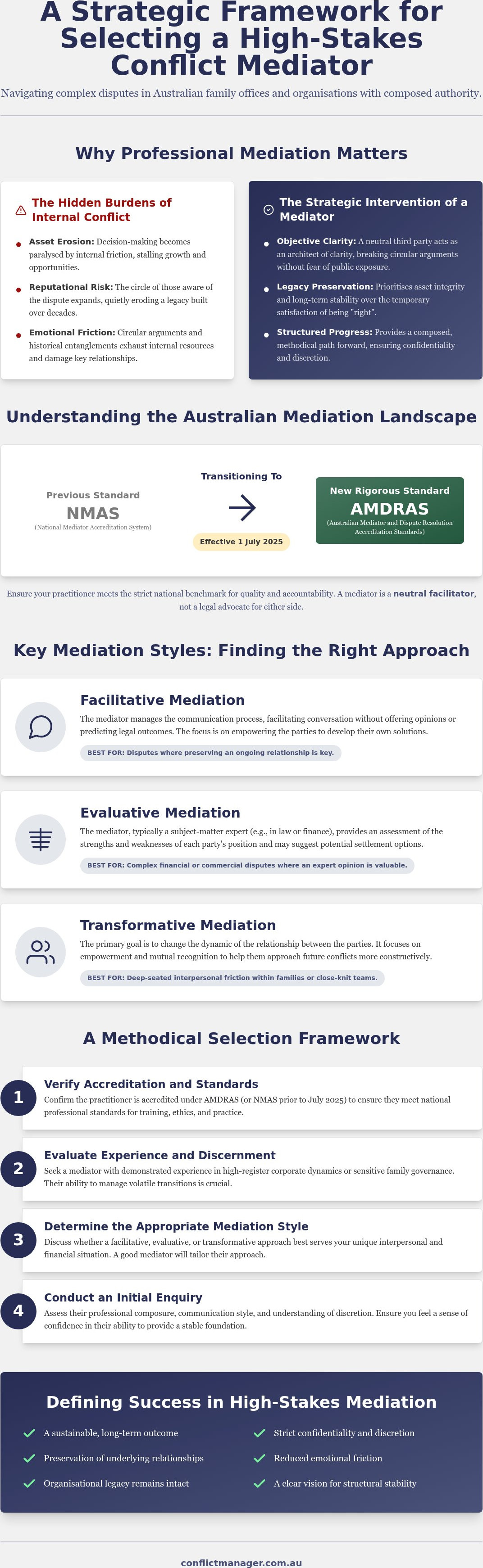
The Australian mediation landscape has undergone a significant professionalisation in recent years. For those determining how to choose a conflict mediation service, understanding the regulatory framework is the first step toward ensuring quality and accountability. As of July 1, 2025, the Australian Mediator and Dispute Resolution Accreditation Standards (AMDRAS) replaced the National Mediator Accreditation System (NMAS). This transition represents a shift toward more rigorous assessment and a modernised approach to dispute resolution across the country. It ensures that practitioners aren't merely self-appointed guides but are instead professionals held to a strict national benchmark.
When considering the process of Wisely Choosing A Mediator, it's essential to distinguish between mediation and legal representation. A mediator is a neutral third party. They don't provide legal advice or act as an advocate for either side. Instead, they manage the process and the environment, allowing the parties themselves to reach a sustainable agreement. This neutrality is the cornerstone of the process, providing a safe harbour for difficult conversations that might otherwise collapse into litigation.
Different disputes require different methodologies. Facilitative mediation is the most common, where the mediator manages the communication process without offering an opinion on the outcome. In contrast, evaluative mediation involves a practitioner with specific subject-matter expertise who may provide guidance on the strengths and weaknesses of each party's position. For organisations or families dealing with deep-seated interpersonal friction, transformative mediation focuses on shifting the underlying relationship dynamics rather than just settling the immediate dispute.
AMDRAS Accreditation and Professional Standards
The AMDRAS framework, overseen by the Mediator Standards Board (MSB), guarantees a high level of ethical conduct and procedural integrity. To maintain accreditation, Australian mediators must complete a minimum of 20 hours of dispute resolution practice and 25 hours of professional development every two years. This requirement ensures that your chosen professional remains current with the latest psychological and structural techniques. If you are managing complex stakeholder dynamics, engaging in Stakeholder Facilitation can provide the necessary structural support to navigate these transitions safely.
Facilitation vs. Mediation: Choosing the Right Tool
Choosing the correct intervention depends on the scale and nature of the friction. Facilitation is typically employed for broader groups where the goal is to align multiple stakeholders or manage structural changes. It's about movement and flow. Mediation is a more focused, intensive process designed for specific disputes where emotions or high-value assets are at stake. In multi-generational family offices, a hybrid approach is often required. This involves facilitating long-term governance discussions while using mediation to resolve acute disagreements between individual members, ensuring the legacy remains protected from internal erosion.
Key Criteria for Evaluating a Mediation Professional
Expertise is rarely a generic commodity. When you're determining how to choose a conflict mediation service, the primary filter should be the practitioner's specific experience within high-asset environments. A generalist may understand the mechanics of negotiation, but they often lack the depth required to navigate the intricate web of trust structures, shareholder agreements, and intergenerational expectations that define family offices. You need a professional who understands that the preservation of legacy is often as important as the immediate financial settlement.
A mediator's temperament is their most effective tool. It's the ability to remain unruffled when tensions peak. This steady hand provides a sense of order during periods of high stress, acting as a grounded presence that prevents the dialogue from devolving into circular arguments. Look for evidence of sustainable outcomes in their track record. A history of long-term stability in resolved cases is a far better indicator of success than a simple settlement rate. You're looking for a professional who views volatile situations with total objectivity.
Discerning Expertise in Family Wealth and Governance
High-net-worth disputes operate at the intersection of deep-seated emotion and rigid commercial logic. A mediator must be capable of speaking both languages. They need to grasp the nuances of complex inheritance structures and the weight of responsibility that comes with significant wealth. While the Australian Government's guide to Family Dispute Resolution offers a helpful baseline for the legal requirements of family mediation, bespoke family office disputes often demand a practitioner with a high-level corporate and psychological register. This ensures they can navigate the structural friction of a family business without becoming emotionally entangled in the dynamics.
Assessing Composure and Executive Presence
Can the mediator command a room of high-powered stakeholders? This isn't about dominance, but about quiet confidence. In volatile situations, the mediator's composure sets the tone for the entire process. They must be able to de-escalate high-stakes environments through a measured, sophisticated pace of communication. When learning how to choose a conflict mediation service, evaluate the practitioner's ability to provide internal contrast to the chaos. A wise external counsellor brings a sense of stability that lowers the room's pulse and builds trust through a logical, methodical sequence of thought. If they seem hurried or sensationalist, they're likely ill-equipped for the quiet authority required in your specific context.
The Selection Process: From Initial Enquiry to Engagement
Moving from the recognition of a problem to the selection of a solution requires a disciplined approach. When researching how to choose a conflict mediation service, you must first define the scope of the disagreement. Is this a structural failure in governance, a financial dispute over asset distribution, or a breakdown in interpersonal relationships? Clarity here prevents the engagement of a specialist whose skills don't align with the core issue. It's about finding a professional who can navigate your specific maze with quiet confidence.
Once the scope is clear, shortlisting becomes an exercise in precision. You should prioritise professionals with a proven background in Australian family or business law; specifically, those accustomed to high-stakes environments. The initial enquiry is your first opportunity to observe the mediator's analytical style. Does their communication feel methodical and logical? A steady hand is often revealed in these earliest interactions. You aren't just looking for a facilitator; you're looking for a wise, external counsellor capable of viewing volatile situations with total objectivity.
Assessing the methodology is about more than just checking boxes. It's about finding a process that feels reassuringly structured. A professional engagement should conclude with a clear roadmap, setting expectations for all stakeholders involved. This ensures everyone enters the room with a shared understanding of the path toward resolution. If you are ready to begin this process, exploring Family Conflict Resolution services can provide the structured guidance your situation requires.
Critical Questions to Ask During an Initial Consultation
Balance. Composure. Experience. The interview stage is where you test for composed authority. Ask the practitioner how they handle power imbalances between family members or shareholders. In high-asset environments, the loudest voice isn't always the most relevant one. Inquire about their approach to managing high-emotion outbursts during a session. Finally, ask them to describe their experience with multi-generational wealth transfers. Their answers should reflect a deep understanding of both structural and psychological dynamics, suggesting they won't become emotionally entangled in the friction.
Identifying Red Flags in a Mediation Service
Urgency. Guarantees. Generalisation. These are the markers of an unsuitable service. Be wary of mediators who lack a clear, methodical process or those who offer a "one-size-fits-all" approach to bespoke family disputes. Artificial urgency or promises of "guaranteed" results are significant red flags. Mediation is a process of discovery and negotiation; it's not a product with a pre-determined outcome. A wise external counsellor will focus on the integrity of the process rather than selling a quick fix, ensuring the final resolution is both sustainable and clear.
Achieving Sustainable Outcomes with Conflict Manager
Clarity. Resolution. Legacy. These three pillars form the foundation of the Conflict Manager philosophy. We provide a sense of order during periods of high stress, acting as a steady hand for those navigating the complexities of family and corporate governance. When deciding how to choose a conflict mediation service, the final metric of success is the sustainability of the outcome. Our approach meets complex human dynamics with composed authority, ensuring that every stakeholder moves from a state of disruption toward a vision of structured resolution.
We act as a neutral third party that brings total objectivity to clouded situations. By viewing volatile environments through a lens of professional discernment, we help families and organisations identify the structural friction points that internal efforts often miss. This external perspective is essential for breaking circular arguments and establishing a path forward that respects both the interpersonal relationships and the commercial realities of the situation. Our methodology is designed to lower the pulse of the room, replacing the heat of conflict with the cool logic of a structured plan.
A Steady Hand for High-Net-Worth Families
Specialised mediation for family offices requires a deep respect for the integrity of family assets. Succession and governance are sensitive transitions that carry the weight of a multi-generational legacy. We guide families through the friction of these shifts, providing the stability needed to navigate intergenerational conflict without eroding the family's core values or financial standing. It's about preserving the relationships that matter while resolving the disagreements that threaten them. This bespoke approach ensures that the resolution is as unique as the family it serves, providing a clear path forward that reduces emotional friction.
Restoring Order to Organisational Conflict
Organisational conflict management is a strategic necessity during periods of high-stakes structural change. When leadership teams face misalignment, the resulting stagnation can damage both morale and the bottom line. We facilitate communication that leads to sustainable alignment, helping executives achieve the clarity required to lead with confidence once again. This process involves more than just a meeting; it's a comprehensive evaluation of the dynamics at play, designed to achieve long-term stability. Discover how Conflict Manager can restore order to your organisation through a methodical and logical progression toward resolution.
Restoring Order and Preserving Your Legacy
Disruption is not a permanent state; it's a transition that requires a steady hand. By understanding how to choose a conflict mediation service, you've taken the first step toward reclaiming structural integrity for your family or organisation. Success lies in selecting a practitioner who possesses the composed authority to manage high-stakes dynamics while respecting the weight of your legacy. We've explored the importance of AMDRAS accreditation and the necessity of a methodical selection framework that prioritises sustainable outcomes over quick fixes.
Conflict Manager provides national coverage across Australia, specialising in the unique pressures of family office and high-net-worth dispute management. Our approach is grounded in total objectivity and a commitment to asset integrity. When the path forward feels clouded, a wise external counsellor can provide the clarity needed to move beyond circular arguments. Request a confidential consultation with a Conflict Manager expert to discuss your specific needs. You don't have to navigate these complexities alone; structured resolution is within reach.
Frequently Asked Questions
What is the difference between mediation and legal representation in Australia?
A mediator acts as a neutral facilitator; a lawyer is an advocate for a specific party. In the Australian context, the mediator manages the communication environment to help parties reach their own consensus. They don't provide legal advice or fight for a particular side's interest. This distinction is vital for maintaining the structural integrity of the process and ensuring a balanced dialogue.
How much does a professional mediation service typically cost for a family office?
Private family mediation in Australia typically ranges from 2,000 to 7,000 dollars in total. A full day session often costs between 3,000 and 5,000 dollars, which is usually shared between the parties. These fees cover the intensive work required to navigate high asset environments and include the initial intake assessments for each participant.
Can mediation be effective if one party is unwilling to participate fully?
Full participation is the goal, but mediators use mandatory suitability assessments to screen for readiness and safety. Under the Family Dispute Resolution Regulations 2025, practitioners must evaluate the situation before joint sessions can proceed. If a party remains entirely resistant, the mediator provides an objective assessment of the next steps, which may include issuing a Section 60I certificate.
How long does the mediation process usually take for complex business disputes?
While a single full day session can resolve many issues, complex business disputes often require several weeks of preparation. This involves individual intake sessions and the drafting of initial frameworks to ensure all stakeholders are aligned. The methodical pace ensures that everyone has the space to consider the long term implications of the proposed resolution without feeling rushed.
Is mediation legally binding for family wealth or inheritance disputes?
Agreements reached are not automatically legally binding. To become enforceable, they must be formalised as consent orders approved by the court or as binding financial agreements. This step is essential for ensuring the sustainability of the resolution and protecting the organisational or family legacy from future challenges.
What happens if a resolution cannot be reached during the mediation process?
If a resolution isn't reached, the parties retain their right to pursue litigation or other external interventions. However, the process often clarifies the core issues and narrows the areas of disagreement. This makes any subsequent legal action more focused and potentially less expensive by removing the circular arguments that previously clouded the situation.
How do I ensure the confidentiality of our family office discussions?
Confidentiality is established through a formal agreement signed by all participants before the sessions begin. In the Australian context, these discussions are generally inadmissible in court proceedings. When determining how to choose a conflict mediation service, you should verify that the practitioner has specific protocols for handling sensitive corporate or trust data with total discretion.
Does a mediator need to have a legal background to be effective?
A legal background is not a requirement for an effective mediator. The primary benchmark is accreditation under the Australian Mediator and Dispute Resolution Accreditation Standards (AMDRAS). When learning how to choose a conflict mediation service, focus on the practitioner's ability to manage high register psychological dynamics and complex human transitions rather than just their legal credentials.


