

Downsizing is often treated as a mathematical exercise in cost-cutting, yet it is almost always a psychological crisis of trust. Disruption, friction, uncertainty; these are the silent costs when a restructure lacks a human-centric strategy. You likely recognise the heavy atmosphere in the office, the whispered concerns in the breakroom, and the palpable anxiety of those who remain. Effectively managing conflict during downsizing isn't just about damage control, it's about protecting the very foundation of your future operations.
It's possible to navigate these complexities with a composed, professional approach that restores operational clarity and secures your reputation. This article provides a strategic framework for resolving team friction while ensuring you retain your most valuable talent through the transition. We'll explore how to align executive goals, implement sustainable communication frameworks, and address the specific nuances of the Australian landscape, including the 2027 tax-free redundancy thresholds and the recent implementation of Payday Super. By moving from a state of reactive disruption toward a vision of structured resolution, you can maintain organisational equilibrium even in the most volatile environments.
Key Takeaways
- Identify the difference between task-oriented friction and interpersonal discord to address the root causes of team instability effectively.
- Master a strategic framework for managing conflict during downsizing that focuses on rebuilding the psychological contract with your remaining workforce.
- Evaluate the limits of internal HR during redundancies and understand when external facilitation is required to bridge the "neutrality gap".
- Apply a methodical two-step process of objective assessment and facilitated dialogue to restore order and clear communication channels.
- Secure your organisation's reputation and retain essential talent by navigating structural changes with a composed, professional methodology.
The Anatomy of Conflict During Organisational Downsizing
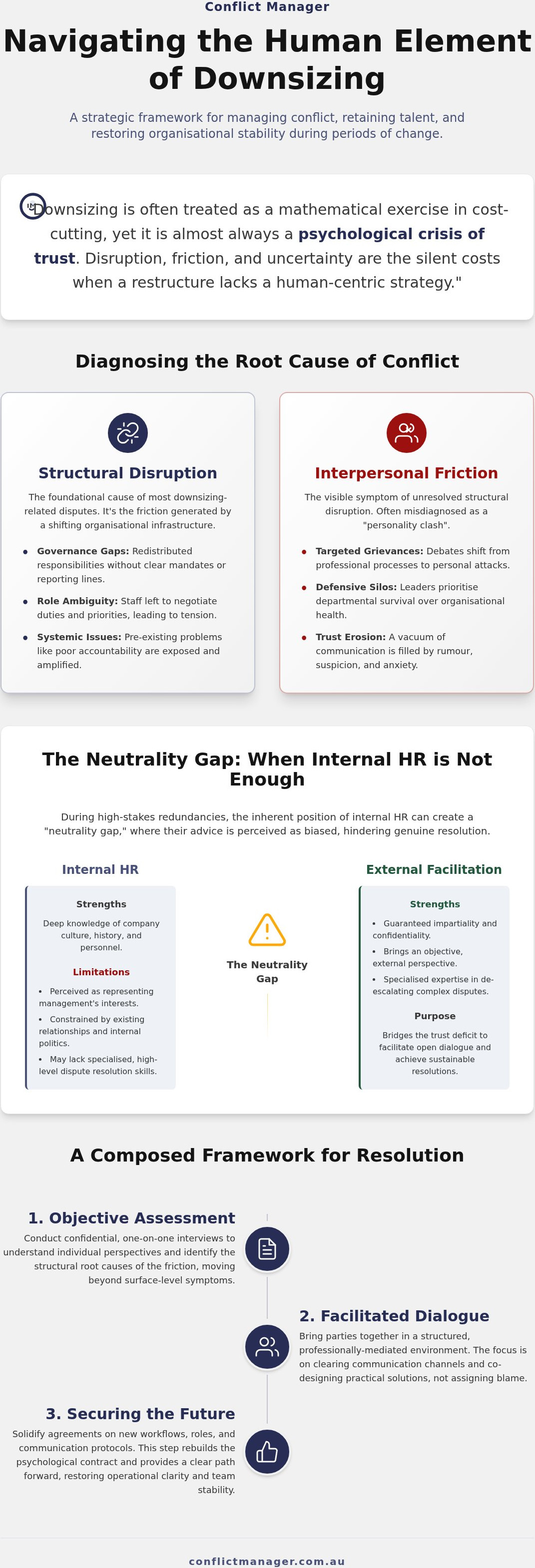
Disruption. Friction. Uncertainty. Downsizing is rarely just a reduction in headcount; it is a fundamental breach of the unwritten agreement between an organisation and its people. This psychological contract represents the mutual expectations and obligations that define the employment relationship. When this contract is severed, the resulting friction often transcends mere operational adjustments. Understanding The Anatomy of Conflict During Organisational Downsizing requires a nuanced look at how structural changes disturb human connections. While task-oriented friction, such as debating new workflows or reporting lines, can be productive, it quickly curdles into damaging interpersonal discord when employees feel their security is threatened. Effectively managing conflict during downsizing requires distinguishing between these two states before the culture becomes toxic.
Redundancy often acts as a high-pressure catalyst, exposing cracks in leadership or communication that were previously manageable. Long-dormant systemic issues, such as poor accountability or a lack of transparency, suddenly surface with renewed intensity. The costs of leaving this friction unaddressed are significant. Beyond the immediate dip in productivity, organisations face the risk of losing "stars", those high-performers who have the mobility to leave when the environment feels unstable. In the Australian context, failing to address these tensions can also escalate into formal industrial relations risks or Fair Work claims, turning internal friction into a public and costly legal matter.
The Psychology of Uncertainty
Uncertainty breeds self-preservation. When the threat of redundancy looms, leadership teams often retreat into defensive silos, prioritising the survival of their own departments over the health of the whole organisation. This unvoiced anxiety creates a vacuum, which is inevitably filled by suspicion and rumour. Organisational volatility is the state where structural change outpaces internal communication. Without a steady hand to guide the narrative, this vacuum erodes the trust necessary for future recovery and leaves staff feeling adrift.
Recognising the Early Signals of Discord
Early detection is vital for any leader. You should look for the shift from constructive professional debate to grievances that target individuals rather than processes. You might notice "survivor syndrome" taking root among the remaining staff, which manifests as a complex mix of guilt, anger, and deep disengagement. Traditional management interventions, which often rely on "business as usual" rhetoric, frequently fail here because they don't account for the emotional weight of the transition. When internal efforts to manage these disputes become circular or emotionally charged, it's a clear signal that the existing power dynamics are hindering resolution rather than helping it.
Structural Disruption vs. Interpersonal Friction: Diagnosing the Root Cause
Disruption. Misalignment. Resentment. Conflict is rarely a spontaneous combustion of personalities; more often, it's the friction generated by a shifting organisational infrastructure. When managing conflict during downsizing, leaders often mistake the heat of an argument for the source of the fire. They treat a "personality clash" between two department heads as a matter for simple mediation, failing to recognise that the dispute is actually a rational response to overlapping jurisdictions or a sudden governance gap. If the structural cause remains unaddressed, the friction will inevitably return, regardless of how many interpersonal "fixes" are applied.
Governance. Integrity. Stability. During a transition, the impact of governance gaps on team stability cannot be overstated. When roles are made redundant, the remaining responsibilities don't simply vanish. Instead, they're often redistributed without clear mandates, leading to a state of perpetual negotiation between staff. Addressing the symptom without the cause leads to recurring disputes that drain executive energy and erode trust. It's vital to ensure legacy values are preserved while the organisation evolves its headcount and strategy, ensuring that the "how" of the work doesn't get lost in the "who" of the restructure.
Role Ambiguity and Conflict
The pressure to "do more with less" is a common refrain in Australian boardrooms, yet it frequently creates avoidable friction between remaining team members. Without clear, documented responsibilities in a post-downsizing environment, employees are forced to compete for resources or protect their own patches of influence. Managing the overlap of duties that follows a reduction in force requires more than just an updated spreadsheet; it requires a deliberate recalibration of expectations. Engaging in organisational conflict management can help identify these structural root causes before they solidify into permanent cultural damage.
The Influence of Workplace Culture
A culture of composure acts as a preventative tool, dampening the escalation of high-emotion disputes before they reach a breaking point. Psychological safety remains paramount, as it allows staff to voice concerns about the new structure without fear of further redundancy. When people feel safe to point out where the new reporting lines are failing, the organisation can adjust its course with precision. Culture serves as the container for all professional interactions during restructuring. By fostering a grounded environment, leadership can move the team from a state of reactive anxiety toward a shared vision of future stability.
The Limits of Internal HR: Why External Facilitation is Critical During Redundancy
Objectivity. Distance. Discretion. When an organisation undergoes significant restructuring, the internal HR team is often positioned at the centre of the storm. While these professionals are skilled in standard dispute resolution, the unique pressures of redundancy create a profound neutrality gap. It's difficult for a team member to trust a mediator who was, only hours earlier, issuing redundancy notices to their colleagues. This perceived bias is why managing conflict during downsizing requires a perspective that exists entirely outside the company's internal power dynamics.
Executive-level friction presents a different set of challenges. When misalignment occurs at the board or C-suite level, internal staff are rarely in a position to facilitate a resolution without risking their own standing. A neutral third party provides a steady hand, viewing volatile situations with total objectivity. This external presence allows for a level of transparency that is often impossible to achieve internally. Stakeholders are more forthcoming with an external mediator because the risk of internal retribution is removed, allowing the true root causes of friction to surface safely.
The Burden of Perceived Bias
Existing relationships within a firm can easily cloud a manager's perspective. In the high-stakes environment of a restructure, even the most professional HR leader may face claims of favouritism, particularly when they are overseeing the selection process for remaining roles. This is especially sensitive in Australian family offices or board-level matters where interpersonal histories span decades. Maintaining the integrity of the resolution process requires a facilitator who has no stake in the outcome. By removing the "executioner" stigma often attached to internal HR during layoffs, an external counselor can rebuild the trust necessary for the organisation to move forward.
The Facilitator as an Objective Counselor
The methodology of guided stakeholder facilitation is designed to reach sustainable, clear outcomes rather than temporary "quick fixes". A seasoned professional remains unruffled by high-stakes business disputes, providing the grounded reassurance that leadership teams need during periods of high stress. Recent data from Forbes suggests that managers already spend over four hours a week dealing with conflict; during a downsizing event, this burden can become overwhelming. External intervention allows leadership to focus on strategic recovery while the facilitator manages the interpersonal friction. This process moves the organisation from a state of disruption toward a vision of structured resolution, ensuring that the transition is handled with the composure it deserves.
A Composed Framework for Resolving Downsizing-Related Disputes
Precision. Method. Resolution. Moving from the chaos of a restructure to a state of order requires a framework that is both rigorous and empathetic. Effective strategies for managing conflict during downsizing rely on a structured progression that removes the heat from the situation while preserving the dignity of all involved. This methodical approach ensures that decisions are based on data rather than defensive reactions.
- Step 1: Objective Assessment. We begin by gathering data from all affected stakeholders. This is a period of active listening where perspectives are collected without judgement, providing a clear map of the friction points within the organisation.
- Step 2: Facilitated Dialogue. Once the landscape is understood, we create a controlled, safe environment for difficult conversations. This is a neutral space where grievances can be aired without fear of professional reprisal.
- Step 3: Root Cause Identification. Building on the distinction between structural and interpersonal friction, we separate the emotional noise of the transition from the underlying governance gaps that are causing the most damage.
- Step 4: Agreement and Action. Here, we document clear, sustainable pathways for the new team structure. These are not vague promises but specific, actionable commitments that define how the team will operate moving forward.
- Step 5: Integration and Follow-up. Resolution is not a one-time event. We ensure the resolution holds by scheduling follow-up sessions as the new organisation settles into its rhythm.
For leaders seeking to restore equilibrium quickly, engaging in expert stakeholder facilitation provides the external perspective necessary to close the neutrality gap and secure the organisation's future.
Facilitating High-Emotion Conversations
De-escalating volatility during mediation requires a steady hand and a focus on future-state solutions. It's essential to validate each party's perspective, acknowledging the genuine pain of the transition, without compromising the core business goals of the restructure. By steering the conversation away from past-tense grievances and toward the shared requirements of the new team, we lower the emotional temperature. This allows participants to move from a defensive posture to a collaborative one, ensuring that the friction of the past does not dictate the culture of the future.
Achieving Sustainable Outcomes
Quick fixes often fail because they don't address the structural shifts that occurred during the downsizing process. Sustainable resolution requires a commitment to ongoing governance and clarity. By building internal capacity for conflict management during the resolution process, we empower your remaining team to handle future friction with the same level of composure. This ensures that the stability achieved during facilitation is not temporary but becomes a permanent feature of your organisational culture.
Restoring Order and Clarity: How Conflict Manager Guides the Transition
Order. Clarity. Perspective. The conclusion of a redundancy process should not be marked by exhausted silence, but by the restoration of operational focus. At Conflict Manager, our philosophy is rooted in the belief that periods of high stress require more than just management; they require a steady, external hand capable of viewing complex dynamics with total objectivity. By managing conflict during downsizing through a lens of composure, we allow leadership teams to step back from the emotional weight of the transition and refocus on the strategic future of the firm.
Our expert-led approach is designed to guide stakeholders through the resolution process without becoming entangled in the interpersonal friction that typically accompanies structural change. We specialise in facilitating high-emotion business disputes where the stakes involve not just financial assets, but the long-term integrity of the organisational culture. Whether you are navigating a family office governance shift or a large-scale corporate modernisation, our role is to act as a neutral third party that brings clarity to clouded situations.
A Steady Hand for High-Stakes Transitions
Providing objective, neutral guidance is essential when internal efforts have reached an impasse. We assist leadership teams in achieving clarity and asset integrity, ensuring that the psychological contract is repaired rather than permanently fractured. Our methodology focuses on movement and structural integrity, helping you navigate the difficult transition from a state of disruption toward a vision of structured resolution. If your organisation is currently facing the friction of a sensitive transition, we invite you to contact us for a confidential discussion regarding your specific needs. We remain unruffled by high-stakes environments, offering a grounded perspective that internal teams, naturally close to the situation, may struggle to maintain.
The Path Toward Resolution
Reaffirming a commitment to professional respect and long-term stability is the final step in any successful restructure. Leaders who are ready to move beyond complexity toward a state of professional harmony can engage in a process that prioritises sustainable outcomes over temporary fixes. By choosing a path of professional conflict management, you secure the retention of key talent and protect your reputational standing in the Australian market. To begin this journey, you may enquire about our Organisational Conflict Management services to see how we can support your transition with composure and authority.
Securing Your Organisation’s Future Stability
Structural integrity. Cultural resilience. Operational clarity. Navigating a reduction in force requires more than a spreadsheet; it demands a deep understanding of the human dynamics at play. We've explored how separating structural gaps from interpersonal friction allows a team to heal, while external facilitation bridges the neutrality gap that often hampers internal HR efforts. By applying a methodical framework to managing conflict during downsizing, you protect your reputation and retain the high-performers essential for your next chapter.
Conflict Manager provides seasoned professional mediators for high-stakes Australian environments, ensuring sustainable outcomes for complex organisational restructuring. Our objective, neutral third-party perspective on team disputes brings order to even the most volatile transitions. You don't have to carry the burden of these difficult conversations alone. It's possible to transform a period of disruption into a foundation for future success. Achieve clarity and stability with our expert facilitation services. With the right guidance, your organisation can emerge from this period of change stronger, more focused, and ready for growth.
Frequently Asked Questions
How do you manage team conflict during a downsizing process?
Effective strategies for managing conflict during downsizing involve moving from reactive damage control to a structured, data-driven framework. Leaders should prioritise objective assessments that identify exactly where role overlaps or governance gaps are causing friction. By addressing these structural root causes rather than just the emotional outbursts, you restore operational clarity and lower the overall pulse of the organisation.
What are the most common causes of conflict during organisational restructuring?
Conflict during restructuring typically stems from role ambiguity, governance gaps, and a perceived breach of the psychological contract. When staff don't understand their new reporting lines or responsibilities, they often retreat into defensive silos. This structural uncertainty manifests as interpersonal friction, turning professional disagreements into person-oriented grievances that can derail the entire transition process if left unaddressed.
When is the right time to bring in an external mediator for a workplace dispute?
You should engage an external mediator when the internal HR team is perceived as biased or when the dispute involves high-level stakeholders. If the conflict revolves around the very people who are managing the redundancy process, a neutrality gap emerges. Bringing in a steady, external hand ensures that the resolution process remains objective and that all parties feel safe to speak honestly without fear of retribution.
How does 'survivor syndrome' impact team conflict after redundancies?
Survivor syndrome often creates a volatile mix of guilt, anxiety, and resentment among the staff who remain. These employees may feel a sense of betrayal toward the organisation, which leads to disengagement or friction with management. Addressing this requires a focus on psychological safety and clear, sustainable communication frameworks that acknowledge the difficulty of the transition while providing a vision for the future.
Can conflict in a family office be resolved without damaging family relationships?
Resolving disputes in a family office requires a specialised approach that separates familial dynamics from business governance. It's possible to reach a resolution without damaging relationships by using a neutral facilitator who understands the weight of responsibility inherent in family legacies. This process creates a controlled environment where difficult conversations can happen without the emotional entanglements that typically cloud family interactions.
What is the difference between internal HR mediation and professional external facilitation?
Internal HR mediation is often hampered by existing relationships and the "executioner" stigma attached to downsizing. Professional external facilitation offers total objectivity and a distance that internal staff simply cannot provide. This external perspective allows for a more thorough analysis of systemic issues, as stakeholders are generally more forthcoming with a third party who has no stake in the company's internal power dynamics.
How do you handle high-emotion disputes at the executive leadership level?
High-emotion disputes at the executive level are best handled through guided stakeholder facilitation that focuses on future-state solutions rather than past grievances. A seasoned professional remains unruffled by the high stakes of the C-suite, providing the composure necessary to de-escalate volatility. By focusing on asset integrity and strategic alignment, the facilitator moves the leadership team from a state of disruption toward structured resolution.
What steps can leaders take to maintain culture during a reduction in force?
Leaders can maintain culture by ensuring that structural change doesn't outpace internal communication. Preserving legacy values during managing conflict during downsizing requires transparency and a commitment to the psychological contract. By fostering an environment of psychological safety, you allow the remaining team to voice their concerns about the new structure, ensuring the organisation settles into its new rhythm with professional respect.


