

Friction. Stagnation. Risk. The belief that entrenched family or organisational conflict can be resolved through just one more internal "talk it out" session is often a costly misconception. When significant assets are at stake and communication has completely collapsed, the presence of a neutral third party mediator isn't just a luxury; it's a structural necessity. You've likely found that despite your best intentions, internal discussions often loop back to the same points of tension, leaving everyone involved feeling more isolated than they were before the conversation began.
It's exhausting to manage the weight of a family legacy or a complex business while the very foundations are splintering under the pressure of emotional history. This article demonstrates how a seasoned professional provides the composure and structural integrity required to move past these entrenched deadlocks. We'll examine the specific mechanics of external intervention and how a methodical, objective approach can restore communication and secure long-term stability for your shareholders and future generations. Discover how the right framework can turn volatile transitions into sustainable resolutions.
Key Takeaways
- Recognise why entrenched emotional history often renders internal attempts at resolution ineffective for complex family and organisational structures.
- Understand the critical distinction between passive neutrality and the active, expert-led facilitation required to navigate high-stakes friction.
- Learn how a neutral third party mediator provides the necessary structural integrity to protect family legacies and business assets during volatile transitions.
- Differentiate between the collaborative discovery of mediation and the rigid, binding nature of arbitration to choose the right framework for your situation.
- Identify the specific criteria for selecting a seasoned counsellor capable of maintaining total objectivity while managing strong personalities and high-net-worth dynamics.
Understanding the Neutral Third Party Mediator: Beyond Simple Neutrality
Movement. Clarity. Resolution. A neutral third party mediator is often perceived as a silent observer, yet the reality of high-stakes dispute resolution requires a far more dynamic presence. Mediation serves as a structured process where an external expert doesn't just sit in the room; they actively build the framework for progress. For high-net-worth families and complex organisations, this professional acts as a facilitator of structural clarity, ensuring that the friction of the past doesn't derail the stability of the future.
Objectivity is the cornerstone of resolving multi-generational family office friction. When historical grievances overlap with business assets, internal logic often fails. An external professional brings psychological safety by remaining unruffled by the emotional weight of the situation. They aren't part of the family history or the corporate hierarchy. This distance allows them to view volatile situations with total objectivity, creating a sanctuary for honest dialogue that internal efforts simply cannot provide.
The Core Attributes of Professional Neutrality
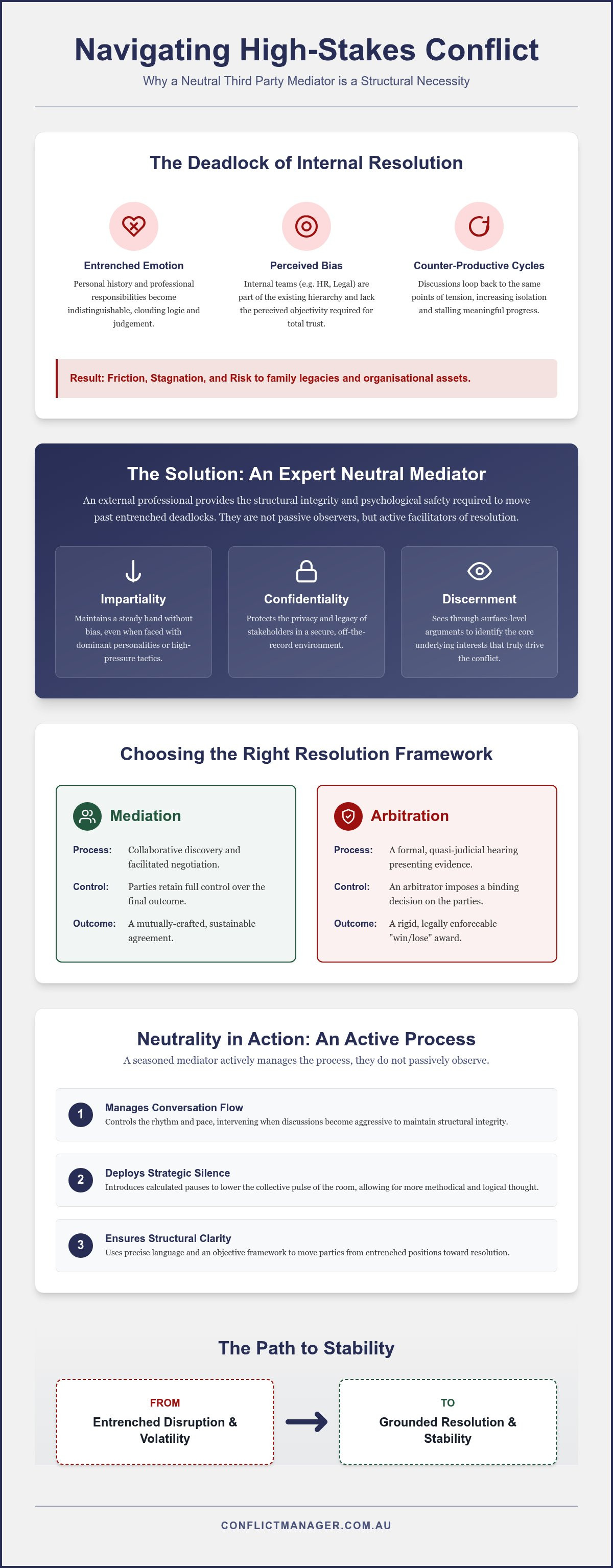
- Impartiality: Maintaining a steady hand without taking sides or showing bias, even when faced with significant pressure from dominant personalities.
- Confidentiality: Protecting the privacy and legacy of high-profile stakeholders through a secure, off-the-record environment that keeps sensitive matters out of the public eye.
- Discernment: The ability to see through surface-level arguments to the underlying interests that truly drive the conflict.
Why "Neutral" Does Not Mean "Passive"
A seasoned mediator doesn't merely watch the clock. They actively manage the rhythm and pace of difficult conversations. They intervene when the tempo of the discussion becomes too aggressive and introduce silence when it's needed most. This isn't passive; it's a deliberate strategy to ensure the structural integrity of the process remains intact even when emotions run high. By using precise language and controlled pauses, they lower the collective pulse of the room, allowing for a more methodical and logical communication flow.
In a high-stakes Australian business context, professional neutrality is the active provision of an objective framework that allows conflicting parties to move from entrenched disruption toward a grounded, commercial resolution.
The Gravity of Emotion: Why Internal Resolution Often Falters
History. Legacy. Tension. When family office dynamics or corporate leadership structures face significant upheaval, the emotional weight is often staggering. Internal resolution attempts frequently falter because the participants are too close to the flame. Even the most seasoned executives find their logic clouded by emotional entanglement; a state where personal history and professional responsibility become indistinguishable. This isn't a reflection of poor leadership. It is a natural consequence of high-stakes friction where the outcomes directly impact one's identity and future.
Structural changes such as mergers, succession planning, or asset redistribution introduce a level of complexity that internal teams are rarely equipped to manage. While HR and legal departments are essential for daily operations, they often lack the perceived objectivity required for total trust in a crisis. They are part of the existing hierarchy. They have established reporting lines and professional histories. For a resolution to hold, stakeholders must believe the facilitator has no hidden agenda or personal stake in the outcome. This is why a neutral third party mediator is required to provide the distance and composure that internal staff simply cannot maintain.
The Psychology of Entrenched Conflict
High-emotion situations trigger defensive stances that inevitably stall progress. In the context of multi-generational wealth transfers, perception gaps often create a divide that logic alone cannot bridge. The older generation may view their actions as necessary stewardship, while the younger generation perceives only rigid control. These conflicting narratives make it nearly impossible to reach a consensus without an external perspective. Identifying the point where internal efforts become counter-productive is essential for effective stakeholder facilitation before the dialogue turns into a permanent deadlock.
The Cost of Unresolved Friction
- Asset erosion: Prolonged disputes threaten the structural integrity of a family office, leading to delayed decisions and missed investment opportunities.
- Reputational risk: Internal conflict carries the constant danger of leaking into the public domain, potentially damaging the brand's standing in the market.
- Relational fractures: Without a neutral third party mediator to guide the transition, interpersonal disagreements can lead to permanent breaks in family or professional bonds.
The financial and emotional toll of stagnation is often higher than the cost of intervention. When the internal pulse of an organisation is erratic, a steady, external hand is the only way to restore order and ensure the preservation of the collective legacy.
Mediation vs. Arbitration: Choosing the Right Resolution Framework
Choice. Control. Consensus. When navigating high-stakes friction, the framework you select determines whether the outcome is a sustainable resolution or a temporary ceasefire. Deciding between mediation and arbitration isn't just a matter of legal preference; it's a strategic decision that impacts the long-term health of your family office or organisation. While both paths offer an alternative to public litigation, they serve fundamentally different objectives. Arbitration prioritises finality through a binding, judge-like decision. Conversely, a neutral third party mediator focuses on discovery and facilitation, ensuring any agreement reached is one that all parties can genuinely support.
For private organisations, the distinction is critical. Arbitration often mirrors the adversarial nature of a courtroom, where a "winner-takes-all" result can leave relational fractures that never quite heal. Mediation operates on the logic of mutual interest. It allows for a nuanced exploration of underlying concerns that a formal arbitrator might overlook. By choosing a facilitative path, you maintain authority over the result rather than outsourcing the fate of your assets to an external decision-maker.
Mediation: Preserving the Legacy
Success in a family business requires more than just a signed document. It requires a restoration of trust. Mediation allows for creative, bespoke outcomes that a rigid legal process simply cannot provide. Whether it involves restructuring a board or redefining a succession plan, the process is designed to be flexible. This focus on Family Office Conflict Resolution ensures that communication channels remain open, providing the stability necessary for future generations to thrive. A neutral third party mediator acts as the architect of this environment, building a space where complex human dynamics can be addressed without the threat of a forced verdict.
Arbitration and Litigation: The Final Resort
There are instances where a collaborative approach may no longer be viable. If stakeholders are fundamentally unwilling to engage in good faith, the finality of arbitration becomes a necessary tool. However, this path carries significant risks for private entities. The formal nature of these proceedings can escalate tension, making it difficult to return to a functional working relationship once the dust has settled. Transitioning from a legalistic stance to a facilitative one is often the more prudent move for those who value asset integrity and reputational security. It's about choosing a process that builds bridges rather than one that merely draws a line in the sand.
Selecting a Mediator: Criteria for High-Stakes Environments
Stability. Expertise. Composure. Selecting a neutral third party mediator for a family office or high-level board isn't merely a matter of checking a CV for technical qualifications. It's an assessment of character and presence. In environments where dominant personalities and significant assets intersect, the facilitator must possess a level of composed authority that commands respect without being overbearing. They need to navigate the intricate dynamics of high-emotion business disputes with total objectivity, ensuring that the structural integrity of the process remains intact even when the dialogue becomes volatile.
A proven methodology is essential. You aren't looking for someone to just "hear everyone out"; you're looking for a professional who can move stakeholders from a state of disruption to a structured resolution. This requires a deep understanding of complex organisational structures and the specific pressures that come with managing substantial private wealth. The right professional acts as a wise, external counsellor who remains unruffled by the weight of the responsibility at hand.
The Interview Process: What to Ask
When evaluating a potential mediator, the questions you ask should go beyond their success rates. Inquire about their specific experience with multi-generational wealth and the nuances of trust and succession. Ask how they manage a stakeholder who refuses to acknowledge the interests of others or how they've handled situations where communication has completely broken down. You need to assess their ability to remain unruffled during volatile exchanges. A seasoned professional will be able to describe how they maintain the rhythm of a session when tensions peak, ensuring that the conversation stays focused on sustainable outcomes rather than historical grievances.
Cultural and Organisational Fit
Shared vocabulary is a prerequisite for trust. The mediator must speak the language of the boardroom, the balance sheet, and the family legacy with equal fluency. This alignment ensures that they understand the context of the friction without needing a lengthy induction. Their style should mirror the values of the family or board, providing a sense of order that feels bespoke rather than clinical. Quiet confidence is an essential trait for a mediator because it projects a sense of unruffled order that allows stakeholders to feel secure even during the most difficult transitions. If your current internal efforts have reached a stalemate, it's time to engage an expert in stakeholder facilitation who understands the unique pressures of your environment.
The Path to Stability: How Conflict Manager Facilitates Resolution
Order. Resolution. Stability. Transitioning from entrenched friction to a state of functional order requires a methodical sequence that internal efforts often lack. At Conflict Manager, we act as a wise, external counsellor, viewing volatile situations with total objectivity to identify the path forward. This isn't about temporary fixes; it's about providing the structural integrity needed to resolve complex organisational and family friction. We guide families and organisations through the most difficult structural changes, ensuring that high-emotion events don't lead to the erosion of your collective assets. Our role is to remain unruffled by the stakes, providing a calming presence that allows for logical, measured communication even when the history is heavy.
Expert-led facilitation is the bridge between disruption and clarity. We understand that in high-stakes environments, the weight of responsibility can feel isolating. By introducing a steady hand, we help stakeholders navigate the friction of interpersonal dynamics without becoming emotionally entangled in them. This methodical approach ensures that every participant feels heard within a framework that prioritises the long-term health of the organisation over short-term concessions.
Our Facilitation Process
The journey toward resolution begins with a comprehensive assessment of the human and structural dynamics at play. We don't just look at the surface-level disagreement; we examine the historical weight and the logic of the current disruption. This initial phase is crucial because it allows us to map the friction points before any formal dialogue begins.
- Initial assessment: We conduct a deep-dive into the existing friction to understand the underlying interests and the specific pressures facing all stakeholders.
- The mediation phase: We establish a grounded space where difficult conversations can occur safely. As a neutral third party mediator, we manage the rhythm of these sessions to prevent further relational damage.
- Outcome implementation: We ensure that the final agreement is clear, sustainable, and capable of withstanding future transitions. This involves translating consensus into a practical framework for the organisation.
Securing the Future of the Organisation
Professional mediation does more than just stop the fighting. It preserves the integrity of your assets and strengthens the internal foundations that have been weakened by prolonged tension. By moving from a state of complexity toward a vision of structured resolution, you protect the legacy of your family office or business for shareholders and future generations. A neutral third party mediator provides the composure required to turn a volatile situation into a grounded agreement that holds firm under pressure.
If your organisation is currently hindered by entrenched friction, the most prudent step is to introduce a steady, external hand. It's time to Consult with a Neutral Third Party Mediator to restore the composure and structural clarity your situation demands. We provide the objectivity needed to move past the deadlock and secure a stable future.
Restoring Order to Complex Legacies
Clarity. Consensus. Continuity. We've explored how emotional history and structural complexity can paralyse even the most resilient organisations. While internal attempts at resolution often loop back to the same points of friction, a methodical approach provides the necessary distance to see a path forward. Choosing mediation over more adversarial frameworks ensures that your family legacy or corporate assets remain protected during difficult transitions. Specialising in family office and organisational conflict, we provide the steady hand required to navigate high-stakes environments.
Engaging a seasoned neutral third party mediator allows you to move from a state of disruption toward a vision of grounded, sustainable outcomes. Our expert facilitation for high-net-worth stakeholders ensures that the final resolution is both clear and functional for future generations. You don't have to navigate these volatile transitions alone. Engage a Composed Expert for Your Dispute Resolution to begin the process of restoring order. There is a way through the friction. With the right facilitation, your organisation can emerge from conflict with its foundations strengthened and its communication restored.
Frequently Asked Questions
What is the primary role of a neutral third party mediator?
The primary role of a neutral third party mediator is to act as a facilitator of movement and structural clarity within a dispute. They don't impose decisions; instead, they provide a grounded framework that allows stakeholders to navigate their own path toward a sustainable resolution. By viewing volatile situations with total objectivity, the mediator ensures that the conversation remains focused on the future rather than becoming bogged down in historical grievances.
How does mediation differ from legal arbitration in Australia?
Mediation in Australia is a voluntary process focused on consensus and relationship preservation, while arbitration is a more formal, adversarial process resulting in a binding decision. While an arbitrator acts like a private judge, a mediator works to restore communication and protect the integrity of the family or business legacy. This distinction is critical for those who wish to maintain control over the final outcome rather than outsourcing it to an external authority.
Can a mediator help if the parties are no longer on speaking terms?
A mediator is specifically equipped to facilitate resolution even when parties are no longer on speaking terms. Through techniques such as "shuttle mediation," the professional can manage the flow of information between separate rooms, ensuring that progress continues without the risk of immediate emotional escalation. This structured distance allows for the methodical exchange of interests and proposals, eventually rebuilding enough safety to consider direct communication in the future.
Is the mediation process confidential for high-profile families?
Confidentiality is a fundamental pillar of the process, particularly for high-profile families whose reputations are significant assets. Unlike public court proceedings, the details of the mediation remain private and protected by strict agreements. This secure environment allows stakeholders to discuss sensitive financial and emotional matters with the confidence that their internal friction won't leak into the public domain or impact their standing in the community.
How long does a typical mediation process take to reach a resolution?
The timeline for resolution varies based on the complexity of the dispute, though the process is generally much faster than litigation. While some matters are resolved in a few intensive sessions, others may take several months. In high-stakes environments, the focus is on a methodical pace that allows for thorough discovery without the artificial urgency that can lead to fragile or unsustainable agreements.
What happens if we cannot reach an agreement during mediation?
If an agreement isn't reached, the parties retain all their legal rights and are free to pursue other forms of resolution, such as arbitration or litigation. However, the process often provides significant value by clarifying the underlying interests and narrowing the points of contention. Even without a final signature, stakeholders frequently leave with a better understanding of the structural dynamics at play, which can prevent further escalation of the friction.
Do we need legal representation present during the mediation sessions?
Legal representation isn't a mandatory requirement for mediation, though many stakeholders choose to have their advisors present or available for consultation. The neutral third party mediator doesn't provide legal advice; therefore, having a solicitor can provide the necessary reassurance regarding the technical details of a proposed agreement. The focus remains on the facilitative dialogue between the parties, with legal counsel acting as a support structure rather than the primary voice.
How do we know if our conflict is "ready" for a neutral third party?
A conflict is typically ready for external intervention when internal attempts to "talk it out" have reached a stalemate. If you find that conversations are looping back to the same grievances or that emotional entanglement is clouding the logic of key decision-makers, a mediator is necessary. The presence of significant risk to family legacy or business assets is a clear indicator that the situation requires the composure and structural integrity of a professional.


