

With an estimated 25% of corporate boards considered dysfunctional according to 2025 Forbes data, the quiet erosion of leadership isn't just a personal grievance. It's a structural risk. Knowing how to handle a difficult board member often feels like a lonely burden for chairs and executives who must balance professional decorum with the urgent need for progress. Friction. Paralysis. Erosion. These are the markers of a boardroom losing its way, and they require a steady, objective hand to correct.
You've likely felt the weight of decision-making paralysis or the sharp sting of high-stakes meetings where emotional stress outweighs strategic intent. It's an exhausting reality that threatens to drive away your best talent and tarnish your organisation's hard-won reputation. We understand that your priority is the stewardship of the collective future. This article provides a composed, professional framework to help you identify the roots of boardroom friction and implement sustainable resolution strategies that protect your legacy. We'll explore how to restore order, clarify governance boundaries, and build communication channels that withstand the pressure of high-level responsibility.
Key Takeaways
- Distinguish between healthy, constructive dissent and destructive behaviour to identify when boardroom friction begins to undermine organisational stability.
- Recognise the specific traits of disruptive archetypes, such as the Dominator or the White-anter, to better address their impact on collective decision-making.
- Master a professional framework for how to handle a difficult board member by using objective diagnosis and discreet, private facilitation techniques.
- Understand why external mediation is often more effective than internal intervention when personal histories and high-stakes emotions are deeply entwined.
- Implement sustainable communication strategies and clearer governance boundaries to safeguard your organisation’s assets and long-term legacy.
Understanding the Dynamics of Boardroom Friction
Boardroom friction is rarely the result of a single personality clash. It's a structural signal. Misalignment. Ambiguity. Power. These elements often converge to create a state where the board's primary purpose is obscured by interpersonal static. Within the broader framework of corporate governance, the board serves as a collective fiduciary body. It's a steward of the organisation's legacy, requiring members to remain unruffled by personal ego or individual agendas. When this collective focus falters, the resulting friction creates a drag on every strategic decision. Understanding how to handle a difficult board member starts with recognising that the behaviour is usually a symptom of a deeper systemic issue rather than just a character flaw.
Constructive Dissent vs. Disruptive Conflict
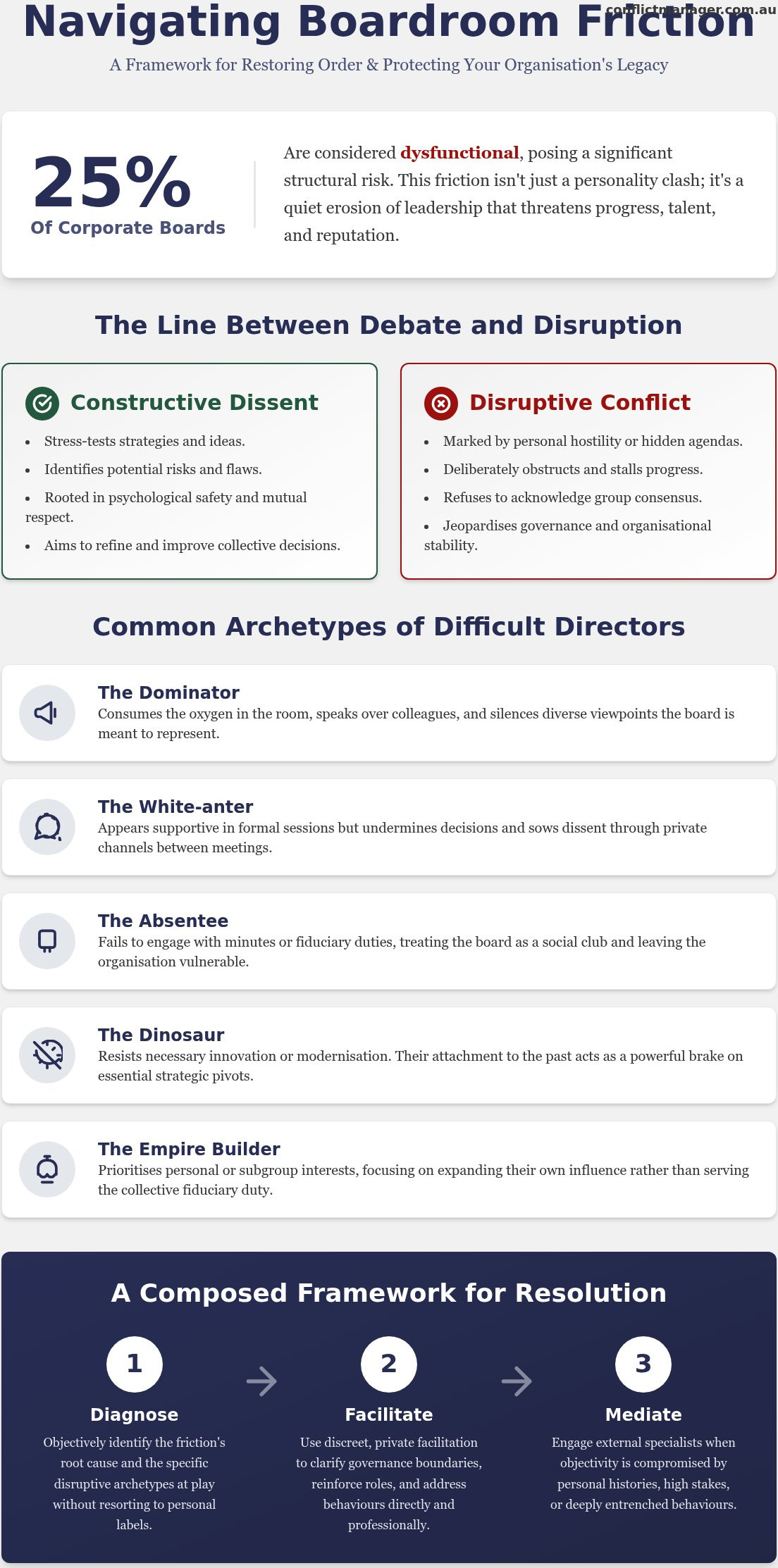
Healthy boards thrive on disagreement. It's the mechanism through which strategies are stress-tested and risks are identified. However, there's a clear boundary where "devil's advocacy" shifts into deliberate obstruction. Constructive dissent is rooted in psychological safety; it allows for rigorous debate while maintaining mutual respect. In contrast, disruptive conflict is marked by personal hostility and a refusal to acknowledge the consensus of the group. When a director's primary contribution is to stall progress rather than refine it, the governance structure is in jeopardy. This shift from professional skepticism to personal hostility is often the first indicator that external facilitation may be required to restore order.
The Impact of Structural Change on Director Behaviour
High-stakes transitions often act as a catalyst for boardroom tension. Mergers, acquisitions, or succession plans can trigger defensive reactions in long-standing members who feel their influence is waning. In Australian family offices, this often manifests as "founder syndrome." This occurs when the transition from a single leader to a multi-generational board creates profound friction. Structural ambiguity, such as unclear reporting lines or overlapping roles, frequently presents as interpersonal conflict. When an individual feels the ground shifting beneath them, their resistance is often a misplaced attempt to restore order. Learning how to handle a difficult board member in these contexts requires an objective assessment of the transition itself. You must ensure the structural roots of the anxiety are addressed alongside the individual behaviour to prevent permanent organisational drift.
Identifying Common Archetypes of Difficult Directors
Diagnosis precedes resolution. Without a clear understanding of the specific disruption at play, any attempt at mediation risks being perceived as a personal attack rather than a professional necessity. Determining how to handle a difficult board member is less about personality management and more about protecting the organisational mission. Disruptive behaviour usually falls into several recognisable categories, each requiring a tailored approach to restore governance.
- The Dominator: This individual consumes the oxygen in the room. They overwhelm the agenda, speak over colleagues, and effectively silence the diverse viewpoints the board is meant to provide.
- The White-anter: Perhaps the most insidious archetype in the Australian boardroom. They appear supportive during formal sessions but spend the intervening weeks undermining decisions through private channels.
- The Absentee or Slacker: These members treat the board as a social club. By failing to engage with minutes or fiduciary responsibilities, they leave the organisation vulnerable to oversight failures.
- The Dinosaur: Often found in long-standing institutions, this director resists necessary innovation or structural modernisation. Their attachment to the past acts as a brake on essential strategic pivots.
- The Empire Builder: This director prioritises personal or subgroup interests. Their focus is on expanding their own influence rather than serving the collective fiduciary duty of the board.
For those overseeing high-stakes transitions, organisational conflict management offers a structured way to address these archetypes before they become permanent fixtures of the boardroom landscape.
The Psychology of the Disruptive Director
Disruption is often a mask for anxiety. When a director feels their status is slipping, or when a family office undergoes a significant succession shift, the need for control intensifies. This is not necessarily a conscious attempt to cause harm. It's a defensive posture. In the Australian corporate context, white-anting refers to the practice of subtly undermining a leader or a decision through private, unofficial channels while maintaining a facade of professional cooperation during formal meetings. Understanding these underlying drivers allows a Chair to address the root cause of the friction rather than just the outward symptom.
Recognising Secondary Symptoms of Board Conflict
Boardroom friction eventually leaks into the wider organisation. High executive turnover is a leading indicator of dysfunction; talented CEOs rarely stay when they feel undermined by those meant to support them. This often leads to decision paralysis, where the board falls into a "peace at any price" trap to avoid further confrontation. When the trust between the Board Chair and the CEO erodes, the structural integrity of the entire organisation is at risk. When internal dynamics reach a point where governance is compromised, boards often look toward formal conflict resolution and removal processes to protect the organisation's integrity.
The Strategic Cost of Unresolved Boardroom Conflict
Conflict in the boardroom is a silent tax on organisational performance. While the immediate stress is felt during meetings, the long-term erosion occurs in the balance sheet and the marketplace. Understanding how to handle a difficult board member is not merely a matter of interpersonal harmony; it's a critical requirement for protecting capital and institutional reputation. When friction is left unaddressed, it creates a vacuum where strategic momentum is lost. Decisions are delayed. Opportunities are missed. The organisation begins to drift while the competition adapts.
- Decision Paralysis: The inability to act on critical strategic pivots or capital investments. When a board is deadlocked, the organisation remains tethered to outdated models because consensus has become impossible.
- Reputational Risk: Boardroom friction is rarely contained within four walls. It eventually leaks to stakeholders, financiers, and the market, signalling instability that can lower valuations and increase the cost of capital.
- Asset Integrity: High-emotion disputes often lead to poor financial oversight. When directors are focused on internal battles, they lose the objective distance required to monitor risk and protect the organisation's core assets.
- Talent Attrition: High-performing leaders rarely stay in dysfunctional environments. A board that cannot govern itself will eventually lose the executive talent it needs to succeed.
Fiduciary Risks and Legal Implications
The legal consequences of unresolved conflict are profound. Under Australian law, directors have a fiduciary duty to act in the best interests of the corporation. Persistent deadlock or disruptive behaviour can lead to a breach of these duties, exposing the board to personal liability. In private or family-owned companies, this friction often crosses the threshold into "oppressive conduct" claims. This occurs when the actions of one director are unfairly prejudicial to others. Protecting the organisation from litigation arising from board-level deadlock requires more than internal policy; it requires a structured approach to resolution that prioritises the collective fiduciary responsibility over individual grievances.
The Erosion of Family and Organisational Legacy
For family offices, the cost of conflict is often measured in generations. Boardroom disputes can lead to intergenerational wealth fragmentation, where primary assets are liquidated simply to resolve a stalemate. The long-term impact on brand value is equally severe. A publicised board dispute can take years to recover from, as trust with partners and the public is difficult to rebuild. Many Chairs hope that time will heal these rifts, yet "waiting it out" is rarely a viable strategy. Without intervention, a single difficult director can dismantle decades of legacy building in a few months of sustained obstruction. Neutral third-party facilitation becomes a strategic asset here, providing the objectivity needed to navigate high-emotion business disputes without entangling the organisation in permanent scandal.
A Composed Framework for Internal Resolution
Resolution. Structure. Clarity. These are the foundations of a functional boardroom. When the initial signs of disruption appear, the primary objective is to contain the friction before it compromises the organisation’s strategic integrity. Determining how to handle a difficult board member requires a methodical approach that prioritises the collective fiduciary duty over individual ego. Internal resolution is not about winning an argument; it's about restoring a state where governance can once again function without the drag of interpersonal static.
- Step 1: Conduct an objective diagnosis. Analyse the behaviour and its specific impact on decision-making. Is the friction a result of personality, or is it a structural signal of a deeper misalignment?
- Step 2: Engage in private facilitation. The Board Chair should initiate a low-stakes, confidential conversation. This provides an opportunity to address concerns directly without the audience of the full board.
- Step 3: Reinforce boardroom charters. Return to the foundational documents. Reaffirming the code of conduct ensures that expectations are anchored in agreed-upon professional standards rather than personal opinion.
- Step 4: Implement structural adjustments. Sometimes the format of the meeting itself is the catalyst. Changing committee assignments or refining the agenda flow can often diffuse tensions by redirecting focus.
- Step 5: Evaluate the necessity of external intervention. Recognise when internal efforts have reached their limit. If the friction remains entrenched, a neutral third party may be required to break the impasse.
The Role of the Board Chair in Facilitation
The Chair serves as the steady hand of the boardroom. To manage a difficult director effectively, the Chair must maintain total neutrality while setting firm boundaries during formal sessions. This requires a level of emotional distance that prevents escalation. Successful Chairs often use "pre-meeting" engagement to align expectations and surface potential objections before they become public disruptions. By addressing concerns in a one-on-one setting, the Chair can guide the individual back toward the collective mission without the pressure of a full quorum. If these internal efforts reach a plateau, professional stakeholder facilitation provides the necessary distance to resolve entrenched disputes without further risking the organisation’s stability.
Leveraging Governance Frameworks
A well-drafted Board Charter is more than a compliance document; it's a tool for conflict resolution. It provides an objective reference point for expected conduct, allowing the Chair to redirect disruptive behaviour back to the agreed-upon standards. Regular, objective board performance reviews also serve this purpose by highlighting dysfunctional patterns in a data-driven, non-confrontational way. A robust Conflict of Interest policy neutralises the Empire Builder by forcing transparency on personal agendas and ensuring that any pursuit of subgroup interests is formally documented and scrutinised against the organisational mission. This structural approach ensures that governance remains unruffled by the shifting winds of individual ambition.
Navigating High-Stakes Impasses with Professional Mediation
Objectivity. Distance. Resolution. These are the qualities that internal efforts often lack when boardroom friction becomes entrenched. While a Chair may follow every governance protocol, personal histories and deep-seated emotional dynamics can create a ceiling for internal resolution. Nearly 30% of directors have experienced a boardroom dispute that directly threatened the survival of their organisation. At this level of risk, the logic of the neutral third party becomes undeniable. Professional mediation provides a structured path forward that internal stakeholders, however well-intentioned, cannot build on their own because they are part of the very architecture they are trying to repair.
External facilitation is not a sign of governance failure. It is a proactive investment in organisational stability. By engaging a specialist, the board signals its commitment to asset integrity and the preservation of the corporate legacy. A mediator brings total objectivity, viewing volatile situations without the burden of past alliances or grievances. This process preserves the dignity of all stakeholders, allowing for a composed exit or a recalibrated working relationship without the need for public scandal or legal escalation. Learning how to handle a difficult board member through professional channels ensures that the focus remains on the mission rather than the conflict.
When the Chair is Part of the Conflict
Internal leadership often struggles to remain objective when the friction involves the Board Chair themselves. In these instances, the power dynamic is skewed, and the CEO or other directors may feel unable to address disruptive behaviour without risking their own positions. A neutral facilitator bridges the gap between a CEO and a difficult Chair, providing a safe environment for high-stakes conversations. Engaging an external expert is best positioned as a standard governance audit or a strategic review. This framing avoids defensive reactions and allows the expert to implement structural changes that might otherwise be perceived as personal attacks.
Sustainable Outcomes for Family Offices and Businesses
Family offices face a unique challenge where personal history and substantial business assets overlap. In these environments, board conflict can lead to intergenerational wealth fragmentation if not handled with extreme care. Professional resolution services focus on long-term stability rather than short-term tactical wins. This approach is particularly vital during periods of structural change, such as succession or jurisdictional audits. By prioritising sustainable communication channels, boards can navigate the friction of transition while keeping the family legacy intact. To move beyond the cycle of disruption, Achieve clarity and stability with our Organisational Conflict Management services.
Restoring the Integrity of Your Boardroom
Disruption. Paralysis. Resolution. These are the stages of a boardroom finding its way back to purpose. The path from friction to order requires more than just patience. It demands a clear-eyed assessment of how to handle a difficult board member within the broader context of your organisation's structural health. We have explored the necessity of identifying disruptive archetypes and the heavy strategic price of allowing conflict to remain unresolved. Whether you're managing the complexities of a family office or navigating a corporate transition, the goal remains the same: protecting the assets and the legacy you've built.
Conflict Manager specialises in high-emotion family office mediation and provides a composed, neutral approach to complex organisational disputes. We focus on sustainable outcomes for Australian families and businesses, ensuring that your governance remains resilient in the face of interpersonal friction. By moving from internal struggle toward objective facilitation, you protect the structural integrity of your leadership team.
Restore boardroom clarity with expert-led conflict resolution.
Order can be restored. With the right facilitation, you can move beyond the static of conflict and return to the vital work of meaningful, collective leadership.
Frequently Asked Questions
How do you handle a board member who dominates every meeting?
The Board Chair must intervene using structured meeting protocols. Use a formal speaking order or strict time limits for each agenda item to ensure all directors have the opportunity to contribute. Direct, private feedback from the Chair after the meeting is also essential. This conversation should focus on the impact of their behaviour on collective decision-making and the need for diverse perspectives in the boardroom.
What is the most effective way to address "white-anting" in the boardroom?
Address white-anting by bringing private dissent into the formal boardroom setting. When the Chair becomes aware of offline undermining, they should invite that director to voice their concerns officially during the next session. This forces transparency. It ensures that all strategic disagreements are recorded in the minutes rather than whispered in corridors, which maintains the integrity of the board's collective decisions.
Can a difficult board member be removed under Australian law?
Director removal depends on the company's constitution and the Australian Corporations Act 2001. For public companies, shareholders can remove a director by resolution under Section 203D. For private companies, the process is usually governed by the specific terms of the shareholders' agreement or the constitution. Boards must follow these procedural requirements strictly to ensure any removal is legally compliant and protects the organisation from claims of oppressive conduct.
What should a CEO do when a board member becomes adversarial?
A CEO should document every instance of adversarial behaviour and seek immediate support from the Board Chair. It's vital to remain objective and focus on how the behaviour impacts operational performance or executive retention. Understanding how to handle a difficult board member as a CEO involves maintaining professional distance. Relying on the Chair to act as the primary facilitator for director-level conduct prevents the CEO from becoming personally entangled in board politics.
How does professional mediation differ from legal representation in board disputes?
Professional mediation focuses on finding a sustainable, collaborative resolution, whereas legal representation is adversarial and focused on rights and obligations. Mediation aims to preserve the organisational culture and relationships through a neutral third party. Lawyers focus on compliance and potential litigation. Mediation is often a more discreet and cost-effective way to restore boardroom order without the scorched-earth impact of a legal battle.
When is the right time to engage an external conflict manager?
Engage an external facilitator when internal efforts reach a stalemate or when the Chair is perceived as biased. If boardroom friction begins to affect executive mental health or stall critical strategic investments, it's time for a neutral third party. Early intervention is always more effective than waiting for a public crisis. Bringing in an expert early helps to de-escalate tensions before they result in permanent reputational damage.
How can we prevent board conflict during a leadership succession?
Use clear, documented transition plans and engage all stakeholders early in the process. Succession often triggers deep-seated anxieties about status and influence within an organisation. By defining the roles of outgoing and incoming leaders through a structured facilitation process, you can neutralise the defensive behaviours that lead to friction. Transparency is the best defence against the power vacuums and uncertainty that succession often creates.
What role does the Board Charter play in managing difficult behaviour?
The Board Charter acts as the definitive code of conduct for all directors. It sets the standard for professional behaviour, fiduciary duties, and the formal process for resolving disagreements. When a director's conduct falls short, the Chair can use the Charter as an objective reference point to guide them back to their responsibilities. This provides a non-personal, structural basis for addressing disruptive behaviour without it feeling like a personal attack.


