

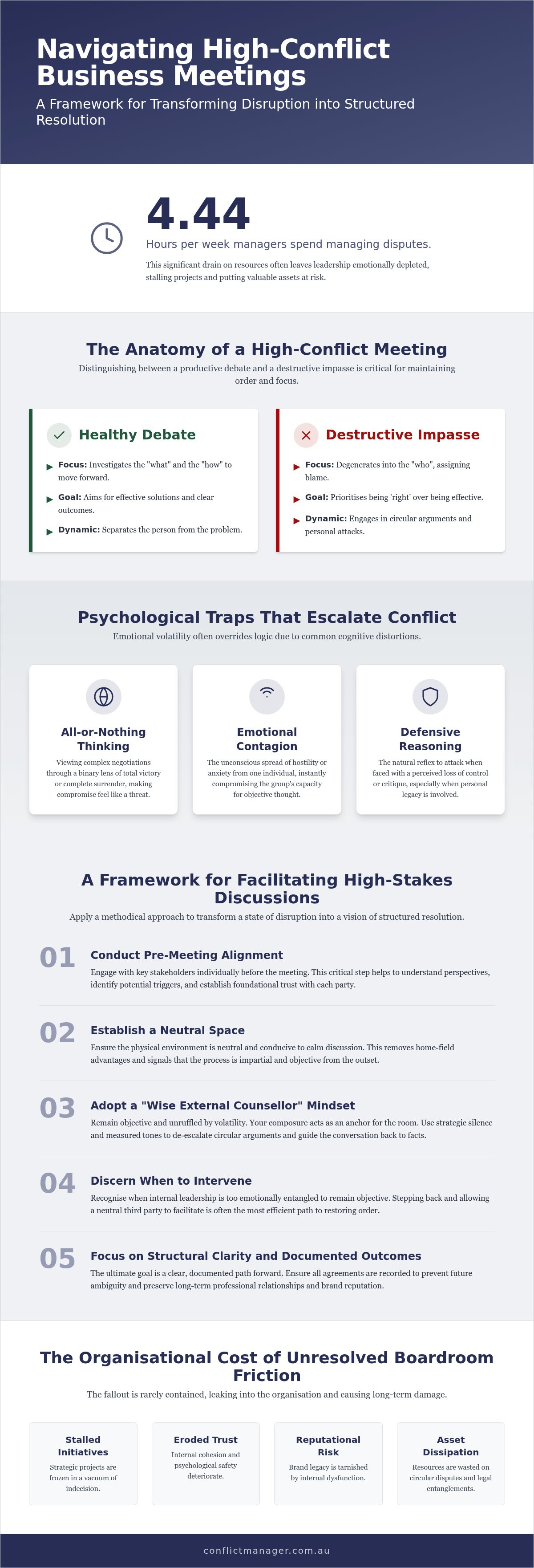
Friction. Stagnation. Risk. When a boardroom transforms into a theatre of circular arguments, the cost isn't just measured in wasted hours but in the slow erosion of organisational integrity. Recent data suggests that managers spend an average of 4.44 hours every week managing disputes, a significant drain that often leaves leadership feeling emotionally depleted. You've likely seen how easily a single volatile session can stall a project or put sizeable assets at risk when stakeholders reach an impasse. It's a heavy burden to carry when you're trying to maintain a steady course amidst internal turbulence.
This guide provides a framework for facilitating high-conflict business meetings with the objective poise of a seasoned professional. You'll discover how to navigate these heated dynamics to restore structural stability and secure clear, documented outcomes that actually move the needle. We'll look at expert facilitation strategies that neutralise hostility, protect your brand's legacy, and ensure that difficult conversations lead to a sustainable path forward rather than further division. By applying a methodical approach to these high-stakes environments, you can transform a state of disruption into a vision of structured resolution.
Key Takeaways
- Identify the psychological triggers, such as emotional contagion and binary thinking, that erode board-level decision-making and stall organisational momentum.
- Learn the essential steps for facilitating high-conflict business meetings, including the critical role of pre-meeting alignment and the physical requirements of a neutral space.
- Develop a "wise external counsellor" mindset to remain unruffled by volatility while using silence and measured tones to de-escalate circular arguments.
- Discern when internal leadership is too close to the friction to remain objective and why external intervention is often the most efficient way to restore order.
- Focus on achieving structural clarity and documented outcomes that preserve your brand's reputation and long-term professional relationships.
The Anatomy of High-Conflict Business Meetings
Friction. Impasse. Fragility. A high-conflict meeting isn't just a robust exchange of ideas; it's an environment where emotional volatility overrides logic. When facilitating high-conflict business meetings, one must understand that the stakes transcend the immediate agenda. For high-net-worth family offices or private boards, these sessions often involve the weight of legacy and the preservation of substantial assets. Traditional meeting management, which relies on rigid agendas and timekeeping, often buckles when participants feel their identity or future security is under threat. This erosion of structural integrity happens when the board can no longer separate the person from the problem, leading to a paralysis that affects every level of the organisation.
Recognising the Signs of High-Emotion Impasse
Distinguishing between a healthy debate and a destructive impasse is critical for maintaining order. Healthy debate focuses on the "what" and the "how". Destructive conflict pivots to the "who". You'll notice circular arguments where the same grievances are aired without progression, often recycling points that were supposedly settled in previous sessions. The conversation shifts from solving a commercial problem to a "blame-game" cycle that prioritises being right over being effective. Physical cues often precede verbal outbursts. Watch for rigid posture, avoidant eye contact, or the sudden, sharp closing of a laptop. These are the markers of a room that has lost its composure, requiring a steady hand to guide it back to objectivity.
The Cost of Mismanaged Boardroom Friction
The fallout of unresolved friction is rarely contained within the boardroom walls. It leaks into the organisation, stalling strategic initiatives and creating a vacuum where decisive action should be. For family offices, the risk is even more acute. A failure in the process of conflict resolution can lead to the permanent fracturing of relationships that took generations to build. Beyond the human cost, there's the risk to brand reputation and the potential for asset dissipation. When internal leaders are too emotionally entangled to facilitate, the result is often a long-term erosion of trust. This makes facilitating high-conflict business meetings a task that requires total objectivity, something internal stakeholders often struggle to provide when they have skin in the game. Without a neutral third party, these disputes can spiral into legal entanglements that further deplete resources and focus.
Psychological Dynamics: Why Business Meetings Escalate
Rigidity. Fear. Contagion. When facilitating high-conflict business meetings, one quickly observes that technical expertise often retreats in the face of psychological pressure. The most common trap is all-or-nothing thinking. This is a cognitive distortion where stakeholders view complex negotiations through a binary lens of total victory or complete surrender. When outcomes are framed this way, the middle ground doesn't just feel undesirable; it feels like a direct threat to one's professional or personal identity. Unmanaged emotions like betrayal and ego become the primary drivers of the discussion, pushing logical discourse to the periphery and stalling the momentum of the entire organisation.
In a boardroom setting, emotional contagion is the rapid, unconscious spread of affect where one individual's hostility or anxiety ripples through the group like a physical shockwave, instantly compromising the collective's capacity for objective thought. This phenomenon explains why a single volatile stakeholder can derail a multi-million dollar negotiation in minutes. The atmosphere becomes heavy with unspoken tension, making it nearly impossible for others to remain unruffled without a steady, external hand to ground the conversation.
The Trap of Defensive Reasoning
High-level stakeholders often possess immense intellectual capacity, yet they may lack self-awareness during periods of intense stress. When faced with a perceived loss of control or a critique of their performance, the natural reflex is to attack. This defensive reasoning is particularly visible in family office environments where legacy and inheritance dynamics complicate standard business logic. A vote against a specific strategy isn't just a commercial disagreement; it's often interpreted as a critique of a family member's competence or a betrayal of a shared history. Without a neutral party to navigate these undercurrents, the meeting quickly descends into a battle for survival rather than a search for a solution.
Navigating the Blame Preoccupation
As tension rises, the focus of the meeting inevitably shifts. The group moves away from the constructive question of how to fix a problem and toward the destructive preoccupation with whose fault it is. Historical grievances act as anchors, dragging current-day structural changes back into the mire of past conflicts. This blame-game cycle is a symptom of a room that has lost its focus on the future. When the psychological weight of a dispute becomes too heavy for internal resolution, seeking organisational conflict management can provide the necessary distance to reset the room and restore a sense of order. It's about moving from a state of complexity toward a vision of structured resolution.
A Framework for Facilitating High-Stakes Discussions
Structure. Order. Precision. When facilitating high-conflict business meetings, the architecture of the session is as vital as the discussion itself. A robust framework acts as a container for volatility, ensuring that emotional energy is channelled into structural resolution rather than personal destruction. This begins with pre-meeting alignment. It's a process of assessing stakeholder perspectives individually before the room is even booked. By conducting these preliminary discussions, a facilitator can map the terrain of the dispute, identifying the psychological triggers and legacy issues that might otherwise cause a sudden impasse. This preparatory work ensures that when the parties finally meet, the facilitator isn't walking into an ambush but a managed environment.
Establishing a "Neutral Space" is the next requirement. This isn't merely about finding a venue at a neutral office centre; it's about creating a psychological environment where every participant feels the process is objective and safe. In this space, the facilitator acts as a steady hand, ensuring that no single party dominates the narrative through volume or status. It's about moving the group from a state of complexity toward a vision of structured resolution, where the physical and psychological settings support logical discourse over emotional outbursts.
Setting the Objective Agenda
A successful session relies on an "Objective Agenda" that prioritises future-state outcomes over past-tense grievances. When soliciting topics, use neutral language that avoids personal provocation. Instead of listing "The failure of the Q3 project", frame the item as "Strategic adjustments for Q4 performance". This subtle shift in vocabulary reduces the reflex for defensive reasoning. Finalising the schedule requires careful time-boxing. By allocating specific, non-negotiable blocks for high-stakes items, you prevent the group from falling into the circular arguments that often consume hours of productive time. If a topic cannot be resolved within its window, it's documented and moved to a separate track; this preserves the momentum of the broader meeting.
Ground Rules and Impulse Control
Radical professional respect is the non-negotiable standard for high-stakes facilitation. Ground rules must be explicit: no interruptions, no personal disparagement, and a commitment to issue-based critique. When these boundaries are breached, the facilitator's role is to provide a firm, calm redirection. This is particularly challenging when stakeholders hold significant power, such as a founder or a major shareholder. In these moments, the facilitator's authority comes from their total objectivity. You aren't there to judge the validity of their anger, but to enforce the structure that protects the organisation's assets and relationships. By remaining unruffled, you provide a model of composure that the rest of the room can eventually mirror.
Maintaining Composure: Strategies for the Facilitator
Stability. Objectivity. Discernment. When facilitating high-conflict business meetings, the facilitator's internal composure is the anchor for the entire group. If you become rattled, the room loses its only neutral point of reference. Adopting the "Wise External Counsellor" mindset means maintaining total objectivity even when the dialogue becomes heated. You aren't there to judge the participants; you're there to observe the dynamics and navigate the friction. Active listening becomes your most potent tool. By validating a stakeholder's emotion without necessarily agreeing with their premise, you signal that they've been heard. This reduces the need for them to increase their volume or aggression to gain attention.
The Power of the Measured Response
Techniques for lowering the collective heart rate involve deliberate pacing. Silence isn't an absence of activity; it's a strategic pause that forces a reset. When a stakeholder makes a highly emotional claim, reframe it using objective, abstract nouns. Instead of engaging with "He's trying to ruin my legacy", pivot to "We're discussing the long-term sustainability and structural integrity of the family office." As a neutral third party, the facilitator's role is to act as a steady hand that brings clarity to clouded situations by stripping away the emotive layer to reveal the underlying commercial or organisational issue. This measured tone suggests a deep understanding of the problem without becoming emotionally entangled in it.
Managing Extreme Behaviours with Empathy
Holding the line on behaviour requires a delicate balance of empathy and authority. You can validate that a stakeholder is frustrated while firmly stating that personal disparagement is a breach of the agreed ground rules. If the tension becomes unmanageable, don't hesitate to call for a short adjournment or a cooling-off period. This allows the physiological response to subside and prevents the meeting from spiralling into a permanent impasse. Avoid the "insight trap" at all costs. You aren't there to fix a stakeholder's personality or provide clinical psychotherapy. Your focus must remain on the movement toward a documented outcome. If the internal friction has reached a point where composure feels impossible to maintain, engaging professional stakeholder facilitation ensures the process remains objective and results-oriented. It's about preserving the professional relationship while achieving the structural clarity required to move forward.
The Logic of External Intervention: When to Step Back
Perspective. Distance. Clarity. When internal efforts to manage boardroom friction reach a stalemate, the issue is rarely a lack of skill; it's a lack of distance. Facilitating high-conflict business meetings requires a level of neutrality that is virtually impossible for someone embedded in the organisation's daily operations or family lineage. Every internal stakeholder carries a history of past interactions, perceived slights, and vested interests that colour their interventions. This is the "prophet in their own land" problem, where the most insightful advice is discounted because of the source's proximity to the friction.
An external facilitator brings a steady, objective perspective that is unencumbered by internal politics. They remain unruffled by high-stakes environments because their professional standing is tied to the integrity of the process, not the specific commercial outcome. This distance allows them to see the structural integrity of the dispute without becoming emotionally entangled in the human friction. They provide the necessary order during periods of high stress, moving the group toward sustainable outcomes that internal efforts struggle to reach under pressure. By acting as a neutral third party, they bring clarity to clouded situations and lower the collective pulse of the room.
Evaluating the Need for Professional Mediation
Recognising when internal resolution efforts have reached their natural limit is a mark of discerning leadership. Signs of this threshold include the repetition of circular arguments despite multiple attempts at resolution, or a perceptible risk to sizeable assets and brand reputation. Conflict Manager acts as a steady hand in these volatile moments. By specialising in high-net-worth family office mediation and complex organisational disputes, they provide the neutral ground required to protect the long-term integrity of both business and family structures. This external intervention ensures that legacy and professional relationships are preserved even when the current dynamics feel beyond repair.
Transitioning from Complexity to Resolution
The movement from a state of disruption to a vision of structured resolution is methodical and logical. It begins by acknowledging the difficult reality of the impasse and transitions into an analytical reset of the boardroom dynamics. Clear, documented outcomes from these sessions are essential. They ensure that the path forward is not just understood but codified, providing stability and accountability post-meeting. If your boardroom has become a theatre of circular grievances, it's likely time to introduce a wise, external counsellor to restore order. Discover how Conflict Manager can facilitate your next high-stakes meeting and help preserve the professional relationships that underpin your organisation's success.
Restoring Structural Integrity to the Boardroom
Navigating the friction of high-stakes disputes requires more than just a firm hand. It demands a sophisticated understanding of the psychological undercurrents that drive emotional contagion and binary thinking. By implementing a framework of radical professional respect and an objective agenda, you can protect your organisation's assets and legacy from the erosion of trust. Facilitating high-conflict business meetings is a task that often exceeds the capacity of internal leaders who are already emotionally invested in the outcome.
When the pulse of the room remains high and strategic initiatives stall, seeking a neutral third party provides the distance needed for genuine resolution. Conflict Manager offers specialised expertise in high-net-worth family office disputes and complex organisational conflict across Australia. Our approach ensures that even the most volatile dynamics are met with a steady, objective hand; this allows for documented outcomes that preserve professional relationships. Restore stability to your organisation with expert facilitation and move from a state of complexity toward a vision of structured, lasting resolution. You don't have to navigate these transitions alone.
Frequently Asked Questions
What is the difference between a standard meeting and a facilitated high-conflict session?
Standard meetings prioritise efficiency and tasks, whereas high-conflict sessions focus on emotional regulation and the restoration of structural order. In these volatile environments, a facilitator doesn't just manage time; they manage the room's collective heart rate. These sessions require a neutral third party who can navigate the friction of interpersonal dynamics without becoming entangled in the commercial outcomes. It's about moving from a state of complexity toward a vision of structured resolution.
Can an internal manager effectively facilitate a high-conflict business meeting?
Internal managers often struggle because they lack the necessary distance to remain objective. This is the "prophet in their own land" problem, where their interventions are viewed through the lens of past grievances or political alliances. When facilitating high-conflict business meetings, the authority of the facilitator comes from their total neutrality. An internal leader with skin in the game cannot provide the steady hand required to ground a volatile boardroom.
How do you handle a stakeholder who refuses to follow meeting ground rules?
Firm, calm redirection is the primary tool for managing stakeholders who breach ground rules. You must validate the stakeholder's frustration while holding the line on their behaviour, ensuring that personal disparagement doesn't derail the session. If the breach persists, a brief adjournment or cooling-off period is essential. This allows the physiological response to subside and prevents a single individual from compromising the structural integrity of the entire discussion.
What happens if a high-conflict meeting reaches a total impasse?
Reaching a total impasse requires a methodical shift in strategy rather than a forced conclusion. The facilitator documents the specific points of disagreement to ensure clarity and then moves those items to a separate, intensive track. This prevents the impasse from stalling the entire agenda. By acknowledging the disruption and allowing for a cooling-off period, you preserve the professional relationships while searching for a sustainable path forward that avoids further division.
How long does a professional conflict resolution process typically take?
The duration of the process depends on the complexity of the dispute and the number of stakeholders involved. Typically, it begins with individual pre-meeting alignment sessions to map the terrain of the conflict. This is followed by one to three intensive facilitated sessions designed to achieve structural clarity. While some sessions reach a resolution in a single day, multi-session engagements are common for enterprise-level clients or complex family office disputes.
Is external facilitation suitable for private family office disputes?
External facilitation is particularly effective for private family offices because it protects both the legacy and the assets from emotional volatility. In these environments, business logic is often complicated by inheritance dynamics and historical grievances. A seasoned professional provides an objective perspective that internal family members cannot replicate. This neutral intervention helps maintain the structural integrity of the office while ensuring that difficult transitions don't lead to permanent fracturing.
What are the risks of ignoring persistent boardroom conflict?
Ignoring persistent boardroom conflict leads to a slow erosion of trust and a loss of organisational momentum. Over time, unresolved friction stalls strategic initiatives and puts sizeable assets or brand reputation at risk. There's also a significant human cost, as managers spend an average of 4.44 hours each week addressing disputes. Without intervention, these circular arguments become a permanent drain on resources and can eventually lead to the departure of key talent.
How do you ensure that meeting outcomes are sustainable and legally sound?
Sustainability is achieved through clear, documented outcomes that codify the path forward. By ensuring that every stakeholder's perspective is validated during the session, the resulting agreement carries more weight and longevity. While facilitators ensure the process is objective and methodical, stakeholders should always have their final agreements reviewed by their own legal counsel. This ensures the resolution is both structurally sound and compliant with any existing commercial or family governance requirements.


