

Disruption. Friction. Realignment. The dissolution of a business partnership is rarely just a legal transaction. It's a structural shift that, if handled poorly, can dismantle years of equity and professional standing in a matter of months. You've likely spent years building this enterprise; the prospect of watching it fragment under the weight of interpersonal friction is understandably daunting. Choosing mediation for business partnership dissolution offers a way to bypass the public theatre of the courtroom while maintaining the integrity of your assets. It's a method designed to lower the pulse of the situation and restore order.
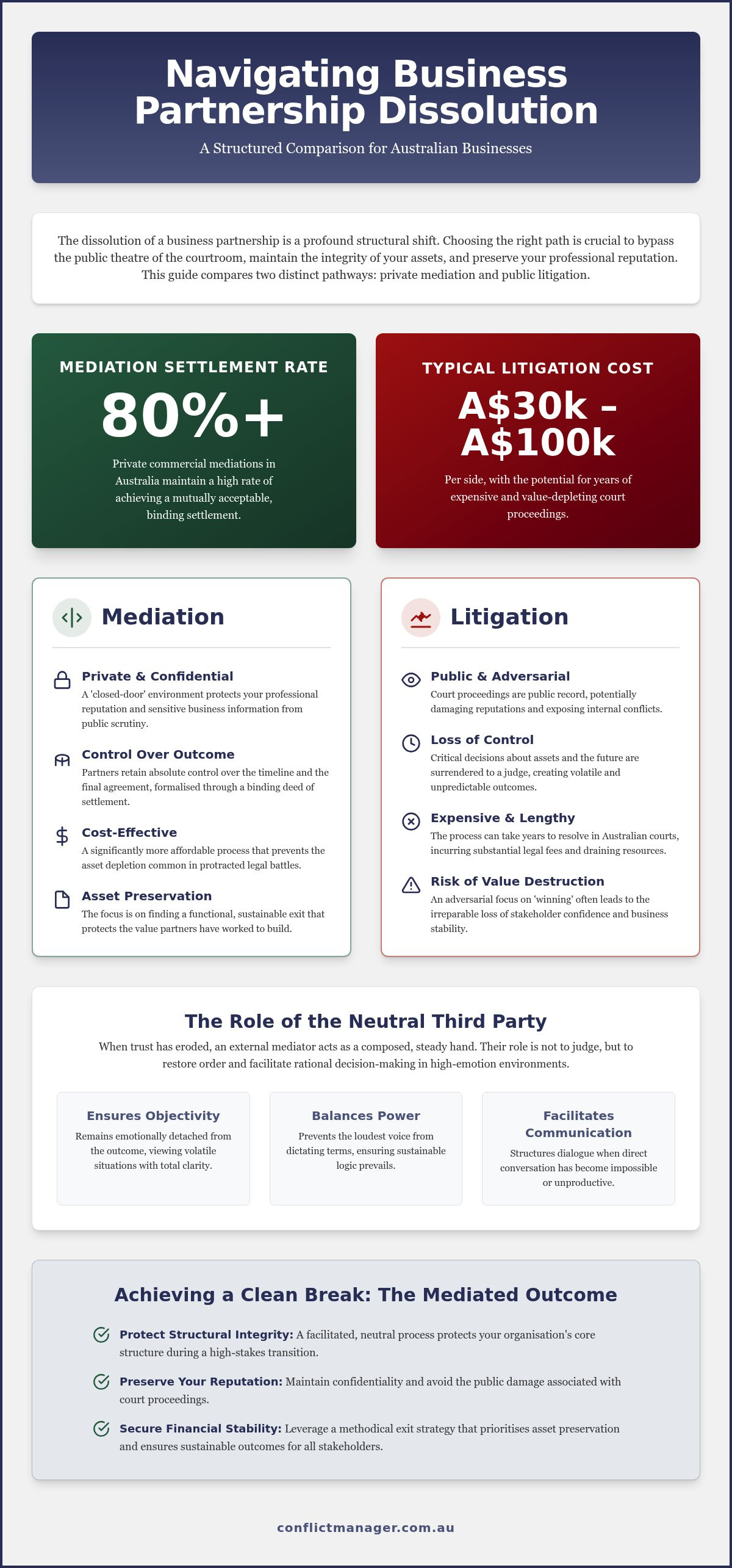
Research indicates that while traditional litigation in Australia often costs between A$30,000 and A$100,000 per side, private commercial mediation maintains a settlement rate of 80% or higher. This article demonstrates how expert facilitation provides a structured, objective, and sustainable exit strategy for complex partnerships. You'll discover how to secure a clean break, often formalised through binding deeds of settlement, that preserves your professional reputation and ensures sustainable financial outcomes for all stakeholders. We'll examine the logic of external intervention and the specific path toward a composed resolution.
Key Takeaways
- Understand how a facilitated, neutral process protects the structural integrity of your organisation during a high-stakes transition.
- Discover why mediation for business partnership dissolution is a cost-effective, private alternative to the public and expensive nature of Australian court proceedings.
- Learn to leverage your existing Partnership Agreement as a foundation for a methodical and objective exit strategy.
- Identify the specific steps required to gather financial data and set an agenda that prioritises asset preservation and leadership stability.
- Explore how professional stakeholder facilitation brings clarity to high-emotion environments and ensures a sustainable outcome for all involved parties.
Understanding Mediation for Business Partnership Dissolution
Structure. Realignment. Equilibrium. The dissolution of a commercial partnership represents a profound shift in both human and financial architecture. It's a moment where the internal logic of a business often struggles to sustain itself under the weight of divergent interests. Choosing mediation for business partnership dissolution provides a pathway toward a structured exit, guided by a neutral professional who remains unruffled by the friction of the room. By Understanding Mediation as a formalised discipline, stakeholders can appreciate how it functions as a buffer against the erratic nature of the Australian court system.
The core objective of this process is the attainment of a mutually acceptable agreement that bypasses the volatility of litigation. For Australian businesses, this isn't merely about compromise; it's about maintaining absolute control over the timeline and the final outcome. Partnership mediation serves as a deliberate strategic tool for the preservation of organisational assets and the maintenance of operational continuity during periods of high-stakes transition.
The Role of the Neutral Third Party
Objectivity is a rare commodity when trust has eroded. An external mediator acts as a steady hand, viewing volatile situations with total clarity while remaining emotionally detached from the outcome. Their presence is vital for facilitating communication when direct dialogue has become impossible. They don't just host a conversation; they balance the power dynamics that often skew during sensitive negotiations. This ensures that the loudest voice doesn't dictate the terms, but rather the most sustainable logic prevails. It's a methodical approach to human friction that prioritises the integrity of the business structure over personal grievances.
When to Consider Mediation Over Litigation
Identifying the tipping point where internal resolution is no longer viable is a critical leadership skill. If discussions regarding asset division or leadership transition have stalled, early intervention is essential to prevent asset depletion. Litigation is a public, expensive, and often destructive process that can take years to resolve in Australian courts. In contrast, mediation is a confidential, "closed-door" environment that protects your professional reputation. Many Australian commercial contracts now include mandatory mediation clauses, recognising that a facilitated settlement is often the only way to ensure a clean break without destroying the very value the partners worked to build. Waiting too long to engage a mediator often results in the irreparable loss of stakeholder confidence and business stability.
The Structural Mechanics of Partnership Mediation
Structure. Asset. Legacy. The dissolution of a business partnership is a profound structural overhaul that ripples through every level of an organisational chart. Staff, suppliers, and stakeholders all feel the tremors of a partnership in flux. Mediation for business partnership dissolution serves as the stabilising force in these moments. It moves beyond the binary of right and wrong to find a functional path forward. By addressing the human and structural dynamics simultaneously, we prevent a temporary transition from becoming a permanent failure.
The original Partnership Agreement provides the initial logic for any exit. It's the blueprint. Yet, even the most robust agreements rarely account for the human evolution of a decades-long partnership. When trust erodes, the technical language of a contract is often insufficient to guide the partners through the nuances of a split. This is where Resolving Business Partnership Disputes through expert facilitation bridges the gap between legal theory and operational reality.
Complex asset structures add layers of difficulty to the negotiation. Family trusts and family office holdings introduce fiduciary duties that extend well beyond the partners themselves. A disagreement over a simple valuation often masks deeper psychological friction regarding legacy or control. A mediator must navigate these technicalities while addressing the emotional undercurrents that threaten to derail the process. It's a methodical exercise in untangling the personal from the professional.
Managing High-Emotion Situations
High-emotion environments are inherently volatile. They require a composed hand to de-escalate interactions and restore a sense of order. We focus on the "Steady Hand" approach. This means maintaining a neutral environment where rational decision-making is possible. We shift the focus away from litigating past grievances. Instead, we start designing future stability. It's about moving the stakeholders from a state of reactive conflict to one of proactive planning.
Preserving Asset Integrity
A business must remain operational during its dissolution. If the machinery stops, the value dies. We work to minimise the "friction cost" of the dispute. This is the financial drain caused by indecision and internal strife. Protecting the integrity of sizable assets, particularly within high-net-worth family structures, requires a methodical approach to transition. For organisations facing such structural shifts, engaging in professional stakeholder facilitation ensures the business remains a viable entity throughout the change.
Mediation vs Litigation: Protecting Assets and Reputation
Privacy. Discretion. Control. When a commercial alliance reaches its conclusion, the path chosen dictates whether the transition is a measured realignment or a public fracture. In the Australian legal landscape, the distinction between a mediated settlement and a court-mandated ruling is stark. Choosing mediation for business partnership dissolution ensures that sensitive financial data and internal friction remain behind closed doors, whereas litigation enters the public record. For high-net-worth families and established organisations, this confidentiality isn't merely a preference; it's a structural necessity for the preservation of legacy.
The financial disparity between these two paths is equally significant. Industry data indicates that while a partnership dispute taken to trial in Australia typically costs between A$30,000 and A$100,000 or more per side in legal fees, most mediated resolutions are achieved for a total cost between A$2,000 and A$10,000. This efficiency allows capital to remain within the business rather than being diverted to protracted legal battles. Beyond the balance sheet, mediation grants partners the power of self-determination. You retain the ability to craft a resolution that reflects the nuances of your industry, rather than surrendering the outcome to a judge who may lack specific sector expertise.
The Hidden Costs of Public Disputes
Public conflict carries a heavy price that extends beyond the immediate legal bill. Reputational damage is often irreversible. A public court battle can signal instability to investors, clients, and staff, potentially devaluing the business before it can even be divided. There's also a profound emotional toll on family members and associated stakeholders who are caught in the crossfire of a hostile dissolution. The opportunity cost is perhaps the most insidious factor. Every hour spent on discovery and depositions is an hour diverted from growth and future ventures. Mediation allows for a clean break or a professional co-existence that maintains the integrity of your professional standing.
Mediation as a Strategic Choice
Flexibility is the hallmark of a facilitated exit. Unlike a court, which is often limited to blunt financial awards, mediation for business partnership dissolution allows for bespoke solutions. This might include phased buy-outs, intellectual property licensing, or structured leadership transitions that a judge simply cannot provide. The speed of resolution is another critical factor. While the Australian court system can see cases drag on for years, mediation often concludes within days. This rapid pace restores order quickly, allowing all parties to move toward their next objective with their assets and dignity intact.
Establishing the Framework for a Sustainable Exit
Logic. Precision. Alignment. A sustainable exit is a deliberate construction. It requires a transition from reactive conflict to a structured, methodical negotiation. When embarking on mediation for business partnership dissolution, the first step involves a rigorous audit of the current organisational state. This involves gathering comprehensive financial data, including independent valuations of assets held in Australian proprietary limited companies or family trusts. Defining core objectives early prevents the process from drifting into unproductive territory. Without this foundation, the mediation risks becoming a series of circular arguments rather than a clear progression toward a final settlement.
Setting the agenda is a strategic exercise in prioritisation. We address the most critical structural elements first: asset division, leadership transition, and the allocation of future liabilities. During the negotiation phase, the mediator’s role is to guide partners away from entrenched positions toward their actual underlying interests. A "position" is a fixed demand, whereas an "interest" is the underlying need for security, continuity, or reputational safety. By identifying these shared or compatible interests, we can craft solutions that a traditional legal framework might overlook. This methodical approach ensures that the business remains a viable entity throughout the transition period.
Pre-Mediation Facilitation
Before the joint sessions begin, we conduct individual stakeholder interviews. These private discussions allow us to identify the underlying friction that may not be apparent in a formal boardroom setting. We establish clear ground rules for engagement, ensuring the environment remains objective and professional at all times. This preparation ensures that everyone enters the mediation room ready for a rigorous process rather than a confrontation. It is a necessary step to lower the emotional temperature and prepare all parties for a focused, outcome-oriented discussion.
Drafting the Sustainable Outcome
The final resolution document must serve as a definitive roadmap for the future. It focuses on the dual pillars of clarity and stability. We meticulously address post-dissolution communication protocols and the specifics of non-compete clauses to prevent future overlap or friction. It is essential that the agreement respects the fiduciary integrity of the family office or trust structure, ensuring that the dissolution of the partnership does not compromise the broader family legacy. For organisations seeking a measured approach to these complex transitions, our Conflict Resolution Consulting provides the necessary structural support to ensure a clean and professional break.
Achieving Clarity through Expert-Led Facilitation
Order. Stability. Clarity. These are the markers of a successful transition. When the internal logic of a business fails under the pressure of interpersonal friction, an external perspective becomes essential. Conflict Manager acts as a steady hand, viewing complex human and structural dynamics with total objectivity. By engaging in mediation for business partnership dissolution, stakeholders move from a state of disruption toward a vision of structured resolution. This process isn't merely about ending a contract; it's about resetting the organisational foundation.
A professional mediator remains unruffled by high-stakes environments. They provide a sense of order that internal efforts often struggle to maintain. This neutrality is the most effective path to a sustainable outcome, as it removes the emotional entanglement that typically stalls progress. The mediator's role is to act as a wise, external counselor, ensuring that the weight of responsibility is shared and that the friction of the transition doesn't lead to structural collapse. Without this neutral buffer, the risk of asset depletion and reputational damage increases significantly.
Conflict Resolution for Australian Organisations
Australian business structures, from proprietary limited companies to complex trust arrangements, require a tailored approach that respects local regulations and market conditions. We manage the ripple effects of dissolution on the broader leadership team, ensuring that staff and key stakeholders remain focused on operational continuity. Expert facilitation provides the necessary buffer during these complex structural changes. It ensures that the exit strategy isn't just a legal cessation, but a strategic realignment that respects the integrity of the business. This methodical flow allows for a transition that feels inevitable and calming, moving the organisation toward a vision of long-term stability.
Securing the Future of the Family Office
For high-net-worth families, the stakes extend far beyond the immediate balance sheet. Protecting multi-generational wealth requires a methodical approach to internal disputes that prioritises asset integrity. We focus on maintaining family stability while navigating professional separation, ensuring that the legacy remains intact for future generations. A professional facilitator understands the delicate balance between family dynamics and commercial necessity. They act as a compassionate guide who understands the weight of responsibility without becoming entangled in the conflict. To learn more about how we can support your organisation through these transitions, Enquire about our specialised mediation services.
Securing a Measured Transition for Your Organisation
Transitioning from conflict to resolution requires more than just legal paperwork; it demands a structural realignment that preserves the value of your assets and the integrity of your professional reputation. Choosing mediation for business partnership dissolution is the most viable path for those seeking to avoid the public and expensive nature of Australian courts. We've examined how a methodical framework and a focus on interests over positions can lead to a sustainable break that allows for professional co-existence or a clean separation.
By engaging expert-led facilitation for high-stakes business disputes, you ensure a specialised focus on asset integrity and organisational stability. A neutral, objective approach to complex human dynamics allows for a resolution that respects the legacy of all stakeholders involved. This process restores order and provides the clarity needed to move forward with confidence. Begin the path to a composed resolution with Conflict Manager. Stability is within reach, even during the most complex organisational shifts.
Frequently Asked Questions
Is mediation for business partnership dissolution legally binding in Australia?
Mediation outcomes are typically formalised into legally binding deeds of settlement in Australia. While the discussion itself is non-binding, the resulting agreement becomes an enforceable contract once signed by all parties. This document provides a definitive roadmap for mediation for business partnership dissolution, ensuring that the terms are recognised by the courts. It's a structured way to secure a clean break while maintaining the integrity of the original partnership's intent.
How long does the mediation process typically take for a complex business?
The timeline for mediation for business partnership dissolution is significantly shorter than litigation, often concluding within days or weeks. While complex organisations require thorough preparation, the actual facilitated sessions usually occur over one to three days. This rapid pace is essential for maintaining business stability and minimising the period of disruption. It allows stakeholders to move toward a vision of resolution without the years of delay common in the Australian court system.
What happens if my partner refuses to participate in mediation?
Participation in mediation is generally voluntary, though many Australian commercial contracts include clauses that mandate it before litigation can begin. If a partner refuses, you may need to demonstrate your good-faith attempt at resolution to the court later. Often, the neutral perspective of an external facilitator can encourage a reluctant partner to engage. They help the other party understand that a facilitated settlement is far less destructive than a public legal battle.
Can we use mediation if we have already commenced legal proceedings?
Mediation can be initiated at any stage of a dispute, even after legal proceedings have commenced in an Australian court. In fact, many judges will stay a case to allow the parties to attempt a facilitated resolution. Transitioning from a litigious environment to a mediated one often lowers the pulse of the conflict. It allows partners to regain control over the outcome rather than leaving the final decision to a judge's ruling.
How much does professional mediation cost compared to going to court?
Mediation is a highly cost-effective alternative to the traditional Australian court system. While litigation that goes to trial often costs each side between A$30,000 and A$100,000 or more in legal fees, the mediation process is significantly more efficient. By avoiding the billable hours of a protracted legal battle, more capital remains within the business or family trust. This allows stakeholders to resolve their friction without the financial depletion associated with a public trial.
Do I need to have my lawyer present during the mediation sessions?
You aren't required to have a lawyer present during mediation, but many stakeholders choose to have legal counsel available for advice. The mediator acts as a neutral facilitator, not a legal representative for either side. Having a lawyer can provide reassurance when drafting the final settlement deed. However, the focus remains on direct communication between the partners to find a functional, structural path forward that prioritises the integrity of the organisation.
What is the role of a mediator in a family office dispute?
In a family office context, the mediator acts as a steady hand capable of viewing volatile multi-generational dynamics with total objectivity. They manage the psychological friction that often underlies technical disagreements over asset division or control. Their role is to protect the family legacy while facilitating a professional separation. By acting as a wise, external counselor, they bring clarity to clouded situations and ensure that the family's multi-generational wealth remains secure.
How is confidentiality maintained during the mediation of a high-profile dissolution?
Confidentiality is a foundational element of the mediation process. Unlike the public record of Australian courts, mediation is a "closed-door" environment where all discussions remain private. Parties typically sign a confidentiality agreement before the process begins, ensuring that sensitive financial data and internal friction are protected. This discretion is vital for high-profile organisations and high-net-worth families who must preserve their professional reputation while navigating a difficult structural transition.


