

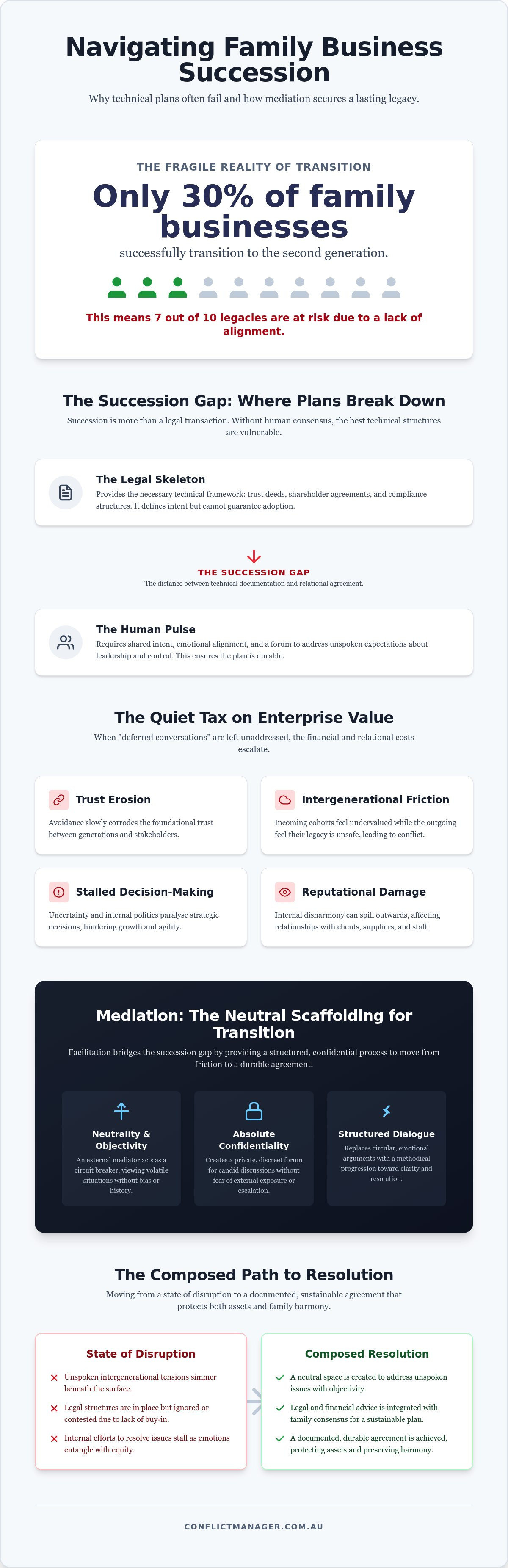
Only about 30% of family businesses successfully transition to the second generation. This statistic highlights a fragile reality for many Australian enterprises. Tension. Exhaustion. Uncertainty. You likely feel the weight of this transition daily. There is the silent friction of unspoken intergenerational tension and the nagging fear that legal structures might be ignored. In such a climate, mediation for business succession planning serves as a vital anchor. Internal efforts often stall as emotions entangle with equity, making objective progress difficult. You want to protect what you’ve built, yet the human element often feels more volatile than the market itself.
Professional mediation provides the emotional and structural scaffolding necessary to navigate these shifts. It acknowledges that a legacy isn't just a set of accounts; it's a living history. This article explores how these facilitated processes bridge the gap between technical succession structures and the complex human dynamics that determine a legacy’s survival. We'll examine the path towards a documented, durable agreement that ensures business continuity while actively preserving family harmony. You'll discover how to replace internal friction with a sense of order, clarity, and composed leadership.
Key Takeaways
- Understand why technical legal structures often fail without the emotional scaffolding required to align leadership and legacy.
- Discover how mediation for business succession planning creates a neutral space for stakeholders to address unspoken tensions with total objectivity.
- Learn to integrate the roles of legal and financial advisors with professional mediation to ensure family trusts and agreements are truly sustainable.
- Identify the specific pivot points in your organisation’s growth that signal the need for a facilitated, rather than purely internal, transition.
- Gain a clear methodology for moving from a state of disruption toward a documented resolution that protects both your assets and your family harmony.
The Silent Threat to Business Succession: When Structure Lacks Alignment
Succession is far more than a mere transaction; it's a proactive governance process essential for the longevity of Australian enterprises. Many families believe that a signed document is the final destination. This is the paradox of the perfect plan. A trust deed or a shareholder agreement provides the necessary skeleton, yet it often lacks the pulse of genuine human consensus. Without emotional alignment, these documents remain structurally vulnerable. Mediation for business succession planning addresses this by focusing on the human architecture behind the legal one. It ensures the transition is supported by shared intent rather than just technical compliance.
The "deferred conversation" is the primary source of this instability. These are the unspoken expectations about leadership capability and asset control that linger beneath the surface of board meetings. Left unaddressed, they become a silent threat to business continuity. Identifying these friction points early allows for a transition that feels like a natural evolution rather than a forced disruption. It protects the integrity of the assets by ensuring the people managing them are in total accord.
The Cost of Deferred Intention
Avoidance acts as a quiet tax on enterprise value. When difficult leadership conversations are delayed, trust erodes over time. This erosion often manifests as intergenerational friction, where the incoming cohort feels undervalued and the outgoing cohort feels unsafe. The financial impact is tangible. Stalled decision-making and reputational damage can devalue a legacy faster than sudden market shifts. Moving from a state of avoidance to one of structured engagement through external facilitation stops this decline. It replaces circular, emotional arguments with a methodical progression toward clarity. This ensures the transition doesn't become a source of permanent organisational friction or family disharmony.
Bridging the Gap Between Legal Rigour and Human Reality
Lawyers and accountants are vital for technical integrity. They provide the necessary expertise regarding tax, equity, and law. However, they aren't always equipped to facilitate the high-emotion discussions that determine whether a plan actually works in practice. These discussions require a neutral space where stakeholders can speak without the weight of judgment or immediate legal consequence. This is where mediation serves as a steady hand, viewing volatile situations with total objectivity. The Succession Gap is the distance between technical intent and relational agreement. Closing this gap is the only way to ensure that legal structures are respected and durable over the long term.
The Mechanics of Mediation: Creating Neutral Scaffolding for Transition
Neutrality. Perspective. Discretion. These elements form the foundation of a successful transition. Mediation for business succession planning provides a structured environment where these qualities aren't just goals; they're prerequisites for progress. In high-net-worth family office settings, the weight of history often clouds current decision-making. A mediator acts as a circuit breaker, viewing volatile situations with total objectivity. This external presence allows stakeholders to move beyond internal friction and toward a state of composed alignment. It creates a space where complex human dynamics are acknowledged without being allowed to derail the business’s structural integrity.
Confidentiality remains a paramount concern for Australian families managing significant assets. The process is designed to be a private forum where sensitive issues can be discussed with total candour. By removing the fear of external exposure or legal escalation, stakeholders can focus on the movement of the business rather than the protection of their individual positions. It’s about establishing a steady hand that guides the room toward a vision of structured resolution. This methodical approach ensures that every voice is heard, creating a sense of order that is often missing from purely internal discussions. For those seeking this level of clarity, engaging in stakeholder facilitation can provide the necessary external perspective to break through long-standing stalemates.
Facilitating Difficult Conversations with Composure
De-escalation is a technical skill. When board or family meetings descend into circular arguments, the mediator manages the pulse of the conversation to restore efficiency. This intervention changes the room’s dynamic by replacing reactive emotions with logical sequence. Insights from Using a Mediator for Family Business Disputes suggest that third-party facilitators are uniquely positioned to address the underlying friction that internal leaders often ignore. They ensure the dialogue remains thorough yet focused on the future, preventing the transition from becoming bogged down in past grievances. It’s a process of moving from abstract concerns to concrete, actionable outcomes.
Sustainable Outcomes over Short-Term Compromise
A quick fix rarely survives the first year of a new leadership structure. Durable agreements require more than just a handshake; they require documented outcomes that provide a foundation for future governance. The focus must remain on asset integrity as a shared goal for all involved parties. By prioritising multi-generational stability over short-term compromise, mediation ensures the business remains robust through the transition and beyond. This commitment to sustainable results creates a sense of security for both the outgoing founder and the incoming executive team. It transforms a period of high-stakes disruption into a methodical step toward long-term continuity.
Beyond the Balance Sheet: Why Legal Advice Requires Emotional Scaffolding
Expertise. Precision. Compliance. These are the domains of the legal and financial professional. While these experts secure the technical integrity of a family trust or shareholder agreement, they often operate in a vacuum of relational data. Mediation for business succession planning fills this vacuum. It addresses the psychological register, specifically the profound weight of legacy and the pervasive fear of loss that often paralyses decision-making. In a family office, "fairness" is rarely a simple mathematical division. It's a nuanced perception of value, contribution, and future potential that requires a steady, external hand to navigate.
The Interplay of Governance and Emotion
Structural integrity requires more than just rules; it requires buy-in. Integrating mediation into existing family office governance frameworks allows for a smoother transition of control, which is distinct from the transition of ownership. One can own equity without having the right to dictate daily operations. Managing this distinction is vital for business continuity. The ultimate goal is to ensure the plan survives the "Sunday lunch test," where family harmony is maintained alongside a high-functioning leadership structure.
Protecting the Legacy from Internal Friction
Friction is an inevitable byproduct of change. Sibling rivalries, in-law dynamics, and disparate work ethics can all act as triggers that destabilise a founder's vision. By using mediation for business succession planning, families can address these triggers in a neutral forum to clarify roles and responsibilities within the new hierarchy. This prevents internal friction from becoming a structural failure. Professional mediation acts as the connective tissue between various professional advisers, ensuring that legal and financial strategies are underpinned by genuine stakeholder alignment.
Identifying the Pivot Point: When to Introduce Professional Mediation
Timing. Alignment. Momentum. These are the markers of a successful transition, yet they are often the first victims of structural stagnation. Recognising the pivot point where a business moves from a founder-led model toward a multi-generational or executive-led structure is critical for long-term stability. This transition represents a significant structural shift that requires more than updated contracts. It requires a facilitated alignment of vision. Mediation for business succession planning is most effective when introduced during these quiet periods of growth, before internal friction escalates into a crisis. By engaging a steady, external hand early, you can manage high-emotion disputes before they reach the litigation stage. This proactive approach ensures that the leadership transition is viewed as a strategic opportunity rather than a looming threat to the family’s wealth and the business’s operational integrity.
Warning Signs of Succession Stagnation
Disruption often begins quietly. You might notice circular arguments that prevent decision-making at the board or family level. These repetitive patterns signal that the current governance structure is struggling under the weight of unspoken expectations and unaddressed fears. Another warning sign is when stakeholders begin seeking independent legal advice prematurely as a defensive measure. This posturing often indicates a breakdown in trust and a shift toward a zero-sum mindset. Leadership ambiguity also causes anxiety among staff and external stakeholders, which can devalue the business legacy and lead to a loss of key talent. Recognising these signs allows you to pivot toward a structured resolution before the damage becomes irreversible. It’s about restoring order before the friction becomes a permanent feature of the organisational culture.
The Logic of Early Intervention
Proactive mediation reduces the long-term conflict tax on a business. This tax isn't just financial; it's measured in lost productivity, eroded trust, and missed strategic opportunities. By creating a roadmap for transition that all generations can support, you ensure the legacy remains intact and the business remains competitive. Learning How to Manage Conflict in a Family Office Structure is an essential part of this proactive governance. This approach moves the conversation from a state of defensive complexity toward a vision of collaborative order. It ensures the transition is a planned evolution rather than a forced reaction to internal pressure. If your organisation is approaching a significant leadership milestone or experiencing the first signs of intergenerational friction, contact Conflict Manager to facilitate a composed and objective path forward.
Securing the Future: The Composed Path to Resolution
Order. Stability. Continuity. These are the markers of a legacy that has successfully transitioned through the friction of change. The journey from organisational complexity toward a vision of structured resolution is rarely linear, yet it is entirely manageable with the right framework. Mediation for business succession planning reframes this period not as a conclusion of a founder’s influence, but as a sophisticated evolution of the family legacy. It ensures that the transition of leadership is as robust as the legal structures supporting it. By moving beyond reactive disputes and toward a methodical alignment of interests, Australian families can protect their wealth and their relationships with equal precision.
Conflict Manager serves as a steady, objective guide during these high-stakes transitions. We act as a neutral third party capable of viewing volatile situations with total objectivity. This external perspective brings clarity to clouded situations, allowing stakeholders to focus on the movement of the business rather than the friction of interpersonal dynamics. It is about establishing a composed environment where the weight of responsibility is shared and the path forward is clearly documented. This methodical progression moves the family from a state of disruption toward a vision of long-term asset integrity.
A Vision of Structured Resolution
The initial engagement focuses on context setting and meticulous agenda design. It is a period of establishing the thematic foundation for the sessions to follow. During this phase, stakeholders often experience a vital shift from hardened positions toward a collaborative practice. This transition is essential for ensuring the long-term stability of the family office. By the time the process concludes, the Succession Gap is closed, replaced by a durable agreement that the next generation can support with confidence. The focus remains on sustainable outcomes that protect both the business and the family harmony for decades to come.
Taking the First Step Toward Clarity
Introducing the concept of mediation to reluctant family members or partners requires a focus on shared outcomes rather than current friction. Frame the intervention as a tool for governance and preservation rather than a response to failure. A wise, external counsellor provides the necessary emotional scaffolding to make these conversations feel safe rather than confrontational. This neutral presence lowers the pulse of the room, allowing for a logical sequence of decisions that protect the business’s structural integrity. If you are ready to move from complexity toward a vision of order, enquire about our Family Office Mediation and Business Succession Facilitation to begin your journey toward a structured resolution.
A Structured Path Toward Organisational Continuity
Succession is a sophisticated evolution rather than a final transaction. It requires more than just technical precision; it demands a deep alignment of human intent. You've discovered that while legal documents provide the skeleton, mediation for business succession planning provides the pulse that keeps the legacy alive. By addressing the Succession Gap early, you replace circular arguments with a methodical progression toward a documented, durable agreement. This process ensures that your assets remain protected and your family harmony remains intact through the most volatile periods of transition.
Conflict Manager provides specialised family office conflict resolution and neutral, third-party objectivity for complex organisations across Australia. Our expert guidance for high-stakeholder facilitation acts as a steady hand, viewing high-stakes environments with total clarity. We help you move from a state of internal friction toward a vision of structured resolution. It's a commitment to the long-term integrity of your enterprise. Secure your legacy with expert-led succession mediation and ensure your leadership transition is a source of strength rather than disruption. Your legacy deserves a composed and certain future.
Frequently Asked Questions
What is the difference between business succession mediation and legal arbitration?
Mediation is a voluntary, collaborative process where a neutral facilitator helps parties reach their own agreement, whereas arbitration involves a third party making a binding decision after hearing arguments. In the context of business succession, mediation prioritises the preservation of relationships and shared vision. It allows for creative, interest-based outcomes that legal rulings often overlook. This collaborative approach ensures that the final agreement is one that all stakeholders genuinely support rather than one imposed by an external authority.
How long does the mediation process for a family business succession typically take?
The duration of the process depends on the complexity of the business structure and the current level of alignment among stakeholders. Typically, a comprehensive succession mediation involves an initial assessment followed by a series of structured sessions over three to six months. This timeframe allows for the thorough exploration of sensitive issues without rushing the development of a durable agreement. It ensures that the transition is methodical and gives participants the necessary space to process significant leadership shifts.
Can mediation help if family members are already not on speaking terms?
Mediation is specifically designed to facilitate progress when direct communication has broken down. A skilled mediator acts as a buffer, managing the pulse of the conversation and ensuring that discussions remain productive rather than reactive. Through techniques such as separate caucus sessions, a facilitator can bridge the gap between estranged parties without requiring immediate face-to-face interaction. This creates a safe, neutral environment where stakeholders can begin to address structural requirements despite their current interpersonal friction.
Is succession mediation confidential for high-profile family offices?
Confidentiality is a foundational element of the mediation process, providing a private forum for sensitive family and financial matters. Unlike court proceedings, which are often a matter of public record, mediation sessions are strictly private and conducted under a formal confidentiality agreement. This protection is essential for high-profile Australian family offices that need to discuss asset integrity and leadership capability without risking reputational damage. It allows for total candour in a secure, controlled environment.
How do we choose the right mediator for our complex business structure?
Selecting the right professional requires a focus on both commercial acumen and psychological register. You should seek a mediator with specific experience in complex organisational structures and intergenerational family dynamics. A steady hand who remains unruffled by high-stakes environments is essential for viewing volatile situations with objectivity. Look for a facilitator who understands the nuances of Australian business regulations and has a proven record of moving stakeholders from disruption toward a vision of structured resolution.
What happens if we cannot reach an agreement through mediation?
If a total agreement isn't reached, the parties retain all their legal rights to pursue other avenues such as litigation or arbitration. However, the mediation process often clarifies the core points of contention and narrows the scope of the dispute. Even a partial agreement can provide a more stable foundation than a complete stalemate. The insights gained during the process frequently lead to a more methodical approach to future negotiations, reducing the eventual cost of resolution.
Should our other professional advisers (lawyers/accountants) be present during mediation?
Integrating your existing legal and financial advisers can be highly beneficial during specific stages of the mediation. They provide the technical expertise regarding tax, equity, and law that informs the final agreement. However, the mediator manages the room to ensure that the focus remains on stakeholder alignment rather than purely technical debate. This collaboration ensures that the resulting succession plan is both relationally sound and technically robust, bridging the gap between human reality and legal rigour.
Is mediation suitable for small family businesses as well as large family offices?
Mediation for business succession planning is highly effective for enterprises of all sizes, from small family firms to large multi-generational offices. The core challenges of leadership transition, asset control, and family harmony are universal. Small businesses often face even greater risks from internal friction due to the high concentration of family involvement in daily operations. A facilitated process brings the same level of order and clarity to a small firm that it does to a complex organisation.


