

The most significant threat to a successful structural shift isn't the strategy itself, it's the silence that precedes it. Silence creates a vacuum, and in the absence of clear direction, the rumour mill often fills the gap with fear and speculation. You probably recognise the tension that builds when a transition is imminent. There's a legitimate concern that high-emotion friction could destabilise the workplace or lead to costly industrial disputes. It's a heavy burden to carry when you're trying to maintain order while steering the ship toward a new horizon.
Friction. Resistance. Uncertainty. This guide offers a sophisticated framework for communicating organizational change to avoid conflict, allowing you to neutralise these forces before they take root. You'll discover how to move beyond reactive messaging toward a strategy that preserves organisational stability and retains your best people. We'll examine the logic of transparent leadership, the necessity of aligned messaging, and the specific steps required to transition through complexity with composed authority and a steady hand.
Key Takeaways
- Understand why structural shifts trigger a psychological threat response and how a perceived loss of agency fuels workplace friction.
- Discover a strategic framework for communicating organizational change to avoid conflict by establishing a single source of truth that neutralises the rumour mill.
- Identify the limitations of internal leadership during high-stakes transitions and the value of an objective, neutral third party in managing stakeholder emotions.
- Master the use of two-sided messaging to build credibility and preserve trust when addressing the inherent risks of a corporate restructure.
- Learn how to anchor your change narrative to long-term organisational integrity to ensure a smooth transition with minimal staff turnover.
The Psychology of Resistance: Why Organisational Change Triggers Conflict
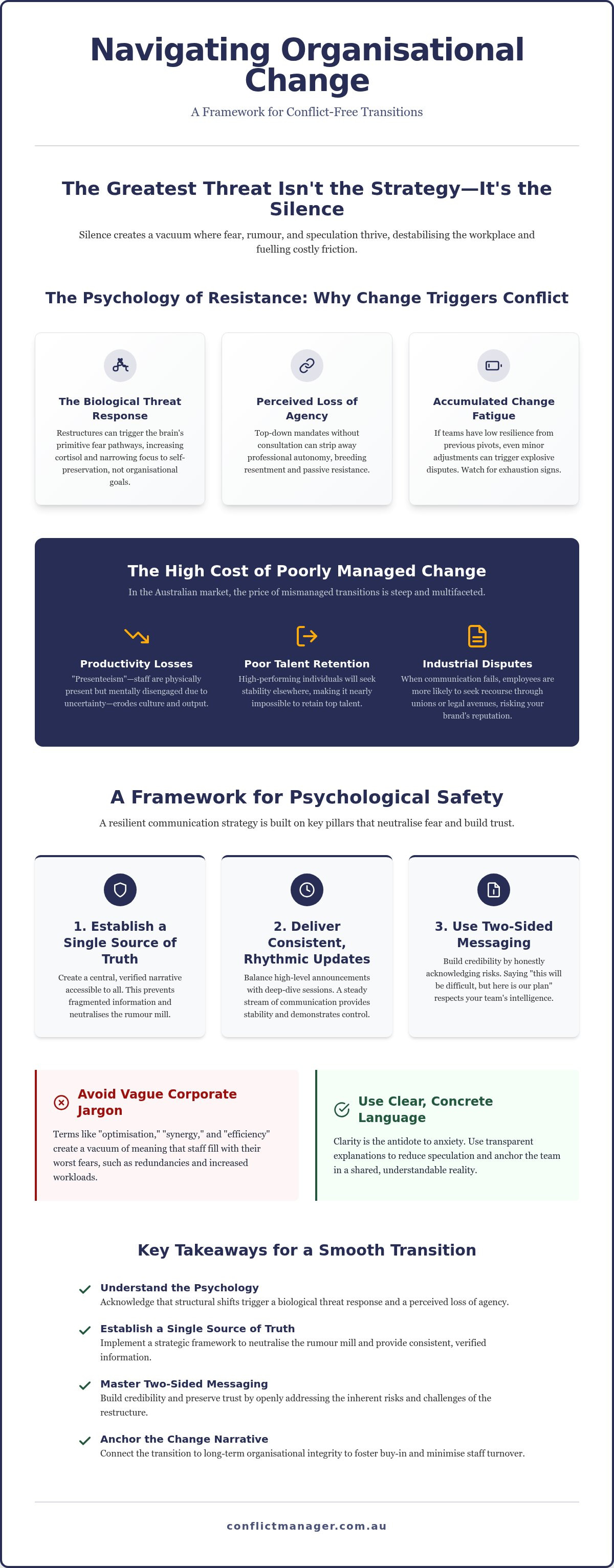
Resistance is rarely logical. It's biological. When an executive team announces a restructure, the human brain often processes this shift not as an opportunity for growth, but as a direct threat to personal security. This "threat response" triggers the same neural pathways as physical danger, leading to heightened cortisol levels and a narrowed focus on self-preservation. Effective leadership involves communicating organizational change to avoid conflict by addressing these primitive anxieties before they manifest as workplace disruption.
Conflict often stems from a perceived loss of agency. When mandates are handed down from the top without consultation, employees feel their professional autonomy is being stripped away. This perceived lack of control breeds resentment, which frequently translates into passive-aggressive behaviour or subtle sabotage of the new initiative. Beneath the surface of every workplace is an unspoken contract; a psychological agreement of mutual loyalty and stability. When change disrupts this contract without adequate explanation, the resulting sense of betrayal can be profound.
Identifying change fatigue early is essential for maintaining organisational integrity. If your team has recently endured multiple pivots or leadership shifts, their capacity for resilience is likely depleted. In this state, even minor adjustments can trigger explosive disputes. Recognising the signs of exhaustion, such as increased absenteeism or a decline in collaborative spirit, allows for a more measured and empathetic approach to the transition.
Deconstructing the Fear of the Unknown
The language used during transitions can either soothe or inflame. Abstract nouns like "optimisation," "synergy," and "efficiency" are often interpreted as code for redundancies or increased workloads. These terms create a vacuum of meaning that employees fill with their worst fears. Clarity is the antidote to this anxiety. By replacing vague corporate jargon with concrete, transparent explanations, you reduce the space for speculation and fear to grow.
A legitimacy judgment is the internal assessment an employee makes regarding whether a proposed change is fair, necessary, and conducted with integrity by the leadership team.
The Cost of Poorly Managed Change in Australia
In the Australian market, the price of mismanaged transitions is steep. Productivity losses often stem from "presenteeism," where staff members are physically present but mentally disengaged due to uncertainty. This state of limbo erodes the culture and makes talent retention nearly impossible as high-performing individuals seek stability elsewhere. Beyond internal culture, there's a significant risk of formal industrial disputes. When informal communication channels fail and employees feel unheard, they are far more likely to seek recourse through external bodies or legal avenues. Prioritising a strategy for communicating organizational change to avoid conflict isn't just about culture; it's a necessary safeguard for your brand’s reputation and operational continuity.
Designing a Communication Strategy that Prioritises Psychological Safety
Clarity. Consistency. Control. These are the foundational pillars of a resilient communication architecture. Successfully communicating organizational change to avoid conflict requires more than a simple announcement; it demands a structured environment where psychological safety is the priority. When employees feel safe, they're more likely to engage with the logic of the transition rather than retreating into a defensive posture.
The rumour mill thrives on ambiguity. Establishing a "Single Source of Truth" ensures that every stakeholder, from the boardroom to the warehouse, accesses the same verified narrative. This central repository of information prevents the fragmentation of reality that so often fuels workplace toxicity. By providing a steady stream of rhythmic communication, you balance brief, high-level updates with deep, explanatory sessions that allow for nuance and detail.
Credibility isn't built by pretending there are no risks. A "Two-Sided Message" approach acknowledges the potential difficulties of a restructure while clearly outlining the path forward. This level of honesty builds trust because it respects the intelligence of your audience. When leadership is brave enough to say "this will be difficult, but here is how we will manage it," they create a sense of order that a purely positive, one-sided message cannot achieve.
Transparency vs. Discretion: Finding the Balance
Determining what to share requires a sophisticated understanding of your audience. In corporate settings, transparency often focuses on job security and operational shifts. However, when communicating with high-net-worth family members or family office stakeholders, the focus must shift toward asset integrity and long-term stability. Using objective, fact-based language allows you to share necessary strategic data without triggering the emotional volatility that often accompanies high-stakes family or financial transitions.
Selecting the Right Messenger for the Right Moment
Internal leaders often struggle to remain objective during a restructure because they have "skin in the game." Their proximity to the situation can lead to perceived bias, which undermines the message before it's even delivered. A neutral third party can bridge the gap between the board and the floor, acting as a steady hand that remains unruffled by internal politics. Engaging in professional stakeholder facilitation provides the composed authority necessary to navigate these volatile moments. This external perspective brings a vision of structured resolution, allowing internal leadership to focus on future stability while the facilitator manages the immediate interpersonal friction.
Internal vs. External Facilitation: Navigating High-Emotion Transitions
Identity. Loyalty. Perception. The identity of the messenger is often just as critical as the message itself. Even when a CEO acts with the best intentions, they're inherently part of the "in-group" that designed the change. This proximity often triggers a defensive response from staff who may view internal announcements through a lens of suspicion or past grievances. Communicating organizational change to avoid conflict requires a level of perceived neutrality that internal leadership, by definition, cannot possess.
Objectivity remains the rarest commodity during a corporate restructure. Leaders are often navigating their own professional shifts while trying to anchor their teams; this emotional entanglement makes it difficult to remain unruffled when tensions peak. An external facilitator acts as a steady hand capable of lowering the collective pulse of the room. They bring a sense of order that isn't weighed down by internal politics or historical friction, ensuring that the transition leads to sustainable outcomes rather than temporary compliance.
The Pitfalls of DIY Conflict Management
Internal change programmes frequently fall victim to confirmation bias. When leadership has spent months crafting a strategy, they naturally look for data that supports their vision while overlooking subtle signs of growing resentment. This often leads to the sunk cost fallacy, where an organisation continues down a friction-heavy path simply because of the resources already invested. When a manager attempts to mediate disputes within their own department, it inadvertently creates perceptions of favouritism. This perceived bias can deepen existing workplace silos and turn a minor disagreement into a formal industrial dispute.
The Value of the Neutral Third Party
A neutral third party provides an objective mirror to both leadership and stakeholders. They facilitate difficult conversations without the baggage of past history; this allows participants to focus on the future rather than relitigating the past. This creates a safe harbour where employees feel comfortable venting grievances or providing honest feedback without fear of professional repercussion. By removing the emotional entanglement of internal hierarchy, an external expert brings clarity to clouded situations. By prioritising an external perspective, you're not just delivering news; you're communicating organizational change to avoid conflict through a process that feels fair and objective.
A Methodical Framework for Communicating Change Without Friction
Framework. Sequence. Integration. Moving from a state of disruption to one of structured resolution requires a disciplined approach that respects both business logic and human dynamics. Communicating organizational change to avoid conflict is not a single event; it's a multi-phased process designed to lower the collective pulse of the workforce. By following a methodical framework, leadership can move beyond reactive damage control toward a proactive culture of alignment.
Phase 1: The Pre-Communication Audit. Before the first word is spoken, you must identify potential flashpoints. This involves mapping out stakeholders who may act as "naysayers" and those most impacted by the shift, allowing for a tailored approach that anticipates friction rather than merely reacting to it.
Phase 2: The Narrative Anchor. Connect the change to the organisation's long-term integrity. A change that feels arbitrary will be resisted; a change that feels essential to the mission will be supported. Your narrative must provide a sense of order that transcends the immediate disruption.
Phase 3: The Multi-Channel Rollout. Consistency is your greatest asset. Ensure that every touchpoint, from official emails to casual manager briefings, delivers the same verified truth. This prevents the fragmentation of reality that fuels the rumour mill and preserves organisational stability.
Phase 4: The Facilitated Dialogue. Move from broadcast to genuine engagement. This is where you transition from telling people what is happening to facilitating a space where they feel heard. This dialogue is essential for neutralising high-emotion friction and building a sustainable path forward.
Phase 5: The Post-Change Stabilisation. Reinforce new norms and celebrate the achievement of stability. Without this final phase, the organisation risks slipping back into old habits or harbouring latent resentment that could surface in future transitions.
Step-by-Step: From Announcement to Alignment
Drafting the initial message requires a balance of clarity, composure, and empathy. It's about being direct about the "what" while being deeply sensitive to the "how." Scheduling small-group sessions for high-impact stakeholders allows for more nuanced discussions. In your written materials, the strategic use of punctuation, such as em-dashes, can help provide internal contrast and clarify complex points; this ensures the message remains sophisticated yet accessible to all levels of the organisation.
Addressing Objections with Composed Authority
Anticipate the "What about me?" questions before they are asked. When leadership provides grounded, objective responses to high-emotion outbursts, they demonstrate a steady hand that remains unruffled by volatility. In the absence of a clear narrative, silence from leadership is often interpreted as a lack of a plan rather than a lack of information. To ensure your framework is executed with total objectivity, engaging in professional Organizational Conflict Management can provide the external expertise needed to navigate these high-stakes transitions. By focusing on structural integrity and human dynamics, you can ensure that communicating organizational change to avoid conflict becomes a catalyst for growth rather than a source of permanent friction.
Restoring Stability: The Role of Expert Facilitation in Successful Transitions
Resolution. Order. Continuity. The final phase of any structural transition isn't marked by the conclusion of an announcement, but by the restoration of genuine stability. Communicating organizational change to avoid conflict is a journey that moves from the initial state of disruption toward a vision of structured resolution. This is where the organisation shifts from merely surviving the change to thriving within the new architecture. When the friction of the transition is managed with precision, the focus returns to performance and growth rather than interpersonal disputes. Stability is not the absence of change; it's the presence of a clear, shared direction that every stakeholder understands.
For family offices and high-net-worth individuals, the stakes of a restructure extend far beyond simple operational efficiency. It's about preserving a legacy. When communication is mishandled, the resulting conflict can threaten asset integrity and long-term family cohesion. Expert facilitation ensures that these assets remain intact by providing a neutral space where complex human dynamics are addressed with total objectivity. This preservation of legacy ensures that the business or family unit remains resilient, even as the structural foundations shift and evolve.
Achieving Clarity Amidst the Fog of Change
Resolving structural friction requires an analytical approach that internal teams often cannot provide due to their own proximity to the situation. A professional mediator acts as a wise, external counsellor who views volatile situations without emotional entanglement. They build a foundation for future organisational resilience by guiding leadership on how to navigate high-stakes environments with composure. This isn't just a short-term fix; it's a strategic investment in the firm's long-term health. By prioritising clarity, you ensure that the logic of the change is understood and accepted by all stakeholders, moving the collective focus from a state of complexity toward a vision of resolution.
Engaging Conflict Manager for Your Organisation
Engaging a neutral third party for structural mediation is a methodical and logical process. Our seasoned professionals remain unruffled in high-stakes environments, acting as a steady hand that brings clarity to clouded situations. We focus on achieving sustainable outcomes through expert-led facilitation that respects the weight of your responsibility and the friction of interpersonal dynamics. If you're currently facing a high-stakes restructure or structural shift, you can contact Conflict Manager to discuss facilitating your organisational transition. By choosing an objective partner, you ensure that the process of communicating organizational change to avoid conflict results in a stronger, more stable organisation that is ready for the future.
Navigating Toward a Vision of Structured Resolution
The transition from disruption to stability requires more than just a well-drafted announcement. It demands a deep understanding of the psychological threat response and a commitment to maintaining a single source of truth. By prioritising transparency and acknowledging risks through two-sided messaging, leadership can preserve trust even during high-stakes structural shifts. These steps ensure that the unspoken contract with your people remains intact and the organisational culture stays resilient.
Mastering the art of communicating organizational change to avoid conflict ensures that your best talent remains engaged and your structural integrity stays intact. When internal dynamics become too complex or emotionally charged, the presence of a neutral third party brings the objectivity needed to bridge the gap between the board and the floor. Conflict Manager provides objective, neutral third-party mediation. Our seasoned professionals specialise in high-emotion business and family disputes, providing a steady hand to lower the collective pulse of the room.
Clarity. Stability. Growth. Secure the stability of your organisation with expert facilitation and ensure your next transition is defined by order rather than friction. It's within your capacity to lead your team through complexity toward a future of renewed purpose and sustainable success.
Frequently Asked Questions
How can I tell if my organisational change is likely to cause conflict?
You can identify potential conflict by observing shifts in workplace culture, such as a sudden drop in engagement or a rise in speculation. When a restructure threatens a person's sense of control or professional identity, resistance is almost inevitable. Early signs often include passive-aggressive behaviour or a withdrawal from collaborative projects. Recognising these indicators allows leadership to address anxieties before they transform into formal industrial disputes or toxic workplace silos.
What is the most common mistake leaders make when communicating change?
The most frequent error is a lack of transparency or waiting too long to share information. When leaders remain silent until they have every detail finalised, they inadvertently allow the rumour mill to define the narrative. This vacuum of information creates anxiety and distrust among staff. It's far more effective to share what you know with composed authority while being honest about the elements that are still being decided.
Can an external mediator help if the conflict has already started?
External mediators are highly effective even after conflict has ignited because they bring total objectivity to a volatile environment. Unlike internal managers, a mediator isn't emotionally entangled in the outcome or the history of the dispute. They provide a safe harbour for stakeholders to vent grievances and move toward a structured resolution. This neutral perspective is often the only way to break a deadlock and restore organisational stability.
How do I communicate change to a high-net-worth family office?
Communicating change within a family office requires a focus on asset integrity and the preservation of family legacy. You must move beyond corporate jargon to address the specific human dynamics and long-term financial security of the stakeholders. This often involves small-group sessions and a steady, empathetic voice that acknowledges the weight of responsibility. Using a neutral third party helps manage the high-emotion friction that frequently accompanies family transitions.
What should I do if a key stakeholder refuses to accept the change?
When a key stakeholder resists, you must move from broad messaging to a more focused, facilitated dialogue. It's essential to understand whether their resistance stems from a fear of losing status or a genuine concern about the new structure's viability. By addressing their specific objections with grounded, objective responses, you can often find a path toward alignment. This process requires patience and a commitment to ensuring every high-impact voice feels heard.
How long does the facilitated communication process usually take?
The timeline for a facilitated process varies based on the organisation's size and the depth of the transition. A thorough framework generally spans several weeks, beginning with a pre-communication audit and moving through to post-change stabilisation. This deliberate pace is necessary to lower the collective pulse of the room and ensure that the new norms are fully integrated. Rushing this sequence often leads to latent resentment that surfaces later.
Is it better to announce change all at once or in stages?
A staged rollout is generally the most effective method for communicating organizational change to avoid conflict. Briefing high-impact stakeholders in small-group sessions before a general announcement allows you to address specific anxieties in a controlled environment. This approach ensures consistency across all leadership levels and prevents the fragmentation of truth. It allows the organisation to move through the transition with a sense of order and transparency.
How does professional facilitation differ from standard HR management?
Professional facilitation differs from standard HR because it provides a level of neutrality that internal departments simply cannot achieve. While HR is part of the corporate hierarchy, an external facilitator acts as a wise counsellor who remains unruffled by internal politics. They specialise in managing high-emotion friction and structural mediation without the baggage of past interpersonal history. This objectivity is vital for achieving sustainable outcomes in high-stakes environments.


