

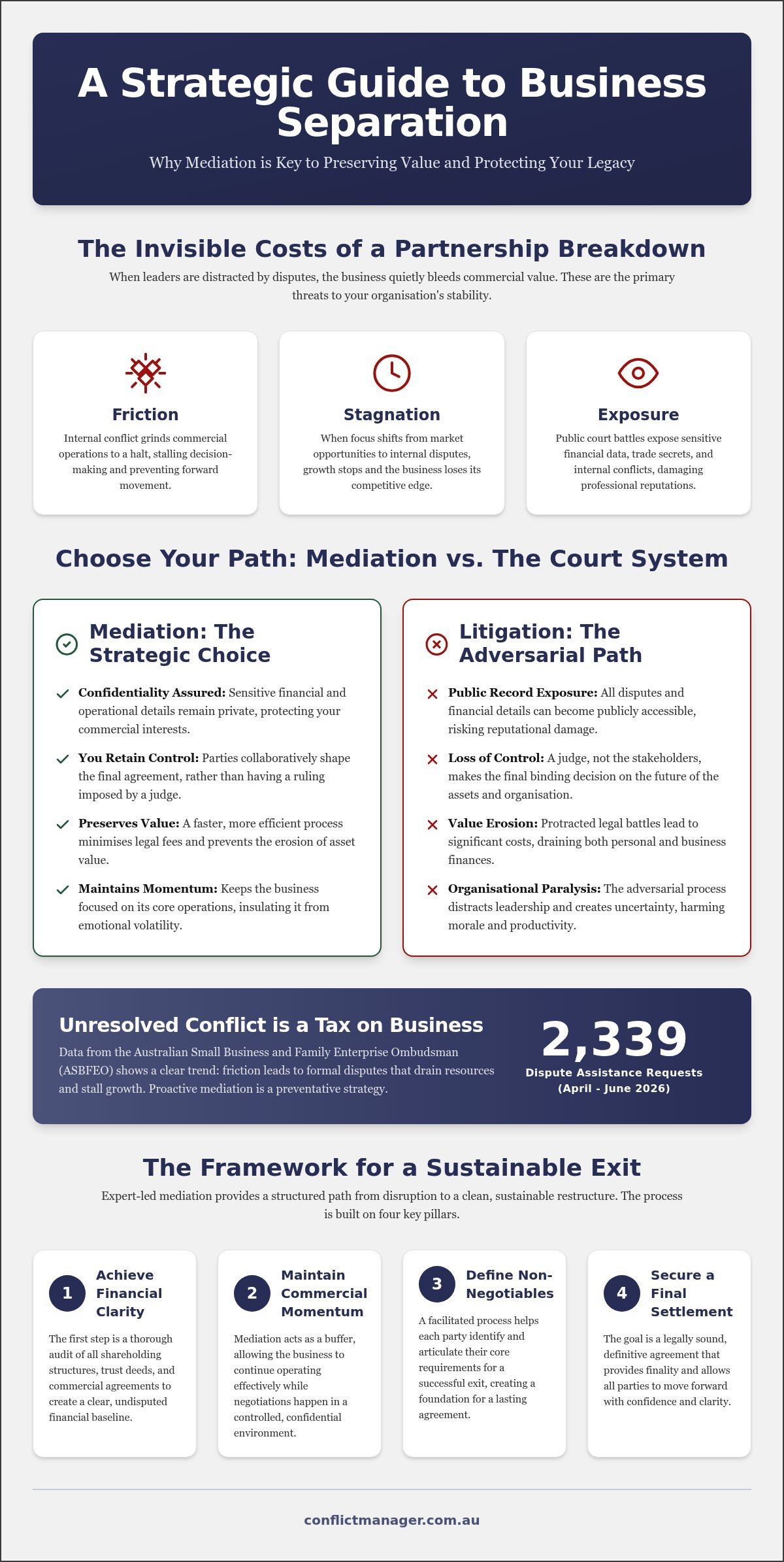
The most expensive part of a business separation isn't the division of assets; it's the invisible leak of commercial momentum that occurs when leaders stop looking forward and start looking at each other. Friction. Stagnation. Exposure. These are the quiet killers of commercial value when a partnership reaches its natural end. Prioritising mediation for business separation agreement negotiations isn't just a way to avoid the courtroom; it's a strategic decision to insulate your professional reputation and your balance sheet from the volatility of a public dispute.
Separating a business is undeniably one of the most taxing transitions an executive or founder will ever face. We understand that you want a clean, sustainable exit that provides financial clarity without the erosion of asset value caused by protracted legal fees. You'll discover how expert-led mediation preserves your commercial stability and keeps sensitive financial data confidential. This guide examines the mechanics of structured resolution, the latest Australian ADR trends for 2026, and how to achieve a restructure that respects the legacy of what you've built.
Key Takeaways
- Understand why high-net-worth families and Australian enterprises prioritise private resolution over the public exposure of the court system to protect sensitive financial data.
- Explore how professional mediation for business separation agreement negotiations acts as a buffer against emotional volatility while maintaining commercial momentum.
- Learn the essential steps for auditing shareholding structures and trust deeds to ensure your exit strategy is built on financial clarity.
- Discover how a facilitated negotiation allows parties to retain control over the final settlement rather than leaving the future of the organisation to a judge's ruling.
- Identify the framework for defining non-negotiables that lead to a clean, sustainable restructure rather than a temporary fix.
Navigating the Complexity of Business Separation in Australia
Complexity. Tension. Erosion. Business exits are rarely simple. They represent a fundamental shift in structural integrity that can, if left unmanaged, destabilise the very foundation of an organisation. When partners decide to part ways, the friction of this transition often stalls commercial operations, leading to a loss of momentum that's difficult to regain. This isn't merely a legal formality; it's a complex human and structural dynamic that requires a steady hand to manage. Separation, when handled poorly, becomes an anchor that drags down the future potential of everyone involved.
There's a common misconception that separation is primarily a matrimonial concern. While family law focuses on domestic assets, a commercial dissolution involves shareholder agreements, trust deeds, and intellectual property. The stakes are different. The focus shifts from personal support to the preservation of commercial value and professional reputation. Utilising Mediation to facilitate these discussions ensures that technical complexities are handled with total objectivity. It allows for a level of nuance that the adversarial court system simply cannot provide, keeping sensitive data out of the public record.
Inertia is the enemy of value. Unresolved conflict acts as a tax on the business, eroding shareholder confidence and distracting from core operations. Data from the Australian Small Business and Family Enterprise Ombudsman (ASBFEO) indicates that requests for assistance with contract and payment disputes reached 2,339 between April and June 2026. This highlights a clear trend: businesses that wait too long to address friction face higher risks of organisational paralysis. Transitioning early into mediation for business separation agreement negotiations is a proactive step toward protecting the entity's underlying value.
The Structural Integrity of Family Businesses
Family offices and intergenerational enterprises face unique pressures. The separation isn't just about the balance sheet; it's about the legacy. A clumsy exit can cause collateral damage to peripheral business units or damage the family's standing in the Australian market. A specialised approach balances the need for a clean commercial break with the preservation of internal stability. It requires an understanding of the weight of responsibility that comes with managing high-stakes human dynamics without becoming emotionally entangled in them.
Recognising the Signs of a Non-Sustainable Partnership
Partners often try to resolve issues internally until the situation becomes volatile. Recognising when internal facilitation has reached its natural limit is vital for survival. External intervention moves the conversation from a state of disruption toward a vision of structured resolution. It stops the cycle of reactive decision-making and allows for a methodical, logical progression toward a clean exit. This shift from "dispute" to "negotiated strategy" is what prevents total organisational collapse during periods of high stress.
The Mechanics of Expert-Led Mediation for Commercial Agreements
Privacy. Precision. Finality. Mediation isn't a passive conversation; it's a disciplined, confidential process designed to navigate the structural and psychological hurdles of a commercial split. A neutral party facilitates this negotiation, ensuring that the mediation for business separation agreement remains focused on commercial logic rather than personal grievance. This confidentiality is essential for Australian directors who must protect sensitive trade secrets and shareholder data from the public record of a courtroom. It allows for a level of transparency between parties that would be impossible in an adversarial setting.
High-stakes transitions often create power imbalances or emotional friction that can paralyse decision-making. The mediator acts as a steady hand, maintaining the pace of negotiation while ensuring no party is overwhelmed by the pressure of the moment. This objective stance is critical for Achieving Effective Settlements that stand up to legal scrutiny. It provides a sense of order when internal dynamics feel chaotic, moving the participants from a state of disruption toward a vision of structured resolution. By focusing on asset integrity, the process ensures that the commercial entity remains viable throughout the transition.
The Role of the Neutral Third Party
Objectivity is the cornerstone of effective resolution. An external facilitator views the organisation's structure with total detachment, identifying pathways that internal stakeholders might overlook due to emotional bias. They create a structured environment where difficult conversations can occur without descending into unproductive conflict. By stripping away the noise, they help parties reach a state of clarity where sustainable decisions can be made. This external perspective is often what's needed to break a deadlock that has persisted for months or years.
Sustainable Outcomes vs. Temporary Truces
A temporary truce is merely a delay of the inevitable. True resolution requires a focus on the long-term stability of the remaining entities. Mediation allows for the precise drafting of terms that will form the foundation of a formal settlement deed. For those seeking professional organisational conflict management, the goal is always a finality that feels equitable. It ensures that once the papers are signed, the commercial path forward is clear and unobstructed by lingering resentment or ambiguity. This methodical approach transforms a period of friction into an opportunity for structural renewal.
Strategic Comparison: Mediation versus the Adversarial Court System
Control. Sovereignty. Discretion. The Australian court system is a blunt instrument designed to apply legal precedent, not to preserve commercial nuance. When a dispute enters the courtroom, the power to decide the company's future is surrendered to a judge who may lack a deep understanding of your specific industry dynamics. Pursuing mediation for business separation agreement negotiations allows stakeholders to retain total authority over the final outcome. This ensures that the resulting settlement is commercially viable and serves the long-term interests of all parties, rather than being a binary ruling that leaves the organisation fractured.
For high-net-worth families and prominent Australian directors, the public nature of court proceedings represents a significant liability. Sensitive financial data, internal trust structures, and intellectual property become matters of public record, accessible to competitors and the media. Mediation offers a sealed environment. It provides the privacy necessary to conduct frank, objective discussions about asset division without risking the brand's reputation. This confidentiality is a strategic asset in itself, protecting the integrity of the business during its most vulnerable transition.
Litigation is an endurance test that few businesses can afford. While the Federal Circuit and Family Court of Australia may charge a fee of A$690 for court-ordered mediation as of July 2026, the hidden costs of legal representation and lost productivity often reach hundreds of thousands of dollars. The timeline is equally punishing, with matters frequently languishing for years. In contrast, data from the Australian Small Business and Family Enterprise Ombudsman (ASBFEO) shows that leasing disputes were resolved in an average of 36 days through alternative dispute resolution in 2024-2025. This efficiency allows leaders to move from complexity toward resolution in weeks, not years.
The Hidden Risks of Litigation for Business Owners
Public disputes create ripples of uncertainty that can lead to rapid client and employee attrition. There's also the danger of "forced discovery," where the court mandates the disclosure of internal documents that could be commercially damaging if leaked. A court-ordered judgement often fails to account for the operational realities of a business, leading to outcomes that are legally "correct" but commercially disastrous. Avoiding this path is essential for those who value the structural integrity of their enterprise.
Mediation as a Risk Management Tool
Viewing resolution through the lens of risk management lowers the organisational pulse. It replaces the "litigation trap" with a methodical, logical progression toward a clean break. This approach allows partners to exit with their professional dignity intact, preserving the possibility of future collaboration or a clean, respectful separation. By acting as a proactive strategy, mediation ensures that the friction of the present doesn't compromise the financial stability of the future.
Preparing for a Sustainable Exit: The Mediation Framework
Stability is born from preparation. A successful transition requires more than just a willingness to talk; it demands a rigorous audit of the organisation's current structural reality. Before entering mediation for business separation agreement discussions, leaders must define what a "successful" outcome looks like beyond the balance sheet. This clarity acts as a compass, ensuring the process remains anchored in commercial logic even when interpersonal friction peaks. Without this foundation, negotiations risk descending into a cycle of reactive concessions that compromise the business's long-term viability.
Gathering the Commercial Facts
Objective data is the most effective tool for lowering the temperature of a dispute. Parties should begin by consolidating shareholder agreements, trust deeds, and comprehensive asset registers. Reviewing existing governance structures and succession plans provides a clear map of the current landscape; this highlights potential roadblocks before they cause a deadlock. Entering mediation for business separation agreement talks without a clear audit of shareholder rights is a high-risk strategy. Providing the facilitator with a "clarity brief" streamlines the process, allowing the focus to remain on resolution rather than fact-finding. This methodical approach ensures that every decision is backed by the commercial reality of the Australian market.
The Psychology of the Negotiation
Separation is as much a psychological transition as it is a structural one. High-pressure sessions require participants to manage their own emotional states with a sense of composed authority. Understanding the underlying motivations of the other party isn't about conceding; it's about finding the common ground necessary for a sustainable exit. Shift the focus from past grievances toward the "future state" of the business. By viewing the situation with total objectivity, stakeholders can move past emotional entanglement and toward a vision of financial stability and professional dignity.
Selecting a mediator with both corporate and psychological expertise is vital for HNW families and complex organisations. You need a steady hand who understands the weight of responsibility and the nuances of family office wealth preservation. Ensuring the right decision-makers are in the room prevents the resolution from being undermined by external influences later. For those ready to begin this structured journey, our expert stakeholder facilitation provides the order and clarity needed during volatile periods of change. This framework ensures the legacy of the business survives the split intact.
Conflict Manager: Restoring Stability to High-Stakes Business Transitions
Order. Clarity. Finality. These are the outcomes we pursue when the internal momentum of a business is threatened by structural change. Conflict Manager provides a steady hand in environments where high emotions and high stakes collide. We navigate the friction of interpersonal dynamics without becoming entangled in them, allowing stakeholders to move from a state of disruption toward a vision of structured resolution. By facilitating mediation for business separation agreement negotiations, we act as the neutral catalyst required to achieve commercial clarity when internal efforts have reached their limit.
Our methodology is built on composed authority and a deep understanding of human dynamics. We recognise that the weight of responsibility during a business split can cloud commercial judgement; therefore, we provide the objective perspective needed to restore order. This approach isn't about temporary fixes. It's about movement, structural integrity, and the navigation of difficult transitions with quiet confidence. By viewing volatile situations with total objectivity, we ensure the legacy of the organisation survives the friction of the present.
Expertise in Family Office and HNW Disputes
Protecting a family legacy requires more than just financial acumen. It demands an appreciation for the emotional weight of multi-generational wealth and the complexities of internal commercial friction. We provide specialised mediation for family offices where the preservation of relationships is as vital as the integrity of the asset register. Our focus remains on sustainable outcomes that provide clear, final transitions for all stakeholders involved. This methodical progression provides a sense of order that internal efforts often struggle to maintain under the pressure of organizational change.
Taking the First Step Toward Resolution
Engaging an external facilitator is a strategic decision to insulate your business from the erosion of value. Our confidential assessment process identifies the core friction points and maps a logical path toward a clean break or restructure. This progression is designed to be inevitable and calming, moving parties away from reactive conflict and toward a sustainable future state. You can expect a process that is sophisticated, measured, and entirely focused on your commercial stability. We invite you to Contact Conflict Manager to discuss your business separation strategy and begin the transition toward professional stability and financial clarity.
Securing Your Commercial Future Through Structured Resolution
Structural change is inevitable; however, the erosion of your organisation's value is not. Choosing mediation for business separation agreement negotiations allows you to step away from the noise of conflict and toward a vision of financial stability. By prioritising private, expert-led facilitation over the public volatility of the Australian court system, you protect both your commercial reputation and the integrity of your assets. This process transforms a period of high stress into a methodical progression toward a clean break or a sustainable restructure.
Our seasoned professional mediators provide the confidential and objective facilitation required to navigate even the most complex family office or organisational disputes. We focus on sustainable commercial outcomes that respect the legacy of what you've built while providing the clarity needed to move forward with confidence. Begin your path to a structured resolution with Conflict Manager today. You don't have to navigate this transition alone; order and clarity are within reach.
Frequently Asked Questions
What is the difference between a business separation agreement and mediation?
Mediation is the facilitated process used to reach a resolution, while a business separation agreement is the final, formalised document detailing the split's terms. One is the journey; the other is the destination. During mediation, parties engage in structured dialogue led by a neutral third party to resolve friction. Once they reach a consensus, the resulting terms are drafted into a deed that provides the commercial and legal framework for the separation.
Is a mediation agreement legally binding for a business separation in Australia?
A mediation agreement becomes legally binding once it's formalised into a written settlement deed or a contract signed by all parties. While the mediation process itself is a flexible negotiation, the resulting terms are intended to create finality. In the Australian commercial landscape, these deeds are enforceable in court, providing the financial clarity and stability required post-separation. It's the standard method for securing a clean, sustainable exit.
How long does the mediation process typically take for a complex commercial split?
Complex commercial splits often reach a resolution within weeks rather than the years typically required for litigation. The timeline depends on the parties' readiness and the complexity of the asset structure. Many Australian businesses find that a series of focused sessions provides the momentum needed to move from disruption to a structured exit. This efficiency prevents the erosion of asset value and allows leaders to focus on future commercial stability.
Can mediation help if there is a complete breakdown in communication between partners?
Mediation is specifically designed to function when direct communication between partners has become impossible. The facilitator acts as a buffer, translating grievances into objective commercial terms. By using a neutral third party, partners can negotiate through the mediator without the need for direct, high-friction interaction. This structured environment lowers the organisational pulse and allows for progress even in high-emotion environments where trust has been significantly damaged.
Who should attend the mediation sessions for a family office dispute?
Primary stakeholders with the authority to sign a mediation for business separation agreement must attend the sessions to ensure finality. In family office disputes, this often includes multi-generational family members and key directors. While legal or financial advisors may provide support, the process remains focused on the principals' ability to reach a sustainable outcome. Ensuring the right people are in the room prevents external influences from undermining the resolution later.
What happens if we cannot reach an agreement during the mediation process?
If an agreement isn't reached, the parties remain free to pursue other forms of alternative dispute resolution or proceed to litigation. Mediation is a "without prejudice" process, meaning nothing said during the sessions can be used against a party in court later. However, most participants find that even an incomplete agreement provides clarity on certain issues, narrowing the scope of the dispute and reducing future legal fees.
How much does professional business mediation cost compared to litigation?
Private mediation is substantially more cost-effective than the hundreds of thousands of dollars often consumed by protracted commercial litigation. While court-ordered mediation fees in Australia are set at A$690 as of July 2026, the real savings come from avoiding legal representation for a multi-year trial. Investing in expert facilitation protects the business's balance sheet from the erosion of value caused by public legal battles and lost commercial momentum during the transition.
How do we ensure confidentiality is maintained throughout the mediation?
Confidentiality is maintained through a formal agreement signed by all participants before the sessions begin. Unlike the public record of the Australian court system, mediation is a private process where sensitive financial data and trade secrets remain protected. This discretion is vital for preserving professional reputations and asset integrity. It creates a safe environment for frank discussions, ensuring that internal friction doesn't become a matter of public exposure.


