

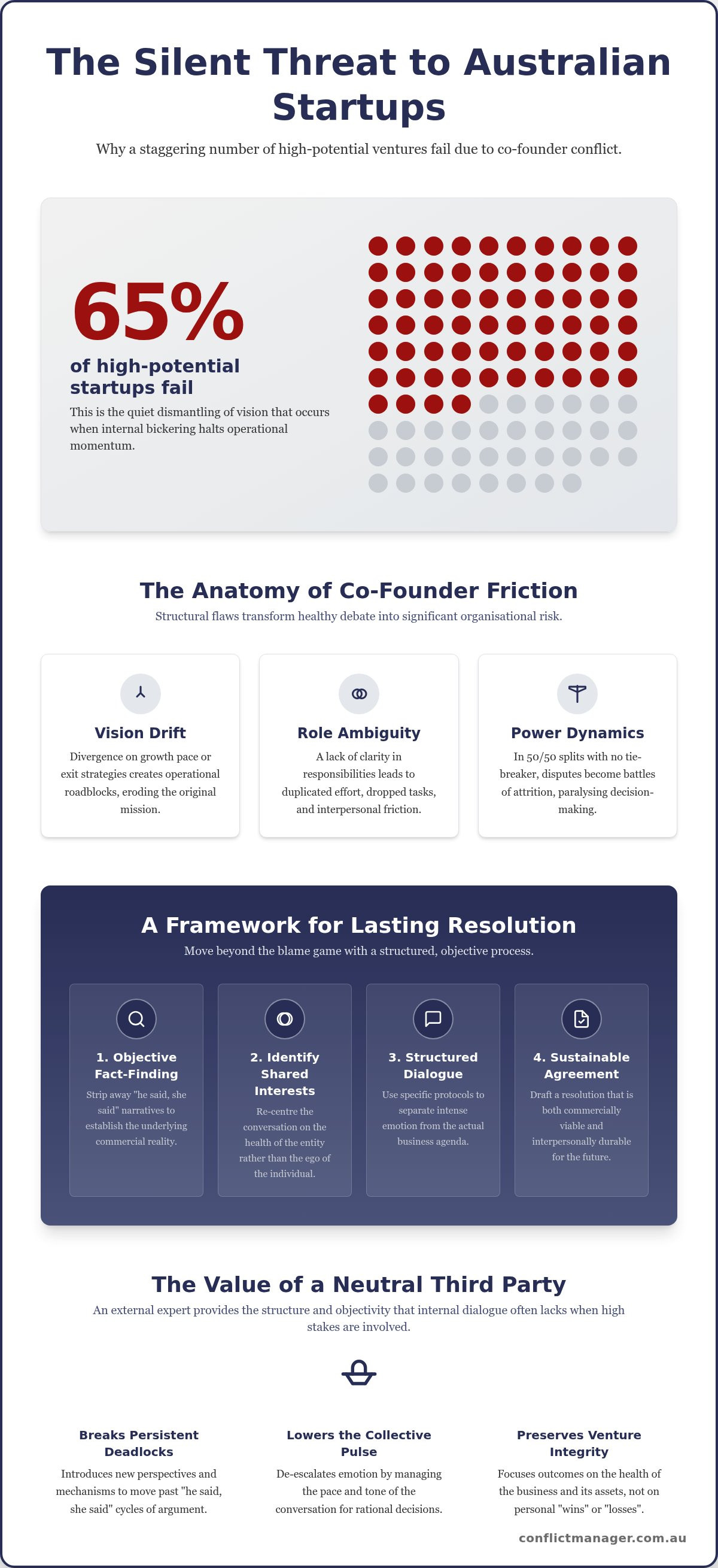
Sixty-five per cent of high-potential startups fail due to co-founder conflict. Stagnation. Friction. Erosion. This data reflects the quiet dismantling of vision that occurs when internal bickering halts operational momentum, often because the path to resolving co-founder disputes seems obscured by emotion. You're likely familiar with the exhaustion of circular arguments and the persistent anxiety that your multi-million dollar Australian venture is slipping away. It's a difficult reality to face, especially when the stakes involve significant assets and the collective future of your team.
Resolving these tensions doesn't have to result in a scorched-earth legal battle or the end of your partnership. You'll discover a methodical, expert-led framework for de-escalating friction and achieving sustainable professional clarity. We'll move through the logic of objective intervention, explaining why internal attempts at resolution often fail under the weight of history and pressure. By adopting a composed, structural approach to alignment, you can restore integrity to your business and find a path forward that preserves both your capital and your peace of mind.
Key Takeaways
- Identify the structural markers of vision drift and role ambiguity that transform healthy debate into significant organisational risk.
- Implement a methodical framework for resolving co-founder disputes by prioritising commercial reality over the emotional weight of internal friction.
- Gain insight into how high-pressure environments trigger survival instincts, and learn strategies to manage these physiological responses with professional composure.
- Evaluate structured resolution paths, including role realignment and expert-led mediation, designed to preserve the integrity of your venture’s assets.
- Understand the value of a neutral third party in breaking persistent deadlocks and lowering the collective pulse of a leadership team during difficult transitions.
The Anatomy of Co-Founder Friction: Beyond the Personal
Disruption. Friction. Stagnation. These are not merely interpersonal inconveniences; they are the structural indicators that a co-founder relationship has shifted from healthy, creative tension into a state of systemic risk. When the shared vision that built a venture begins to fracture, the resulting fallout threatens more than just daily operations. In high-net-worth environments, where business interests are often intertwined with family legacies and multi-million dollar asset portfolios, the cost of inaction is immense. The preservation of these assets requires a level of objectivity that is difficult to maintain when you are standing in the centre of the storm.
Traditional internal fixes often falter because they rely on the very power dynamics that are currently under strain. In a 50/50 equity split, there is no natural tie-breaker. Without a neutral mechanism, resolving co-founder disputes becomes a battle of attrition rather than a path to clarity. Founders often find themselves trapped in a cycle of emotional exhaustion, unable to see the commercial reality through the fog of personal history. This is where established dispute resolution frameworks become essential, providing a scaffold for objective negotiation when internal dialogue has reached a deadlock.
Vision Drift and Strategic Misalignment
Strategic misalignment is a failure of governance, not just a difference of opinion. It often starts as a subtle divergence in the desired growth pace or a disagreement regarding a potential exit strategy. One founder might envision a rapid, aggressive scale-up to attract acquisition, while the other prioritises long-term stability and dividend yield. These silent disagreements eventually manifest as operational roadblocks, where every decision becomes a proxy for an unspoken conflict. Over time, this drift erodes the foundation of the partnership, making the original mission feel like a distant memory.
The Role of Power Dynamics in Australian Business Structures
The psychological weight of equal ownership can be paralysing. In many Australian proprietary limited companies, partnership and shareholder agreements are drafted during the honeymoon period of the business. These documents often fail to account for the complexities of a future deadlock. When the bond between founders frays, the influence of external stakeholders, such as venture capital investors or influential family members, can either provide a much-needed bridge or deepen the existing rift. The pressure to maintain a facade of unity for these stakeholders often adds a layer of performance that prevents genuine resolution, leaving the founders to navigate a volatile environment with limited structural support.
A Facilitation Framework: Moving Beyond the Blame Game
Resolving co-founder disputes requires a deliberate departure from the environments where the conflict was forged. Meetings held within the company boardroom often carry an implicit home-turf advantage or a heavy history of past friction. By establishing a neutral ground, you remove these environmental triggers and signal a commitment to a fresh, objective process. This physical shift is the first step in moving from a cycle of blame toward a framework of facilitation. It allows for a more measured pace where the focus remains on the structural integrity of the venture.
The process follows a logical sequence designed to lower the collective pulse of the leadership team:
- Objective Fact-Finding: Stripping away the layers of "he said, she said" to identify the underlying commercial reality.
- Identifying Shared Interests: Re-centring the conversation on the health of the entity rather than the ego of the individual.
- Structured Dialogue: Using specific protocols to separate the intense emotion from the actual business agenda.
- Sustainable Agreement: Drafting a resolution that is both commercially viable and interpersonally durable.
Seeking the "Source of Truth"
It is common for co-founders to hold two entirely different versions of the company’s history. These divergent narratives are often shaped by individual stress responses and differing operational priorities. An external facilitator plays a critical role here, synthesising these perspectives into a single, workable narrative that both parties can accept. It is vital to avoid the recruitment of allies during this phase. Involving staff or investors in the feud is a strategic error that compromises the organisation's internal stability and external reputation.
Re-aligning with Organisational Goals
Effective resolution requires shifting the focus from "Who is right?" to "What does the business require?" When the company’s mission serves as the ultimate arbiter, personal grievances lose their power to stall progress. The Entity-First approach prioritises the structural health and commercial viability of the organisation over the personal preferences or grievances of its individual founders. This shift in perspective allows for a more logical evaluation of potential outcomes. For those seeking a steady hand to guide this transition, organisational conflict management provides the necessary distance to view the situation with total objectivity.
De-escalating High-Emotion Disputes with Composure
Emotion. Ego. Entrenchment. These are the visceral drivers that often derail the process of resolving co-founder disputes. When a venture representing years of labour and significant capital is at risk, the human brain often reverts to primal survival instincts. High-stakes environments, particularly those involving substantial Australian assets or complex family legacies, trigger the same physiological responses as physical danger. Adrenaline spikes. Perspective narrows. Decisions become driven by a need to defend territory rather than to optimise commercial outcomes. Recognising this biological reality is the first step toward regaining control over the narrative.
Maintaining composure requires a disciplined approach to communication. The "Pause" is a critical tool in this framework. Immediate responses to inflammatory emails or comments rarely lead to resolution; they usually just prolong the conflict. By delaying a response by even twenty-four hours, you allow the physiological spike to subside. This ensures that emotional volatility does not leak into public-facing operations. Protecting the integrity of your brand and the stability of your workforce depends on your ability to keep the internal friction contained and managed with professional distance.
The Psychology of the Co-Founder Bond
The co-founder relationship is frequently compared to a professional marriage. It carries a similar weight of shared history, mutual dependency, and deep-seated expectations. Over time, specific trigger points develop. These are the unspoken grievances that lead to circular, unproductive arguments. Identifying these patterns allows you to separate the personal hurt from the professional disagreement. You must learn to acknowledge emotional distress, both your own and your partner's, without letting those feelings dictate the commercial terms of your eventual agreement.
Managing Egos in a High-Stakes Environment
In the context of a multi-million dollar business, ego is rarely about simple arrogance. It is usually a mask for a fear of losing control, status, or security. Effective mediation involves creating opportunities for "Saving Face." This means allowing a co-founder to reach an agreement without feeling defeated or diminished in front of their peers or investors. Empathy plays a vital role here. By understanding the other side’s "why," a neutral facilitator can help both parties navigate toward a resolution that feels like a mutual evolution rather than a personal loss. This approach preserves the dignity of both individuals while ensuring the business remains on a stable footing.
Structured Paths to Resolution: Options for Co-Founders
Resolution is not a binary choice between total victory and complete dissolution. It is a spectrum of structural adjustments. When internal dialogue reaches a stalemate, the venture requires a new framework to maintain its operational integrity. This often begins with a negotiated realignment. By redefining roles and responsibilities, you can reduce the daily friction that stems from overlapping authorities. Clarifying who holds the final decision-making power in specific domains allows each founder to focus on their core strengths without the shadow of constant interference.
In cases where the partnership has reached a fundamental deadlock, expert-led mediation offers a structured, confidential process to reach a binding or non-binding agreement. This approach provides a safe environment to explore outcomes that might not be visible in the heat of a boardroom argument. For situations where the relationship is truly irreparable, a "buy-sell" provision may be the only way to ensure the business survives. This mechanism allows for a clean exit, protecting the venture’s capital and ensuring that the operational momentum built over years isn't sacrificed to personal discord.
Mediation vs. Litigation: A Comparison of Outcomes
Mediation is a private solution for a private dispute. Unlike the public theatre of court proceedings, it keeps the details of your internal friction away from competitors, staff, and the media. Court cases often result in a "burned earth" effect where the business’s reputation is permanently tarnished. Data shows that during litigation, businesses can experience 25% higher staff turnover and up to 30% customer churn in affected service areas. Choosing a mediated path prioritises the preservation of legacy and assets over the high-cost, high-risk nature of a public legal battle.
Redefining the Governance Framework
Sometimes, the most effective way of resolving co-founder disputes is to expand the circle of oversight. A governance overhaul might include the introduction of independent directors or facilitators to break deadlocks. These neutral voices bring a sense of order and objectivity to a volatile boardroom. Formalising communication protocols and ensuring a clear succession plan is in place provides a safety net for the future, even if a departure isn't imminent. If you are currently facing a stalemate that threatens your venture’s stability, engaging in professional stakeholder facilitation can provide the steady hand needed to navigate these complex transitions and restore organisational clarity.
Engaging a Neutral Third Party for Sustainable Outcomes
Clarity. Stability. Resolution. These three elements represent the foundation of a successful business intervention. When a business relationship reaches a point of systemic failure, the internal participants are often too emotionally entangled to see a clear exit. An external, objective voice is frequently the only viable way to break a persistent deadlock. This is not a sign of weakness in leadership. Rather, it is a pragmatic recognition that the structural health of the venture requires a neutral perspective to restore order and protect the capital involved.
A neutral facilitator acts as a steady hand during periods of high organisational friction. By removing the home-turf advantage and the historical baggage of the boardroom, they lower the collective pulse of the leadership team. This allow the founders to move from a state of overwhelming complexity toward a vision of structured, sustainable peace. Conflict Manager facilitates these transitions with quiet confidence and professional discernment; we ensure that the resolution prioritises the integrity of the business assets and the long-term stability of the organisation over individual grievances.
The Value of Objective Facilitation
One of the greatest hurdles in resolving co-founder disputes is the perception of bias. When one founder makes a suggestion, the other often views it through a lens of past grievances or suspected ulterior motives. A facilitator removes this friction by acting as a translator between conflicting communication styles. They strip away the emotional subtext to reveal the commercial logic beneath. This process ensures that the final agreement is not something imposed from the outside, but a solution that both parties feel they own and can realistically sustain for years to come.
Taking the First Step Toward Resolution
Suggesting external intervention can be a sensitive task. It is best framed as a commitment to the business’s future rather than a critique of the partnership. You might suggest that a neutral third party can help clear the operational roadblocks that have stalled recent progress. This positions the facilitator as a resource for the entity, not an ally for one side. It changes the conversation from a battle of wills to a shared project of organisational recovery.
The initial consultation typically involves a confidential assessment of the current dynamics and a mapping of the commercial stakes. It is an opportunity to establish the ground rules for a structured dialogue. By engaging a professional, you are choosing to preserve your venture’s legacy rather than watching it erode through continued conflict. If you are ready to restore alignment to your leadership team, you can enquire about our co-founder mediation services to begin the process of structured resolution.
Restoring Structural Integrity and Professional Alignment
Integrity. Stability. Legacy. These are the cornerstones of a resilient Australian business, yet they are often the first things threatened when internal friction takes hold. The preservation of a multi-million dollar venture requires more than just interpersonal goodwill; it demands a commitment to structural order. By moving away from circular arguments and adopting a methodical framework, you can begin the process of resolving co-founder disputes with professional composure. We've explored how identifying vision drift and establishing neutral ground can break the cycle of emotional exhaustion that often plagues high-net-worth leadership teams.
Conflict Manager provides the steady hand necessary to navigate these volatile transitions. Our team is specialised in managing high-emotion business disputes and high-net-worth family office governance. We bring a composed, neutral approach to complex organisational friction, ensuring that your legacy and assets remain protected throughout the resolution process. Don't let internal deadlock compromise your venture's future. You can restore clarity to your leadership team with Conflict Manager and move toward a vision of sustainable alignment. There's always a path forward that honours both your professional contributions and the long-term health of the entity.
Frequently Asked Questions
Is co-founder mediation legally binding in Australia?
Mediation is a voluntary process; however, any agreement reached and signed by both parties becomes a legally binding contract. In the Australian context, these settlements are often drafted as a formal Deed of Settlement. This ensures that the terms of resolving co-founder disputes are enforceable in a court of law if one party fails to uphold their obligations. It provides a secure, private conclusion to a period of instability.
What happens if my co-founder refuses to engage in mediation?
You cannot compel a partner to attend mediation, but you can highlight the risks of continued deadlock. Refusal often leaves litigation as the only remaining path; this is significantly more expensive and public. Explaining that a neutral facilitator aims to protect the venture's assets rather than take sides can sometimes lower their defensive guard. It's about shifting the focus from personal victory to organisational survival.
How long does the co-founder dispute resolution process typically take?
The timeline depends on the complexity of the business structure and the entrenchment of the parties. Most facilitated resolutions are achieved within weeks; this is a stark contrast to the years often required for Australian court proceedings. A structured approach involves an initial assessment followed by intensive sessions. This speed is critical for maintaining operational momentum and preventing the erosion of market confidence during the period of friction.
Can mediation help if we have already started legal proceedings?
Mediation remains a viable and often preferred option even after legal proceedings have commenced. In fact, many Australian courts require parties to attempt alternative dispute resolution before a trial date is set. Shifting from a litigious stance to a facilitated dialogue can save thousands in legal fees. It allows you to regain control over the outcome rather than leaving the future of your business to a judge's decision.
How do we handle a dispute if there is no shareholder agreement in place?
Absence of a formal agreement makes the role of a neutral third party even more vital. Without pre-defined exit or deadlock clauses, you must rely on the Corporations Act 2001 and good-faith negotiation. A facilitator helps establish a temporary governance framework to manage the dispute. This prevents the business from descending into chaos while you work toward a more permanent, sustainable arrangement for the future.
Will our staff and investors find out about the mediation process?
Confidentiality is a primary advantage of the mediation process. Unlike court records, which are generally public, everything discussed in a private facilitation remains strictly between the participants and the mediator. This protection ensures that internal friction doesn't damage your reputation with investors or cause unnecessary alarm among your workforce. Maintaining this quiet room is essential for protecting the venture’s long-term commercial value and stability.
What is the difference between a mediator and a lawyer in a co-founder dispute?
A lawyer is an advocate who focuses on protecting your individual legal rights and achieving the best possible personal outcome. A mediator acts as a neutral facilitator who focuses on the health of the entire organisation. They don't take sides or offer legal advice. Instead, they provide the steady hand needed to bridge the communication gap. This distinction is crucial for resolving co-founder disputes without destroying the underlying business relationship.
Can mediation help us decide if we should stay together or part ways?
Mediation provides the objective clarity needed to evaluate the viability of the partnership. The process often reveals whether the friction is a temporary role misalignment or a fundamental divergence in vision. If the relationship is irreparable, the facilitator helps coordinate a conscious uncoupling that protects the business assets. Whether you choose realignment or a clean exit, the goal is a resolution that offers a stable path forward for everyone.


