

Stagnation. Friction. Erosion. These are the quiet catalysts that transform a balanced 50/50 partnership into a structural trap when consensus fails. You likely established this equal ownership as a testament to mutual trust, yet that same symmetry now fuels the paralysis of a deadlock. Finding an objective method for resolving deadlocks between 50/50 shareholders is no longer just a legal preference; it's a commercial necessity to stop the financial haemorrhaging and relational decay that occurs when a board reaches a permanent stalemate.
We understand that internal efforts to break a tie often struggle under the weight of history and emotion. This article provides a structured, expert-led framework to restore commercial momentum to your organisation and move beyond the current impasse. You'll gain a clear decision-making path designed to preserve business value and restore professional or familial harmony. We explore the logic of external intervention and how neutral facilitation provides the steady hand needed to navigate these complex human and structural dynamics within the Australian market. By following this methodical approach, you can transition from a state of complexity toward a vision of structured resolution.
Key Takeaways
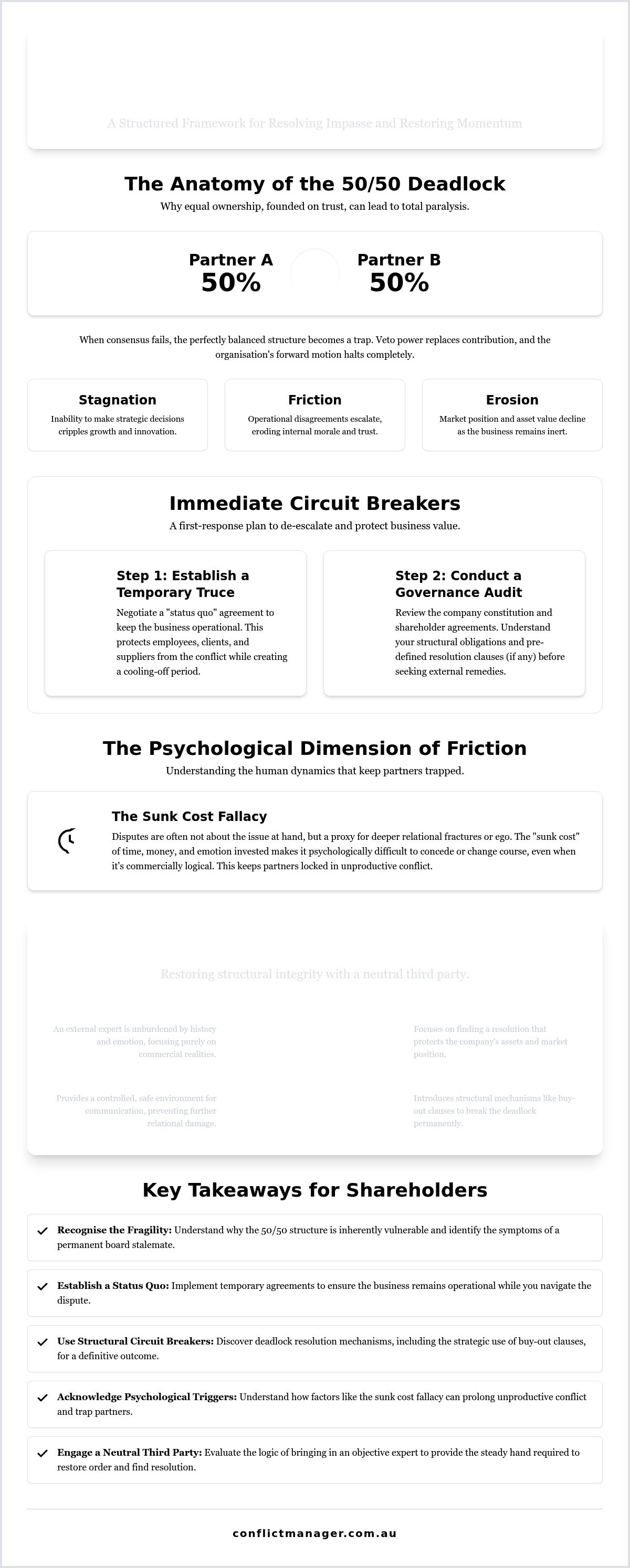
- Identify why the 50/50 structure is inherently fragile and how to recognise the symptoms of a permanent board stalemate.
- Learn how to establish temporary status quo agreements to ensure the business remains operational while you work through the dispute.
- Discover the mechanics of structural circuit breakers for resolving deadlocks between 50/50 shareholders, including the strategic use of buy-out clauses.
- Understand the psychological triggers, such as the sunk cost fallacy, that often keep partners trapped in unproductive conflict.
- Evaluate the logic of engaging a neutral third party to provide the objective perspective required to restore structural integrity.
The Anatomy of the 50/50 Deadlock: Why Equal Ownership Leads to Paralysis
Equilibrium. Fragility. Stasis. These qualities define the 50/50 shareholding structure when consensus evaporates. While equal ownership is often founded on a desire for fairness and mutual respect, it creates a structural environment where power is perfectly balanced and, consequently, perfectly neutralised. In this state, neither party can command the majority required to pass a resolution. A deadlock is a structural inability to move forward without external facilitation.
The cost of this inertia is rarely static. It accumulates. As shareholders remain locked in opposition, the organisation’s market position begins to erode. Competitors capitalise on the delay while internal morale begins to fracture. Crucially, we must distinguish between operational disagreements, which are common friction points in any healthy firm, and strategic deadlocks that threaten the very survival of the entity. Resolving deadlocks between 50/50 shareholders requires identifying whether the blockage is a temporary hurdle or a fundamental breakdown in governance.
The Structural Trap of Equal Authority
A 50/50 split often starts as a collaborative ideal but frequently ends as a defensive stalemate. When trust thins, the primary tool of the shareholder shifts from active contribution to the exercise of veto power. This is not just about saying "no". It is about the capacity to halt any forward motion. The tipping point occurs when the desire to protect one's position outweighs the collective goal of business growth. Without a pre-defined deadlock resolution clause, the path to progress is effectively barred by the very structure meant to ensure equality. The business becomes a passenger to the dispute.
Identifying the Core Source of Friction
Effective resolution requires an honest appraisal of the conflict’s origin. You must ask if the dispute is truly about a capital expenditure or a pivot in strategy. Often, the deadlock serves as a proxy for deeper relational fractures that have simmered beneath the surface for years. In many Australian family offices, these disputes are entangled with questions of legacy, ego, and multi-generational expectations. Resolving deadlocks between 50/50 shareholders necessitates looking past the balance sheet to understand the human dynamics at play. When the issue is personal rather than commercial, traditional business logic rarely suffices to break the cycle of opposition. Recognition of this reality is the first step toward restoring order.
Immediate Circuit Breakers: Navigating the Initial Stagnation
Tension. Friction. Paralysis. When a board reaches an impasse, the instinct is often to accelerate towards a final resolution or a legal confrontation. However, immediate de-escalation is the primary requirement for restoring a baseline of functional communication. A cooling-off period isn't a sign of weakness. It's a strategic pause designed to prevent permanent damage to the corporate structure. Resolving deadlocks between 50/50 shareholders requires a shift from reactive posturing to deliberate, methodical action.
The Power of the Temporary Truce
Negotiating a "holding pattern" is essential to protect asset value while the dispute is addressed. Shareholders should agree to a "status quo" arrangement, ensuring that the business remains operational and that day-to-day decisions continue without interference. This truce shields employees, clients, and suppliers from the board-level conflict. By setting strict boundaries for communication, you prevent further emotional erosion. This is where expert stakeholder facilitation becomes invaluable, as it provides a controlled environment for dialogue. Establishing these parameters ensures that the business doesn't suffer financial haemorrhaging while the partners seek a way forward.
A Methodical Audit of Existing Governance
Before seeking external legal remedies, you must conduct a clinical review of your internal framework. This process moves the focus from personal grievances to structural obligations. In Australia, if your company was formed without a bespoke agreement, you may be relying on the replaceable rules under the Corporations Act 2001. These rules are often insufficient for resolving deadlocks between 50/50 shareholders, as they don't provide a natural tie-breaker. A clear audit involves several steps:
- Step 1: Locate and review the specific wording of the company constitution and any existing shareholder agreements.
- Step 2: Identify any existing mediation or arbitration mandates that have already been agreed upon.
- Step 3: Document the specific points of disagreement with clinical objectivity, stripping away emotive language.
- Step 4: Engage a neutral facilitator to chair the next discussion.
The process of Preventing Shareholder Disputes often relies on these early-stage interventions. If your current governance documents lack clear "circuit breaker" provisions, this audit will highlight the exact gaps that need to be addressed. By identifying these structural deficiencies early, you can move toward a resolution that prioritises the health of the entity over the victory of the individual.
Structural Mechanisms for Long-Term Resolution
Resolution. Integrity. Finality. These are the objectives when moving from the stagnation of an impasse toward a sustainable governance structure. While immediate de-escalation provides breathing room, resolving deadlocks between 50/50 shareholders often requires more permanent structural adjustments. This transition doesn't just involve legalities; it's about shifting from a model based on veto power to one defined by decisiveness. Whether through the clean break of a buy-out or the introduction of a neutral third party, the goal is to restore the business's capacity to act.
Tie-Breaker Clauses and Buy-Sell Provisions
When a partnership reaches a terminal state, buy-sell provisions offer a methodical exit ramp. The "Russian Roulette" clause is a significant mechanism; it allows one shareholder to name a price, forcing the other to either buy at that price or sell their own shares for the same amount. It's a high-stakes strategy that ensures the price remains fair because the proposer must be willing to accept either side of the transaction. Similarly, a "Texas Shootout" involves sealed bids where the highest bidder buys out the other, while a "Dutch Auction" sees partners bid the lowest price they'll accept to leave. For those seeking less aggressive paths, "Put" and "Call" options provide a structured timeline for a partner to exit. Central to all these mechanics is the requirement for an independent valuation. Without a neutral assessment of the firm's worth, equity transfers often trigger further friction.
Introducing Neutral Governance
Not every deadlock requires a total exit. Often, the bottleneck can be cleared by introducing a third, neutral vote to the board. Appointing an independent director provides the tie-breaking capacity necessary for resolving deadlocks between 50/50 shareholders without dissolving the partnership. In the context of Australian family offices, a non-executive chair can offer the objective distance needed to separate familial history from commercial strategy. This external facilitator acts as a steady hand, ensuring that decisions are made based on the entity's best interests rather than personal leverage. By restructuring the board to include neutral governance, partners can maintain their equity while surrendering the capacity to cause operational paralysis. This approach preserves the business's legacy while allowing for the evolution of its leadership. It's a way to recognise that the entity's health must eventually supersede the individual's control.
The Psychological Dimension of Shareholder Friction
Trust. Identity. Loss. These are the visceral undercurrents that sustain a corporate stalemate long after the commercial logic has been exhausted. While the previous sections focused on the structural and legal mechanics of resolving deadlocks between 50/50 shareholders, the human element remains the most significant barrier to progress. Composure is the essential anchor in these moments. Without it, the board table becomes a theatre for unresolved grievances rather than a centre for strategic governance. Understanding the psychological drivers of conflict is not a secondary concern; it is the foundation upon which any lasting resolution must be built.
One of the most persistent obstacles is the "Sunk Cost" fallacy. Shareholders often cling to deadlocked positions out of a profound fear of loss, feeling that conceding any ground would dishonour years of personal sacrifice and financial investment. This often triggers a quiet identity crisis. When a partnership fractures, individuals may feel their professional standing or legacy is under threat. This perceived vulnerability leads to defensive posturing, where maintaining a veto becomes more important than the health of the organisation. Rebuilding trust requires acknowledging these fears and shifting the focus from individual victory to collective preservation.
High-Emotion Business Disputes
Commercial disagreements are frequently just the surface expression of unspoken grievances. In the Australian private sector, particularly within family offices, shareholder voting patterns are often dictated by decades of relational history rather than the current fiscal year's data. A dispute over a capital injection might actually be a proxy for a perceived lack of recognition or a shift in familial power. Developing a high degree of emotional intelligence is a prerequisite for structural resolution. When partners can recognise these triggers, they can begin to separate the person from the problem. This clarity allows for a more objective assessment of the business's needs, stripping away the emotional weight that prevents decisive action.
The Neutral Third Party as a Steady Hand
Internal attempts at resolution often fail because the participants are too emotionally entangled in the outcome. Every suggestion is viewed through a lens of suspicion, and every compromise feels like a defeat. This is where the logic of external intervention becomes undeniable. A neutral third party acts as a steady hand, capable of viewing a volatile situation with total objectivity. The role of the facilitator is to absorb and diffuse stakeholder anxiety, creating a controlled environment where clarity can emerge from the noise of the dispute. If you find your board caught in an emotional stalemate, engaging in professional organisational conflict management can provide the necessary objective distance to move forward. This expert-led facilitation ensures that the path toward resolving deadlocks between 50/50 shareholders remains methodical, logical, and, above all, composed.
The Logic of External Facilitation: Restoring Organisational Integrity
Stability. Momentum. Order. These are the primary dividends of external intervention. While partners often perceive the introduction of a third party as a surrender of autonomy, it's actually a strategic investment in the business’s longevity. Resolving deadlocks between 50/50 shareholders through professional facilitation allows for the restoration of organisational integrity without the destructive impact of public litigation. It provides a structured space where the weight of responsibility can be shared and the friction of interpersonal dynamics can be managed with professional distance. This methodical progression moves the reader from a state of complexity toward a vision of structured resolution.
Avoiding the Courtroom Trap
Litigation is a blunt instrument. For private Australian firms and high-net-worth family offices, the courtroom represents a significant reputational hazard. Public filings expose internal fractures to competitors, clients, and lenders, often devaluing the very assets the partners are fighting to protect. Court-ordered liquidation on just and equitable grounds is the nuclear option. It's a process that benefits no one, as it often results in the fire-sale of assets and the permanent dissolution of the entity's goodwill. Mediation serves as a confidential and controlled alternative to legal combat. It allows the parties to retain their agency while working toward a bespoke outcome that a judge simply cannot provide. By choosing a private path, you preserve the legacy you've built.
Engaging Conflict Manager
At Conflict Manager, we provide the steady hand required to navigate these high-stakes transitions. Our methodology for resolving deadlocks between 50/50 shareholders focuses on moving stakeholders from high-stress friction toward a vision of structured resolution. We act as a neutral party, viewing the situation with total objectivity to identify the structural and psychological blockages that internal efforts cannot reach. Our process is methodical and logical. It begins with an acknowledgement of the current disruption and moves through an analytical phase to find the most sustainable path forward. This approach ensures that the business remains the priority throughout the transition. By engaging in professional stakeholder facilitation, you choose a path of order over chaos. You can consult Conflict Manager to resolve your shareholder deadlock and begin the transition back to commercial momentum today. The path to resolution is deliberate and begins with the decision to seek clarity.
Restoring Momentum and Structural Integrity
A stalemate doesn't have to define your organisation's future. Success in resolving deadlocks between 50/50 shareholders depends on your ability to look beyond the immediate friction and focus on the long-term health of the entity. By implementing immediate circuit breakers and exploring structural buy-sell mechanisms, you can protect the business's value while addressing the psychological drivers that often fuel these disputes. Order and clarity are achievable when you pivot from defensive posturing toward a vision of structured resolution. This methodical approach ensures that the entity's survival remains the priority throughout the transition.
Our team provides expert-led mediation for high-net-worth families and organisations with national Australian expertise in organisational conflict. We focus on delivering sustainable outcomes for complex structural disputes, ensuring your legacy remains intact. You don't have to navigate this transition alone. Restore clarity to your organisation with Conflict Manager and move back toward commercial momentum. A clear path forward is within reach, provided you have the steady hand of a neutral third party to guide the way.
Frequently Asked Questions
What is a 50/50 shareholder deadlock and how does it affect business?
A deadlock occurs when two equal shareholders cannot agree on a strategic or operational decision, resulting in a total inability to pass resolutions. This stagnation leads to operational paralysis, financial haemorrhaging, and a loss of market position. It effectively traps the entity in a state of suspended animation where no forward progress is possible without external intervention or a structural change. The business becomes a passenger to the dispute.
Can a 50/50 shareholder fire the other in Australia?
No, one 50/50 shareholder cannot unilaterally dismiss the other from their role as a director or employee without a majority vote. Since neither party holds more than 50% of the voting power, a stalemate is inevitable unless specific provisions exist in the company constitution or a shareholder agreement. In most Australian private companies, removing a co-founder requires mutual consent or a court order, making internal resolution particularly complex.
How much does it cost to resolve a shareholder dispute through mediation?
The cost of mediation varies based on the complexity of the dispute and the value of the assets involved. Unlike litigation, which can consume substantial sums in legal fees and court costs, mediation is a more controlled investment in the business's longevity. It avoids the public reputational damage and the high financial burden of a courtroom battle. You should view these costs as a strategic reallocation of resources toward restoring organisational stability.
What happens if a 50/50 business has no shareholder agreement?
In the absence of a bespoke agreement, Australian companies fall back on the replaceable rules of the Corporations Act 2001. These rules are generally silent on resolving deadlocks between 50/50 shareholders, often leaving the parties with no clear internal path forward. This frequently forces shareholders toward the nuclear option of a winding up petition in court, where a judge may order the liquidation of the business on just and equitable grounds.
Is mediation legally binding for shareholder disputes?
Mediation itself is a voluntary and confidential process, but the settlement agreement reached at its conclusion is a legally binding contract. Once both parties sign a deed of settlement, the terms become enforceable in an Australian court of law. This provides a sense of finality and order. It allows the organisation to move from a state of volatility toward a vision of structured resolution with total legal certainty.
What is a "Texas Shootout" clause in a shareholder agreement?
A Texas Shootout is a structural circuit breaker where both shareholders submit sealed bids to purchase the other's interest in the company. The party with the highest bid is then obligated to buy the other's shares at that price. This mechanism ensures a clean break and provides a definitive exit ramp. It's designed to establish a fair market value through the pressure of competition, ending the deadlock through a final equity transfer.
How do we appoint an independent director to break a tie-vote?
Appointing an independent director typically requires an amendment to the company's constitution or a mutual resolution between the existing shareholders. This neutral third party provides the casting vote necessary to clear the 50/50 bottleneck on specific strategic matters. By introducing an objective perspective, the board can bypass personal friction and make decisions based purely on the commercial best interests of the Australian entity, restoring operational momentum and structural integrity.
Can Conflict Manager help with family office disputes specifically?
Yes, Conflict Manager specialises in stakeholder facilitation for high-net-worth families and family offices facing internal friction. We understand the unique psychological dimension of family business disputes, where legacy and emotional entanglement often complicate commercial strategy. Our methodology provides a steady hand to navigate these high-stakes environments. We act as a neutral third party that brings clarity to clouded situations and ensures the preservation of both assets and familial harmony.


