

What if the most significant risk to your family’s legacy isn't a volatile market, but the quiet erosion of trust between those meant to inherit it? Legacy. Friction. Resolution. When communication breaks down across generations, the structural integrity of an estate often begins to buckle under the weight of unspoken expectations and complex fiduciary obligations. Understanding the role of a mediator in family trust disputes is essential for those who wish to avoid the public scrutiny of a courtroom and the permanent fracturing of kinship.
You likely feel the immense pressure of maintaining order while navigating the delicate emotional landscape of your family's history. It's a difficult reality to face, especially when internal efforts to find common ground only seem to deepen the divide. This guide will show you how a professional mediator acts as a steady, objective hand to facilitate these transitions, ensuring that wealth remains a tool for connection rather than a source of conflict. We will examine the path toward confidential resolution, the clarity required for effective trust governance, and the methods used to honour a legacy without sacrificing the relationships that give it meaning.
Key Takeaways
- Complexity. Friction. Fiduciary duty. Understand why the intersection of family history and legal obligations requires a specialised approach that traditional litigation cannot provide.
- Gain insight into the specific role of a mediator in family trust disputes as a neutral third party who brings order and composure to volatile situations.
- Privacy. Discretion. Asset protection. Discover how mediation keeps sensitive family matters out of the public record while avoiding the significant delays of the court system.
- Learn the methodical steps of the mediation process, focusing on how stakeholders can achieve clarity and sustainable governance through structured dialogue.
- Explore the logic of external intervention for preserving both the structural integrity of family wealth and the intergenerational relationships that sustain it.
Understanding the Complexity of Family Trust Disputes
Wealth. Duty. Expectation. A family trust is more than a tax-effective structure or a vehicle for asset protection; it's often the physical manifestation of a family's history and its future ambitions. When friction arises, it rarely stays confined to the technicalities of the trust deed. Instead, the dispute often bleeds into the personal, where fiduciary obligations meet intergenerational grievances. This intersection creates a unique form of pressure that can destabilise even the most robust financial foundations.
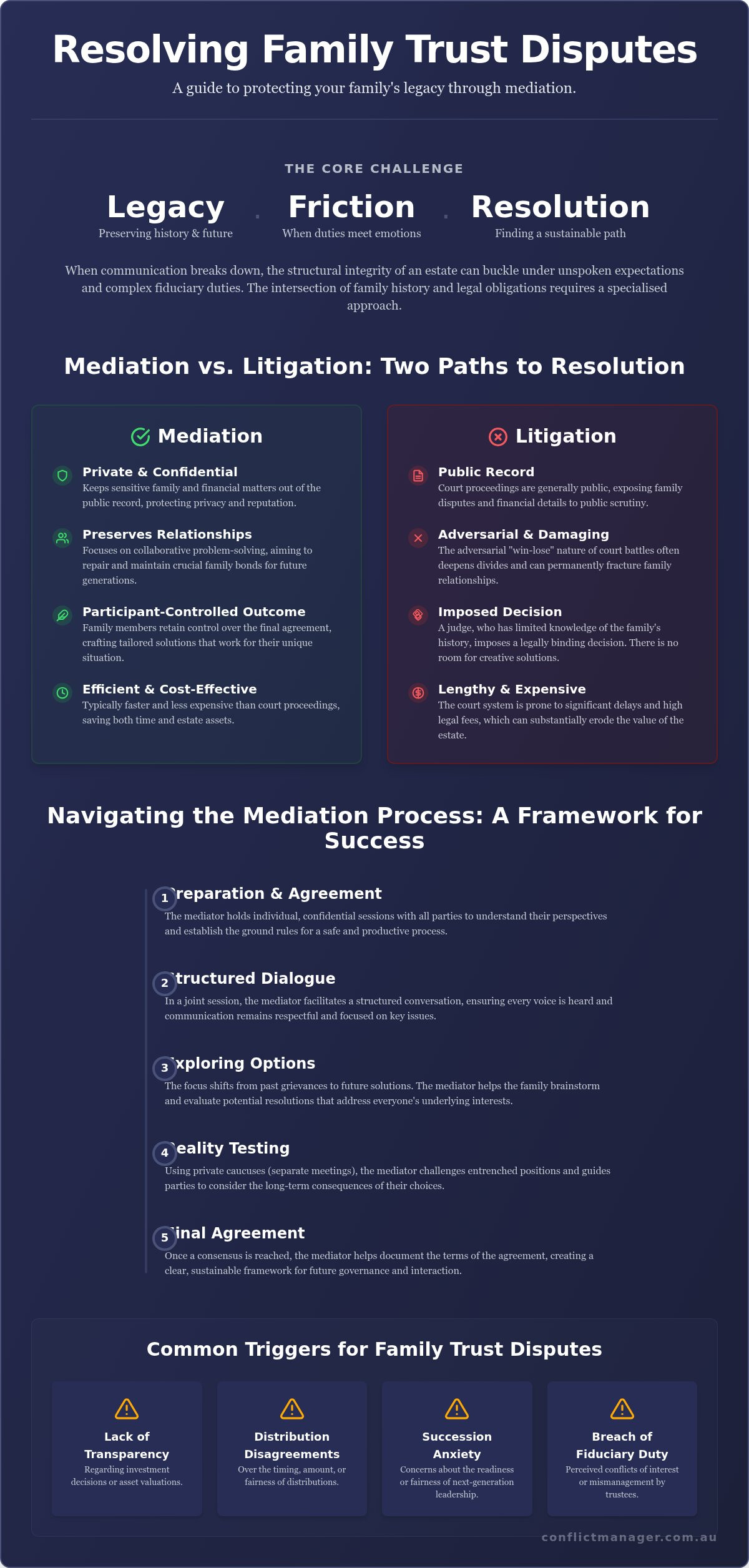
Traditional legal channels frequently struggle in this environment. The adversarial nature of litigation tends to sharpen divides rather than heal them. It forces family members into opposing camps, where the focus shifts from finding a sustainable resolution to winning a legal argument. This is where the role of a mediator in family trust disputes proves vital. By removing the threat of public judgment, a mediator creates space for a different kind of conversation. Common triggers for these disputes include:
- A lack of transparency regarding investment decisions or asset valuations.
- Disagreements over the timing and amount of distributions.
- Anxiety surrounding succession planning and the readiness of the next generation.
- Perceived breaches of fiduciary duty by trustees who are also family members.
The Structural vs. Emotional Divide
Conflict often stems from a fundamental mismatch between legal rights and relational needs. A trust deed provides the rules, but it can't manage the resentment that builds when a beneficiary feels unheard or sidelined. Mediation serves as a bridge between these two realities. It allows stakeholders to address the structural requirements of the trust while acknowledging the emotional weight behind the disagreement. Without this balance, a resolution might be legally sound but relationally hollow, leaving the family legacy vulnerable to future fractures.
The Role of the Family Office in Conflict
In high-net-worth environments, the family office often finds itself at the centre of the storm. While these structures are designed to provide stability, they can also become breeding grounds for entrenched positions. Trustees may feel they're honouring the founder's intent, while beneficiaries may feel trapped by outdated governance models. The role of a mediator in family trust disputes is to view these volatile situations with total objectivity. By facilitating a dialogue that prioritises the integrity of the assets and the health of the family unit, a mediator helps move stakeholders from a state of disruption toward a vision of structured, long-term order. Silence is often the greatest risk; unaddressed tension doesn't disappear, it simply waits for the next transition to resurface.
The Essential Functions of a Mediator in Trust Resolutions
A mediator enters a volatile situation with total objectivity. They aren't there to judge or impose a verdict, but to provide a confidential environment for sensitive financial disclosures that families would prefer to keep private. In the role of a mediator in family trust disputes, the first priority is often de-escalating high-emotion friction that has likely built up over years. They act as a steady hand, translating complex legal positions into shared family interests and moving the focus away from winning toward functioning.
Facilitating Clarity and Objective Communication
Order. Neutrality. Progression. Circular arguments are the death of resolution. A mediator organises the conversation to prevent stakeholders from falling back into well-worn patterns of blame. Through active listening, they uncover hidden motivations that trust deeds alone cannot address. This methodical approach establishes a thematic foundation for resolution, ensuring every voice is heard without allowing any single party to dominate the dialogue. It's about stripping away the noise to find the core structural issues at play.
Reality Testing and Perspective Shifting
Parties often enter mediation with entrenched views on their legal rights. A skilled mediator uses reality testing to challenge these assumptions in a non-confrontational manner. This involves guiding stakeholders to consider the long-term consequences of their choices, including the financial and relational toll of a public battle. When deciding on Mediation Vs Litigation, families must weigh the speed of private resolution against the unpredictable nature of court rulings. Beneficiaries are often helped to understand the immense weight of a trustee's fiduciary duties, which can shift the perspective from suspicion to empathy. This shift is essential for breaking the deadlock of internal friction.
Designing Sustainable and Clear Outcomes
Short-term fixes rarely last in multi-generational wealth structures. The goal is to create long-term governance frameworks that align with the original intent of the trust. By ensuring all parties feel their interests have been considered, the mediator improves the durability of the final agreement. This process moves the family from a state of disruption toward a vision of structured order. For those seeking a composed approach to family wealth resolution, this external perspective is often the only way to preserve the integrity of the estate while restoring the balance of interpersonal dynamics. The role of a mediator in family trust disputes is ultimately to design a path forward that all stakeholders can support.
Mediation vs. Litigation: Protecting Privacy and Assets
Litigation is a blunt instrument. In the Australian legal system, court proceedings are generally open to the public, meaning sensitive financial structures and private family grievances can be accessed by the media or competitors. For high-net-worth families, this transparency is rarely a desirable outcome. The role of a mediator in family trust disputes is to act as a shield, providing a confidential forum where stakeholders can resolve friction without the risk of public exposure. While a judge is bound by rigid legal precedents, a mediator has the flexibility to help families design creative, bespoke solutions that the court simply cannot order.
The permanent fragmentation of family bonds is a common side effect of protracted legal battles. Litigation focuses on "winning," which often requires attacking the character or competence of other family members. This adversarial approach creates deep-seated resentment that persists long after a verdict is reached. Mediation, by contrast, prioritises the preservation of the relationship. It moves the conversation away from blame and toward a shared vision of the future, ensuring the family unit remains intact to oversee the legacy they've built.
Confidentiality as a Strategic Asset
Privacy. Discretion. Reputation. These are the hallmarks of a successful wealth transition. Private families often prefer the quiet confidence of a closed-door resolution to avoid the scrutiny that follows public trust disputes. By keeping the details of trust distributions and governance issues private, families protect their standing within the broader business community. A mediator ensures that sensitive disclosures remain within the room, allowing parties to speak honestly without fear that their words will be used against them in a public forum or reported in the financial press.
Cost Control and Asset Integrity
Protracted legal battles are an immense drain on a trust’s capital. In many cases, a full trial can cost between $200,000 and $500,000 or more, significantly depleting the very assets the dispute is meant to protect. Beyond the direct legal fees, the Australian court backlog means that a resolution through litigation can take years to achieve. During this time, the trust’s investment strategy may be paralysed by uncertainty. Mediation offers a more efficient path, often reaching a sustainable resolution in a matter of days or weeks. This speed allows the family to maintain a steady hand over their investments and prevents the erosion of the estate’s value through unnecessary administrative and legal costs.
Navigating the Mediation Process: A Framework for Success
Structure. Sequence. Finality. A successful mediation isn't a happy accident; it's the result of a disciplined framework designed to move stakeholders from a state of reactive friction toward a sustainable governance model. The role of a mediator in family trust disputes begins well before the parties enter the room. It starts with an initial consultation to assess whether the dispute is suitable for mediation and to identify the specific structural or emotional blocks preventing a resolution. In the Australian legal context, pre-litigation mediation is often a formal requirement for trust matters, yet the most effective resolutions come from a voluntary commitment to the process.
Preparation: Setting the Stage for Resolution
Effective preparation ensures that the session doesn't devolve into a repeat of previous failed arguments. This phase involves identifying all key stakeholders, including those who might not be named beneficiaries but hold significant influence over the family dynamic. Advisors, such as accountants and lawyers, play a critical role here. They provide the necessary financial and legal data, allowing the mediator to focus on the interpersonal friction. Mentally preparing for these conversations is equally important. It requires stakeholders to shift from an adversarial mindset to one focused on long-term stability and problem-solving.
The Session: From Friction to Stability
During the session, the mediator manages the rhythm of the day, ensuring the dialogue remains productive and objective. If the conversation reaches a stalemate, the mediator may use caucuses, which are private meetings with individual parties. These sessions allow for honest reflection without the pressure of an audience. The goal is to move from abstract concepts like trust, legacy, or fairness to concrete, actionable steps. This methodical progression ensures that the final agreement isn't just a temporary truce, but a binding path forward that protects both the assets and the family legacy. If you require a structured approach to resolve your current impasse, you can enquire about our family conflict resolution services to begin this process.
The final stage is the documentation of the agreement. This isn't merely a summary of the day; it's a clear, binding roadmap that outlines future governance and distribution. By capturing the resolution in writing, the mediator ensures that the clarity achieved during the session is preserved for years to come. This finality is what provides the steady hand families need to move forward with confidence, knowing their wealth and relationships are no longer at risk of public or private collapse.
Conflict Manager: A Steady Hand in Family Wealth Resolution
Integrity. Continuity. Resolution. When the structural foundations of a family trust are tested by internal friction, the path forward often feels clouded by emotion and legal complexity. Conflict Manager provides the composed authority needed to restore order. We specialise in family office mediation, offering a steady hand to high-net-worth families across Australia who seek to preserve both their assets and their kinship. By acting as a wise external counsellor, we help stakeholders navigate difficult transitions without becoming emotionally entangled in the dispute.
Our expertise in the role of a mediator in family trust disputes allows us to address the root causes of organisational friction with precision. We understand the weight of responsibility that comes with managing multi-generational wealth; therefore, our approach is always grounded in a deep understanding of human and structural dynamics. We move the conversation from a state of disruption toward a logical sequence of resolution, ensuring that every stakeholder feels heard while maintaining the integrity of the trust deed. This methodical flow is essential for building trust in high-stakes environments where the preservation of legacy is the ultimate priority.
Bespoke Mediation for High-Net-Worth Families
Sustainable outcomes require more than a temporary agreement. We focus on creating long-term governance frameworks that reflect the original intent of the family legacy. Our mediation process is bespoke, tailored to the unique needs of families navigating high-emotion transitions. By maintaining total objectivity in volatile situations, we provide a reassuring path toward stability. This external perspective is often the only way to break through entrenched positions and find a way forward that honours the family’s history. Our approach focuses on specific pillars of resolution:
- Establishing a neutral and confidential ground for objective dialogue.
- Identifying the underlying interests and motivations of all beneficiaries.
- Crafting governance models that prevent future structural friction.
- Ensuring the long-term integrity of the trust’s assets.
Taking the First Step Toward Clarity
Early intervention is critical. Engaging an external mediator before positions become fully entrenched can save significant time, cost, and relational damage. Initiating this conversation with other family members can be difficult, but it's a necessary step toward protecting the estate from the risks of public litigation. We suggest framing the discussion around the shared goal of legacy preservation and the benefits of a confidential, private resolution. Moving from a state of complexity toward a vision of structured resolution requires a steady hand and an objective voice. Contact Conflict Manager for a confidential discussion regarding your family trust dispute.
Securing Your Family’s Legacy Through Structured Resolution
Wealth. Legacy. Continuity. Preserving the integrity of a family trust requires more than just legal compliance; it demands a sophisticated approach to interpersonal friction. This guide has detailed how the role of a mediator in family trust disputes provides a confidential path away from public litigation and toward sustainable governance. By prioritising discretion and objective dialogue, families can avoid the permanent fragmentation of bonds that often follows adversarial court battles.
Clarity is the foundation of any enduring estate. Whether you're navigating high-emotion transitions or complex distribution disagreements, the presence of a steady, external hand ensures that decisions are made with total objectivity. Conflict Manager brings specialised expertise in family office mediation to help you reach sustainable resolution outcomes. Restore clarity to your family trust—enquire about our mediation services today. You don't have to navigate these volatile transitions alone; order and legacy are within reach.
Frequently Asked Questions
What is the specific role of a mediator in a family trust dispute?
The primary role of a mediator in family trust disputes is to act as a neutral third party who facilitates objective dialogue between trustees and beneficiaries. They provide a confidential environment where sensitive financial friction can be addressed without the fear of public exposure. By de-escalating high-emotion conflicts and translating complex legal positions into shared family interests, they move the group from a state of disruption toward a vision of structured, long-term order.
Is mediation compulsory for trust disputes in Australia?
Mediation is frequently a mandatory requirement in the Australian legal system before a trust dispute can proceed to a full court hearing. Judges often direct parties to attempt alternative dispute resolution to ensure that every effort has been made to resolve the matter privately. This requirement reflects the court's preference for families to maintain control over their legacy and assets through a structured, facilitated conversation rather than a public judgment.
How long does the mediation process typically take for complex trusts?
A private mediation session can often reach a sustainable resolution in a matter of days or weeks. This efficiency highlights the vital role of a mediator in family trust disputes, especially when compared to the Australian court system where backlogs and procedural requirements can delay a trial for several years. For complex trusts involving multiple stakeholders, the timeline depends on the readiness of all parties to engage in the structured dialogue necessary for a durable agreement.
Can a mediator provide legal advice during the session?
A mediator does not provide legal advice or act as a legal representative for any party involved in the dispute. Their purpose is to remain totally objective, acting as a guide through the friction of interpersonal dynamics rather than a source of legal counsel. Stakeholders are encouraged to have their own legal advisors present to ensure their rights are protected while the mediator focuses on facilitating a clear and sustainable governance model.
What happens if we cannot reach an agreement during mediation?
If an agreement isn't reached, the parties remain free to pursue other avenues, including litigation in the Australian court system. Mediation is a voluntary process that only becomes binding once a formal settlement agreement is signed by all stakeholders. Even if a full resolution isn't achieved, the process often brings clarity to specific issues, which can simplify future legal proceedings or lead to a partial agreement that reduces ongoing friction.
How much does family trust mediation cost compared to going to court?
Settling a trust dispute through mediation typically costs between $65,000 and $140,000, which is significantly less than a full trial. Research indicates that a court trial can cost between $200,000 and $500,000 or more, often depleting the trust's capital and harming the family legacy. By choosing mediation, families can save between $100,000 and $350,000 while maintaining a steady hand over their assets during the resolution process.
Is the outcome of mediation legally binding in Australia?
The outcome of a mediation session becomes legally binding once all parties sign a written settlement agreement. In Australia, this document functions as a contract that can be enforced by the courts if any party fails to honour the agreed terms. This finality provides the structural integrity and order needed for families to move forward with confidence, knowing that the governance and distribution of the trust are clearly defined.
Who should attend the mediation session for a family office dispute?
Trustees, beneficiaries, and key decision-makers within the family office should attend the mediation session to ensure a comprehensive resolution. It's also common for professional advisors, such as accountants or lawyers, to be present to provide technical data and support. The goal is to have every stakeholder who has the authority to settle the dispute in the room, allowing for a methodical progression from complexity toward a final, binding agreement.


