

With over A$5.4 trillion set to pass between generations in Australia over the next two decades, why do so many families allow this transition to become a source of permanent fracture? Legacy. Stability. Continuity. These pillars of wealth often crumble when internal friction takes hold, making the task of preserving family relationships during wealth disputes feel like an impossible feat. You're likely facing the heavy pressure of frozen assets or the looming shadow of a public scandal. It's exhausting to manage this emotional weight alongside the financial stakes, especially when communication has completely stalled.
It's natural to feel that litigation is the only way forward when positions become entrenched. However, you deserve a structured, expert-led path that secures a sustainable financial outcome without destroying your most vital bonds. This article outlines a methodical approach to conflict resolution that avoids the noise and exposure of the courtroom. You'll discover how a neutral, external perspective can bring clarity to clouded dynamics, moving your family from a state of disruption toward a vision of restored order and long-term asset integrity.
Key Takeaways
- Understand how living governance bridges the gap between founding visions and multi-generational stewardship.
- Prioritise private mediation over public litigation as the most effective path for preserving family relationships during wealth disputes.
- Address the psychological weight of legacy to resolve the root causes of friction rather than just the financial symptoms.
- Follow a structured framework that begins with assessing stakeholder readiness to ensure a stable, neutral ground for resolution.
- Leverage specialised facilitation to navigate the intricate dynamics of family office structures and protect your financial legacy.
The Intersection of Legacy and Friction: Understanding Family Wealth Disputes
Disputes regarding family wealth are frequently reduced to mere legal disagreements over wills or trust deeds. This narrow lens fails to capture the true gravity of the situation. In high-net-worth environments, wealth is rarely just currency; it is identity. It is a symbol of a founder’s sacrifice and a successor’s worth. When friction arises, traditional legal pathways often intensify the heat by forcing parties into adversarial stances. These routes prioritise technical entitlements over emotional continuity. A neutral third party acts as a steady hand. By lowering the emotional pulse of the room, they allow stakeholders to see past the immediate conflict toward the long-term goal of preserving family relationships during wealth disputes.
The Anatomy of a Wealth Dispute
Control. Recognition. Security. These abstract forces drive the majority of disagreements. Financial assets often become convenient proxies for deep-seated interpersonal grievances that have simmered for decades. A dispute over a specific property portfolio or a shareholding might actually be a plea for acknowledgement or a manifestation of a fear of being sidelined. We define family wealth dispute resolution as a process of restoring structural order to a family’s financial affairs. Through family mediation, families can address these psychological drivers in a private setting that respects the nuance of their history. This approach ensures that the settlement isn't just a division of capital, but a reconstruction of trust.
Why High Net Worth Families are Uniquely Vulnerable
High-net-worth families operate within a web of multi-layered assets. Family trusts, private equity holdings, and complex corporate structures create a landscape where a single disagreement can freeze millions in capital. The boundaries between family roles and professional duties are often non-existent. A sibling is also a co-director; a parent is also the primary trustee. This overlap means that personal friction quickly threatens the integrity of the family office. Without clear structural boundaries, the noise of the dispute can devalue the very legacy everyone is fighting to protect. Preserving family relationships during wealth disputes requires uncoupling these professional roles from personal histories to find a path that serves the balance sheet and the family unit equally.
Governance Gaps and the Multi-Generational Divide
Legacy. Authority. Transition. The evolution from the founder era to the stewardship era is rarely a seamless process; it is a complex transition where the singular vision of a creator meets the diverse aspirations of multiple successors. While many Australian families rely on trust deeds and formal wills to manage this change, governance is actually a living practice of communication and shared decision-making rather than a collection of static legal folders. When governance is viewed only as a technical requirement, it fails to address the shifting values of younger family members who may prioritise different investment strategies or social outcomes. The cost of silence in these moments is high. Avoiding difficult conversations leads to a slow decay of the family's structural integrity, allowing minor disagreements to fester into deep-seated resentment. Adopting frameworks like the 6 C's of Managing Family Business Conflicts can help families move from reactive friction to proactive governance.
Intergenerational Succession Pressures
Succession is not merely a transfer of capital; it is a transfer of power and identity. For the incumbent generation, wealth often represents a lifetime of risk and achievement, leading them to use inheritance as a tool for continued control. Conversely, the rising generation may feel stifled by a legacy they didn't build, creating a friction that threatens the very assets they are meant to inherit. Preserving family relationships during wealth disputes requires the facilitation of a shared vision that respects the history of the wealth while creating space for new leadership to emerge without the shadow of constant overreach.
The Role of the Family Office in Conflict
The family office often finds itself at the centre of these intergenerational storms. Staff and professional advisors can become unintentional participants in internal disputes, which quickly erodes the objective distance required for sound financial management. Preserving family relationships during wealth disputes becomes significantly more difficult when the family office board becomes a battleground for personal grievances. Maintaining stability during periods of significant structural change requires a steady, external hand to manage the human dynamics. If your internal team is struggling to navigate these tensions, seeking professional stakeholder facilitation can restore the necessary boundaries to protect both your assets and your family unit.
The Quiet Path: Mediation vs. the Adversarial Courtroom
Publicity. Binary outcomes. Exhaustion. Litigation is a blunt instrument designed for legal finality rather than relational restoration. While some traditional legal perspectives suggest that the courtroom is the most effective venue to protect interests, this view often overlooks the irreparable damage an adversarial process inflicts on the family bond. Mediation offers a private, bespoke environment where the focus remains on nuanced resolution rather than a simple win or loss. By opting for a facilitated path, stakeholders can achieve a significant financial and emotional return on investment. This approach secures the family’s public reputation through confidential management, ensuring that internal friction doesn't become a matter of public record.
Evaluating the Adversarial Approach
Court proceedings are inherently public and rigid. In Australia, a contested family law matter can take between 12 and 24 months to reach a final hearing, leaving assets frozen and legacies in limbo during the interim. This extended timeline creates a period of intense financial instability that can devalue complex holdings and disrupt the operation of family offices. Litigation costs are equally prohibitive, frequently ranging from A$30,000 to over A$150,000 per side in legal fees. Beyond the capital drain, the risk of a judge-led outcome is high. A court may impose a binary decision that satisfies neither party, often resulting in a total breakdown of the family unit that persists long after the legal files are closed.
The Benefits of Professional Facilitation
Clarity. Cooperation. Innovation. Professional facilitation provides a structured dialogue that moves beyond the rigid constraints of a courtroom. It allows for creative outcomes, such as restructuring a family trust or establishing new governance protocols, which a court simply cannot order. This flexibility is essential for preserving family relationships during wealth disputes, as it prioritises the functional future of the group over historical grievances. Achieving clarity through objective observation ensures that every stakeholder feels heard without the need for aggressive posturing. By maintaining the integrity of family trusts through cooperation, you can resolve friction while keeping the family’s private affairs away from the noise of the public domain.
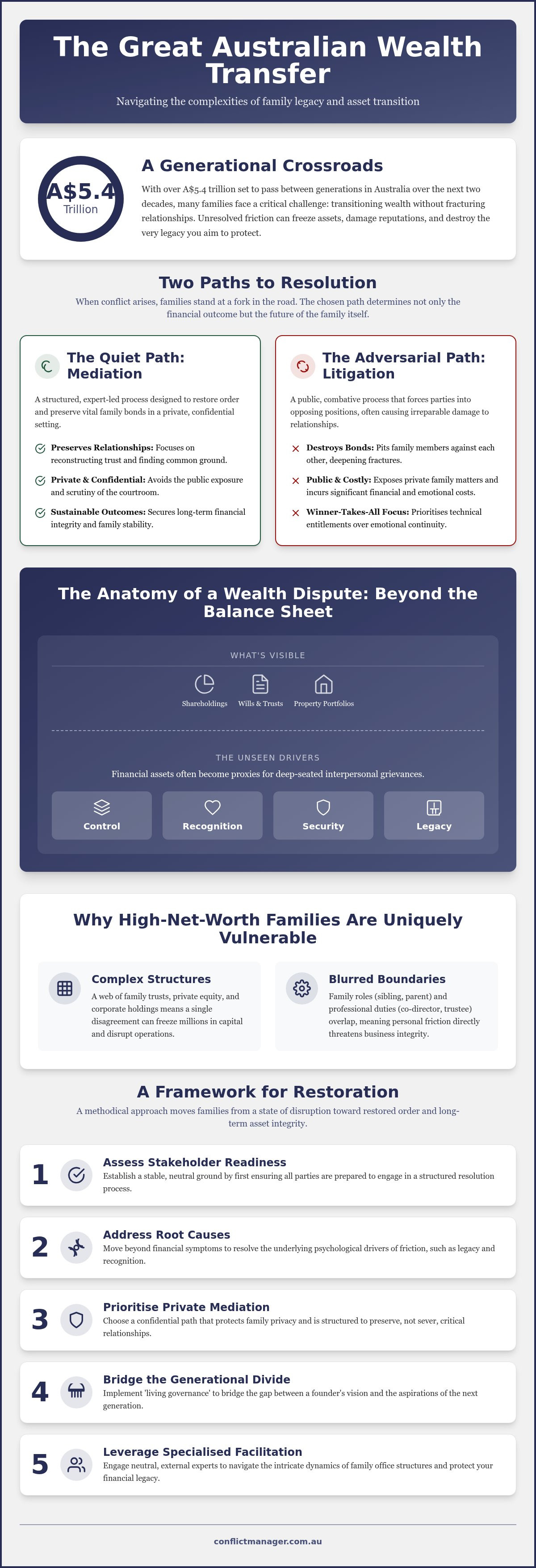
Frameworks for Restoration: Steps to Resolve Wealth Disputes
Assessment. Readiness. Neutrality. A successful resolution doesn't manifest through luck; it's the result of a deliberate, structured framework that prioritises order over impulse. The initial phase involves a careful assessment to determine the readiness of all stakeholders to engage in a process that requires both transparency and a willingness to move forward. Establishing a neutral ground for communication is paramount. It ensures that the environment itself doesn't become a source of leverage or discomfort for any participant. By identifying the core drivers of friction, we move beyond surface-level financial disputes to address the structural and psychological roots of the conflict. This methodical approach is essential for preserving family relationships during wealth disputes, as it transforms a volatile environment into a manageable transition. Developing a sustainable resolution plan ensures that the outcome accounts for future generational shifts and provides a clear map for the family's shared financial future.
Preparing for the Facilitation Process
The role of professional advisors, such as lawyers and accountants, must be carefully integrated into the mediation room. While these professionals provide the technical data and legal context necessary for a settlement, their function here is to support the facilitation rather than to lead an adversarial charge. Setting clear Rules of Engagement is a prerequisite for success. These guidelines ensure that dialogue remains respectful, productive, and focused on the future rather than litigating the past. It's equally necessary to acknowledge the emotional reality of the dispute. Ignoring the human element often leads to a breakdown in the technical settlement, as unresolved resentment can quietly sabotage even the most logically sound financial agreements.
Crafting Sustainable Outcomes
Sustainable outcomes are defined by their ability to remain robust under future family pressure, ensuring that the resolution survives the inevitable shifts in interpersonal dynamics. To achieve this, we move from rigid positions, which are the specific demands each person makes, to underlying interests. These interests represent the fundamental needs for security, recognition, or autonomy. This shift is a cornerstone of preserving family relationships during wealth disputes, as it prioritises the collective health of the family unit over individual victory. Once an agreement is reached, documenting the resolution in a clear, accessible format provides the long-term stability required to prevent the same friction from resurfacing during the next generational transition. If your family is ready to move from disruption to order, engaging in professional family conflict resolution provides the structured path needed to protect your legacy and your bonds.
Conflict Manager: Facilitating Clarity for Australian Families
Authority. Stability. Discernment. Conflict Manager provides a steady hand for Australian high-net-worth families facing periods of intense friction. Our approach is grounded in a deep understanding of the unique dynamics within family offices and complex wealth structures. We don't just manage the surface-level symptoms of a disagreement. We address the underlying structural gaps that allow conflict to take root. By maintaining total objectivity as a neutral third party, we bring a sense of order to high-stakes environments where emotions often cloud the path to resolution. This focus on clarity is essential for preserving family relationships during wealth disputes, ensuring that the financial legacy remains intact while the family unit finds a way to function effectively again. We act as a compassionate guide, viewing volatile situations with total objectivity to move stakeholders from complexity toward a vision of structured resolution.
The Value of an External Counsellor
Internal attempts at resolution often fail because they are tethered to historical biases. Siblings, parents, and trustees are often too emotionally entangled to view the situation with the necessary distance. A seasoned professional remains unruffled by the high-emotion nature of these disputes. We provide a vision of structured resolution where there was previously only complexity. This external perspective allows for the navigation of difficult transitions without the baggage of past grievances. It moves the conversation from a cycle of blame to a methodical evaluation of future possibilities. The rhythm of our process is slow and deliberate, designed to lower the pulse of the room and build trust through a logical sequence of interventions.
Securing the Family Legacy
Logic. Neutrality. Restoration. The ultimate goal is a family office that operates with total structural integrity. Facilitated governance ensures that wealth is preserved for future generations, not just through legal documents, but through a living practice of cooperation. preserving family relationships during wealth disputes requires a bespoke path that respects the weight of your responsibility. We guide families through these transitions with a steady hand, ensuring that the resolution is as robust as the assets it protects. Our expertise in family office friction allows us to see the human and structural dynamics that others might overlook. You can contact Conflict Manager to discuss how our stakeholder facilitation services can restore stability to your family's financial and personal affairs. We provide the neutral ground necessary for functional communication to resume and for your legacy to be secured.
Restoring Order to Your Family Legacy
Resolution. Clarity. Continuity. Navigating a high-stakes wealth dispute requires more than a legal settlement; it demands a total restoration of the family’s structural integrity. We’ve examined how moving from the public noise of litigation to the quiet path of private mediation protects both your financial interests and your privacy. We’ve also highlighted that governance must be a living practice of communication to bridge the multi-generational divide. By prioritising shared interests over rigid positions, preserving family relationships during wealth disputes becomes a tangible reality rather than an elusive goal.
Conflict Manager offers expert-led facilitation for high-net-worth families, providing the composed, objective, and neutral third-party guidance necessary to secure sustainable outcomes focused on your family legacy. You don't have to navigate these complex human and structural dynamics without support. A steady, external hand brings order to periods of high stress, ensuring your assets and your bonds remain intact for the generations that follow. Begin a composed path toward resolution with Conflict Manager and secure the future of your family’s financial and emotional heritage.
Frequently Asked Questions
What is the difference between family wealth mediation and legal representation?
Mediation is a neutral facilitation process focused on mutual agreement, while legal representation involves an advocate fighting for one party's specific entitlements. Conflict Manager provides stakeholder facilitation rather than legal advice. We focus on the structural and human dynamics to find a path forward that satisfies all parties. This approach prioritises the family unit's long-term health over a binary win-loss outcome typically found in adversarial legal settings.
Can a dispute be resolved if family members are no longer on speaking terms?
Resolution is possible even when communication has completely broken down. We use structured techniques like shuttle mediation, where the facilitator moves between separate rooms to convey interests without direct confrontation. This creates a buffer that lowers the emotional pulse. It allows for the gradual rebuilding of a functional dialogue, which is a critical step in preserving family relationships during wealth disputes when direct contact feels too volatile.
How long does the family wealth dispute resolution process typically take?
The timeline varies based on the complexity of the assets and the readiness of the stakeholders. While Australian litigation can take 12 to 24 months, a facilitated resolution is typically much faster, often concluding within a few months of intensive sessions. This efficiency prevents the long-term financial instability associated with frozen assets. We move at a deliberate pace that ensures thoroughness without the artificial delays of the court system.
Is the mediation process confidential for high-profile families in Australia?
Confidentiality is a cornerstone of the mediation process in Australia. Unlike the public nature of the Federal Circuit and Family Court of Australia, mediation occurs in a private environment. All discussions and documents shared during the process are protected by strict confidentiality agreements. This ensures that high-profile families can resolve internal friction without the risk of public scandal or reputational damage that often accompanies open court proceedings.
What happens if we cannot reach an agreement through facilitation?
If a total agreement isn't reached, the parties remain free to pursue other avenues. However, the facilitation process often clarifies the core issues and narrows the scope of the dispute. Even a partial agreement can restore a level of structural order. Most families find that the insights gained during the process provide a roadmap for future resolution, even if a final settlement isn't achieved in the initial sessions.
Do we need to have a formal family office structure to engage your services?
No, a formal family office is not a prerequisite for our services. We work with a wide range of high-net-worth families, including those with private companies, family trusts, or diverse investment portfolios. Whether your wealth is managed through a sophisticated office or a more informal structure, the focus remains on resolving the interpersonal friction that threatens asset integrity. We adapt our facilitation framework to match your family's specific organisational needs.
How does family wealth mediation protect our long-term assets?
Mediation protects assets by preventing the value destruction caused by prolonged conflict and frozen capital. By establishing clear governance and shared vision, we ensure that the family legacy remains robust under pressure. This is a vital component of preserving family relationships during wealth disputes, as it removes the financial stress that often fuels personal resentment. Structured resolution ensures that assets are managed with continuity rather than being liquidated under court order.
Can mediation address disputes involving family trusts and estates?
Mediation is highly effective for disputes involving family trusts, estates, and complex inheritance matters. While legal documents provide the technical framework, mediation addresses the underlying disagreements regarding control and distribution that the documents themselves cannot solve. We facilitate a dialogue that respects the founder's original intent while accounting for the current needs of beneficiaries. This approach ensures that the trust remains a tool for legacy rather than a source of permanent fracture.


