

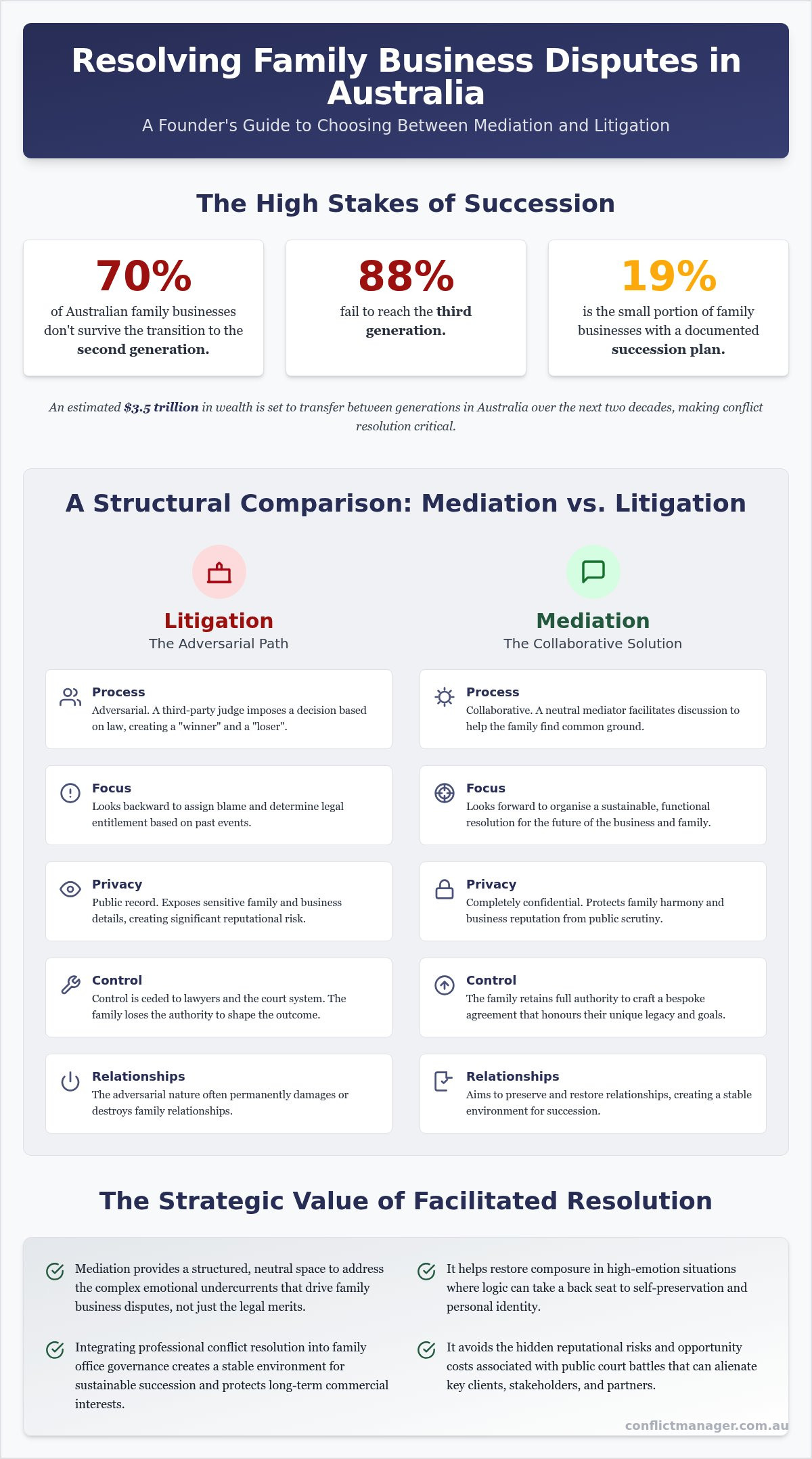
Seventy per cent of Australian family businesses don't survive the transition to the second generation, and a staggering eighty-eight per cent fail to reach the third. Legacy. Continuity. Friction. These are the forces at play when internal disputes arise, making the choice of mediation vs litigation for family business one of the most critical decisions a founder will ever face. While the instinct might be to seek a definitive ruling in court, the public nature of the legal system often exposes sensitive details that can permanently damage a hard-earned reputation.
You're likely feeling the weight of mounting legal costs and the exhaustion that comes from long-standing sibling or intergenerational friction. It's a heavy burden to carry, especially when the future of the estate feels like it's hanging by a thread. This guide explores how to choose between the adversarial nature of litigation and the restorative potential of mediation to protect your family legacy. We'll look at the privacy benefits of alternative dispute resolution and provide the clarity you need to organise a sustainable succession plan that keeps the business intact.
Key Takeaways
- Understand why traditional legal frameworks often fail to address the complex emotional undercurrents that drive family business disputes.
- Compare the structural differences of mediation vs litigation for family business to identify which path preserves your privacy and long-term commercial interests.
- Evaluate the hidden reputational risks and opportunity costs associated with public court battles that can alienate key stakeholders and partners.
- Use a strategic framework to determine if internal communication can still be salvaged before a conflict reaches the point of no return.
- Learn how integrating professional conflict resolution into your family office governance creates a stable environment for sustainable succession.
The Unique Friction of Family Business: Why Standard Resolution Fails
Conflict in a family enterprise isn't merely a commercial disagreement; it's a collision of history, identity, and shared future. Standard resolution models often falter because they treat the business as a sterile entity, separate from the dinner table. When assessing mediation vs litigation for family business, one must recognise that traditional HR policies or rigid legal frameworks typically address the symptoms rather than the source. These approaches overlook the subterranean emotional undercurrents that dictate how decisions are actually made behind closed doors. Unresolved friction acts as a silent tax on the organisation, draining mental energy and stalling strategic momentum.
For the modern Australian family office, the mandate extends beyond asset protection to the preservation of relational harmony. Professional Family mediation serves as a vital tool in this context. It provides a structured environment where the objective is clarity, not just compliance. Without this steady hand, internal efforts often struggle under the pressure of historical grievances, leading to a state of disruption that threatens the very structural integrity of the estate.
The Intergenerational Wealth Transfer Challenge
Succession. Anxiety. Legacy. As an estimated $3.5 trillion in wealth prepares to move between generations in Australia over the next two decades, the stakes have never been higher. Many founders struggle with the psychological transition of stepping away, a phenomenon often described as "Founder Syndrome." This anxiety creates structural friction between trusts, beneficiaries, and heirs who may hold vastly different visions for the future. In 2026, maintaining asset integrity during these transitions requires more than a clever tax structure; it requires a documented plan for navigating the inevitable friction of change. Only 19 per cent of Australian family businesses currently have such a plan, leaving the majority vulnerable to fragmentation.
High-Emotion Situations in Professional Environments
Facts alone don't settle family arguments. In high-stakes environments, stakeholders often feel their identity is at stake, causing logic to take a back seat to self-preservation. The psychological weight of a family legacy can make even minor operational shifts feel like a betrayal of the past. Restoring composure in these moments isn't about winning a legal argument. It's about providing a neutral space where stakeholders can view volatile situations with objectivity. When the goal is a sustainable resolution that keeps the business intact, the process must account for the human cost of the conflict, not just the legal merits of the case.
Mediation vs Litigation: A Structural Comparison for Australian Families
Litigation. Judgment. Finality. These are the hallmarks of a system designed to determine legal rights rather than preserve human relationships. In the Australian context, choosing between mediation vs litigation for family business is a choice between two entirely different philosophies of resolution. Litigation seeks a "legal truth" through an adversarial process where a third-party judge imposes a decision based on evidence and law. Mediation, conversely, pursues a "functional resolution" through a collaborative process facilitated by an objective expert. The path chosen often dictates whether the family remains a cohesive unit or fractures into opposing factions.
Courts are designed to look backward to assign blame or determine entitlement. Mediation looks forward to organise a sustainable future. For high-net-worth families, the difference isn't just about the financial cost. It's about who holds the power to shape the outcome. In a courtroom, the locus of control shifts to a stranger. In a mediation room, the family retains the authority to craft a bespoke agreement that honours their specific legacy and commercial goals. This distinction is vital when the objective is to keep the business intact while navigating high-stakes transitions.
The Adversarial Nature of the Australian Court System
Court proceedings in Australia are generally matters of public record. This transparency poses a significant threat to the reputation of a family enterprise. A public battle can alienate clients and partners who may view internal instability as a risk to the business's structural integrity. The judiciary operates on a rigid timeline that rarely aligns with commercial cycles. Because court orders result in a "win-lose" outcome, they rarely lead to the long-term stability required for a successful succession. The psychological toll of being cross-examined by a relative's legal counsel can cause irreparable damage to the family bond, making future cooperation nearly impossible.
The Collaborative Logic of Expert Mediation
Confidentiality is a strategic asset for families who value their privacy. It allows for a nuanced approach to Conflict Resolution that addresses specific interpersonal dynamics without external scrutiny. Stakeholder facilitation ensures every individual feels heard, which is essential for ensuring sustainable buy-in for the eventual agreement. This structured dialogue replaces the hostility of cross-examination with a methodical search for clarity. If you're currently facing these pressures, engaging a professional facilitator can provide the composed authority needed to restore order and protect the estate's future.
Beyond the Balance Sheet: The Hidden Costs of Public Litigation
Publicity. Exposure. Erosion. These are the silent predators of a family's standing in the Australian business community. While the financial outlay of a contested court matter can easily exceed $150,000 per side in legal fees, the most profound damage often occurs in the intangible assets of the estate. When weighing mediation vs litigation for family business, the calculation must extend far beyond the immediate legal bill. A judge can settle a legal argument, but they cannot mend a broken intergenerational bond or restore the trust of a long-term commercial partner. Legal finality, imposed from the bench, rarely signals the end of the underlying conflict; more often, it cements resentment into the family's history.
The opportunity cost of a multi-year legal battle is equally significant. Every hour spent in a lawyer's office or a courtroom is an hour stolen from business growth, innovation, and strategic oversight. For a family enterprise, this distraction can lead to a loss of market share as competitors capitalise on the perceived instability of the leadership group. The emotional exhaustion that accompanies public litigation drains the very energy required to lead an organisation through volatile economic cycles. It leaves the business vulnerable, not because of market forces, but because the internal foundations have been compromised by adversarial friction.
Privacy and the High-Net-Worth Individual
High-net-worth families often operate through intricate trust structures and family office arrangements that rely on discretion for their structural integrity. Litigation is a public process by default. Sensitive information regarding asset valuations, distribution strategies, and internal governance becomes part of the public record, accessible to competitors and the media alike. Protecting the family brand in an age of instant digital transparency requires a deliberate move toward private resolution. Maintaining the quiet confidence of a family legacy is impossible when the internal mechanics of the estate are being aired in a public forum. Mediation offers a secure environment where these details remain confidential, preserving the family’s dignity and competitive advantage.
The Friction of Prolonged Uncertainty
Ongoing litigation creates a persistent state of disruption that can paralyse a business for years. Staff morale often declines when employees sense a lack of cohesion at the top, leading to the loss of key talent who seek more stable environments. Leadership stability is the bedrock of commercial success; public disputes crumble that bedrock. Choosing mediation vs litigation for family business allows for a swifter return to operational focus. Settling a dispute through facilitated dialogue is often more profitable than winning in court, as it allows the family to organise their future without the shadow of a pending judgment. This path restores order, allowing the enterprise to move from a state of complexity toward a vision of structured resolution.
Determining the Right Path: A Framework for Family Stakeholders
Decision. Strategy. Preservation. Choosing the correct path requires a cold-eyed assessment of the current state of disruption. When weighing mediation vs litigation for family business, stakeholders must look beyond the immediate grievance to the long-term structural integrity of the enterprise. It's about determining if the human bridge can still be salvaged or if the foundations have become too toxic for internal repair. This evaluation isn't just a legal exercise; it's a governance requirement for any family office that values its continuity.
The "Legacy Test" is a powerful tool in this process. It asks a simple but profound question: how will the next generation view the choices made today? A public court battle often leaves a permanent stain on the family history, whereas a private, facilitated agreement demonstrates a commitment to mature leadership. If the assets are complex but the relationships still possess a modicum of trust, mediation is the logical choice. However, if the friction has reached a point where communication is no longer possible without a neutral third party, external intervention becomes an inevitability rather than an option.
When to Engage a Professional Mediator
Early intervention is the hallmark of sophisticated family governance. Engaging a facilitator before friction hardens into a legal dispute can prevent the "silent tax" on business performance mentioned earlier. Research shows that approximately 85 per cent of mediations result in a successful agreement, effectively removing the need for costly litigation. This path is particularly vital when the business must continue to operate despite internal disagreements. Professional mediation allows you to design robust governance structures for the future, ensuring that succession is a planned transition rather than a crisis-driven event. If you're navigating these high-stakes decisions, our Family Conflict Resolution services offer the objective guidance required to move forward with confidence.
When Litigation Becomes the Necessary Alternative
There are instances where the collaborative logic of mediation reaches its limit. Litigation may become the necessary alternative when dealing with bad faith, fraud, or fundamental breaches of fiduciary duty. If one party refuses to engage in a good-faith resolution process, the court system provides a mechanism for accountability that private facilitation cannot replicate. It's worth noting that even in these cases, the Australian legal system often requires "genuine steps" to be taken before a hearing. Under the Civil Dispute Resolution Act 2011 (Cth), mediation remains a key component of these steps. Even when litigation has already commenced, mediation can still be used as a strategic tool to narrow the issues and protect the estate from total exhaustion.
Restoring Stability: The Strategic Value of Facilitated Resolution
Stability. Order. Continuity. These are the primary objectives of a well-governed family office. Viewing the choice of mediation vs litigation for family business as a strategic management decision, rather than a legal last resort, allows the leadership group to maintain control over the family narrative. When resolution is positioned as a core component of governance, it ceases to be a sign of failure. Instead, it becomes a sophisticated tool for maintaining the structural integrity of the enterprise during periods of high stress or intergenerational transition.
The Conflict Manager approach provides a steady hand to view volatile situations with total objectivity. We act as a neutral third party that brings clarity to clouded situations, moving the family from a state of disruption toward a vision of structured resolution. This methodology acknowledges the weight of responsibility and the friction of interpersonal dynamics without becoming emotionally entangled in them. By providing composed authority and objective guidance, we help stakeholders navigate difficult transitions while ensuring the business remains a functional, cohesive entity.
Sustainable Outcomes for Multi-Generational Businesses
Consensus-based outcomes possess a psychological durability that court orders cannot match. We facilitate the creation of "Living Agreements," which are frameworks designed to evolve alongside the family's needs. These agreements don't just settle a past dispute; they provide a roadmap for how future friction will be managed. This ensures the business remains unruffled even as the family grows and new stakeholders enter the fold. When a resolution is reached through consensus, every party feels their perspective has been integrated into the final outcome. This sense of shared ownership is the foundation of long-term stability and is essential for the survival of the estate across multiple generations.
Next Steps: Moving Toward Clarity
Introducing the concept of mediation to resistant stakeholders requires a focus on shared legacy. It's often helpful to frame the discussion around the preservation of the family brand and the avoidance of the "silent tax" that ongoing conflict places on business performance. Choosing between mediation vs litigation for family business is ultimately a choice about how you wish to be remembered by those who inherit the estate. It's essential to select a facilitator who understands the specific movement and psychological register of high-net-worth family wealth dynamics. If you're seeking a way to resolve friction and restore order to your organisation, contact Conflict Manager for a confidential discussion regarding your situation.
Securing the Future of the Family Estate
Clarity. Privacy. Legacy. The choice between mediation vs litigation for family business is ultimately a decision about where you place the locus of control. Litigation hands that authority to the courts, exposing sensitive family office structures to public scrutiny and the rigid timelines of the judiciary. Mediation keeps the power within the family, allowing for the restoration of order without the reputational damage of a public battle. By prioritising functional resolution over legal combat, you protect the structural integrity of your enterprise for the generations to come. It's a strategic move that transforms a state of disruption into a vision of structured continuity.
Succession is a delicate transition that requires a steady hand and total objectivity. Professional conflict resolution for high-net-worth families provides the objective third-party facilitation needed to navigate high-stakes emotions and complex organisational friction. Our approach focuses on sustainable and clear outcomes that keep the business intact while preserving intergenerational bonds. Restore stability to your family office with expert mediation. Choosing a collaborative path today ensures your legacy remains unruffled by the disruptions of the past and ready for the opportunities of the future.
Frequently Asked Questions
Is family business mediation legally binding in Australia?
Mediation agreements become legally binding once they are formalised into a written settlement agreement or a deed. In the Australian legal system, these documents function as a contract between the parties. While the mediation process itself is a flexible dialogue, the resulting agreement provides a structured foundation for future conduct. If necessary, these agreements can be filed with the court as consent orders to ensure they carry the weight of a judicial mandate.
How much does mediation cost compared to litigation for a family dispute?
Mediation is significantly more cost-effective than a public court battle. A contested court matter in Australia typically costs between $30,000 and $150,000 per side in legal fees. By contrast, the total cost for a private mediation session usually ranges between $3,000 and $8,000, which is typically split between the parties. This financial clarity allows the family office to preserve estate capital for business growth rather than depleting it on adversarial legal processes.
Can we switch from litigation to mediation once the court process has started?
You can transition to mediation at any stage of the litigation process, even after a court case has commenced. Australian courts actively encourage parties to seek alternative resolution pathways to reduce the burden on the judiciary. Under the Civil Dispute Resolution Act 2011, taking genuine steps to resolve a dispute is a professional requirement. Pausing litigation to engage in a private session often provides the circuit breaker needed to reach a functional resolution.
How long does the mediation process typically take for a family office?
The duration of mediation is measured in days rather than the years often required for commercial litigation. Most family business disputes can be resolved in one or two full-day sessions, provided all stakeholders are prepared to engage. This efficiency is a vital asset for complex organisations facing a state of disruption. It allows the leadership group to return their focus to operational stability and succession planning without the shadow of a prolonged legal battle.
What happens if one family member refuses to participate in mediation?
Mediation is fundamentally a voluntary process, but a refusal to participate can have legal consequences in Australia. For civil disputes, the court may consider a party's refusal to engage in mediation when determining the allocation of legal costs. If one stakeholder remains resistant, a professional facilitator can often assist by conducting individual pre-mediation sessions. These private discussions help to lower the pulse and build the trust required for a joint meeting.
How is confidentiality maintained during a private mediation process?
Confidentiality is maintained through a combination of professional standards and a signed mediation agreement. In the Australian context, statements made during mediation are generally without prejudice, meaning they cannot be used as evidence in subsequent court proceedings. This protection creates a secure environment for high-net-worth families to discuss sensitive asset structures. It ensures that internal friction remains a private matter, protecting the structural integrity and reputation of the family brand.
Do we need to have our solicitors present during the mediation sessions?
You aren't required to have solicitors present, but many stakeholders choose to involve them for high-stakes commercial disputes. The role of the solicitor in this setting is to provide objective legal advice rather than to act as an adversary. When weighing mediation vs litigation for family business, having legal counsel can provide a sense of order and security. However, the facilitator remains the primary guide, ensuring the dialogue stays focused on functional outcomes rather than legal technicalities.
What is the success rate of mediation for family business succession disputes?
The success rate for mediation in Australia is remarkably high, with approximately 85 per cent of sessions resulting in a successful agreement. This statistic highlights the restorative potential of the process compared to the unpredictable nature of a court judgment. For family business succession disputes, mediation provides a tailored framework that addresses the human undercurrents driving the conflict. It moves the parties toward a sustainable resolution that keeps the business intact for the next generation.


