

What if the greatest threat to your merger's success isn't found on the balance sheet, but in the quiet friction of your hallways? Ambition. Uncertainty. Friction. These forces often collide when two distinct legacies are forced into a single frame, creating a volatile environment where key talent feels expendable and culture clashes become the norm. You're likely already aware that the technical integration of systems is simple compared to the complex task of aligning human interests. Effectively managing conflict during a merger is the essential discipline that prevents emotional exhaustion from devaluing your hard-won acquisition.
It's understandable to feel the weight of this transition as leadership teams struggle to maintain order amidst the noise. This guide offers a composed path forward, showing you how to navigate high-stakes friction with structural stability and professional clarity. We'll explore how to establish sustainable communication channels and resolve cultural disputes to ensure your organisation emerges as a unified, stable entity. By the end, you'll have the insights needed to preserve your legacy and secure the long-term value of your new enterprise.
Key Takeaways
- Recognise that organisational friction is an inevitable byproduct of merging distinct legacies, requiring a methodical approach to structural and human integration.
- Understand how conflict manifests across cultural, structural, and personal domains to identify the root causes of leadership friction.
- Discover why managing conflict during a merger often requires objective, external facilitation to bridge the neutrality gap that internal teams cannot overcome.
- Learn to implement strategic communication frameworks that reduce ambiguity, protect key talent, and maintain leadership clarity during periods of intense change.
- Identify how professional conflict management acts as an investment in your organisation's future by preserving asset value and establishing sustainable channels for dialogue.
The Anatomy of Friction during Organisational Mergers
Conflict. Disruption. Realignment. These elements are not signs of a failed strategy; they are the natural byproducts of structural and human integration. When two distinct entities merge, the established norms that once provided security are suddenly dismantled. This shift in power dynamics creates a vacuum where friction thrives, often manifesting as territorial disputes or passive resistance. Managing conflict during a merger becomes a necessity to prevent this friction from devaluing the very assets the deal was designed to secure. The ultimate objective is a state of composed integration, where the friction of change is transformed into the energy of a unified purpose.
Why Mergers Trigger High-Emotion Disputes
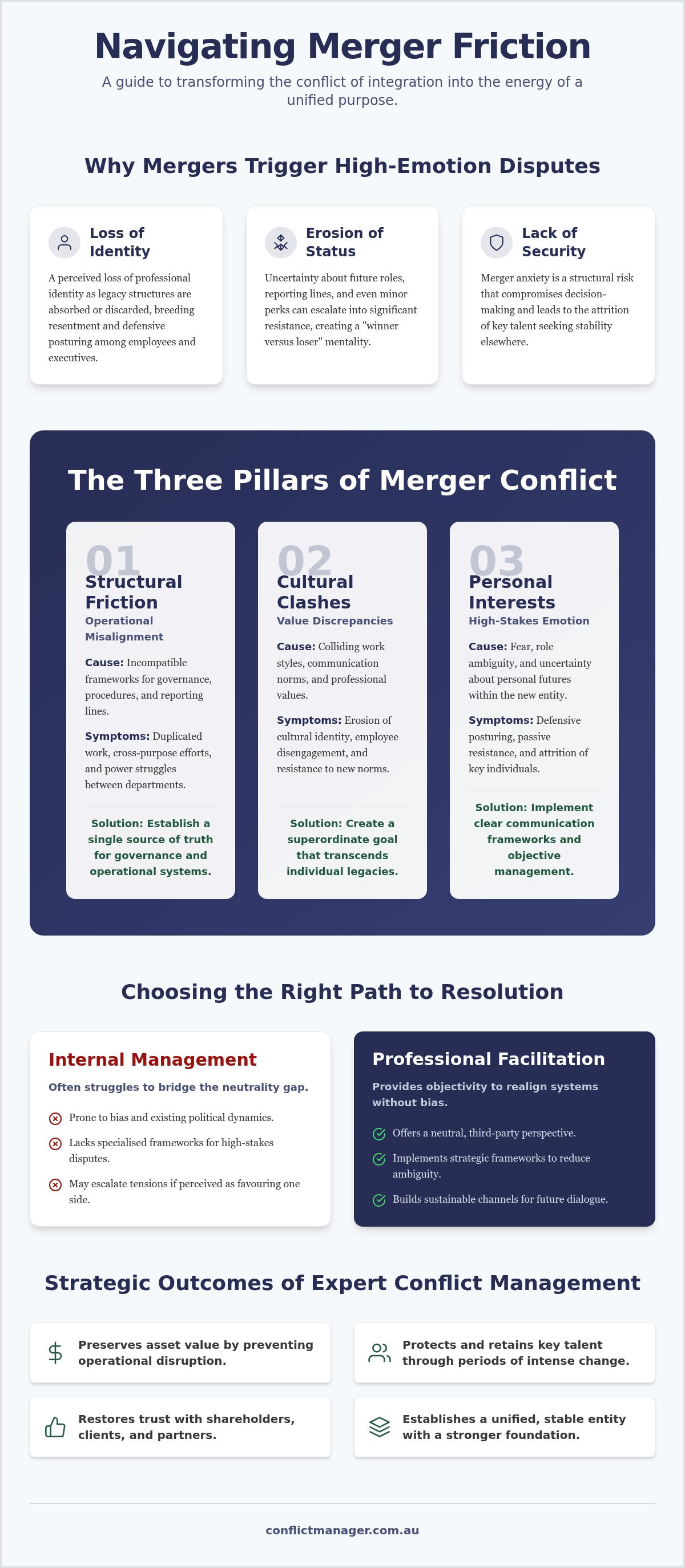
Identity. Status. Security. Disputes often arise from a perceived loss of professional identity as legacy structures are absorbed or discarded. Employees and executives alike may view the transition through a "winner versus loser" lens, which breeds resentment and defensive posturing. Uncertainty regarding future roles, reporting lines, and even minor perks can escalate into significant resistance. Merger anxiety is a structural risk factor that compromises decision-making and operational continuity. Without intervention, this emotional volatility leads to the attrition of key talent, as your most valuable people are often the first to seek stability elsewhere when the cultural fabric begins to fray.
The Impact on Stakeholder Trust
Ambiguity is the enemy of order. When leadership fails to provide a clear roadmap, ambiguity breeds a form of functional anarchy within teams. This erosion of trust isn't limited to the internal workforce; it extends to shareholders, clients, and partners who rely on the organisation's stability. The Post-merger integration process requires more than just technical alignment; it demands the restoration of relational integrity. Maintaining a steady hand during this transition is paramount. Professional management of the friction ensures that managing conflict during a merger is handled with the necessary objectivity. By addressing these disruptions early, leadership can move from a state of reactive crisis management toward a vision of structured, sustainable growth. This methodical approach ensures that the legacy of both organisations is respected while a new, stronger foundation is built for the future.
Identifying the Three Pillars of Merger Conflict
Conflict during a merger is rarely a single, isolated event. It is more accurately viewed as a complex structure supported by three distinct pillars: structural, cultural, and personal. These domains often overlap, creating a feedback loop where a procedural disagreement escalates into a personal dispute. Effectively managing conflict during a merger requires a granular understanding of these intersections. When leadership can categorise the friction, they can apply targeted interventions rather than relying on broad, ineffective mandates.
Structural Friction and Operational Misalignment
Governance. Procedures. Reporting lines. Structural friction occurs when two organisations attempt to operate using incompatible frameworks. This often manifests as uncoordinated efforts to solve integration problems, where teams from both sides duplicate work or work at cross purposes. Clarity is only achieved through a methodical review of all operational systems. By establishing a single source of truth for governance, you remove the ambiguity that fuels power struggles between department heads. If you're observing these tensions early, seeking professional stakeholder facilitation can provide the neutral perspective needed to realign these systems without bias.
Cultural Clashes and Value Discrepancies
Every organisation has its own rhythm and communication norms. When these work styles collide, the resulting friction can feel like an attack on professional values. This is particularly evident in family business mergers, where legacy preservation is often as important as financial gain. An academic analysis of merger impacts suggests that the erosion of cultural identity is a primary driver of employee disengagement. To counter this, leadership must establish a superordinate goal; a shared objective that transcends individual legacies and provides a new, unified focus for the combined entity.
Personal Interests and High-Stakes Emotion
Fear is a powerful disruptor. Role ambiguity and the threat of job loss create a volatile environment where "negative opinion leaders" can quickly derail integration efforts. Inclusive facilitation is essential here. By acknowledging these fears through empathetic leadership, you can transition stakeholders from a state of resistance to one of cooperation. Early warning signs, such as siloed communication or a sudden drop in productivity during due diligence, should be treated as structural risks. Addressing these personal anxieties with professional clarity ensures that the human element of the merger is managed with the same rigour as the financial assets.
Internal Management vs Professional Mediation: Choosing the Right Path
Deciding who should lead the resolution process is a critical strategic choice that often determines the long-term success of an integration. Many organisations instinctively turn to their internal Human Resources teams to handle the rising friction. While these professionals are adept at managing standard operational grievances, the unique, high-stakes pressure of an organisational merger often renders them structurally compromised. This creates a neutrality gap. Effectively managing conflict during a merger requires a level of total objectivity that internal stakeholders simply cannot provide because they are, by definition, part of the transition themselves.
The Limitations of Internal HR in a Merger
Internal HR directors often find themselves in an impossible position. They are expected to remain neutral while their own roles, reporting lines, and legacy cultures are under threat. This emotional entanglement is visible to the rest of the leadership team, leading to a perceived bias that erodes trust. When an HR professional is seen to favour the legacy norms of one entity over another, their ability to facilitate genuine alignment evaporates. They often struggle under the weight of executive pressure, where board members may expect them to "deliver" a specific outcome rather than a sustainable resolution. This environment makes it difficult to address the root causes of friction without fear of political blowback or career repercussions.
The Logic of External Intervention
Professional mediation introduces a sense of order that internal efforts often lack. An external facilitator acts as a wise counselor, providing a steady hand that remains unruffled by the high-stakes environment. This neutral third party has no career legacy to protect and no personal interest in the final power structure, allowing them to view volatile situations with complete objectivity. They create a safe space for difficult conversations at the leadership level, where executives can voice concerns without the fear that their honesty will be used against them in the new hierarchy. This structured approach moves the dialogue away from defensive posturing and toward a logical, methodical resolution. By removing the emotional entanglement of internal politics, professional facilitation brings clarity to clouded situations and ensures that the integration proceeds on a foundation of genuine stakeholder alignment.
Strategic Frameworks for Facilitating Stakeholder Alignment
Alignment is not a passive state. It is a deliberate construction. Managing conflict during a merger requires a transition from reactive firefighting to a methodical framework of engagement. When two cultures collide, the resulting friction can either be a source of ongoing decay or the catalyst for a more robust, unified entity. Success depends on the leadership's ability to implement a structured response that acknowledges the human element while maintaining focus on the strategic objective. Ambition. Uncertainty. Friction. These forces are manageable when viewed through a logical lens.
Step 1: Early Detection and Assessment
Turf wars often begin in the shadows of due diligence. Identifying these power dynamics before they escalate into open hostility is vital for long-term stability. Objective stakeholder interviews allow for the mapping of friction points without the distortion of internal bias. This process uncovers the hidden anxieties that often fuel resistance to change. Early intervention preserves merger value by preventing the compounding of relational debt. By documenting these tensions early, you can build a bespoke integration strategy that addresses specific departmental concerns before they become systemic failures.
Step 2: Facilitated Dialogue and Negotiation
Clarity. Boundaries. Respect. Effective negotiation requires a clear distinction between what is negotiable and what is not. Leadership must respect legacy interests while firmly pivoting toward the new, shared mission. This often involves thinking outside the box to incorporate diverse perspectives that might otherwise be sidelined. Implementing superordinate goals creates a unified front where warring factions are forced to collaborate on a mission that is larger than their individual departments. Decisiveness. Speed. Clarity. Anxiety thrives in the gaps between announcements. By balancing inclusivity with quick, decisive movement, leadership can reduce the window for speculation to take root.
Step 3: Implementing Sustainable Outcomes
Stability. Commitment. Legacy. The final stage of alignment is the establishment of new organisational norms. These values must be more than just words on a screen; they must be clear, documented, and respected across all levels of the merged entity. A methodical communication plan is the backbone of this framework. It must be designed to reduce ambiguity by providing consistent, transparent updates to all stakeholders. When people understand the logic behind structural changes, their resistance often shifts to a form of cautious cooperation. This structure ensures that managing conflict during a merger is handled with professional authority. If your leadership team is facing integration friction, our experts in organisational conflict management can help you restore order and secure your legacy.
Restoring Stability: The Role of Expert Conflict Management
Order. Clarity. Resolution. These are the fundamental pillars of a successful transition. Professional mediation isn't just a reactive tool for settling disputes; it's a strategic investment in the structural integrity of the new organisation. It moves the conversation beyond immediate friction toward a vision of long-term stability. Managing conflict during a merger requires a level of emotional distance that leadership teams often lack when they're in the thick of a high-pressure transition. By introducing an expert facilitator, you ensure that the integration is guided by logic rather than reactive impulse. This methodical approach preserves the value of the deal by preventing the slow decay of culture and trust that often follows unaddressed friction.
A Composed Hand in High-Stakes Environments
Stability. Authority. Objectivity. In high-pressure environments, a steady voice acts as an anchor for stakeholders who feel adrift. Our approach at Conflict Manager provides this presence, guiding boards and executive teams through the resolution process with quiet confidence. We help you achieve clarity when internal perspectives are clouded by the exhaustion of a high-stakes deal. This external guidance allows leaders to step back from the interpersonal friction and focus on the strategic goals that necessitated the merger in the first place. It's about bringing order to chaos without becoming entangled in the internal politics of either legacy entity. We recognise that managing conflict during a merger is as much about psychological safety as it is about operational alignment.
Securing the Future of the New Organisation
Legacy. Integrity. Value. For high-net-worth families and complex organisations across Australia, the preservation of legacy is paramount. When you secure the future of a new organisation, you're doing more than just protecting a balance sheet. Expert-led stakeholder facilitation ensures that the human element does not sabotage the strategic vision of the merger. When interpersonal disputes are resolved through a methodical framework, the resulting organisation is more than just a combination of assets; it becomes a unified force. This approach secures the future by building sustainable communication channels that will serve the company long after the initial integration is complete. It's about protecting the value you've worked hard to create through every phase of the organisational transition. Reach out for a confidential discussion regarding your organisational transition.
Securing a Unified Future
The path to a successful integration is paved with clarity and structural integrity. You've seen how friction across structural, cultural, and personal domains can devalue an acquisition if left unaddressed. Managing conflict during a merger isn't about avoiding these tensions; it's about navigating them with a composed, neutral, and objective third-party perspective. While internal efforts often struggle under the weight of emotional entanglement, expert-led mediation provides the steady hand needed to bridge the neutrality gap. By implementing methodical frameworks and sustainable communication channels, you protect your organisation's legacy and ensure the human element aligns with your strategic vision.
The transition from disruption to order is possible when you prioritise professional clarity over reactive management. Our team specialises in high-stakes organisational change, delivering sustainable outcomes for even the most complex stakeholder disputes. Achieve clarity and stability in your merger with expert facilitation. With the right guidance, your new entity can emerge stronger, more stable, and fully unified for the journey ahead.
Frequently Asked Questions
Why is conflict almost inevitable during an organisational merger?
Conflict arises because mergers disrupt the fundamental sense of security and identity within an organisation. When two distinct cultures, systems, and power structures are forced to integrate, friction is the natural result of these shifting boundaries. It isn't a sign of failure but a predictable byproduct of large-scale change. Managing conflict during a merger requires acknowledging these human responses as structural risks that need a methodical, logical resolution to ensure long-term stability.
What are the most common sources of friction between merging leadership teams?
Leadership friction usually stems from role ambiguity, territorial disputes, and discrepancies in governance models. Executives often fear a loss of autonomy or status as reporting lines are redrawn and decision-making authority is centralised. These tensions are exacerbated by a lack of clear communication regarding the new hierarchy. When leaders feel their legacy is being erased, they may engage in defensive posturing that stalls the entire integration process and creates silos within the new entity.
How can a neutral third-party mediator help during a business merger?
A neutral mediator brings total objectivity to a situation where internal perspectives are often clouded by personal stakes. They act as a steady hand, facilitating difficult conversations without being entangled in the political fallout of the deal. By providing a safe space for stakeholders to voice concerns, they help identify the root causes of friction. This professional facilitation ensures that the resolution is based on logical outcomes rather than the loudest or most influential voice in the room.
What is the difference between internal HR resolution and professional mediation?
Internal HR teams are often personally affected by the merger, which creates a neutrality gap that undermines their effectiveness in high-stakes disputes. They may be perceived as biased toward their original legacy organisation. Professional mediation, however, offers a wise counselor approach that is entirely independent of the company's internal hierarchy. This independence allows for a more rigorous and objective assessment of the conflict, ensuring that the path to integration remains clear and uncompromised by career interests.
Can conflict during a merger actually lead to a stronger organisation?
Yes, when managed correctly, conflict can act as a catalyst for deeper alignment and innovation. It forces leadership to examine legacy inefficiencies and build a more robust, unified culture from the ground up. By resolving these disputes through a structured framework, the organisation establishes sustainable communication channels that didn't exist before. This process transforms the energy of friction into a shared commitment to a superordinate goal, resulting in a more resilient and adaptable enterprise.
How do you manage cultural clashes between two merging companies?
Cultural clashes are best managed by establishing a superordinate goal that transcends individual legacy values. It's not about choosing one culture over the other, but about co-creating a new set of norms that reflect the combined entity's mission. Leadership must be clear about what is negotiable and what is not, while respecting the career investments of all employees. Methodical communication and inclusive facilitation are essential to reduce the anxiety that fuels cultural resistance during these transitions.
What happens if conflict during a merger is left unaddressed?
Unaddressed conflict leads to the slow decay of asset value and the loss of key talent. When uncertainty is allowed to fester, your most valuable people are often the first to seek stability elsewhere. This attrition devalues the merger and creates a culture of distrust that can take years to repair. Ambiguity breeds anarchy, and without a steady hand to restore order, the strategic vision of the integration will eventually be sabotaged by unresolved interpersonal friction.
How does Conflict Manager support family offices during structural changes?
Conflict Manager provides specialised stakeholder facilitation for high-net-worth families navigating complex structural changes. We understand that family office mergers involve deep emotional legacies and the preservation of multi-generational assets. Our approach brings a sense of order to these high-stakes environments by acting as a neutral third party capable of viewing volatile family dynamics with total objectivity. We focus on achieving sustainable outcomes that protect both the family's legacy and the long-term integrity of their assets.


