

Did you know that the average manager now spends over four hours every week mediating disputes instead of driving strategy? Friction. Erosion. Stagnation. These are the quiet thieves of enterprise value, yet the true cost of unresolved workplace conflict often remains hidden beneath the surface of daily operations. It's a weight that senior leaders shouldn't have to carry alone, especially when personal stress and rising turnover amongst key personnel begin to threaten your institutional legacy.
We understand that internal efforts often struggle to gain traction when emotions are high and objectivity is compromised. This article provides a clear framework to measure the quantifiable and qualitative toll that lingering disputes take on your financial health and organisational performance. You'll find validation that seeking a steady, neutral hand isn't just a relief; it's a strategic necessity for those who value stability. We'll explore the path back to clarity, moving from the complexity of current disruptions toward a vision of structured resolution.
Key Takeaways
- Friction. Stagnation. Erosion. Learn to distinguish between productive dissent and the chronic tension that stalls progress and erodes your organisation's structural integrity.
- Discover a framework to quantify the true cost of unresolved workplace conflict, accounting for leadership time, recruitment lag, and lost productivity.
- Understand how internal disputes lead to decision paralysis and the formation of silos, undermining the collaborative spirit of your senior personnel.
- Legacy. Stability. Continuity. Explore the unique risks that lingering tensions pose to family offices and the long-term protection of multi-generational institutional legacies.
- Recognise why engaging a neutral third party for stakeholder facilitation is a strategic investment in long-term stability and sustainable outcomes.
The Anatomy of Friction: Understanding the Invisible Drain on Performance
Friction. Erosion. Stagnation. These are the quiet thieves of enterprise value. Friction is rarely a sudden event; it's a slow accumulation of unaddressed grievances and structural misalignments. We define unresolved workplace conflict as a chronic state of tension that persists long after the initial disagreement has passed. It's an invisible drain on organisational energy. When disputes linger, they transition from simple misunderstandings into systemic failures that compromise your institutional legacy.
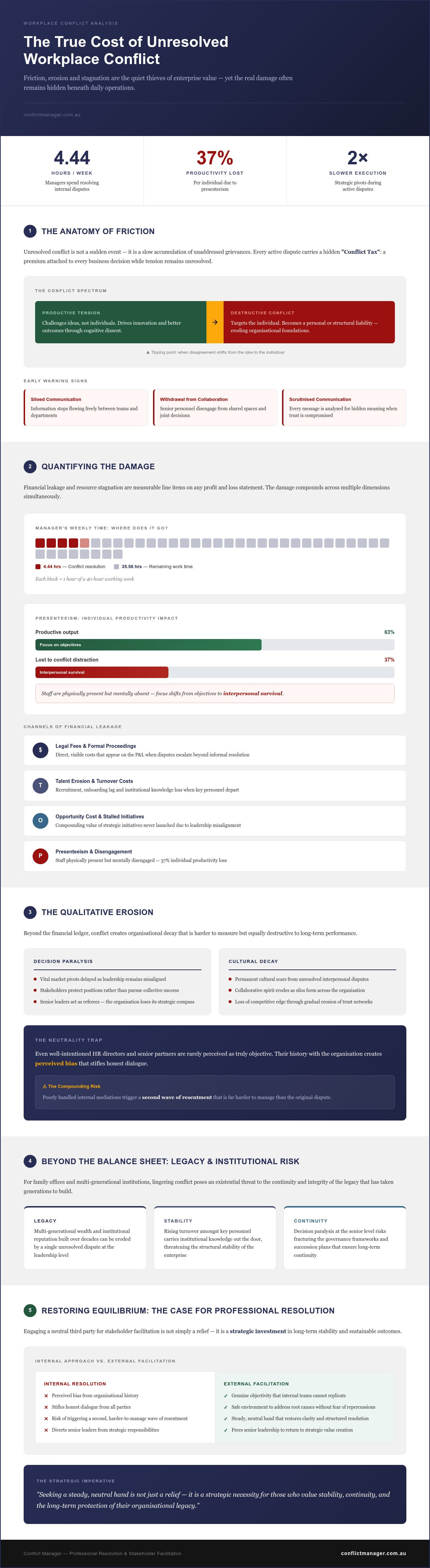
Leaders often overlook the "Conflict Tax" they're paying daily. This is a hidden premium attached to every business decision made while a dispute remains active. When trust is compromised, every communication is scrutinised for hidden meanings. Every strategic pivot takes twice as long to execute because stakeholders are more focused on protecting their positions than on collective success. The cost of unresolved workplace conflict isn't just found in legal fees; it's found in the hours of lost focus and the gradual erosion of your firm's competitive edge.
The Difference Between Productive Tension and Destructive Conflict
Innovation requires a degree of cognitive dissent. When professionals challenge ideas with composure, they drive better outcomes. This is healthy tension. However, there's a distinct tipping point where disagreement shifts from the idea to the individual. Once it becomes a personal or structural liability, it begins to erode the foundation of the business. You'll recognise these early warning signs when communication becomes siloed or when senior personnel begin to withdraw from collaborative spaces. Managing this transition requires an understanding of the psychological register of the workplace, ensuring that professional disagreements don't mutate into permanent cultural scars.
Why Internal Resolution Often Compounds the Cost
Internal leaders often fall into what we call the neutrality trap. Even with the best intentions, an HR director or a senior partner is rarely perceived as truly objective. Their history with the organisation creates a perceived bias that can stifle honest dialogue. When internal mediations are poorly handled, they often trigger a second wave of resentment that is far harder to manage than the original dispute. Understanding Workplace Conflict as a systemic issue helps leaders recognise when their own involvement might be contributing to the friction. High-stakes environments require an external, steady hand. A neutral third party brings a level of objectivity that internal teams simply cannot replicate, providing a safe environment to address the root causes of friction without the fear of internal repercussions.
Quantifying the Damage: Direct Financial Leakage and Resource Stagnation
Financial leakage. Resource stagnation. Structural decay. These aren't just abstract concepts; they're measurable line items on a profit and loss statement. The cost of unresolved workplace conflict manifests most clearly in the sheer volume of hours diverted from revenue-generating activities. Research from 2026 indicates that managers now spend an average of 4.44 hours per week attempting to resolve internal disputes. For a high-level executive team, this redirection of energy represents a massive drain on the bottom line. Beyond the clock, we must consider "presenteeism." This occurs when staff are physically at their desks but mentally disengaged, often resulting in a 37% loss in individual productivity as focus shifts from objectives to interpersonal survival.
The Executive Time Sink: Reclaiming the Boardroom
When senior leaders act as referees, the organisation loses its strategic compass. The hourly rate of a C-suite executive is far too high to be spent on interpersonal mediation. This friction creates a state of decision-making paralysis, where vital market pivots are delayed because the leadership team is fundamentally misaligned. The Financial Cost of Workplace Conflict extends into every missed opportunity and every stalled project. In this context, opportunity cost is the compounding value of the strategic initiatives that were never launched because the leadership team was trapped in a cycle of dispute management.
Turnover and Talent Erosion in the Australian Market
Australia's talent market is particularly sensitive to cultural health. Replacing a senior stakeholder or key executive isn't just a matter of recruitment fees; it's a structural shock. The "onboarding lag" for a high-level role can span months, during which institutional knowledge is lost and strategic momentum halts. Unresolved disputes act as a catalyst for this talent erosion, with 62% of professionals admitting they've considered leaving a role due to workplace friction. This is a premium cost that few organisations can afford to pay repeatedly.
There's also the regulatory burden to consider. In the Australian context, a botched internal dispute often escalates to the Fair Work Commission. Litigation expenses, compliance audits, and potential settlement costs represent a direct hit to capital reserves that could have been invested in growth. This cycle damages your employer brand, making it increasingly expensive to attract the top-tier talent required for future stability. Recognising these risks early allows for organisational conflict management that protects both your financial health and your institutional legacy.
The Qualitative Erosion: Decision Paralysis and Cultural Decay
Beyond the balance sheet lies a more insidious drain on enterprise value. Friction. Silos. Paralysis. These are the markers of qualitative erosion. When a dispute remains unaddressed, it begins to compromise the structural integrity of the entire business. Departments often stop collaborating simply to avoid conflict-heavy zones, creating isolated silos that stifle the flow of information. This isn't just a cultural issue; it's a strategic failure that prevents the organisation from operating as a cohesive unit.
The cost of unresolved workplace conflict is often felt most acutely in the erosion of psychological safety. Innovation requires a level of vulnerability that disappears the moment trust is compromised. In the modern Australian landscape, hybrid work has become a significant catalyst for these tensions. Research from 2026 suggests that 46% of disputes for remote or hybrid workers now begin on communication platforms like Slack or Microsoft Teams. Without the nuance of face-to-face interaction, small misunderstandings quickly mutate into chronic grievances that drain collective energy. The Real Cost of Workplace Conflict includes this mental health toll and the subsequent drop in creative output that occurs when staff are more focused on interpersonal survival than on problem-solving.
Trust as Organisational Capital
Trust acts as a lubricant for complex transactions and structural changes. In high-trust environments, decisions are made with speed and confidence. Conversely, low-trust environments suffer from a heavy "checking tax." Employees spend an exhausting amount of time on defensive documentation and double-checking instructions to protect themselves from potential blame. This shift from a growth mindset to a defensive posture is the first step toward a toxic organisational culture. It's a state where the preservation of the individual takes precedence over the health of the institution.
Structural Stagnation During Change
Unresolved conflict is the primary barrier to successful organisational restructuring. When a business attempts a strategic pivot or a change in leadership, any lingering friction acts as an anchor. Passive-aggressive resistance often replaces open dissent, making it nearly impossible to gain genuine buy-in for new initiatives. This stagnation is particularly dangerous during periods of market volatility where agility is paramount. Facilitating clarity through external mediation helps remove the emotional static from these transitions. By addressing the root causes of friction, a neutral third party can help restore the equilibrium required to move the organisation forward with a unified purpose.
Beyond the Balance Sheet: The Threat to Legacy and Institutional Integrity
Legacy is fragile. For high-net-worth families and private firms, the cost of unresolved workplace conflict isn't merely a line item on a quarterly report. It's a direct threat to the continuity of the family office. When disputes between family members or long-term stakeholders are left to fester, they often lead to the fragmentation of sizable assets. Instead of a unified, growing portfolio, you end up with a fractured collection of interests. This structural breakdown is often accompanied by an immense emotional toll that can discourage future generations from ever wanting to participate in the family's institutional legacy.
There's also a significant "Reputational Tax" to consider within the Australian market. Our business community is close-knit, and private friction has a way of becoming public knowledge through subtle leaks or visible board-level stagnation. When external partners or key stakeholders sense instability, their confidence wavers. This loss of trust can devalue a firm's market perception almost overnight, making future partnerships more difficult and expensive to secure. Protecting your brand requires more than just crisis management; it requires a commitment to resolving internal friction before it escapes the boardroom.
Protecting the Multi-Generational Family Office
Succession is the ultimate test of a family's structural integrity. Inheritance disputes are rarely just about the division of wealth. They're usually about recognition, fairness, and historical grievances that have never been aired. Even the most seasoned family principals can find their judgment clouded by the high-emotion nature of these transitions. Maintaining asset integrity requires professional facilitation to ensure that governance structures remain robust under pressure. A neutral party provides the steady hand needed to navigate these transitions, ensuring that the family's history remains a source of strength rather than a liability.
The Fragility of Brand and Reputation
Reputation is a premium asset that takes decades to build and only weeks to erode. In high-stakes environments, a single unresolved board-level dispute can signal a lack of leadership to the wider market. This perception of volatility can lead to a withdrawal of stakeholder support or a cooling of interest from potential investors. Preserving your legacy demands a quiet, external resolution strategy. It's an asset-protection move that ensures private matters stay private while the organisation continues to function with total objectivity. If your family office or private firm is facing these challenges, engaging in family conflict resolution is a vital step toward protecting your multi-generational legacy.
Restoring Equilibrium: The Strategic Value of Professional Resolution
Stability. Clarity. Continuity. When an organisation moves beyond the mere recognition of friction, it begins the vital work of structural restoration. We must shift the narrative from the expense of mediation to the strategic investment in organisational stability. The cost of unresolved workplace conflict is a compounding debt; professional resolution is the capital injection that allows a firm to resume its growth trajectory. By choosing to intervene, leaders signal a commitment to the institutional health of the business and the well-being of its most valuable stakeholders.
The ROI of External Mediation
Efficiency is the hallmark of professional facilitation. Consider the stark contrast between a focused two-day mediation and a six-month legal battle that drains both capital and morale. While litigation focuses on past grievances, professional resolution looks toward sustainable outcomes. These are resolutions that don't just stop the immediate fight; they repair the underlying structure to prevent future erosion. Neutral facilitation is the most efficient path back to leadership clarity, allowing senior personnel to stop refereeing disputes and start driving the organisation's core objectives once again.
Confidentiality is another premium benefit of this approach. In high-stakes environments, the ability to resolve sensitive board-level or family office disputes away from the public eye is invaluable. It protects the brand's reputation while ensuring that the root causes of tension are addressed with total objectivity. This methodical approach lowers the collective pulse of the organisation, replacing volatile emotions with a structured path toward a shared vision.
A Methodical Path to Resolution
The Conflict Manager approach is defined by composed authority. We guide stakeholders through complex human dynamics without becoming emotionally entangled in the friction. The process begins with an honest acknowledgement of the disruption, followed by a rigorous assessment of the structural and interpersonal drivers of the dispute. This methodical progression is designed to bring order to even the most volatile situations, moving the parties from a state of complexity toward a vision of structured, sustainable order.
External intervention provides the steady hand necessary to navigate high-emotion transitions. It offers a safe environment for difficult conversations that internal teams simply cannot facilitate due to perceived bias or historical baggage. By restoring equilibrium, you protect your institutional legacy and ensure that your organisation remains resilient in the face of future challenges. Engage a steady hand to resolve your organisational friction.
Securing Your Institutional Legacy and Strategic Focus
Disruption. Stagnation. Resolution. We've explored how friction within the leadership team or family office isn't merely a social inconvenience; it's a structural leak that erodes capital and talent. The cost of unresolved workplace conflict spans from the measurable drain on executive hours to the long-term fragmentation of multi-generational family assets. Ignoring these tensions doesn't just stall your current operations. It actively compromises the institutional integrity you've worked decades to build.
Restoring order requires a methodical approach and a neutral, third-party hand capable of navigating high-stakes disputes with total objectivity. Whether you're protecting HNW family assets or seeking to resolve complex organisational friction, the path back to clarity begins with a commitment to sustainable, clear outcomes. It's time to move from a state of emotional entanglement toward a vision of structured stability. Secure the stability of your organisation with expert mediation. You don't have to navigate these difficult transitions alone. A steady hand is ready to help you reclaim your strategic focus and protect your legacy for the generations to follow.
Frequently Asked Questions
How much does unresolved workplace conflict actually cost an Australian business per year?
While specific 2026 Fair Work Commission figures vary by industry, the broader economic impact is substantial. Conflict costs the UK economy over £60 billion annually, and Australian firms face similar pressures through lost productivity and legal fees. For an individual firm, the cost is often measured by the 37% drop in productivity per disengaged employee. This cumulative drain represents a significant portion of annual operating expenses that could be better allocated to growth.
What are the most common hidden costs of leadership team disputes?
Leadership disputes often lead to decision-making paralysis and the formation of protective silos. When senior partners are misaligned, strategic pivots are delayed and market opportunities are missed. These hidden costs also include the onboarding lag associated with replacing high-level executives who depart due to toxic environments. The organisation loses momentum, institutional knowledge, and the ability to execute complex transactions with speed, which directly undermines its competitive advantage in the market.
How does conflict in a family office differ from standard corporate disputes?
Family office disputes are unique because they involve the intersection of personal inheritance and commercial governance. Unlike standard corporate friction, these disputes carry the risk of fragmenting multi-generational family assets and damaging the family's institutional legacy. The emotional entanglement is deeper, making it harder for internal parties to remain objective. Professional resolution in this context focuses on protecting the family's long-term stability and asset integrity while navigating complex interpersonal dynamics.
Can workplace conflict lead to direct financial losses in a hybrid work environment?
Digital friction is a major contributor to the cost of unresolved workplace conflict in hybrid environments. Misunderstandings on platforms like Slack or Teams account for 46% of remote disputes, leading to rapid disengagement. These digital grievances often fester longer because they lack the nuance of face-to-face interaction. The resulting drop in collaboration leads to direct financial losses through stalled projects, increased absenteeism, and the high cost of replacing disaffected remote talent.
What is the "Conflict Tax" and how do I calculate it for my organisation?
The Conflict Tax is the hidden premium paid on every business decision made during an active dispute. You can estimate this by calculating the hourly rate of the senior leaders involved and multiplying it by the four hours per week they typically spend on mediation. Add the potential value of strategic projects delayed by the friction. This figure represents the immediate capital drain that results from a leadership team being trapped in a cycle of dispute management.
When is the right time to engage an external mediator rather than using internal HR?
You should engage an external mediator when the stakes involve senior leadership or the organisation's structural integrity. Internal HR teams often face the neutrality trap where their history with the firm creates a perceived bias. External intervention is essential when emotions are high and a second wave of resentment must be avoided. A neutral third party brings total objectivity and a steady hand to volatile situations that internal staff aren't equipped to handle.
How does unresolved conflict impact the long-term legacy of a family-owned business?
Unresolved friction acts as a catalyst for the fragmentation of family-owned businesses. When inheritance and succession issues aren't addressed with professional facilitation, the business often struggles to survive the transition to the next generation. This erosion of trust can lead to the liquidation of assets that took decades to accumulate. Preserving your legacy requires a methodical approach to resolving deep-seated interpersonal dynamics before they become permanent cultural scars that discourage future generations from involvement.
What is the return on investment (ROI) for professional conflict resolution services?
The ROI of professional resolution is found in the speed of the outcome and the sustainability of the agreement. A structured mediation process typically resolves a dispute in days, whereas litigation or internal stagnation can last for years. By addressing the cost of unresolved workplace conflict through expert facilitation, organisations reclaim their strategic focus and protect their brand's reputation. This investment ensures long-term stability and prevents the recurring expense of high-level talent turnover and legal intervention.


